Archives

yesterday

BEATLES MANZANA

Image via Wikipedia

Yesterday, the big nutritional and societal issues that trouble me did not seem so far away. It was an unusual day as my afternoon was devoted to working with children as part of a new project I am involved in.

In the morning I saw a client who at age 42 weighs 371 pounds and requires a cane. She had recently come to me with uncontrolled diabetes and pending renal failure. Surprisingly, she had made some pretty profound changes in the time since I had last seen her and had greatly improved her blood sugar levels. When I asked her what explained the change, she said being spoken to about her kidney damage; and her love for her nine-year-old daughter made her face that big mighty river that flows through all of us.

I encounter many common themes in my work, and often the same ones coincidentally present themselves repeatedly in the course of a month, a week or even a day. One of my current recurrent themes, represented by that client, has been women in their early forties with way too much pain and far, far too many pounds and medications to bear. I always wonder, where did this story start, how did it get so extreme, how was it not prevented?

These questions often leave deep indentations as I press my fingertips into my forehead while bowing over my desk. On some days, the pressure is so deep I can almost feel my prefrontal cortex. But, yesterday, I knew I needed to ready myself for the children, so I yanked my hand down away from my head and put on my happy face. Little did I know the answers to my rhetorical questions lay in these young kids who awaited me.

First, was a pretty, very precociously developed, thirteen-year-old girl who hates her body and by association herself. As I was speaking with her she picked up her cell phone, pushed a button and brought it to her ear almost as unconsciously as brushing a hair behind one’s ear. As I asked her to put the phone away, I fumbled looking to offer her a better connection with me. I asked her and her mom a few of the perfunctory questions but my words sounded hollow. Even at her age, I could tell there were already too many chapters to her story and too few cutesy nutritional clichés that could assuage her experience of being fat.

Next, was a six-year-old boy. He is a big boy at 100 lbs. He was accompanied by both of his very big parents who were eager to help their son as well as themselves. With the boy quickly picking his way through the things in my crowded office I needed a distraction fast. I passed the dad these fun picture cards I have where different scenes are creatively constructed out of fruits and vegetables–while asking the mom for some history.

Dad did successfully engage the boy while Mom described to me that he started on whole milk as a one-month-old infant because her WIC checks for formula were stolen. Since then he has always drunk a lot of milk at will without limit–until very recently. How much milk did she say he drank a day? Why had she not gotten new WIC checks? Already, six years of details had passed me by due to my split attentions. What else was already missed in this young boy’s story and by how many people? Done looking at the cards, the child slid off his dad’s lap and came and stood right in front of me. He asked me the hardest question to answer simply–Is milk good for you?

And then, a lovely, smart and very insightful thirteen-year-old came and placed her presence before me. Within the passing of our first few shared sentences, she told me that she doesn’t eat breakfast or lunch at school because she does not want the other kids to make fun of her. At 271 pounds she has lost the right to eat in peace. A right so assumed we don’t even define it–has already been denied this child–and who knows what else has accompanied this loss. And dinner, she eats in her bedroom in front of the television.

Her mom, full of appropriate concern then joined us. She assumed responsibility for a household with much dysfunction in regard to structure and care associated with food and eating but she was more guilty of love than neglect. Still, her daughter now has abnormal glucose and insulin levels, has had to undergo an ultrasound for an ovarian cyst related to hormonal imbalance, suffers from depression and has already been on a number of medications for various issues.

Though the session was over, I apologized for having to go. I felt a shadow hanging over me–the connection between these children’s stories and those of the women who I described above. Is it already too late for these kids? Is their situation already too extreme? Was too much already missed and not prevented? And, is twenty the new forty?

But, I had to rush out to go pick up my own daughter. It was her birthday–my, seventeen came suddenly.

Thank you for listening, sharing, following and supporting my writing. Please subscribe in the sidebar to receive notice of new posts. Comments and greetings always welcome.

In health, Elyn

Related Posts: She Weighs How Much; Of Poverty and Light; Some Big Feet to Fit

IMG_1775

Broken My Plate

My Plate Haiku

Hunger tiptoes in

From bellies, hearts or minds

Feed me now she calls.

By Eva

some big feet to fit

My first pair Image by deshanta via Flickr

Yesterday, my first patient, Harry, was late and my second patient, Dan, was early. As I went out to the waiting room to call Dan, I saw Harry checking in with the receptionist. I had worked with him a few years back and remembered him well. He greeted me warmly and said he understood that he would have to wait. He assured me that this was not a problem.

This is a story about these two men. It probably should be two different stories. But, since the lines of their lives intersected on that morning, and since they share many commonalities–though Harry is black and Dan is white–merged, for now, they will be.

Harry and Dan are both 52-years-old. They are both over six feet tall and over three hundred pounds, though Dan dwarfs Harry in height and weight. They both are caring fathers. Harry has some older boys while Dan has an adorable non-biological three-year-old son he is raising. They are unemployed and poor, have had difficult lives and confront stress on a daily basis. They have diabetes and the usual laundry list of related issues. Impressively, and not commonly seen, they have both successfully and proudly quit 35 year-long cigarette addictions–Harry in the past two years, Dan about three months ago. You can see they were both once very handsome. Harry’s good looks are better preserved. Dan’s are more difficult to perceive due to his lack of teeth, long dirty stringy hair and enormous belly, but his pretty blue eyes and sculpted face tell me he once broke a few hearts. Oh, and they both like ginger ale.

I started working with Dan a few months ago. The loud-talking, heavy-walking, gentle giant stomped into my office in June feeling lousy. He had just been diagnosed with diabetes. He described to me a life marked by serious fatigue and inertia. He spent most of his day splayed on the couch watching television while keeping an eye on his preschool son. He started his day with coffee containing a mountain of sugar, drank iced tea throughout the afternoon and despite his lack of teeth, mainly ate an enormous dinner of starchy, fatty food which he said could probably feed five. At 380 pounds and smoking at least a pack a day, he could barely climb a flight of stairs. His ability to do the odd jobs he got paid for like mowing lawns and shoveling snow was becoming too difficult.

He presented with the common combination of desperation and despair but with a twinkle in his eye. I am always looking for some sign of the life force because making change necessitates pulling something out from the inside. Being illiterate and impoverished as Dan is, can profoundly dampen if not obliterate that inner will, but an eye twinkle is a good indicator that there is still fire within. Illiteracy and diabetes education are not a great combination but he has persevered and has made some amazing changes for someone who has only known mainly one path for half a century. He has literally and figuratively awakened recently and expresses his gratitude for the wake-up call. Though some of his work has been championed from my wonderful little office support team, he actually greatly surprised me by undertaking to quit smoking essentially from his own initiative.

At this week’s visit, he told me that his son just started a daycare program at a local YMCA. He and I had discussed his getting a Y membership which would now be great since he has to take his son there every day. He told me that he had tried to apply for a scholarship as I suggested, but that required bringing in some documentation and filling out some forms. Even as I handed him some free trial membership coupons I have for my clients, I knew that even this simple step requires filling out some paperwork at the other end.

At the end of our meeting, I brought him to the scale. I asked him to remove his old, worn-out heavy steel-toed boots that barely had a lace left between them. I weighed him and I weighed his boots at 4.2 pounds. Cumulatively, that is a lot of weight to drag around. Knowing the answer, I asked if he had sneakers.

With my steps already weary, I then walked back out to the waiting room to call Harry who I knew was waiting. I was still thinking about Dan–wondering how much a pair of good, supportive sneakers for his very large feet would cost. Being able to read and write and having some good sneakers sure would help this man to get moving.

I was abruptly brought back to the moment upon encountering Harry. There he was sitting at an empty table usually reserved for insurance representatives–about to dive into a take-out container of eggs, bacon, home fries, and toast. Though just last week I had to confiscate the bag of Swedish Fish a patient had brought into my office, in all my years I had never experienced catching anyone with a full-blown meal. “Where did you get that?” I asked in shock. “From the diner,” he replied. “How did you get it since I last saw you just a few minutes ago?” “I called them and they delivered it,” he explained somewhat surprised by my reaction and naiveté. “Am I busted?” he asked. No wonder he hadn’t minded earlier if I took my time. I dragged him and the breakfast into my office.

Harry actually has a lot more personal and community resources than Dan, but right now his blood sugar and health markers are much worse–and his situation had deteriorated since I had last worked with him a few years ago. I expressed my concern. He said that he had a lot of personal and family problems recently–though he was not making excuses. He lives alone and barely cooks at home. He is a personable guy and when I asked if there are a lot of local restaurants that know him by name–he confirmed my suspicion. Though he still has his teeth, he could soon not have working kidneys.

We looked at pictures from an old Parade Magazine about the comic Drew Carey’s diet and weight transformation. I told him the story of the film “May I Be Frank” that I discussed in Meditation v Medication. He put down the bacon and he told me he wanted his health.

I suppose I tell these tales to give a face and a fake name to the real people behind the current health crisis. Sometimes, I am hoping to inspire with stories of how people do overcome serious health and dietary challenges. Today though, I am wondering how to really help  Harry and Dan a little more. I can assist Dan with the Y application and can call Literacy Volunteers of America; I will loan Harry my DVD copy of the film. But what would those who dream, think and act big do? Who should I call? Oprah, Shaquille O’Neal, Michelle Obama, Drew Carey, the Tom Shoes guy? What do NBA players do with their Nike’s and and1’s after they have worn them on the courts a few times? Is there a healthy food delivery service for patients left languishing while waiting in doctors’ and hospital waiting rooms?

If you have any ideas let me know. Besides, these guys deserve something. They have taken the biggest step to health by quitting smoking. I am thinking of lauding them by posting their photos in the Health Center. Maybe we could write them a Haiku? What do you think?

Thank you for listening, sharing, following and supporting my writing. Please subscribe in the sidebar to receive notice of new posts. Comments and greetings always welcome.

In health, Elyn

Related Posts: Meditation v. Medication; Inventive Incentive

Update 2020: The 2018 Farm Bill allotted $25 million dollars in funding to Produce Prescription Programs. These dollars have ferried in an increase in the number and types of programs designed to provide food as medicine. They are an extension of the pilot program I developed and managed beginning in 2012 at the Health Center where I worked and described in Inventive Incentive. These programs have evolved over time, becoming increasingly sophisticated, supported by additional dollars, research confirming savings in health care spending, and new technologies. Programs increasingly do include the provision of medically tailored meals for specific health conditions and home delivery. Harry certainly had the right idea, just the wrong food.

My Plate Haiku

We serve the fruit of the Spirit

At the deli. Why not ask?

The Yellow Deli

how can you say no to a brownie?

Yesterday, I attended a conference on Bariatrics and Nutrition, put on by the Bariatric Department of my local university medical center. Bariatrics is the science of obesity. Spell check is questioning my use of this word, so let me go appease it. My quick search into its derivation informs me that its root bar is the same as in the word barometer–the measure of the weight of air. The word was created in 1965 and first used in 1977. It rhymes with allopatric, geriatric, pediatric, podiatric and psychiatric, in case you wish to use it in a song or poem.

A brownie on a napkin

The seductive brownie (Photo credit: Wikipedia)

We mainly use the word regarding bariatric surgery or the surgical approach to weight reduction. I have worked with a few people who have had this surgery. There are increasingly newer and easier procedures and more centers doing them–and thereby more people having them–so I chose to attend the conference to better inform myself.

I walked into the dimly lit hotel conference room, with bad feng shui, grabbed the last seat at a table with a few other women, put my stuff down and made my way over to the breakfast spread in the adjoining room. From left to right there was coffee, tea, small glasses of orange and cranberry juice, a big tray of danish, another of white bagels with little individual cream cheese servings, a platter of fruit and an icy bin filled with Sierra Mist, Pepsi, Diet Pepsi, and Brisk iced tea.

The morning session was well presented by highly credentialed physicians, a pharmacist, and a psychologist. I did learn some things that were of professional interest to me, but I was finding myself with another one of my nutritional dilemmas. An endocrinologist spoke about how these procedures and their concomitant weight loss results are greatly reducing blood pressure, cholesterol, sleep apnea, and even the high blood sugar levels of diabetes–and are thereby also reducing the cost burden to our health care system of these conditions. However, I was still unsettled by such invasive methods with major implications for nourishment and still uncertain as to how these experts felt about their own program.

After a few hours, I was drained from the bad room energy and hungry. I stuffed my dilemma and headed out to the more naturally lit lunch area. I was pleased to find myself satisfied by a meal that met my own personal nutritional needs and headed back feeling much better and fortified for the afternoon session. It was a good thing too. Three surgeons, whose mothers or kindergarten teachers must have taught them very good craft skills, were soon to reveal to me the gorier aspects of the art of bariatrics.

Currently, there are three major types of either restrictive or malabsorptive bariatric surgeries that are performed in this country–gastric bypass, gastric banding, and sleeve gastrectomy.  Sleeve gastrectomy is the newest of the three. While I imagined something more benign, a young boy wonder doctor described the procedure by way of both schematic and actual slides of our insides. He explained that the procedure entails using a stapling device that creates a thin vertical sleeve of stomach while the other two-thirds of the stomach on the other side of the staples–is lopped off. Oh.

The next surgeon, who at least looked like he was born before the first use of the word bariatric, also described various procedures. He was very careful to explain that all of these come with some significant complications. Despite his obvious experience and calm demeanor, transparent in his message was that the safest surgery is no surgery.

As I was digesting this, the woman I had been sitting next to all day raised her hand and asked that if one had already had gastric banding, which has the highest weight loss failure, could they be a candidate for sleeve gastrectomy.

At the next break, at risk of being intrusive, I asked the woman if she’d had the band procedure. She replied that she had, and was frustrated that she only lost 50 pounds. She had the band re-tightened which is done by filling it with more saline solution. Quietly, she admitted that she was responsible for having made some bad choices. I left it at that.

A few minutes later she returned from the break room which had been freshly stocked with a new array of sodas and sweets, with a Pepsi and a brownie. The other women at the table, who I had come to realize were not medical professionals, muttered something to her and she replied, “How can you say no to a brownie?”

The final speaker of the afternoon was a plastic surgeon. This guy was a Michelangelo in GQ clothing. Through a series of slides, I witnessed the graphic photos of about twenty post-bariatric surgery patients clad only in their underpants, before and after the liposuction and body contouring procedures he had sculpted on them. I saw the flaccid flesh of breasts, bellies, arms, thighs, and butts hanging in folds from alien-looking bodies. One woman’s belly flesh reached almost to the floor. Matter-of-factly, he showed how he lifted skin, sucked out fat from one area, stuffed it back into another, and sewed people back up often around their entire circumference. He told of removing up to twenty-five pounds of skin and fat during a single procedure.

As shocked as I was by what he was showing, it was what he explained in closing that was more distressing and deeply telling. He shared that some patients have said to him, that in retrospect, even though they may even feel better, they actually liked their bodies more before the procedure. They may have been fat but they felt they at least had a healthier glow or more natural body. Some, express dissatisfaction with other minute parts of their bodies that they had never thought about before, and many still perceive themselves as fat as they ever were. There is no guarantee that the person will experience a greater sense of well-being and less depression–though many do.

At the end of the day, the Bariatric Program Director and conference facilitator asked the panel of presenters, where did they think we are heading in the next five to ten years. Are we going to be doing way more procedures as the obesity rates continue to increase?  Do we fully know what percentage of people who have undergone these procedures truly keep the weight off and the diseases at bay? Do we know the correct prevention measures? The presenters looked a bit deflated in response.

Regarding the prevention question, I left one respectful suggestion on my evaluation form–that the medical community should be particularly mindful of the food it offers at conferences. We talk about healthy eating and yet are unable to establish a new food paradigm in this culture.

Digging for my car keys, I found my dilemma at the bottom of my pocketbook where I had stuffed it. It looked me in the eye and asked, “How can you say no to a brownie?” “It’s tough”, I responded. I headed out into the late afternoon traffic.

How do you say no to a brownie?

Thank you for listening, sharing, following and supporting my writing. Please subscribe in the sidebar to receive notice of new posts. Comments and greetings always welcome.

In health, Elyn

my plate

My Plate Haiku

Adirondack lake

Soothes us from the heat–weightless

We float like feathers. by Elyn

touched by the tempted temperament

Last week, I wrote about The Tempted Temperament. Just days later, I had a related experience I just want to share.

A sweet, 8-year-old girl came to see me along with her mom. She was a beautiful child with long, dark black hair and piercing eyes that carried the wisdom of her ancients. She was rather quiet. And, yes. She was overweight and has already endured bullying by other children.

IMG_3309

Healthy Eating Art

The mom, a tall, slender woman told me part of her child’s story. They have just returned back in the area after living for a year near San Antonio, Texas. I did not get a lot of the family’s history during this consult, partly due to the fact that not all can be disclosed in front of a child, but it was not difficult to glean that there were problems.

I learned that this child is the youngest of four children. Her oldest sister who is nineteen has a more full-bodied figure. The mom, is a loving parent and provides generally well-prepared foods and has nicely established boundaries on fast food and the watching of television. The child has no health problems. I did not, as I would write in my progress note, assess any significant dietary indiscretions.

The mom’s concern is that her daughter is not inclined to want to go out and play much and resists her mom’s offers to go exercise with her. They live in a cramped house in a difficult neighborhood.

This is not an environment for the outdoor spontaneous combustion of calories that should be the birthright of all our children. I learned that the girl enjoys eating and adores musicals, swimming and doing artwork. I knew I was in the company of a pleasant phlegmatic.

Together we discussed community resources, walking to school, school lunches and simple options for play. We addressed the preservation of her self-esteem which her mom already had a good handle on. I then looked into the deep eyes of this dear girl, deciding what to offer her that would be respectful of who she is. As always, and as I hope I am conveying in my stories, there is a deep responsibility in this task of balancing the societal scales, to honor the individual and the circumstances of their lives. And, I usually only have a few minutes to do so.

I glanced around the meager library, medicine cabinet and market basket that metaphorically describes my office. Though I wished I had something richer, I handed her a calendar book that comes with two types of stickers. One sticker is of a fun pair of sneakers, the other of a fork, knife, and spoon in a happy face kind of configuration. It’s designed to encourage a child to keep note of their healthy choices, hopefully in a fun way. Kids generally like it because they tend to love stickers.

The child’s face lit up. After having been rather reserved throughout the meeting, she perked up and said, “I know what I can do with this.” I asked her what that was. She replied, that instead of using the stickers if she ate healthy food or played something, she would draw a picture of that instead. I breathed a sigh of relief. The world will be a more beautiful place graced by the gifts of this young artist.

Thank you for listening, sharing, following and supporting my writing. Please subscribe in the sidebar to receive notice of new posts. Comments and greetings always welcome.

Also, big news this week. I am now on Twitter at http://www.twitter.com/lifeseedsnutrit. You can follow my little bird there and share my stories.

In health, Elyn

My Plate Haiku

Peach baskets brimming

Raspberries ripe on the bush

Apples soon to come.
by Crystal

the tempted temperament

Original Winnie the Pooh stuffed toys. Clockwi...

The Adorable Four Temperaments Image via Wikipedia

Chances are you know a child like Sam. Sam, was a classmate of my daughter since kindergarten and I have watched him grow up. He is a sweet-natured kid. When he was young he was a really big boy with hands like mitts.  His eyes used to almost pop out of his head with excitement when food was presented.  Once, when my husband brought brownies to my daughter’s class in celebration of her birthday, Sam sized him up quickly and befriended him immediately. While waiting, he sidled up to my husband and whispered, “We better eat those brownies soon before they go raw.” The well-being of those brownies was of his utmost concern.

We know that there are two types of people–those who live to eat and those who eat to live. This attribute in individuals is one of those things we seem to just be born with. It is not necessarily defined by genetics or the environment. It is not inherently good or bad.

Amidst the fray about childhood obesity, there is an urgent need to uncover the causes and to implement solutions. External factors such as fast food, school lunches, excessive TV and computer use are the usual culprits, and of course, they are a part of the problem. However, missing from the dialogue is any mention of children’s natural dispositions. Though the external forces must be addressed, in overlooking or disregarding the nature of the individual child and the powerful relationship with the act and art of eating, we lose an opportunity to be sensitive to children with particular natures. Considering this piece may reveal some approaches to care and serve to remove the element of blame or human weakness from the child, as well as the parent.

Hippocrates and the ancient Greeks spoke of the four temperaments. The temperaments described different formative forces that human beings possess that give rise to different soul types. The model of the temperaments as a tool for understanding human nature was popular until the end of the Elizabethan Age. It has been the inspiration for many artistic endeavors and in the 1920s, philosopher Rudolf Steiner integrated it into his work on childhood development where today it remains an active piece of the Waldorf School Movement, which he developed.

The four defined temperaments are choleric, sanguine, melancholic and phlegmatic. In brief, they can be defined as such: the choleric is strong-willed; the sanguine is light, wispy and perhaps flighty with many curiosities; the melancholic is sensitive, suffering, and self-conscious; and the phlegmatic is dreamy and slow in movement. The characters that inhabit A.A. Milne’s Hundred Acre Wood can serve as archetypes of the different temperaments. Tigger is choleric; Piglet is sanguine; Eeyore is melancholic; while Pooh is quintessentially phlegmatic.

In young children, one can easily see distinct aspects of the temperaments and a predominant constitution–though most healthy kids do exhibit some sanguine tendencies. The temperaments can manifest in all aspects of our beings. When it comes to a deeply passionate relationship with food, it is here that Sam and the phlegmatics reign. They live to eat, and accordingly, tend to have soft, round bodies and are most prone to becoming overweight. Remember Pooh’s sheer love of honey and how that devotion caused him to become stuck in the doorway of Rabbit’s house. Dear Pooh.

As most parents can attest, children’s natures become evident almost from birth. In the early years, one can often tell the phlegmatic children by body type along with behaviors. Phlegmatic infants are most likely roly-poly and slow and steady feeders. They are happy to lie in the crib cooing, playing with their hands and feet. With the introduction of solid food, they euphorically greet the oncoming spoon and are not easily distracted from eating. Phlegmatic children may take to walking and talking later than their peers and are generally easy-going.

With the attainment of verbal skills, these children frequently say “I’m hungry.” Though most healthy young children are often hungry due to high growth demands, the phlegmatic’s request for food seems to come less from actual physical hunger and more from a desire to be eating and digesting. This seemingly constant refrain of “I’m hungry” becomes one of the greatest challenges to the parents of a phlegmatic child, especially if the parents do not share that temperamental tendency themselves.

How does one respond to this repetitive declaration of hunger and cry for food? How does a parent distinguish between true physical hunger and emotional or digestive hunger? Does non-physical hunger lack validity and deserve to be ignored or denied?  How many times can a mother just look her cherubic child in the face and say no?  Phlegmatic children are quite endearing and can easily work their way into our hearts in Pooh-like fashion. Over restriction or overindulgence in feeding are both understandable reactions.

In being sensitive to the innate natures of our children at an early stage, we can adopt some feeding practices to better assist them in a healthy unfolding to adulthood. Phlegmatic children can be best served by being mindful of their enjoyment of eating but by providing them satisfaction with foods that are as healthy and naturally sweetened as possible. If no serious emotional issues seem present, then the parent sees to the careful provision of a varied diet at scheduled times and the child sees to their appetite. As the child gets older, helping them to find interests and activities, including physical pursuits that fit their temperament is important. If extreme weight issues can be avoided, the growing child will not be distracted by these matters and can then focus on the development of his or her natural abilities.

It is tempting to believe that we will one day whip all the children into proper shape by successful programming. It is also a commonly held belief that the overweight child is destined to a life of obesity. However, there may be more to be gained and less damage to be done from working with our children’s tendencies than fighting against them. I have observed many round kids morph into lean adolescents through a combination of factors including their genetic blueprint, hormonal changes and their own conscious ability to choose how to feed themselves. Sam is now sixteen. He is a high-level competitive rower. I think he might now be described as highly buff.  He recently told me, that once he discovered what he was interested in he found a way of eating that served his purpose.

The gifts of the phlegmatics are many. They are compassionate, serene, steady individuals capable of faithful and abiding love. They often possess natural musical and artistic abilities, and in the final analysis are the true geniuses–the slow, steady and thoughtful thinkers of our times. By viewing such children through this more compassionate lens we can tend to their care more appropriately and be inspired to feed them well with good intentions.

Were you a Tigger or a Pooh?

Thank you for listening, sharing, following and supporting my writing. Please subscribe in the sidebar to receive notice of new posts. Comments and greetings always welcome.

In health, Elyn

IMG_3096

Avocado’s My Plate Plate

My Plate Haiku

Pick your own today

Happy kids in wide-brimmed hats

Sweet summertime fruit.

by Anna

skinny boys

Skinny boys.  Now there is a group that could use some love. Skinny boys usually, though not always, start out as skinny little kids and stay that way into their teens and young adulthood. You see them everywhere. In spite of this obesity epidemic, these poor boys far outnumber the fat kids everyone is clamoring about, but still, they get no attention.

It was not too long ago that skinny boys had their pants buckled up under their armpits for the protection of their private parts or they were required to wear corny suspenders. Nowadays, it is quite common for their pants to fall below the level of their BVDs even with the use of securing devices like belts and drawstrings–so they are often walking around with their undies showing. How embarrassing. If they do have a belt, they have to force a homemade hole into the leather or hemp, whatever, and the non-buckle end goes wrapping around them like a snake, in order to fit.  

Then, their ribs stick out something terrible. Even nicely developed abdominal six-packs cannot cover up those ribs. Ouch. It must be hard for them to sleep–their bones jabbing into even soft forgiving mattresses. When they walk down the street, even strangers like Italian and Jewish grandmothers, are apt to want to take them home and feed them. What is up? Are their parents not feeding them?

Despite these emotional and physical challenges, there are no programs, whatsoever, designed to help them. There is no foundation for the Prevention of Adolescent Scrawniness, nor a Let”s Chill! initiative coming from the White House. Teachers, mothers, and fathers everywhere need assistance in just getting these kids to sit still. Instead, they are flying off concrete ramps on skateboards, incessantly shooting basketballs, playing guitars and drums with manic enthusiasm, and turning everyday household items into objects d’sport. TVs, video games and writing angst-ridden poetry are the only way to get these kids to stay in one place for any decent amount of time.

One might assume that these skinny boys, when they do eat, are eating carrot sticks and turkey rolled in lettuce leaves. How else could they be so skinny? But, what’s that? They are eating sugar and junk food just like those fat kids? How can that be?

A few months ago, I saw two teen-aged skinny boys walking. One of them carried a two-liter bottle of Mountain Dew, the other a big box of Cap’n Crunch cereal. I say carried, but it was more like they were cradling these products like a young child might cuddle their favorite stuffed animal. As there had been rumors circulating wildly that the Cap’n might be retiring from the high seas as well as from supermarket shelves, their procured box might have generated even additional testosterone excitement and the desperate attachment for the two.

And, just the other day, as I was doing my usual investigative journalism in the local supermarket, I came upon two young, lanky, twenty-somethings crouched down in the cereal aisle, doing some serious nutrition label and ingredient reading. I was touched. After serious deliberation, they stood up and strode confidently away–a box of Frosted Flakes in hand.

Liquid, syrupy, intense, colored sugar, seems to be the lifeblood of skinny boys as coffee is to adults. As many rational grown-ups swear that they cannot survive without their daily Joe, keeping the skinny boys from their sugar would be akin to blood-letting. How else would they thrive? With their powerful internal engines burning high and hot enough to power a jet plane, what else could better serve as jet fuel?

So, that is where skinny boys are at a serious disadvantage in this whole weight war. We direct a societal finger-wagging at fat kids and their parents, preaching of the pain and woe that awaits them should they continue their wanton eating behaviors–but no one has given these skinny kids even a glimpse of what could just as easily be in store for them–that even their propelled metabolisms could be headed for a serious nosedive.

Because, when those adolescent male hormones finally begin to mellow out, even the best of the metabolically privileged, can find themselves in trouble. Tushies sink deeper into the couch in front of the TV, remote glued to hand; the zillion hours of organized sport become a thing of the past once that diploma is received and such play at best becomes an occasional weekend past time; all the pints of beer downed in solidarity or solitude accumulate in the expanding bladder of the belly and a gut begins to cover those once nicely sculpted abs; and the stress and worry of the real world turn acquired food from active fuel into evil, disease-producing stored fat. Excessive sugar intake is detrimental to everyone, and, I have never seen Mt. Dew, do a body good. A pair of true skinny genes or a life pursuit that includes significant physical activity or hard labor are required to stave off the accumulation of pounds in this current climate.

Whereas only 12.7 percent of 15-24-year-old males are obese as defined by Body Mass Index, (BMI), 22.2 percent of 25-34-year-olds fit that classification. That could be a pretty big shock for the unsuspecting ten percent who suddenly find themselves in the holes at the other end of their belts. Their husky elementary school classmates, once the brunt of jokes, have been way better prepared for their impending corpulence and may, in fact, get the last laugh.

Essentially, we need to provide all our children with the template of the basics of a healthy lifestyle and to have a society that ensures fundamental support so they can take better care of themselves throughout their lives.

So be kind to the thinnest amongst us. They have a hard road ahead of them. Chances are, you were once a skinny boy too. The next time you see a skinny boy, hold the judgment, give them a big hug and a prayer for a healthy life–but remember to be gentle, for they are pretty fragile creatures.

Thank you for listening, sharing, following and supporting my writing. Please subscribe in the sidebar to receive notice of new posts. Comments and greetings always welcome.

In health, Elyn

My Plate Plate

My Plate Haiku

Smooth peanut butter

Spread on a peeled banana

Snack time perfection. by Gretchen


still feeding things

One snowy, frigid day this past winter, in Feeding ThingsI wrote about how the birds at my bird feeder were complaining about the milo, millet, cracked seed with oil sunflower seed food that I had given them, squawking that they only liked plain oil sunflower seed. Ingrates, I called them. Who were they to turn up their beaks at my offering in those difficult days when food was scarce?  

Still, I relented. I donned my boots and gloves, precariously positioned the ladder and refilled the feeder with only the plain oil sunflower seed. I should have insisted that they at least try it, which is what you must do with young children who are refusing their vegetables, but instead I chose to view them as lovely guests and extended my hospitality without arguing.

Recently though, the bag of the plain oil sunflower seed was running low, so I decided to blend the milo mix in, kind of like disguising vegetables in sauces for those picky types. For the first few days, the feeder sat sadly unattended. It seemed that my fine feathered friends were not amused by my ruse. Now, however, the temperature was hovering near 100 degrees. Even the mere thought of lugging the ladder back out in the heat was too draining, so I ignored the situation.

A few days later, I did see a bird or two come by, but they did not linger. Imagine then my surprise when the next day, I returned home to find the feeder entirely empty. I thought maybe a non-discriminating crow had discovered and devoured the contents or that some other fluke-like occurrence explained the disappearance of the food–so I took the effort to refill the feeder with my carefully proportioned blend once again. Sure enough, this time I saw the birds actively feeding, and the food was once more quickly gone.

In avian fashion, I puffed out my breast and congratulated myself on my nutritional success–even if it was just for the birds. Unfortunately, my contentment at establishing peace and harmony in the eating world was to be short-lived.

Before my own feathers had even neatly realigned themselves, I came out onto the porch to find teal niblets of plastic scattered all about. A squirrel had managed to eat its way through the bin that I keep the bird feed in and had feasted with abandon. Scoundrel. This was not the first time I have been one-upped by the squirrel squad. In the past, they have actually chewed their way through my screens, entered into my house and unearthed stashes of chocolate.

While I was still contemplating the mess on the porch, Chico, the cat, was meowing fiercely. He was displeased with my decision to only offer him wet food in the evening.   Without even leaving home, I was reminded again of the perplexities and complexities of species feeding. What awaited me when I next headed out into the world of humans would only add to the story.

Over the course of the next few days, I had a few experiences that deepened my ponderings. Firstly, I came face to lips with a caffeinated water marketed locally called element. Apparently, its 50 mg of caffeine per 17 oz bottle–equivalent to a Coca Cola–sets one aloft, focused and refined at any time of day without sugars and chemicals. It is not the first caffeinated water on the market, but the newest; and the latest that has me contemplating the consequences of its extending reach. Though I am sensitive to caffeine and thus avoid it, I did take a few sips. Given its propensity for flight, I thought it might be relevant to my work in bird nutrition.

I then had a mind-blowing moment in a nearby new frozen yogurt establishment. I had observed that this place was frequently “spilling onto to the sidewalk” mobbed and sane people I knew were screaming its praises. With out-of-town guests in tow, I ventured in to meet my newest nutritional nemesis.

This was not your grandpa’s frozen yogurt shoppe. With its electric pink walls, I felt like I was in a bar scene from Star Wars. The aliens around me all seemed to think it was quite ordinary to find lightly sweetened tapioca pearls floating in their shaken Bubble Tea with royal creations named Purple Oreo, Yellow Cupcake, Marshmallow Puff, and Chocolate Stout.  Likewise, they seemed confident, sensuously dispensing their own yogurt and slathering it with a myriad of toppings, some of which I had never seen before–such as little roe-like jelly balls filled with various flavors which pop in one’s mouth. Here, the seduction of food had been elevated to an even higher level. It was jaw-dropping, or should I say jaw-filling, to say the least–and not cheap.

Bubbled up, I stumbled back to the mothership. There, in a cramped coffee shop, on the inaugural day of World Breastfeeding Week, I watched a woman struggle to fit some contraption around her shoulders so that she could nurse her baby. Nothing seems straightforward or simple anymore–even the feeding of our young.

So, as I observed in Feeding Things, this is complicated stuff. I can’t even guess what the food world will look like by the time that little nursing baby comes of age or even starts school. Will the challenges for eaters become easier or more difficult? Will we be assisted in working better with our inherited biology or led further away? What do you think?

But, what about the newt, Everest, you ask? He’s still working his way through the same little containers of flakes and pellets.

Thank you for listening, sharing, following and supporting my writing. Please subscribe in the sidebar to receive notice of new posts. Comments and greetings always welcome.

In health, Elyn

IMG_3279 (1)

Squirrel My Plate

My Plate Haiku

Blueberry bushes

Three children with empty pails

Pluck, pluck, crunch.  Exhale.

By Michael

muse of the girl

Camouflage is definitely not for me. I prefer pretty patterns and soft silky and satiny fabrics. Give me beautiful bold colors or light pastels. Browns and faded olive are not in my color palette. I may be nicely disguised in a flower garden, but I am an easy target on the battlefield. That may explain why I am fielding a lot of enemy fire in the trenches these days. The obesity war seems to be raging on all fronts.  

It’s been a bad week for news journalism with the News of the World scandal, but a few stories got through from the correspondents. First, came the release of the Robert Wood Johnson Foundation, “F as in Fat”, an annual report on the national state of obesity. Apparently, obesity rates are increasing in sixteen states, but, good news, there were fewer than twenty states with increasing rates. My state of New York, is apparently in better shape than most, with only 23.9% of its denizens classifying as obese. Our good showing can be due to the millions in New York City who don’t have cars, and still walk everywhere and climb stairs even to get in and out of the subways. Maybe an unfair advantage, but, Go, team!

Then, there was a commentary article in the Journal of the American Medical Association. Drs. Lindsey Murtagh and David Ludwig, of the Harvard School of Public Health, proposed that morbidly obese children be removed from their homes and placed in foster care, to control for the harmful behaviors by which they are affected. They gave an exception to cases with genetic causes.

Reading this made me wonder if I should have been removed from my home due to secondary smoke exposure. I suppose the smoking could have been attributed to some genetic parental anxiety and my case would have been dismissed. Just imagine though what would it have been like to live with a normal, straight-haired and non-smoking family? But, maybe those parents would have drunk too much or would not have had the patience for my crazy curls? Didn’t everyone drink and smoke, even in pregnancy, back then? It took a while for people to understand the dangers of cigarettes, and for the tobacco companies to fess up. My folks didn’t mean to hurt me.

Now, most everyone has been eating processed and adulterated food for a long while, but, it has taken until rather recently to catch onto what it is doing to us and few in the industry are fessing up. My kids tell me how all their friends’ kitchens are stocked with big bottles of soda, large bags of chips and huge boxes of fun cereals. I know they have at times wished for foster placement due to this. But, maybe I should warn those families. The jig might be up–well, only if their kids are fat.

Despite this multi-paragraph ramble, the headlines are exactly what I don’t want to talk about. I want to discuss the war that doesn’t get covered, that wages within the many girls and women–of all ages and sizes–who hate their bodies and therefore deny a large part of their selves. Or, who, by not loving themselves, direct a lot of abuse to their bodies in both thought and action. Though they often wish they were invisible, we see them walking around in all types of bodies including those we deem acceptable and those we envy. Persons, whose self-worth has long been determined by the numbers on a scale or by an image in a mirror.

The confusion and dictates about food and eating cause as much, if not more, distress for them, than for those who are large-sized without such negative judgment about their weight. The collective pain and problems here are profound as are those we ascribe to obesity–and the physical consequences can be even more severe or deadly. Here, much potential is lost and much love is denied. I think we all have wandered into and many have lingered in this place where reality is distorted and self-flagellation and deprivation seem deserved.

This is the ignored epidemic. Not many resources are designated here, but I have apparently been assigned to cover this beat. My field notebooks are filled with stories and quotes that are usually too intimate for me to share. But they imply a sense that so many girls and women believe that without perfection they cannot be whole and should not take up much space on this generous planet. It is heartbreaking to witness this.

Having been touched by the lives of so many amazing, intelligent, gorgeous, creative, warm, gentle, caring and funny individuals who have been broken in this battle of self and body, these are some things I wish would receive front-page headlines: Bodies change, contours soften, bellies round, babies fill, bloat happens, hunger informs, weight is not absolute, judgmental words injure, beauty shines, food nourishes, wisdom evolves, body protects, hormones ebb and flow, pleasure is permissible, fat is often just a feeling in one’s head and restriction revolts.

If you are living this, put down the staunch resistance, begin the surrender and trust your inner feminine voice. Please know you are all so beautiful and you possess that which really matters. Take a moment to put your hand on your heart and belly and send love to yourself. Take a deep slow breath and be thankful to your body. Send a healing thought out to other women, because I assure you, you are so not alone. Hold the daughters and ask to be held. Reclaim your place. Change the internal tapes. Know there are many paths to healing available. The world needs everything you have to offer.

Any sharings will be welcomed and respected.

Thank you for listening, sharing, following and supporting my writing. Please subscribe in the sidebar to receive notice of new posts. Comments and greetings always welcome.

In love and health, Elyn

Related Posts: Stopping Traffic, Nourish Thyself Well Day, Dolls with Faith, A Meteorological Change of Plans, Size Me Down

IMG_1294

John Lennon’s My Plate

My Plate Haiku

Deep scarlet red beets

Reveal your sweetness to me

Slip out of your skins.

by Elyn

Dietary Haiku

japanese maple

Japanese Bonsai Plant      Image by cskk via Flickr

Here are a few things that happened in my nutritional life this past week. First, I had a client come into my office bummed out about being fat. She sat down and immediately pointed to different parts of her body that she deemed fat. Of utmost disgust were her arms and her big belly. They definitely had to go. She quieted a little as she said she didn’t mind being big in the thighs and butt, and she thinks her hubby actually likes her like that. I asked about her eating habits. A number of issues presented, including the fact that her husband is incarcerated.

I asked how she felt about me making some suggestions. Without skipping a beat, she replied that she would think it was none of my business and I should leave her alone. Despite her distress, she was not ready for a change–a common human experience. Most often I find some traction, but I did not try too hard in this instance and gave her space. (She did eventually come back and see me again.)

Next, my very own brother, in a comment on my recent post, Diet for a Small Caterpillar informed me that only a small percentage of people actually care about nutrition. I wanted to protest, but he is my big brother and he does seem to know about a lot of things.

And, then, the very next day, the United States Government, without giving me very much notice, obliterated the Food Pyramid and issued the newest expression of the most up to date dietary guidelines–the USDA MyPlate.

Briefly, here is my initial response to the MyPlate. Though I appreciate the challenge and consider it an improvement, its teaching concept has been around for a while now, so I am surprised it is being touted as something unique and innovative. While hailed for its message to eat more fruits and vegetables, I think that is also old news. It is overly simplistic as our national food icon.

It does not really relate to how people eat breakfast and lunch and is not relevant to how many even eat dinner. It does not align with most cultural cuisines and supposes a basic meat and potatoes dietary structure. My dinner plate rarely resembles it. It evades many deeper nutritional questions about protein, dairy, fats, and digestion. Disconcertingly, right under the plate, it says, “Balancing Calories: Enjoy your food but eat less.” This makes a broad assumption about all eaters and ignores the serious issues of those who may need to eat more for various reasons.

Essentially, this model has convinced me that it is time to abandon such efforts. If what my brother says is true, that few people even care; or as my client suggests, that not everyone wants to hear it, why do we keep trying to promote this short shelf life, stale message with such a stagnant image? Maybe it is time to try something new to spread meaningful dietary practice.

I sometimes enjoy a line of iced teas from a Japanese company called Ito En. On their bottles, they offer a nice little haiku. Haiku is a Japanese form of provocative poetry that provides a sense of sudden enlightenment simply, intensely and directly. The bottle I now hold says: ten heron heads blow as pampas grass in the morning fog. Lovely, even though it doesn’t stick to the 5–7–5 traditional haiku structure. Maybe because the tea is distributed in Brooklyn or because it is a form that is flexible. Gazing at this bottle, I am inspired to suggest that we should develop Haikus with various themes to promote nutritional messages with greater nuance. Or, perhaps it would be more American to create some jingles. This could employ many creative artists, and I am sure their output would be funnier or more beautiful than anything produced by our governmental agencies. Michael Pollan’s missive, Eat Food, Not Too Much, Mostly Plants, could be turned into a catchy dance number.

Just as I was about to declare the week a washout, one other thing happened. On Friday, I was at one of the three schools where I work with the School-Based Health Program. It was my last visit before summer vacation. I prepared a little healthy snack for the kids I had met with during the year and called them down individually to say good-bye. The message I try to instill in these young children is that they each have an amazing and wonderful body. They are all smart enough to choose to care for their bodies in various ways and can make many decisions for themselves about what and how they choose to eat.

In this closing session, I asked these adorable nine to thirteen-year-olds, what have they been paying attention to based on things we had previously talked about. Without much explanation, they each understood this vague question and all had at least a small answer. Some had big impressive answers. My dimming faith was ignited once again. So, maybe this is the relevant dietary inquiry–What are we paying attention to? There is a lot to choose from in this crazy, nutty, nutrition world.

What message would inspire you or what do you think we need to hear? Is the truth of the matter that our governments’ policies are incongruent with an appropriate dietary promotion or our personal experience as eaters? What are you paying attention to?

Please allow yourself a creative moment to pen your own dietary haiku, jingle or other poetic expression and send it along in a comment. Let’s see what emerges.

Thank you for listening, sharing, following and supporting my writing. Please subscribe in the sidebar to receive notice of new posts. Comments and greetings always welcome.

In health, Elyn

Related Posts: Your Pyramid; Diet for a Small Caterpillar; Haiku for You; Accepting Haikus

My Plate Haiku

Eat Food. Not Too Much. Mostly Plants. by Michael (Pollan)

diet for a small caterpillar

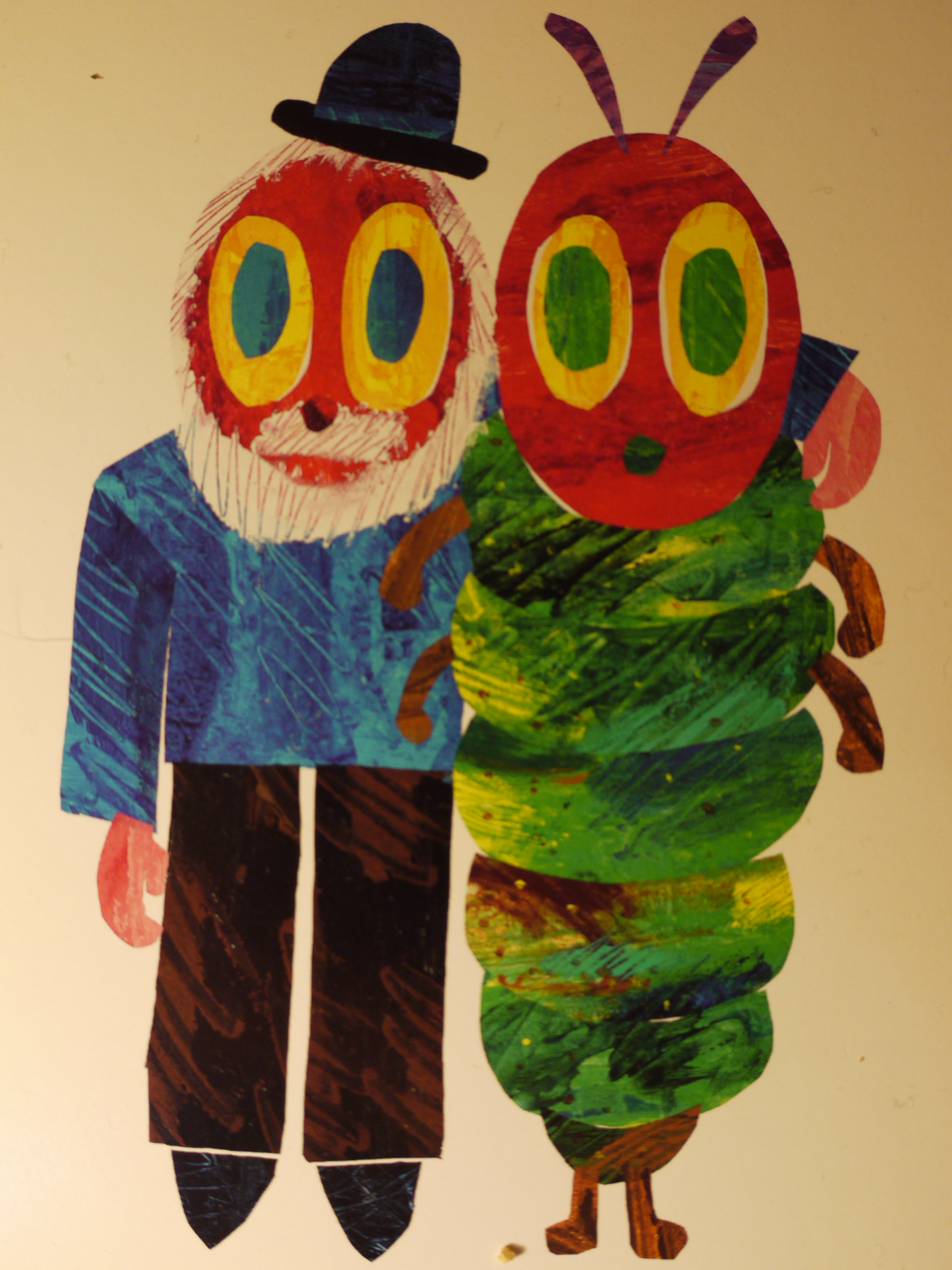
Eric Carle and his Caterpillar by Eric Carle

What reading materials are on my bedside table? I am honored you asked. Right now, I have the catalog for the Omega Institute for Holistic Studies and The Very Hungry Caterpillar by Eric Carle–the story of one caterpillar’s journey to butterflyhood. Though they both relate to personal development, their shared placement is causing me a moral dilemma. You see, I am rereading The Very Hungry Caterpillar because 17,000 copies have been distributed to pediatricians across the country. This is a joint campaign of the American Academy of Pediatrics, the Penguin Young Readers Group and the Alliance for a Healthier Generation.

The cynic in me is ready to rant on this initiative, but with a photo of Thich Nhat Hanh looking at me from the back cover of the catalog, and Omega’s plethora of courses with titles like Embodying Conscious Femininity, Gravity, and Grace and Freeing Ourselves from Negative Patterns oozing out from the inside pages, I am trying to temper my response.

My higher self is saying if you don’t have anything nice to say, don’t say anything at all, offer only constructive criticism, and asking, are you a compassionate, empowering new-tritionist or just a curmudgeonly old one? Well, I will try to open myself up and see what emerges.

Positively, let me say I love children’s literature and its illustration. Not too long ago I spent a wonderful day at The Eric Carle Museum of Picture Book Art in Amherst, Massachusetts. To see the originals of Mr. Carle’s tissue paper art was wonderful. The colors and intricacies of his pictures are even more amazing than they appear in his books. I am grateful that he has created a space to exhibit the collections of the many incredible artists in this genre.

Also, I respect the myriad efforts of the Alliance for a Healthier Generation. A collaboration between the American Heart Association and the William J. Clinton Foundation, its mission is to reduce the prevalence of childhood obesity and to empower kids to make healthy lifestyle choices. Their projects, which include the Healthy Schools Program, are far-reaching, community-based, and creative and colorful in their own way. I use their great materials in my work.

So, what’s my issue with this sweet little book-sharing promotion which is intended to encourage pediatricians to talk with their patients to help families learn about healthy eating habits? To be frank, I am on my thirty-fourth reading of this fourteen-page cardboard book and I am not convinced of its purpose or efficacy for teaching healthy eating.

For those of you who may not know the story, briefly, a caterpillar hatches out of an egg. It is hungry, and through its first five days of life, it eats a hole through increasing amounts of different fruits (one on Monday, two on Tuesday, etc.) but is still not satiated. Then, ignoring the numerical sequence, on its sixth day, it eats a hole through a slice of watermelon–along with eight human-produced high-fat, high-sodium, and high-sugar foodstuffs including salami, sausage, a lollipop, chocolate cake and cherry pie. And, it gets a stomach ache. On the seventh day, a Sunday, it eats through one nice green leaf and feels better. On my most recent reading, I suddenly see this as a religious allegory about sin, redemption, and resurrection, because right after that, all fattened up, he builds a cocoon, stays there for two weeks and emerges as a beautiful butterfly.

Regarding caterpillar growth and nutrition, here is what I know. The caterpillar increases its body mass several thousand times in a matter of weeks and each species has mainly one, and on occasion a few, host plants from which it must eat to survive. Predominantly, they eat only leaves–like from the milkweed family, but a few species can eat flowers and aphids. Analyzing the very hungry caterpillar’s eating behaviors, it has responded to his hunger and high growth needs in a manner similar to that of many teenage boys; problematically, it has partaken in eating foods not optimum for its own species and a lot of them. The messaging here between fruits and junk food along with hunger, satiety and body size is a bit confusing.

The promotional materials for this campaign instruct the parent to teach their child that the fruits are fruits; talk about how fruits are good for the body; discuss how overeating causes stomachaches; expound upon the concept of “sometimes” foods; instruct how green leaves are good for the body, and reinforce that it is important to eat healthy foods so that one can grow up healthy and active like a butterfly. My, that is a heavy load for one little book–let alone one small child.

Maybe I have forgotten a bit about early childhood development, but I think I read this book to my kids when they were about eighteen months old. Certainly, prior to the stage where we were discussing abstract concepts like hunger and health. Even prior to the stage where they might imaginatively embrace the idea that they would grow up and turn into a butterfly. There are many wonderful age-appropriate stories about food, gardening, nature, eating, etc. for young children, and though I am fine with metaphor, I don’t think this is what Mr. Carle had in mind. Now I must worry about children going out and plucking hemlock leaves for a little nibble.

I am glad to report that kids seem to know about and do eat their fruits, though vegetable education still needs a little more work–even for adults. I hope that we do not need to be spoon-feeding parents on such basic concepts; and, additionally, that pediatricians are opening to engaging parents on more specialized and sophisticated aspects of feeding our young than these simplistic measures. They are in a strong position to influence policy, to really support breastfeeding measures, to evaluate infant and early childhood feeding practices and to instruct on the principles of childhood nutrition and appropriate activity.

Might I respectfully suggest providing parents with a copy of Ellyn Satter’s Parent and Child Division of Feeding Responsibilitiesa clear and concise document that addresses the foundations of family eating. And, symbolically, a retreat at the Omega Institute. Their Omega Food Works Dining Hall consciously serves 300,000 vegetarian meals a year using local and organic ingredients. One delicious, nutritious meal like the ones offered there, can speak louder than a thousand words.

Thank you for listening, sharing, following and supporting my writing. Please subscribe in the sidebar to receive notice of new posts. Comments and greetings always welcome.

In health, Elyn

Update May 2021: Acknowledging the passing this week of Eric Carle. In this Eric Carle Commemorative Video, the artist discusses his own thoughts on the meaning of the story and why it captivates the attention of young children. Thank you, Mr. Carle, for opening children’s eyes to the beautiful world of color, art, nature and storytelling. 

Also, for reflections and support for parents regarding children’s health, weight concerns, and the impacts of the Covid-19 Pandemic, please look at the offerings of JoAnn Stevelos at her blog, Children at the Table, and her transformative program, Worthy!: Helping Your Child Be Their Healthiest Weight focused on a foundation of children and parents feeling loved, hopeful and safe.