out of the fire and into the frying pantry

I am not new to this rodeo. For about 40 years, in many ways, I have provided opportunities for people stripped of the usual means, to get some good food. Addressing the nutritional mishaps associated with prevailing health issues–in which I have been long engaged–generally requires food to achieve improved outcomes. Procuring such food, especially with a dearth of necessary currency, begs some creativity and much activity.

Some of my activities involved people coming to me for a few healthy and tasty nibbles, but mainly they required me to send them scurrying off to another program or service; or sometimes more directly to grocery stores, farmers’ markets, veggie mobiles, and food pantries with some voucher, coupon or referral form in hand. While glad to have some options to feed the malnourished cells of chronic disease and to stave off the hungry wolf knocking at the door, I always did so with a sigh. Scurrying is not an easy form of ambulation, especially for those whose bodies are worn down by the toll of strained lives and the lack of quality food. This would not be easy one-stop shopping.

Food coming in

For many years I listened to the sensitive stories of many hundreds of individuals striving toward some recapture of wellness. In exchange, I offered education and support, and guided people as best I could to obtain the remedy of good food. While I would hear of the relief that receiving SNAP benefits (or having them restored) instilled; or the thrill of being able to get fresh fruits and vegetables, only occasionally was I witness to the experience of having a grocery bag in hand and heading to the comfort of one’s home.

This however changed for me a year ago when I took the position of running a Food Farmacy. It is a small food pantry nestled within a medical facility. Its mission (and thus its name) fits into the growing Food As Medicine model of programs by providing health-supporting and enhancing foods–and the services of a Registered Dietitian. As we may look similar to other pantries, distinguishing ourselves and reinforcing messaging about food as a pathway to healing is important. Clients in the pantry community are referred to as guests. At my pantry, guests are those with nutritional risk factors for chronic disease or compromised well-being, and without enough–or enough good–food to eat. They are referred by a medical or behavioral health provider.

Our main model is to provide an order of client-chosen food, generally on a monthly basis. We strive to serve everyone regularly for some number of consecutive months–with a focus on healthy offerings. (But, with other funding streams we operate a little differently.) When I started in December 2021, Covid still dictated our practices. We took all food orders by phone and gave the packed bags out at curbside or by delivery. While this allowed for some interpersonal contact, it was somewhat limited. This changed in September 2022, when we became able to fully open our doors and welcome guests back into the pantry, by appointment. We now serve many in person, enabled some by a limited grant-funded ride service, though a fair number still require delivery–and support by phone. Limited access to transportation is a profound contributor to not having food.

Being able to develop relationships with our guests is certainly facilitated by being able to do so in person, as is deepening the conversation about food while standing amidst it. Discussing the intimate topic of our eating behaviors and revealing how full or empty the larder is, is harder to do on the telephone with a stranger than in the presence of someone greeting you at the door with a warm welcome. Still, we need to do both.

Ready to provide

In my role, I carry food out to cars and sometimes, when my volunteer drivers are not available, I do the deliveries. This means schlepping bags into trunks and back seats; or, in my urban locale, involves driving down alleys, circling through subsidized-housing neighborhoods, climbing steep stairs, and occasionally riding elevators to knock on a door. I gain entry to the threshold of someone’s personal space and transfer the goods. And, while it is usually a quick transaction, that is a powerful exchange. The expressions of gratitude are deep, as the most basic human need–food–is made available.

Then there are connections that take place in the Farmacy. Here things go from soup to nuts, so to speak. The welcome, the conversation, entering the pantry space, being up close and personal with each item, the decision-making, and the often mutual act of the ‘filling of the bags’. I am out constantly hunting and gathering for as much fresh produce and meaty morsels as I can–largely aided and abetted by my regional Food Bank–currently overly strained, as are most–and Nourish New York dollars. To procure some particular healthy items, and enough food, I also have to purchase retail food and rely on some other food donations as well. It is a weekly dance of food in and food out, dictated by availability and price and how many we are serving. Though fresh is always celebrated, I have seen even a can of asparagus, beets, collard greens, olives, pineapple –or salmon make a heart happily flutter. Many a floppy tote bag turns upright, stuffed with victuals, fulfilling its duty to help folk carry out and carry on. Right then and there, some magic happens. Food has appeared. While not as surprising as pulling a rabbit out of a hat, or a quarter from behind the ear, there is often some degree of awe. Here, I witness most directly, more than with any of my other experiences, how much this matters. Here is whispered, ‘This is a lifesaver’ or, ‘I can’t believe this’.

Ready to nourish

For many of our guests, making way to this little, simple food sanctuary–if I may call it that–is like a pilgrimage. Some arrive limping, others in wheelchairs, on crutches–this week, a man with a cane, due to a bullet lodged somewhere in his body. A chair stands waiting in the pantry for those who need to sit. Pain accompanies many, hiding in backs, hips, knees, and feet. Rarely, but not never, in a missing toe or limb. It hobbles in and hobbles out. Sadly though, we can’t perform miracles. We can only provide food, some education, lists of other resources, and an ounce of love.

As big as my work seems to me, this Food Farmacy operates at the tiniest of scale–a staff of three and the few lovelies who lend their helping hands. Out in the big wide world, big programs, projects and pantries with similar intentions are hard at work, day and night. They employ many, yet largely rely on scores of volunteers with the gathering capacity of mice and squirrels; and a skillset that surpasses those of Santa’s elves. A huge invisible army gathers, transports, warehouses, organizes, packs, cooks, distributes, educates, and delivers sustenance to millions. All are starved for dollars and crave legislation that will subsidize their efforts. Wow. Time for a group pulse check.

Ostensibly, there are two intentions of these programs–to decrease nutrition insecurity (and hunger), and to ameliorate–if not heal–illness of such magnitude that should have been prevented in the first place– predominantly diabetes, heart disease, and obesity. Unfortunately, these diagnosis-limited programs exclude so many other conditions that are exacerbated by poor nutrition. There are many different types of program design, though they generally fall into the categories of Medically Tailored Meals, Healthy Groceries, and Produce Prescriptions. While some great initiatives are underway, and some good food medicine is going down, they often lack sustainability, sufficient dose, reach, and duration; and additionally, adequate targeted nutritional sophistication to address the profound problems largely related to the long-term metabolic dysfunction at hand.

At the end of my day, I can find myself collapsed on the couch–sometimes with my head hanging over the edge, below my heart. In its usual dog-like apparition, my dilemma wanders over and licks my face. It takes a seat, quietly nearby. It knows what I will ask, but I ask it anyway. Does this really have to be so hard? Is it too little too late, and, are we really making even a dent in the problem at large? Not only do the little mice, squirrels and elves have to do the hard lifting, they are also expected to measure the impact–to prove to the big guys that they should care and maybe invest. Maybe they will after many more short-term pilot programs are implemented; and while they limit dollars, access, and impose restrictions on and to programs that are known to provide benefits. How’s that for passing the buck? Lots of little mammals have now been left to shoulder the burden of the collective failure of many entities to prioritize the proper nourishment of the populace.

I’ve had my eyes on this work for a long time, since the early years of these efforts, and have shared my thoughts about my own Veggie Rx program in Inventive Incentive. When you peek at the research literature, what you mainly find is mention of increased fruit and vegetable consumption of about a quarter to a half-cup or so per day–which is considered significant. Or, sometimes a small decrease in diabetes markers or pounds. Less easy to measure, but occasionally found, is a documented decrease in hospital admissions–which is what the big insurance companies care about for cost containment. So much wonderful effort for a relatively small return in quantitative terms–though there are other benefits. Our guests report eating better, feeling improved physically and emotionally, being less worried, and trying new foods. Many appreciate being cared for by our program. And while I can see it is very helpful, it is often too little too late.

Lining up for deliveries

When I look both broadly at the societal issues, and intimately at the guests served by my little pantry–I am deeply saddened. How could such injury have been imposed on so many? (Not to mention the insult to dignity that need for such charity can provoke.) Chewed up and discarded by many forces–I wince sometimes at what is required to come find me in some corner of a building, just to get a modicum of food and nutrition education and support–no matter how nice, easy and good we try to make the process.

My dilemma looks at me with those adoring eyes. It knows I have a tendency to be rather grim on these matters. It knows I have bigger thoughts, but it begs for one. So, I tell it something my mother once told me. In the olden days, when my mother was a little girl, the children were given a spoonful of cod liver oil to start their day. Now, maybe that’s where things should start. And, then there are my other ideas about……My dilemma paws at my arm. Oh, what’s that? You were just asking for a dog treat?

Thankfully, there are so many ordinary folks with big hearts that are pumping with generosity. Much gratitude is due to the multitudes who are out there day in and day out, in various capacities (including growing our food and fostering transformation) feeding their neighbors main dish entrees served with a side of love. Or, maybe love is the entree and food the side dish that truly matters. Please check out the organizations, resources, and articles below, consider donations where accepted, and look at the love spread by Alphabet Rockers–a hip-hop children’s music collective based in Oakland, California. Their work is focused on education, diversity, and a healthy lifestyle. 

Thank you for listening, sharing, following, and supporting my writing. Comments and greetings are always welcome.

In health, Elyn
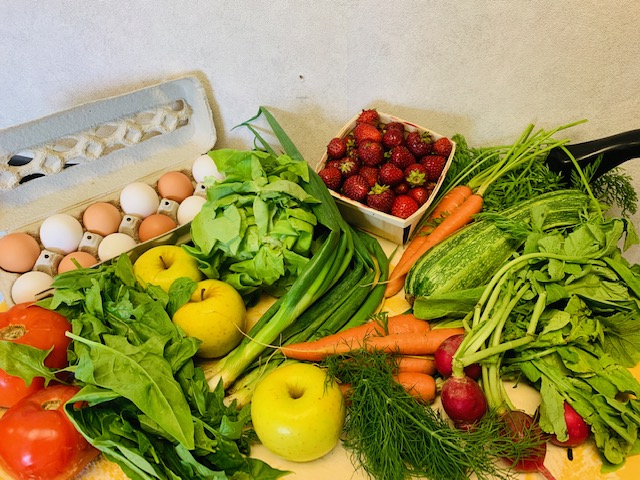
My Plate Rap

Average out what’s heavy

Multiply your veggies

Eliminate the junk food

Simply makes you feel good. By the Alphabet Rockers

Healing Meals Community Project, HEAL Food Alliance (10-point Platform)

Tri-County Services-Ellis Food Farmacy (Agency: Tri-County Services, Option: Ellis Food Farmacy)–my program

Green Bronx Machine; About Fresh/Fresh Connect; Tangelo; Future Farmers of America

Food Bank News: Food Insecurity Isn’t About Food; Here’s What To Do About It

Foodtank: 13 Global Food Banks Reshaping Food Distribution to Address the Root Causes of Hunger

Nutrition Insecurity–What’s In A Name?

I have–in my small circles–laid claim to a few things. These include wearing a lot of black in the 1970s, bridging the gap between the Beats and the Goths. I also take credit for casualizing professional wear, by donning sneakers with skirts and dresses in the 1980s, thus paving the way for working women to be more comfortable. (Boy, did that one take off.) Since then, my trendsetting has leveled off, until a few years ago, when I forwarded the matter of Nutrition Insecurity back into wider awareness.

Now, that might be the most audacious statement that I have ever made public, or that you have ever heard. But, hear me out. In my recent post, Could Not Afford Balanced Meal, I admitted to being late to the use of the term Food Insecurity and mused over how instead I described that issue. However, once I was brought up to speed, I comfortably integrated the terminology into my work at a national organization dedicated to addressing Food Insecurity by providing its program participants with a small subsidy for a few months to procure fresh fruits and vegetables.

I most certainly appreciated and supported the core of the mission. I enthusiastically imagined the mastication of sweet oranges, bright red peppers, emerald spinach, and juicy black and blue berries releasing their rich phytonutrients and antioxidants down the gullets of a couple of hundred individuals fortunate to be enrolled in one of our funded initiatives. I believed in the benefits such provisions would bring to those unable to afford and prioritize the intake of nature’s bounty. I touted the potential impacts–but wasn’t sure how deep they would reach.

As my tenure at the organization lengthened, I observed its focused messaging around Food Insecurity, and began wondering if that was what we were actually addressing. Of course, we were adding some dollars to food budgets, and our evaluations indicated that most participants made use of the program and claimed increased consumption of fruits and vegetables–albeit small. We highlighted the story of one woman who was thrilled to be able to purchase a fresh pineapple. Some who were surveyed described improved well-being. So, what then was I troubled by?

Perhaps I was just getting caught in the weeds. Maybe we were addressing one of the aspects as defined by Low Food Security–the reduced quality, variety, or desirability of one’s diet. But, I doubted that we were making a dent in the other–being without reliable access to a sufficient quantity of food. In September 2019, a year into this work, I began to wonder if it was more accurate to say that we were addressing Nutrition Insecurity, a term I’d not heard being used at that time. So, I took to Google.

My cursory search for Nutrition Insecurity yielded only links to papers investigating severe micronutrient deficiencies like Vitamin A, zinc, and iodine; and Protein-Energy Malnutrition in remote, from here, pockets of the globe–due to a true lack of food from various causes. This is the malnutrition I learned about in college decades ago. Here, our problems are instead ascribed to Food Insecurity, though this is ironic, as certainly there is no actual lack of food. Such emphasis on food rather than nutrition allows for the nutritional consequences of the compromised diets rampant in our society, a different type of malnutrition, to remain ill-defined at best or ignored. This diminishes a focus on nutrition and the need for requisite nutrients to ward off disease and to enhance mental and physical health.

If the good mission of my organization was to provide a modicum of fruits and vegetables, weren’t we trying to address Nutrition Insecurity? I raised the issue with my colleagues. They weren’t sure. I raised it with a group of Yale Public Health students. Their ears perked up and they expressed interest in further consideration of the distinction. My Dilemma roused itself from a long hibernation and asked, “What’s up with you, girl? Does it matter?”

Shortly thereafter, my work at the organization ended. And then, a pandemic ensued. With a vengeance, all of our insecurities came bursting out onto the scene. Food Insecurity, came center stage. It hit the big time. Suddenly, food was being flung everywhere, from wherever it had been withheld or going to waste. I surrendered my query, accepting that the nuance I was trying to suss out was irrelevant. Food was food, and it was going to do its function of providing basic nourishment and keeping bellies full. Good enough. It was time to get to work to get people fed, no matter what. Food Insecurity was running amok. No one needed a fussy Nutritionist in times like these.

Feeling useless, I took myself to the streets a couple of times, volunteering at food drives. I stood in parking lots, with a few dozen others, filling the trunks of hundreds of cars with food. Some of it was good, while other was of a dubious nature. (I did pull the nutrition label from an unappealing package of a meat product to keep for my own edification.) And, where did those few little pretty, purple heads of radicchio come from, I wondered? My Dilemma, who always seems to present itself as a dog–like a big Yellow Lab–growled lowly for only me to hear and obey. It grabbed my chain, holding my vicious little whole foods, vegetarian, junk-food judgmental self back. I said, “You’re welcome,” as I wished well the multitude of thankful drivers. I crawled back home with a little more humility.

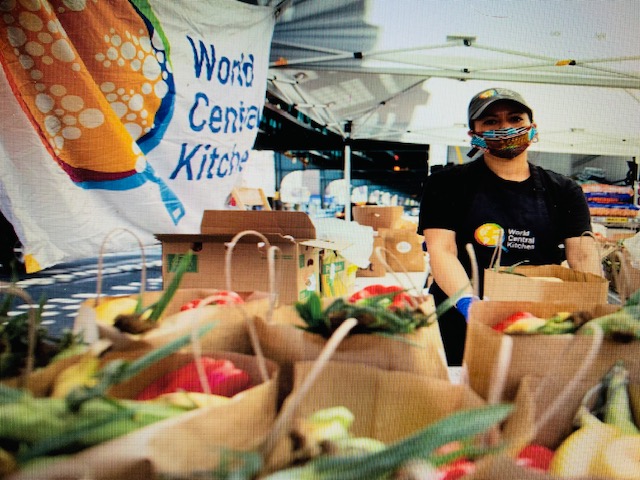
And then a funny thing happened. One day, I found my Dilemma under the table, about to eat my homework. “Drop!”, I commanded. I unfurled the only slightly chewed pages. It was a paper entitled, Time to shift from ‘food security’ to ‘nutrition security’ to increase health and well-being. Dated April 1, 2021, it argues that this shift enables a more inclusive perspective, one necessary to ‘catalyze appropriate focus and policies on access not just to food but to healthy, nourishing food.’ It promotes ‘consistent access to and availability and affordability of food and beverages that promote well-being, while preventing–and if needed, treating disease.’ It was authored by Public Health leaders, Dariush Mozaffarian (Tufts University), Sheila Fleischhacker (Georgetown University), and one of my personal heroes, Chef José Andrés, the founder of World Central Kitchen.

I suspect that those Yale students chatted up my question with their friends at these other institutions, word got out and it floated up to the top. Thanks to them for picking up on my idea and growing this trend. One might still wonder, what’s in a name? Haven’t we already acknowledged that our current healthcare crisis is largely due to diet-related causes? Yes, but it is bigger and broader than that. Adding Nutrition Insecurity to the headlines and to healthcare policy may promote further change and accelerate solutions. Instilling it into our language and infusing it into a wider consciousness may remind us how much it matters. If Chef Andrés can accomplish what he is doing by deploying food and nutrition around the world at a moment’s notice, then we can certainly do better. (Let’s utilize school cafeterias as community meal preparation sites, staffed by a cadre of trained community members–so that everyone can have a warm, nutrient-rich meal to bring to their dinner table.)

Thank you for listening, sharing, following, and supporting my writing. Please subscribe in the sidebar to receive notice of new posts. Comments and greetings always welcome.

Be well. Take care. Stay safe. Let’s heal.

In health, Elyn

Reference: JAMA. 2021;325(16):1605-1606. doi:10.1001/jama.2021.1915

Update March 17, 2022: It seems that Nutrition Insecurity has now taken hold at the USDA. See this.

My Plate Haiku

Every day, I see hunger

But the hunger I see is not only for calories

But for nourishing meals. Chef Andrés,

Right now the people of Ukraine are facing a humanitarian and food crisis. Please click this link to see Chef Andrés’ work feeding people in multiple locations in Ukraine and in the adjoining countries accepting refugees, and to make a donation.

”                               


Oh, Some of the Things I Have Done

A few years ago, while serving as a resource person for a national food security organization, I responded to an inquiry. It was from a woman doing related work for a small non-profit. Though I was then staying and working out of state, she was from a community very close to my home–so there was a welcomed familiarity in connecting with her.

When I returned home, I made the lovely thirty-five minute drive down beautiful back roads to meet with her. Sitting together in her office–a large warehouse space–she described her programs related to food access, nutrition education, and Produce Prescription Programs. Having done the same work myself, I was impressed with her sophisticated and creative approach, and the success of her efforts. She had been in this job for four years and had accomplished a lot in a rural area with limited resources. And, though her face was largely hidden behind a Covid mask, I realized that she had obtained this professional maturity by, at best, her mid-thirties.

We stayed in touch, and a few months later she informed me she was moving on to pursue an unrelated opportunity, and I wished her well. Having become linked on LinkedIn, I noticed that she identified herself as a Public Health Innovator. This intrigued me. While I did not doubt her right to ascribe that title to herself, I wondered what being such an innovator would entail, and might I, with a few decades on her, have any claim as such. And so, I began an inventory of my own path.

Let me acknowledge that by all measures, and certainly by today’s standards, my efforts were itsy-bitsy, teeny-weeny, tiny. I have been a very small fish, in a very small pond, with little personal agency to swim out into larger waters. I had no funds, grants, or extra supports. Maybe just some supervisors who let me do some things–or didn’t stop me. I just wanted to help those I was serving. My reach was small, and the sustainability of my projects limited, but I did possess some type of fins and gills, impelled to create something to fill a need that had lacked attention or address in its time.

What turned into my career began in the early 1980s, a period when the government, still in the wake of the ‘War on Poverty’, was crafting its national nutrition programs to bluntly address abject hunger, the effects of a few decades of corporate interests controlling the American diet were seriously taking their toll but had not yet reached full crisis level, and the folks in the natural foods movement were making the connection between diet quality and personal and societal health–but they were quite marginalized.

Margarine was still cool, soda drinks were just starting to supersize, the term ‘wellness’ was not yet coined, and no one knew were were a mere decade away from an obesity and chronic disease red-alert. Likewise, mimeograph machines were just surrendering to Xerox, typewriters to word processors, and print materials knew not of the worldwide web.

Arriving at this cusp of nutritional awakening, I began to work my way through a number of different community and clinical settings, propelled by geographic moves related to early adulthood and marriage. At each stop, I was witness to emerging issues, and being in unchartered waters I had a modicum of freedom to make things up–or should I say, find some innovative solutions.

I first stepped out of the box in 1980, when as a WIC Nutritionist in the federal program that was then only about five years old, I arranged to walk a group of moms down the street from the WIC clinic site to a little whole-grain bakery for a tour–certainly this was not within normal operating procedures. This was before there was any widespread, soon-to-be earth shattering news about the ills of Wonder Bread. But I had gotten the memo, and I guess thought this was an opportunity for an interesting, educational outing. Though my intention seemed rather innocent or naive, I guess something deeper was rising within me that would inform my future endeavors.

And so I swam forth through the next four decades, trying some innovative things largely within various work settings but beyond the requisite duties of my role. Here are just some of them:

The Nineteen Eighties

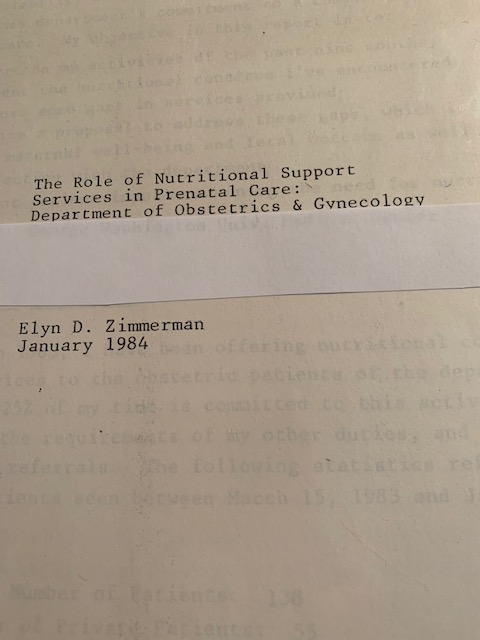
Presented a paper I had written entitled, The Role of Nutritional Services in Prenatal Care, to the medical team in the Department of Obstetrics & Gynecology at a large, prestigious university medical center. (Yes, young me!). This forwarded the integration of nutritional assessment and counseling into prenatal care within that practice and enabled me to later provide specialized nutrition support to pregnant women in other settings. (1984)

Presented workshops on nutritional approaches to women’s health concerns in various workshop settings. Many of these concerns had not been properly understood until the mid-1900s and were only gaining wider recognition and support around the 1970s due to the visionaries and feminists of that period. (1985-1987)

The Nineteen Nineties

Developed a cooking class for pregnant teenagers while working for another WIC Program and observing the demise of home-prepared meals in a peak period of teen pregnancies. I enjoined the collaboration of a local Cornell Cooperative Extension agency and a community food pantry. Participants received a free bag of groceries at each class. (1994)

Implemented the following at a Community Health Center to provide greater options for well being to a low-resourced community: (1997-2001)

Physician-Nurse Team-led walking program and nutrition classes for staff and patients

Center-based Yoga Class Series taught by certified Yoga Teachers–there was a waiting list for the class

Coupon Program and Cooking Demonstrations with the local food-coop

The Two Thousand Aughts

Invited one of the nation’s first mobile produce vans intended to bring quality, discount-priced produce to underserved neighborhoods to make a weekly stop at a Community Health Center to reinforce the notion of ‘food as medicine’. This popular stop served a wide-range of clients, staff, and medical providers and raised awareness about food insecurity. (2008)

Provided to my clients (on a very small scale) low-cost, non-perishable nutritious food samples boxed in cardboard Chinese Food containers. They included sardines, beans, oatmeal, teas, spices–along with cooking instructions. These were essentially a precursor to healthy meal boxes available today. (Back then I wished I had a way to get funding to expand that idea.) (2010)

Expanded eating disorder services and resources at a college. Also, helped initiate changes to support more sustainable practices and local food sourcing for the college’s Dining Services. (2007)

The Twenty Teens

Developed and administered the clinical component of one of the nation’s earliest Produce Prescription Programs. Conducted a Program Evaluation and the Program’s results were published in a Public Health Journal. (2011-2013)

Designed a Diabetes Education Program that had included a diabetes-friendly meal that was prepared together by some of my patients in the Program who were experienced cooks–mainly elderly black ladies who had each fed countless mouths and who could serve an army or at least a filled church. The program also included a dance segment led by a local Latin Dance teacher. (One of the program attendees became a member of the teacher’s traveling dance troupe.) (2012)

Solicited local businesses to donate breastfeeding supplies to a Community Health Center for nursing mothers in honor of National Breastfeeding Month. (2013)

In the mid-Twenty Teens my work took me out of direct care environments and into more Program Management roles. By this point, innovation was largely being measured by technology-based advances where I was less well-equipped–though I still pushed my grassroots efforts where I could. My inspirations and innovations grew out of having sat with thousands of eaters from around the globe and from all walks of life, a plethora of pregnant moms, a couple of hundred college students eating their way from adolescence to adulthood, and a few dozen elementary-aged school children who knew more about food and life than you might think. I looked for every available resource to support them all as best I could, created partnerships when possible, and came up with new solutions when necessary.

Surreptitiously I removed infant formula promotional materials from the ‘free’ gift bags and magazines targeted to pregnant women and quietly encouraged vending machine vendors to replace the most nefarious offerings with others less harmful to the human organism. I produced lots of nutrition education materials and wrote many newsletter articles. And then, I embarked on documenting in 125+ blog posts ‘the intimate art of eating in response to the personal and cultural milieu’. From my work chairs to my pitter-patterings about, I bore witness to much of the difficulties we are now experiencing in even more extreme ways–demanding a more robust and urgent response. My writings presaged much of what we are confronting and I invite you to to search my site for my insights on any number of nutritional matters including breastfeeding, eating disorders, toxic food systems, child health, obesity, racism, health inequities, nutrition insecurity and food marketing. Gosh, things got a lot more complicated than just whole wheat bread.

Looking back, I acknowledge that I did a lot for a small fish. I used to say that one thing I would not do was to dress up like a fruit or vegetable, but I will don the Public Health Innovator Hat, at least for a moment. I still have a list of things that I would love to see be done, so as I ease out of this work, I’d be glad to share my ideas. Also, feel free to build upon my efforts if you can appreciate their value. Finally, fellow innovators, keep up the good work. If I catch sight of your schemes, I will be glad to celebrate them.

Thank you for listening, sharing, following, and supporting my writing. Please subscribe in the sidebar to receive notice of new posts. Comments and greetings always welcome.

Be well. Take care. Stay safe. Let’s heal.

In health, Elyn

P.S. OK. Here is one of my ideas. Let’s implement a program for vulnerable senior citizens similar to the Women, Infant and Children (WIC) Program. Maybe just an add-on program called WICS.

And, here are some other important insights and innovative ideas shared by Food Bank News regarding collaborative efforts working with underserved populations with globally-based examples.

My Plate Haiku

Craving for pickles

And German Chocolate Cake

My friend is pregnant. by Gretchen

Could Not Afford Balanced Meal

I am a little embarrassed to admit this. Here it goes. I came late to the term Food Insecurity. This term is so ubiquitous now in the light of the tragic consequences of the Covid-19 pandemic. Every day, reports about food insecurity are rolling off the presses and plastered everywhere, shocking us into disbelief as we equate it with images of endless lines of cars and people awaiting offerings of food donations. Though the immensity of the problem came on with a vengeance, we seem to have assumed that describing it in this way long had a place and an understanding of meaning among the general populace. The experience is not new.

I am always late to catch on to new trends, including those in our vocabulary. When I do eventually gain awareness, sometimes by use of blunt force, the new words or phrases do not roll easily off my tongue or out through my typing fingers. So, while I may have lagged behind on ‘cancel culture’ or ‘on fleek’–but, food insecurity? C’mon. Really?

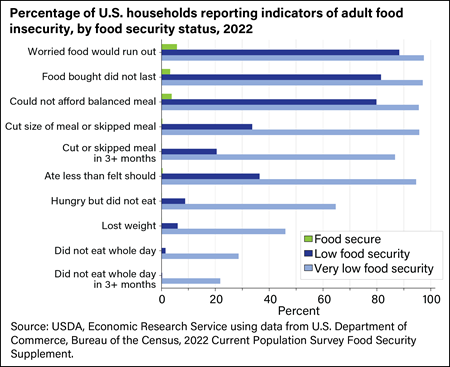
Percentage of households reporting indicators of adult food insecurity in 2019
Indicators of Adult Food Insecurity–2019 USDA

Actually, the definition of food insecurity has many variations. These include: the lack of consistent access to sufficient food for an active healthy life; a lack of available financial resources for food at the household level; a lack of access by all household members at all times to enough food for an active, healthy life, which includes as a minimum the ready availability of nutritionally adequate and safe foods–and assured ability to acquire acceptable foods in socially acceptable ways (without resorting to emergency food supplies, scavenging, stealing, or other coping strategies); and, the state of being without reliable access to a sufficient quantity of nutritious food. While similar, the nuanced differences may contain some significance.

In an attempt to capture the degree of food insecurity and ideally, but imprecisely, the extent of hunger, the USDA established two sub-categories: Low food security–the reduced quality, variety, or desirability of diet with little or no indication of reduced food intake; and, Very low food security–multiple indications of disrupted eating patterns and reduced food intake. (See chart.) (Hmm, ‘Gained weight’ should also be listed.) However one wishes to slice it, it is not pretty.

In 2018, an estimated 1 in 9 Americans were food insecure, equating to over 37 million Americans, including more than 11 million children.[1] It is a lot worse now. Feeding America, the nation’s largest hunger relief organization, tracks this data, with information on current impacts documented here.

As a Nutritionist who has concerned herself with food insecurity issues for almost half a century, not only should I have been hip to the term sooner, I should have been way ahead of the curve–like one of the first to know. Apparently, which means I just learned, the USDA began collecting and measuring data on food insecure households in 1995. That year, I was working for the Special Supplemental Nutrition Program for Women, Infants and Children or WIC-administered by the USDA. Clearly, I missed the internal memo of what they were up to.

My own ignorance came to stare at me with incredulity when in late 2018 my work found me supporting recipients of FINI Program Grants. I understood the program, and it was easy to casually throw around the acronym, but I would hesitate each time I had to recall what FINI stood for. FINI was shorthand for the Food Insecurity Nutrition Incentive Program. FINI Grants were established and written into the 2014 Farm Bill to ‘incentivize’ the purchase of fruits and vegetables by Supplemental Nutrition Assistance Program (SNAP) recipients.

In 2019, just as I had cemented the name of the program into my prefrontal cortex, it was changed to the Gus Schumacher Nutrition Incentive Program or GusNIP, in memory of the former Undersecretary of Agriculture. He was instrumental in visioning and implementing early models of expanding produce purchasing power through vouchers for low-income consumers, and advancing the legislation that authorized the Farm Bill funding. The new name retained the nutrition incentive part but snipped away the food insecurity part.

I appreciate the intention of the program, and have championed its cause and those who lovingly administer it, but I’d prefer the use of the word ‘support’ rather than ‘incentive’. And, I think “Nutrition Security Support’ better encourages the matter.

I also came to learn that there was a Food Insecurity Screening Tool. Developed by the USDA’s Economic Research Service when they began measuring such things, the original version contained 18 questions. That has had different iterations through the years with variations of ten, six and even down to the Hunger Vital Sign’s apparently validated, yet oddly crafted, two questions which are:

“Within the past 12 months, we worried whether our food would run out before we had money to buy more.”

“Within the past 12 months, the food we bought just didn’t last and we didn’t have money to get more.” 

Yikes, how did I miss that? How had it taken me so long, just a mere year or two before the pandemic flashed Food Insecurity before us all like a neon sign, to find familiarity with these terms? Was insecurity a word I used only in describing myself? What had I been doing with my many hundreds of clients to ascertain someone’s vulnerabilities in order to know how to help them? Had I missed something big?

To make sure I hadn’t just forgotten, I searched all of my 125 blog posts dating from 2010 to check. Before 2018, I used the term twice. I am pretty sure that means that a year ago, when I did a big blog cleanup, I inserted it to make it appear that I was appropriately informed back then. But, this has made me really stop to wonder–how had I functioned without the use of the term and the screening tool?

The answer may be relatively simple. With my work in low-income communities, there was not usually much to discern in the way of food insecurity–it was the norm. Regarding distinctions between low or very low levels, I definitely saw both–though I rarely encountered abject hunger as one might in other environments. Hunger in its most pure form is sadly more prevalent now in the wake of Covid-19. Most of the folx who had the capacity to find their way to a nutrition appointment, had at least some resources. Once there with me, I had the time to sit and have real conversations about the intimate details of their feeding lives. And, I employed my own screening tools to glean what I needed to know. Any nutrition consult necessitates some vague calculation of financial means and available food dollars. There is a big chunky space between peanut butter and almond butter.

Nonetheless, I know that many details of people’s circumstances have slipped through my cracks. I have discussed my limitations here. However, I think my assessments regarding my clients’ food resources were somewhat near the mark, though I still feel badly about the time I recommended wild rice to a man who expressed to me his dismay due to the price.

That misstep highlights a distinction between nourishment for the still generally well, and the oh-not-so-good. This marks how the differences mentioned above in defining food insecurity in relation to ‘nutritious’ may matter. Also, if active lifestyle means caring for families, young children, elders, the ill or disabled–one’s own or other’s–or doing low wage service work or manual labor, then my clients were quite active. Healthy was often not up for debate. Through it all, my office desk drawer was well stocked with referrals to every food and health support resource and program around–including some I created. Yet, my efforts could not surmount the magnitude of the underlying problems.

So then, what terms were I using if not food insecurity? A whole bunch, including: poverty, exhaustion, trauma, nutritional violence, food deserts, malnutrition, restrictive and confusing SNAP regulations and bureaucracy, social services system overload, toxic food culture, exclusions for immigrants, disparities, inequality, high food costs, inadequate wages and a sad story to name a few. I guess I got by.

In closing, I share this telling by Jadon-Maurice Forbes, I Didn’t Drink Water At Dinner as a Poor, Black Kid. Start here. You may then be able to skip all the above.

Thank you for listening, sharing, following, and supporting my writing. Please subscribe in the sidebar to receive notice of new posts. Comments and greetings always welcome.

Be well. Take care. Stay safe. Let’s heal.

In health, Elyn

My Plate Haiku

Food bought did not last

Could not afford balanced meal

Food Insecurity

by 37 million Americans

What to Eat in Still Troubled Times

June 2020. This is a revision of a blog I posted on February 9, 2017. Though the struggles don’t seem to cease, this year, our experience during the Covid-19 Pandemic and the fight for Black lives, racial justice and an end to police brutality, demands some extra nutritional fortification and strengthened immunity.

A friend, an indefatigable defender of human rights and environmental causes, writes to me and asks what to eat in troubled times. I reply,

You should eat the foods of the people from around the world who now need your strength of resistance

kim-daniels-yItVmeh1XA8-unsplash

Beans, collard greens,

Tzimmes, hummus, dahl,

Fatteh, dolma, kibbeh,

Chicken soup with tortilla or matzoh ball.

Figs, plantains, chiles, dates,

Guacamole, and holy mole, spooned upon the plates.

Of course, some xocolati, I mean chocolate, dark,
Lots of tea, a handful of nuts 

All strengthening for the heart.

And, don’t forget the grits. (Basic or Savory) You will need them for the soul.

The concurrence of both the Covid-19 pandemic and the Black Lives Matter movement has shone a bright light on the social and health disparities in our country, and the dire consequences for black and brown communities of color. As such, the topics of diet, nutrition, food systems, and food access, which I have previously written about, have been reverberating more loudly of late.

An appreciation of the factors which have contributed to this maleficent situation need include an understanding of the history of the African-American diet–from its African continent roots, the insults of slavery and oppression, to the implications of its modern-day corruption. A discussion of this can be found in An Illustrated History of Soul Food, by Adrian Miller.

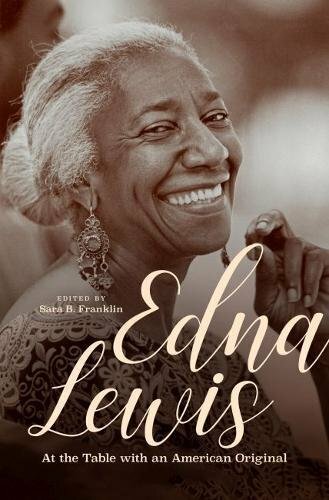
Along the continuum from past to present, through the generations, are two African-American women notable for their contributions to the food, nutrition, culture, and community narrative. One is chef, teacher, political activist, and author, Edna Lewis, (1916-2006). “Lewis cooked and Picture 1 of 1wrote as a means to explore her memories of childhood on a farm in Freetown, Virginia founded by her grandfather and other black families freed from slavery. Long before the natural-food movement gained popularity, Edna Lewis championed purity of ingredients, regional cuisine and farm-to-table eating.”
“She was a chef when female chefs–let alone African American female chefs working in restaurants–were few and far between. She authored what are considered some of America’s most resonant, lyrical and significant cookbooks” including The Taste of Country Cooking*, The Edna Lewis Cookbook*, and, In Pursuit of Flavor*. Bring Me Some Apples and I’ll Make You A Pie*, is a children’s book/cookbook about Ms. Lewis by Robbin Gourley; and, At the Table with an American Original*, is a collection of others’ essays about her life, edited by Sara B. Franklin.

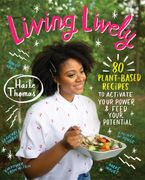
The other is Haile Thomas. At just 19 years of age, this remarkable young woman is a “youth health activist, vegan food and lifestyle influencer, cookbook author, speaker, founder/CEO of the nonprofit organization HAPPY-Healthy Active Positive Purposeful Youth, and a Wellness and Compassion Activist”. A Wellness and Compassion Activist–so needed. I will let her own words speak for her.

Questlove and Haile Thomas Bring Nutrition Activism to All Communities

Haile Thomas: The Happy Organization/Keynote Speaker–FoodTank

Haile Thomas: Living Lively: 80 Plant-Based Recipes to Activate Your Power and Feed Your Potential (due to be released end of July 2020)*

* Please check out these black-owned bookstores for purchase of any of these books: @marcus.books@esowonbooks@peoplegetreadybooks, and @unclebobbies.

Thank you for listening, sharing, following, and supporting my writing. Please subscribe in the sidebar to receive notice of new posts. Comments and greetings always welcome.

Be well. Take care. Stay safe. Let’s heal.

In health, Elyn

Related Posts: Morose Meals and Human Bites; Of Poverty and Light; A Cinderella Story; Love Is Love

Living Lively

Haile’s My Plate

My Plate Reflection-The American Stew of Privilege 

Every immigrant group could look down on them. There was always a bottom that you could be hostile to and that was useful in bringing the country together into the melting pot. What was the basis, the cauldron, the pot? Well, Black people were the pot. Everyone else was melted together, and American.

by Toni (Morrison)

Photo Credit: Grits and Collard Greens–Kim Daniels on Upsplash