Archives

peepin’ out

easter-2120601_640 (1)Right before Easter, word got through to me that Peeps would now be sold year-round. I can’t say if I was aware or not that Peeps, those brightly colored marshmallow bunnies and chicks, only appeared on the market for a relatively short period of time each year in order to celebrate the Resurrection, but apparently, this change was newsworthy.

Truth be told, I am really naive and poorly informed on certain things, like candy and religion. I have been confused for decades between Cabbage Patch Dolls and Sour Patch candies–I think that is what they are called. During nutritional consults, I confess that I have uttered the words, “Do you eat like Cabbage Patch Doll candies?” Not just randomly of course, but in the context of an assessment when I am trying to professionally interpret someone’s intake while sounding like I know what I am talking about.

Somewhere halfway between childhood and deciding to become a nutritionist, I managed to wean myself off of my predilection for sugar woven into various seductive forms. Maybe the end of my relationship with Peeps coincided with my commitment to a vegetarian diet. Eating anything with a face became more distasteful, even if it was just an adorable ball of fluff. I have managed to avoid the things for a long while except for a time where a co-worker enjoyed flaunting her love of them in front of me like the Adoration.

But, upon hearing the news that Peeps would be popping up in stores on a daily basis, I reacted like Puxatawny Phil seeing his shadow on that fateful Groundhog’s Day. Down into the burrow, I hastily fled. Just when I thought that maybe things were getting a little better regarding our capacity to ameliorate incoming incarnations of sugar, this information startled me. To soften the blinding light of blatant commercialism, I had no choice but to go into the dark place below.

By candlelight, I read the small print. Peeps are stewarded by the Just Born Company in Bethlehem, Pennsylvania. According to the website, the wonderful combination of sweet colored sugar and fluffy marshmallow creates an unforgettable taste experience. And, furthermore, it states a great candy isn’t made, it’s just born. Jesus! Don’t these guys realize how bunnies multiply and that chicks are no slackers either when it comes to population growth? I guess they do. Apparently, 5.5 million Peeps are born each day! OMG. See how!

This pronouncement of a seemingly immaculate conception in Bethlehem, rather than some sticky mess, presented a whole new ball of carnauba wax–one of the ingredients in Peeps along with sugar, corn syrup, gelatin, potassium sorbate, natural flavors and red 3, blue 1, yellow 6, or yellow 5 depending on the color. With 6.8 grams of sugar, each Peep is endowed with 1.5 (rounding down) teaspoons of essentially pure sugar–the kind that sends our bodies into metabolic-altering, insulin-demanding, fat-storing sugar shock. (Maybe best to use them to make amazing dioramas and Peep Shows.)

Eventually, In my quest to find out more about this situation, I was forced back above ground. Donning sunglasses, my research led me to my local national chain drug store where I made a few laps around the multi-aisle candy section disguised as a normal sugar craving person. I was forced to blow my cover by asking the clerk where the Peeps were. She reacted as if I must be from another planet. I did not bother to defend my citizenship as an earthling and neither did I explain the whole groundhog thing. But I did say my query had a scientific purpose–or something like that. Obviously, Peeps were not to be found after Easter. I was six weeks too late.

But, I said, I thought they were available all year now, in a widening array of flavors. She had not gotten that memo. She instructed me to go to the company website if I wanted more information. I thought that was funny. She did add though that this year she had gotten her little daughter some watermelon ones, so maybe I was right. I  stiffened like a stale Peep.

Like Catcher in the Rye’s Holden Caulfield who deemed himself the protector of childhood innocence, perhaps I take my influence as a nutritionist of the people and for the people a bit too seriously. In my head, I am charged on a daily basis to personally obliterate obesity, or on a larger scale to clean up this whole nutritional mess and its adherent ills. I liked the care and assistance the drug store clerk had given me despite her initial recoil, and now by association, I cared about her daughter. Could I not issue a global recall of these wolves in chicks’ clothing candies due to salmonella poisoning, avian flu or something to save the children? My usual quandary about how to reconcile the intentions of capitalist markets and the public health smacked me in the face along with another more subtle underlying dilemma–who am I to take sugar from a baby? Don’t they need some sweetness in this cruel harsh world?

Well, I figured it was time to move back up. As by now spring had finally arrived in these parts after the long, extended rodent-predicted winter, I decided it should be safe to step back into the sunlight. Besides, another holiday was upon us– Memorial Day. This one, should actually quell our insatiable appetites, right? But, alas, like Holden, I was once again in for some surprises.

A little weekend travel led me into a highway rest stop convenience store. There, upon the laden Frito-Lay chip rack, I noticed two different generic bags labeled, Doritos Jacked–Test Flavors 404 and 2658. Jesus. I am not positive, but I think the deal is that if you buy a bag you get to let someone know how jacked you were. Have you ever encountered such a thing?

The ingredients list was complete with all of the usual suspects that entice and entwine us. I had a sudden urge to barricade the rack to prevent the innocents from getting their hands on these hyperactivity-inducing substances. But, then I thought, hey, don’t those good folk down there at Frito-Lay and PepsiCo deserve to make a little profit? Just look at all those flavor scientists they are providing work for. And, aren’t our kids maybe just a little too mellow? Besides, I have read the Frito-Lay Promise (link no longer available). Apparently, I can relax, it is all good. And, soon, kiddos are going to be able to make their own snacks on 3-D Printers anyways. Yikes.

Thank you for listening, sharing, following and supporting my writing. Please subscribe in the sidebar to receive notice of new posts. Comments and greetings always welcome.

In health, Elyn

Related Post: Wings of Desire

Related Recipe: 5-Minute Carrot Truffles (bunny approved)

(Update 2018: And, oh my goodness, it looks like there is some trouble down on the peeps farm regarding the Just Born Company’s employee pension plan.)

(Update 2020: This just in! Hot Tamale Peeps. No comment.)

IMG_0612 Emma’s My Plate

My Plate Haiku

The farmers’ market

Each egg at the dairy stand

A different color.

by Enki


post halloween post

Well, I have made it through another scary Halloween. As I once described in The Nightmare Before Halloween, that is a holiday that certainly sends shivers down this nutritionist’s spine. All in all, things went well despite not having a pumpkin. Well, yes, I did wait to nearly the last minute, but still, it was surprising that there did not seem to be a pumpkin to be had. The nice lady at one pumpkin place told me it was a bad year for pumpkins. That might explain it. So, I got a hubbard squash instead for my homey display. They are actually more frightening looking than pumpkins anyway–so I may be on to a new trend. It may fill in as my Thanksgiving vegetarian turkey as well–and with good reason besides just kind of looking a little like a turkey. Check out the wonderful benefits of this curious curcubita as nicely compiled by “The World’s Healthiest Foods”.

One must remember that thrilling the kiddies is big in my Halloween obsessed village. So, with my hubbard squash and my new decoration this year which was a strand of felted witches hats that I looped above my front door, I was prepared to keep up with my next-door neighbors, “the Joneses”. (Go to caption link.)

Oh yeah, and then there was that perpetual pesky candy problem. I teased my always healthy, still naive young mother friend that this year we were doing Trick or Kale. She approved. But, while she baked up some nice little low-sugar treat squares and packaged them individually, warning kids that her offerings were not going to induce a diabetic coma, I was reduced again to the dissemination of some chocolate. Trying to minimize the collective damage, my designated door answerers were strongly instructed in “No Picksies!” This meant no one gets to just put their hand in the cauldron and take what they want. I reminded my daughter who came home for the evening, “They just get one kiss.”

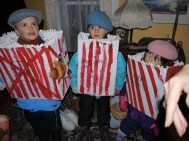
But, along with that little morsel, all the goblins, ninjas, princesses, jellyfish (yeah, that was a really creative costume) also got a cool Eat Your Fruits and Vegetable themed sticker. Yes, really. And, really, they were a big hit–all except for one four-year-old who while walking away turned around and offered back his sticker. Not a bad rate of return given the scads of revelers of various ages ringing the bell. Two kids came to the door dressed in big cardboard boxes portraying Fruit Drink cartons. The nutritional information was all nicely handwritten along their sides. “OOOH! Scary!”, I commented, noticing the High Fructose Corn Syrup listed and gave them extra stickers.

But, as all things must eventually do, the hyperchaotic night came to an end. In the morning, the sun rose again, candy became scarce and all the children and adults were once more deprived. No, that’s not true.  In the morning, the sun rose again, and it was Pete’s birthday, and then when it rose two more times it was my blog’s birthday!

Yes, my blog is now three years old. When it turned one, I celebrated in Dear You, The Readers that my little baby blog had become a bloggler–that is a toddler in blog terminology. And, now, it is a three-year-old bloggler. It is now old enough to take on its social media contemporary, Honest Toddler with whom there are some bones to pick. Honest Toddler, that precocious child who has hijacked its mother’s computer, still has a lot to learn about nutrition. (Update: Honest Toddler’s Twitter Account has been taken away by their mother.)

While it boasted about its advanced candy procuring skills on Halloween and advocated saying Twick or Tweet instead of pronouncing the Rs as a strategy to increase one’s loot, it did quietly admit that it got scared and did a small pee-pee. While it asserts in its Twitter profile “Not Potty Trained. Not Trying.” my little bloggler is fully responsible for what it puts out and is light years ahead of it in regard to culinary sophistication.

For example, Honest Toddler publicly whined that “Arugula tastes like soap and fire had a baby”. Clearly, it does not know that this lovely oak leaf-shaped green is related to the Cruciferous family. It is chock full of sulforaphane, glucosinolates, and chlorophyll with many benefits to live for. That candy-seeking, trans-fat cracker munching child might want to start thinking about things like the prevention of macular degeneration and cancer. My smart for its age bloggler kindly suggests it start with baby arugula and recommends the kitchn’s versatile uses.

But, while there may be some definite differences between these two, they do have one toddler bearing trait in common–they LOVE attention. So, if you can, send some blog love in a blog-like way. It takes a village to raise a blog. My bloggler says, “Tank wu.”

Now just awaiting the next dietary kerfuffle–Thanksgivukkuh.

In health, Elyn

Related Posts: Nightmare Before Halloween, The Eye of the Newt, So How’d It Go

Manon & Michael’s My Plate


My Plate Koan

When someone goes

from cutting your grapes into fourths to cutting them in halves

Do they trust you more or love you less? by Honest Toddler


confluence

This is about confluence–where different streams of my life all flowed together in one special day–today. To start with, it is my birthday. And, twenty-five years ago today, my first child, Morgan, was born and I had my first experience of nursing a baby. Giving birth on my birthday was pretty special, and a big enough confluence in itself, one which was only considered at about 7 pm the evening before, after returning home from seeing the movie, “A Fish Called Wanda” and realizing I was in labor.

But there is more. Today is also part of World Breastfeeding Week which is celebrated during the first week of August. As a nutritionist concerned with the feeding of the species and maternal and child health issues, I do like to honor the week and spend time advocating and educating about breastfeeding in my work. I like that my birthday and nursing day coincide with this annual event. This year, I am using some of the well-produced materials from the U.S. Department of Health and Human Services Office on Women’s Health’s It’s Only Natural campaign as part of my activities at the Health Center and I am continuing to address it as I have done in my previous writings.

imagejpeg_3 (1)

World Breastfeeding Week Display

Also today, Pete and I are in Seneca Falls, New York for Empire Farm Days, the largest agricultural trade show in the Northeast. This show has also taken place during these same dog days of summer for the past eighty years. It is a nice birthday gift to be in the midst of these many farmers whose business it is to grow and raise amazing foodstuff for the masses and for me to have a chance to more fully appreciate their concerns. Food off the farm has a very abstract quality, quite remote from its actual origins. But, being at this show, one can see that farming matters such as soil health, pest management, plant hardiness, marketing and the raising of animals are quite real.

imagejpeg_2 (9)

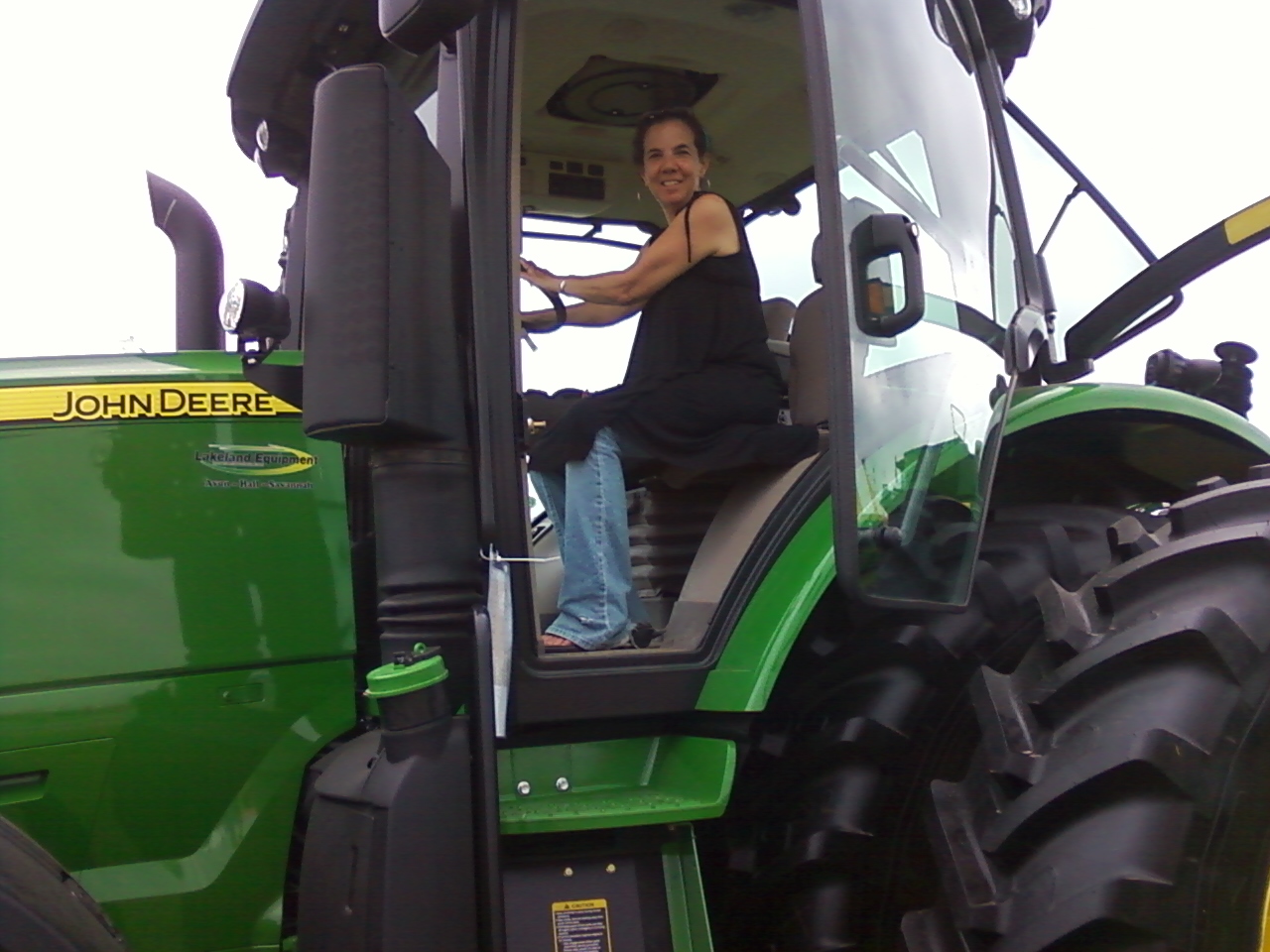
Yep, me driving the big tractor. Empire Farm Days

As today unfolded, it was no surprise to find my alma mater, Cornell University, with a large presence here. Both Cornell and Seneca Falls sit upon the shores of Cayuga Lake, and Cornell’s College of Agriculture and Life Sciences plays a large role in the state’s agricultural initiatives. My nutrition studies took place inches from the ‘Ag School’. I walked miles through its vast acreage, bought college-made ice cream at its Dairy Barn, spent hours studying in its Mann Library, barely survived its microbiology course– and, it was where I met Pete.

The Cornell exhibit was displaying a video called Birth on the Farm. Starting with birds, it shows bluebird babies hatching from their eggs, barn swallows being fed by their parents, and then it moves on to mammals. A sheep, a horse, a dog, and a cow give birth, each baby emerging with amniotic sac intact. Once licked clean by their mama–with a little help from the farmer–these newborns quickly find their way to the nipple or utter and begin to feed.

Witnessing the wildly innate behavior of the mother/infant nursing dyad in the animal world heightened my wonder about how that behavior has become so disrupted among humans. Human babies, like their mammalian cohort, will find their way to the breast as well, when placed on their mama’s tummies. I just finished a research project on breastfeeding, scratching my perpetual itch to understand the modern-day hindrances to feed our infants in the biologically prescribed way that has sustained humanity for millennia. How has something that a puppy can figure out within minutes of birth become something that is culturally perceived as more difficult than rocket science and as contentious as climate change? How has the concept of species-specific milk become so foreign?

I put those questions aside in order to make sure I had time to head over to the nearby Women’s Rights National Park and Museum and Women’s Hall of Fame. This was the icing on my birthday cake. The exhibits are awe-inspiring and provide a really deep appreciation of how arduous the fight for women’s rights has been. Immersed in this incredible history, I picked up my previous thoughts again and mused over the sometimes expressed contention that breastfeeding further chains women to their domestic duties and inhibits their participation in the workplace and in the larger society where they may wish or need to be. Walking in the footsteps of these courageous women bolstered by my feeling that this argument misses the point. It is not breastfeeding, but instead, the lack of mandated maternity leaves, workplace supports and other inequalities in this country that are prohibitive. The exhibits themselves provided some proof.

For example, Norway, the country with the highest breastfeeding rates in the world, also leads in regard to the number of women in parliamentary positions. And this year, Ina May Gaskin is being inducted into the Women’s Hall of Fame. Ina May is the modern “mother of authentic midwifery”. Though midwives had assisted with childbirth since ancient times, their role had been essentially obliterated with the professionalization of male-dominated obstetrics in the early twentieth century. Her efforts sparked a revolutionary movement which not only opened the way for the re-emergence and popularization of midwifery-guided and women-empowered birth but also contributed to the re-establishment of some breastfeeding practice in this country. Interestingly, Ina May perfected her motherly arts at a commune community called The Farm, and her grandmother was an avid admirer of Elizabeth Cady Stanton and the suffragettes.

imagejpeg_2 (11)

Declaration of Sentiments Seneca Falls Women’s Convention 1848

At the end of the afternoon, Pete rejoined me and we went for dinner. A nice end to a very special day. As we sat at the restaurant overlooking the water where the Cayuga-Seneca Canal flows into Seneca Lake, I thought about how my day all flowed together–birthday, college, nutritional work, food and farming, women’s rights, birth, and breastfeeding. All pretty big themes in my life.

Considering this confluence, I contemplated its meaning. Could it be, that if when enough babies are born welcomed and sustained by the mother’s touch, natural nipple, and warm nutritionally complete milk; when women’s capacity to nurture and nourish is deeply valued and protected; and, when our farmers are supported to grow healthy food and to protect the land–that the world may be a safer, healthier and softer place? I hope someday.

Please, let me know what you think and do send greetings! Happy Birthday, Morgan. Love, Mom.

In health, Elyn

My Plate

My Plate

My Plate Haiku

When, in the course of human events, it becomes necessary for one portion of the family of man to assume among the people of the earth a position different from that which they have hitherto occupied, but one to which the laws of nature and of nature’s God entitle them, a decent respect to the opinions of mankind requires that they should declare the causes that impel them to such a course. by Elizabeth Cady Stanton, et. al.


michelle, my first lady

Dear Michelle,

I have been worried about your husband Barack’s eating habits. From following him on the campaign trail during these very arduous times, it seems that news items abound about him chowing down on ribs, chili dogs, pizza and pastries. Yes, I know that he needs to go meet and greet his constituents and that he is eager to support small business owners around the country. This does mean that he must go and find where the people gather–and that is often in settings that involve the communal act of the serving and eating of food.

I deeply appreciate that he is of the people and can get down and chow down with the common folk. I also know he is a very generous guy and stories have reported that he is sometimes buying goodies to bring back to his hard-cranking campaign workers or public servants in the numerous locations where he has touched down.

Michelle Obama - white house kitchen garden

Michelle Obama’s White House Garden


I do not mean to undermine his profound need for nourishment to keep him going, but it seems that a lot of yellow and red light foods are speeding their way down his own gullet–with obvious gusto–and with no traffic infractions being incurred. Just for those of my readers who don’t live in the world of nutrition education, the traffic light metaphor refers to a system of identifying foods as either green, yellow or red light signifying always, sometimes or rarely ever to be eaten.

I am reminded that when Barack’s friend and mentor, former President Bill Clinton was in office, his legendary appetites were the subject of much attention and downright mockery. I remember hearing he lusted for Philly Cheese Steaks. So, why are your husband’s eating habits not garnering the same scrutiny? Unfortunately, unlike pudgy Bill, it is because he is thin–actually, it is worse than that. He is skinny. I say, unfortunately, because being skinny can sneak up and bite ya. I imagine it must have been a bit disconcerting for you when that burly pizza parlor owner, came right over and just picked poor Barack right up off the ground with that big bear hug.

With all the attention on obesity, we forget that the non-obese can suffer health consequences as well and are equally vulnerable to the effects of poor diet, smoking and stress–which I know are issues your husband contends with. These can be more detrimental than just extra pounds alone. I think I heard that he has quit smoking–so that is good.

I will assume that when at home, our dear President consumes lots of White House grown organic vegetables, and grass-fed, hormone-free animal products prepared by some of the best chefs in the land. And, that he plays basketball and does other activities to stay fit. Hopefully, he also has a team of massage therapists and other holistically-oriented practitioners to assist with his well-being. Maybe he just eats these ‘red light ‘ foods when he is on the road–like kids who go crazy for sweets at other people’s homes when such foods are forbidden in their own.

Believe you me, I do know that it is impossible to control our husbands’ behaviors. Here I am a nutritionist, and my own hubby has quite the pedestrian sweet tooth. No amount of my homemade kale chips can keep him from occasionally going out and finding a bag of Cheeze Doodles and the perfect dish of ice cream. I bet Hilary knows what I mean. Still, I am wondering, if given your highly touted platform and efforts regarding the urgency of improving nutritional status and decreasing the burden of illness on our nation, whether Barack could and should be modeling more healthful eating behaviors.

I was troubled by a story I heard on the radio just last week. NPR reported on what Obama and Romney were doing to sustain their non-stop high-energy requirements on the final leg of the campaign. This was right before Hurricane Sandy changed the agenda. They interviewed some campaign assistant who started out by saying that when Barack got off the plane that morning, he headed right over to get some Krispy Kreme doughnuts. You probably don’t know that I have a little, shall we say, vendetta against Krispy Kreme, so you may want to read my posts, Kicking Butt with Krispy Kreme and Magic Doughnuts–The Nutritionist’s Nemesis. So, upon hearing that, I was all ears.

It got worse. I was shocked to then hear Barack himself saying something to the effect that all that nutrition stuff is your thing, but he doesn’t care. It is an election year and the White House will be giving out lots of candy for Halloween. My, I don’t know how you felt about that, but I was disappointed to hear such an off the cuff remark that indicated to me a disregard of the real importance of proper nutrition in improving the health of our citizenry.

To really turn the tide on the dire consequences attributable to the Standard American Diet  (SAD) will take more than lip service. It will take courage to exhibit true leadership in this matter–and leading by example. Sugary sweets are not a substitute for the relief this electorate truly seeks, and perpetuating good-natured excuses and exceptions for our food behaviors will not reduce our massive health costs and its drain on our economy. That quick sugary fix will ultimately lead to a massive crash in mood and energy.

Never you mind. Your husband still has my vote. Yet, I am writing this with trepidation as the election is still a few days away. I do wish for him to have four more years–healthy years– in office. I hope it will not take a quadruple bypass surgery for him to appreciate and attend to the benefits of a healthful and vegan diet as it did his friend Bill. It would have been nice if while stumping in North Carolina he had stopped in at that wonderful restaurant, The Laughing Seed Cafe that I mentioned in Forks on the Road.

Though Barack might not need them, the future of health care, Medicare and Social Security are seriously on the line right now–and we need him to make sure that those programs are there for those of us who will. Perhaps too, with a second term, he can work to integrate some more holistic preventive health measures into Health Care reform. Please, keep up your good work and see if you can get Barack to eat his beets. I read that he does not like them. Do let him know that betalain-rich beets are blessed with many health benefits. Great for the cardiovascular system and the lowering of high blood pressure. And, that makes those beautiful red gems a nice little aphrodisiac food too–wink wink

Thank you for listening, sharing, following and supporting my writing. Please subscribe in the sidebar to receive notice of new posts. Comments and greetings always welcome.

Respectfully,

In health, Elyn

P.S. Congratulations on your beautiful new book, American Grown, The Story of the White House Kitchen Garden and Gardens Across America.

Related Recipe: Minted Spring Pea Salad from American Grown courtesy of Eating Well Magazine

American Grown (Michelle Obama book).jpg

Michelle’s My Plate

My Plate Grace

We hope we live long and strong.

by Obama Family

just today

Just today, I got an email informing me that the way to eat carbohydrates more efficiently and prevent the insulin resistance associated with diabetes is to take Cinnamomum Burmannii, Berberine, Pterocarpus Marsupium, 4-hydroxy isoleucine, #5 – R-Alpha Lipoic Acid (R-ALA). These substances are available in combination in pill form. Well, that sounds nice and easy, I thought. Now just how could I obtain some of these little Burmanniis and Marsupiums for all of the inefficiently carbohydrate-eating, diabetes-prone poor folk. I wished nutritional supplements were available to my clients. I’d settle for some R-Alpha Lipoic Acid.  IMG_3170

Just today, I did not attend the bariatric conference that I went to last year and described in How Can You Say No to a Brownie.  Therefore, I missed the session on Diet Strategies: Which work and which don’t. I guess I will have to wait, along with the rest of the world, on that breaking news.

Just today, I culled through the medical records of a number of clients at the Health Center, collecting data for a project I am working on. Medical records are literature. They contain the stories of lives weathered by poverty documented by scads of lab results, vitals, hospital discharge papers and consult notes. Lives marked by the chronic health problems of diabetes, hypertension, pain, extreme weight, and hospitalizations. Conditions tended to by a boatload of pharmaceuticals, prescribed in an oft crapshoot manner.

Just today, I missed the webinar I had registered for with Renegade Chef Ann Cooper. Without an ounce of rocket science, she is feeding kids healthy foods in schools. I was disappointed. This would have brought some hope and inspiration.

Just today, I received an e-health report from the American Academy for the Advancement of Science describing that 50% of people with hypertension do not have it controlled. I thought about all the records I had just pored over. Most of those with uncontrolled hypertension are on one to three hypertensive medications.

Just today, I wished again–this time for stress reduction programs for my clients. I left my office near tears. I dreamed about a new line of work.

Just today, on my way home, I heard a news story that the US Army had declared a service-wide stand down to bring attention to the problem of suicide in the military. Army bases around the world were shut down for mandatory suicide prevention training.

Just today, I took a walk. I thought about processed food. I use tweezers to extricate it from my clients’ lives though I could use something a bit stronger–like a Jaws of Life. I wondered about a stand-down calling for a moratorium on the low-quality foodstuffs that glut our food supply. I decided that we need a National Day of Nurturing and Nourishment.

Just today, my amazing, earth-moving niece Shanti shared some stories about the beautiful and remarkable greening, gardening, and food work she does with the Clinton Housing Development Company and Cultivate HKNY in the midst of New York City.

Just today, going to pick up my daughter from crew practice, I drove along a quiet road with the sun setting spectacularly on one side while the harvest moon rose beautifully over the other. Arriving home, I read the team’s paperwork asking me to sell David’s Cheesecakes, Grandma’s Pies and cookie dough for a fundraiser. My heart sank. My inability to broker in sugar will cost me some bucks as I will have to choose the buyout.

Just today, I wrote this blog. As I was calling it a day, an old friend posted information about an organization doing wonderful work. I was glad to learn about One.org which is working with women to address childhood malnutrition and putting nutrition on the global agenda.

Just tonight, I shut out the light, deciding I would do a new little campaign at the Health Center. I will call it One Day One Way encouraging people to take back their own health. By the light of the moon, I wished you all good night.

Thank you for listening, sharing, following and supporting my writing. Please subscribe in the sidebar to receive notice of new posts. Comments and greetings always welcome.

In health, Elyn

my plate

My Plate Haiku

If only we could
Change the world on that one day
By feeding our hearts .

by Julie

a bushel and a peck of ways to address childhood obesity

It seems that we spend a lot of time fixing things that should not have ever become so broken. Not only time is wasted but a lot of resources– that seem to be rather scarce these days.

As this relates to the care and feeding on the physical, emotional and spiritual levels of human beings, we certainly have been drawn off course. Some significant digressions from what should have been a rather intuitive matter or a natural symbiotic relationship with the natural and nurturing environment have occurred.

Healthy Children

Healthy Children (Photo credit: Korean Resource Center 민족학교) drawing by 13 yo Suzy An, Irvine, California

Though early humans expended much of their energy trying to procure food for survival, they still seemed to have had time for other endeavors as well–like discovering fire, inventing the wheel and designing clothes. Nomadic cultures certainly had to find to go or take out food solutions. One would think that at this stage of the game, we too should be able to both nourish and progress.

Listening to the persistent conversation about the problem of obesity one might think evolution-wise we were still inventing the wheel. The top experts in the field are engaged in the mandate to ferret out the problem and find solutions, huge research projects are undertaken, big monies are allocated, programs are created, public health campaigns are rampant. The hunt is on and it has been going on for decades. This time its pursuit is not roaming bison or wild turkey but the reclaiming of our natural homo sapien form and functioning. So far, we seem to have only snagged the primordial beast of ‘eat less and exercise more’.

I wonder if this all has to be so difficult. Where and how did we stray so far off course? How did we allow the school food situation to get so bad? Other nations with way fewer resources have maintained a large degree of nutritional integrity, even if in the form of some hearty gruel. Jamie Oliver, a simple lad from England, has managed to bring nourishing food into kids’ cafeterias.

Today, sadly aware that September is Childhood Obesity Awareness Month, I venture into the childhood obesity debacle to suggest that maybe we can shift the focus, listen to our inherent wisdom, reclaim our cultural connectedness and tweak the approach, to save some of the expended resources that we are currently draining. I know these are complicated matters but perhaps there really are more holistic solutions.

Here are some possibilities:

ð  Legislate paid maternity leave of a valuable length. The United States is one of only three countries in the world that do not offer paid maternity leave. The other two are Swaziland and Papua New Guinea. Most countries provide paid leave of between 14-22 weeks. Norway allows 44 weeks, while Canada allows 50. Mothers here who do get to stay home for a meager six weeks after the birth of their babies generally are those whose jobs provide disability insurance. Wow. What a warped difference in consciousness. maternity leave comparison

ð Implement more generous, equitable and flexible time-off policies. Without time for parents to establish healthy routines, many important aspects related to family and child health are neglected. Additionally, one cannot even begin to discuss weight matters without acknowledging the role of stress on our eating and metabolism.

ð Promote and normalize breastfeeding. It is important to understand the nutritional, metabolic, digestive, and immune implications of replacing human breastmilk with artificially manufactured milk substitutes. Updated 2020: Infant Feeding History Revised

ð  Revisit infant feeding recommendations. Our early feeding practices rely on the introduction of cow milk and soy-based proteins, processed grain cereals and juices as babies’ first foods. Infant feeding recommendations promulgated by physicians professionally under-educated on nutritional matters and baby food manufacturers seem almost sacrosanct in our society. Decades-long infant feeding guidelines are based on often misguided attempts to compensate for and mitigate the negative effects of depriving infants of species-specific breastmilk. The digestive imprinting and physiological adaptations to our first foods provide important clues as to children’s feeding inclinations. Ignoring this stage is short-sighted.

Update 2020: Somehow I missed the memo. While I had known the American Academy of Pediatrics had through the years strengthened their stance on promoting breastmilk as babies’ first food, I did not realize that in 2017 they updated their 2008 guidelines on starting solid foods. Notable changes are recommendations for extended breastfeeding, no juice during the first year, and an increased variety of introductory solid foods instead of just iron-fortified cereals. First foods to give your baby.

ð  Appropriately nurture children’s developing food palates–like other food-conscious cultures do). This means we should not be catering to children’s unformed palates. Doing so dwarfs the development required to appreciate more sophisticated and healthier foods, tastes and textures. Overexposing children early to an onslaught of sweet and chemically-produced tastes inhibits acceptance of the wide variety of foods required for a balanced diet and predisposes them to serious health problems. How the french feed their children;

ð   Stop advertising and marketing food to children. Over thirty-five years ago, Michael Jacobson of the Center for Science in the Public Interest and Action for Children’s Television petitioned the Federal Trade Commission (FTC) to restrict advertising aimed at children–in large part due to its effects on children’s dietary preferences and intake. The FTC agreed that such practices were inappropriate. However, the food, toy, and advertising industries pushed back and unfortunately pressured Congress to halt taking action. Today, 17 to 20 billion dollars are spent annually on the marketing of non-nutrient foods to children.

ð Remove unsavory ingredients from the food system. While our FDA continues to hold to its stance that artificial food dyes and preservatives in our food are safe, other countries have begun to take progressive action to remove these substances from their products–even those made by American manufacturers–for the sake of their young citizens.

ð  Redesign supermarket and drug store layouts so that they do not cater to 4- year-olds’ sensibilities. Next time you shop, pay attention to how many cartoon character endorsed products are populating the food aisles, especially at the eye-catching “end caps” and checkout counters.

ð  Direct adequate funding to school meal programs. School lunch in Japan.

ð  Respect recess. Put it back in the schools if it has been taken away. Provide it daily and preferably before lunch. Children innately know how to move. We just have to ensure that they have the appropriate time and space to do so.

ð  Integrate relaxation/yoga/resilience training and cooking/gardening/movement curriculum at all grade levels.  

ð  Protect farmers and subsidize fruits and vegetables.

Well, using agricultural measurement, I think that is enough for now. If we truly and intelligently wish to address this matter–and to heal what should have never become so broken–we have to restore the capacity of those best equipped to nourish and protect our children–the parents, farmers, cooks, teachers and schools. And yes, it may require the funding, creation, and implementation of policies on a larger-scale which will facilitate that as a nation we are prepared to do so.

May we love our children a bushel and a peck.

Thank you for listening, sharing, following and supporting my writing. Please subscribe in the sidebar to receive notice of new posts. Comments and greetings always welcome.

In health, with a hug around the neck, Elyn

Related Posts: Childhood Awareness Month Obesity; The Humanist Imperative to Nourish and Care for Our Children


My Plate Haiku

Smooth peanut butter

Spread on a peeled banana

Snack time perfection. by Gretchen

oh mother

I was hoping not to have to work today. It is Sunday and I promised myself a little repose. So there I was actually lounging on the couch this morning when the news of New York City Mayor Michael Bloomberg’s announcement of the New York City Health Department’s Latch on NYC breastfeeding initiative filtered into my airspace from an NPR podcast.

breastfeeding

breastfeeding (Photo credit: sdminor81)

Clearly, the launch of this voluntary program for New York City’s hospitals was timed to coincide with World Breastfeeding Week. The story started off nicely enough with a rational presentation of the benefits of breastfeeding and informed that 27 out of 40 New York City hospitals have already signed on to the recommended policy. But, it then whacked me with a tirade of the backlash (and responses) to the initiative–bemoaning that women do not want to have their parenting decisions enforced, especially by a man–and specifically not by health policy promoting Mayor Michael Bloomberg.

I rolled over and groaned into the cushions. My hopes for a relaxing day were shattered. I intended to glue my attention to the Olympics–one of the rare times I surrender to watching TV– but this report was going to interfere. Having discussed the topic of breastfeeding previously, I had no choice but to respond to this in a timely manner. Water polo and volleyball could wait, but this must be addressed before track and field and gymnastics takes to the screen.

In brief, Mayor Bloomberg did not make up these policies, and in fact, they are not mandated. These are recommendations consistent with the guidelines of the Baby-Friendly Hospital Initiative. Other larger jurisdictions have already implemented these policies. The intention is not to take choice away from women or to impound life-giving nourishment. It will not send women back into the kitchen chained to the stove with babes pulling on the teat as some editorials that I read implied.

Instead, it is a long-overdue remediation of a situation that separated the human species from their species-specific milk and compromised in both subtle and profound ways the health of many moms and babes. The superiority of human milk, as compared to artificial milk or formula, for human babies is not disputed and its immuno-protective properties are well established. There are many other benefits as well of mother’s milk as a substance and breastfeeding as a method.

What is not as well-known is that formula companies have participated in the disruption of this mother and child feeding relationship for many years and that this has promoted a cultural ignorance about the benefits of breast milk and a communal lack of wisdom regarding supporting women in this most natural of human behaviors. Big corporations have been the beneficiaries of immeasurable profits by influencing infant feeding using extreme measures by literally getting invited right into the hospital.

Pregnant women are wooed with coupons, samples, and free merchandise. New moms are given goodie bags with loyalty promoting formula brands. What formula a baby is started on has nothing to do with the baby or the doctor, but by whatever company got their hands on those tiny sucking lips first. Where else does this marketing intrusion occur so blatantly in matters related to health?

Women’s efforts to nurse have been sabotaged in hospitals for decades by babies being given sugar-water or formula without consent. Birth attendants including doctors and nurses not educated in lactation have also impeded the mother’s success at nursing. The result is a society that for decades has been led to believe that nursing is difficult, inconvenient and an impediment to maternal freedom. What has created barriers for mothers choosing to nurse is not nursing, but a lack of education, limited support, pathetic maternity leave policies, lack of comfortable places for nursing and pumping and a prudish culture that has turned to feed at the breast into a lascivious act aggravated by laws that even make nursing in public illegal in some places.

If you wish to discuss enslaving factors as regards women’s choices, this is what people should be concerned with–not the new policies. Of course, there will be some situations where babies will require formula, and there will be women who will choose formula feeding for a multitude of reasons. But, I am pretty sure the locked cabinet that the policy suggests will not be in the hospital basement by the janitors’ supplies and that women won’t be found dragging their IV poles down the hall in desperate search of a contraband formula to sate their starving babies. And, I strongly doubt that nursing staff will be utilizing methods of intimidation to enforce breastfeeding.

This is just an opportunity to fully educate and inform and to take the profits out of our babies’ bellies. It is one of a long series of efforts by many health care professionals to enhance the health of women and children in both the short and long-term. This is not rocket science nor is it evidence of a nanny state. If we as mothers have to choose our battles–this is not the one to wage.

Thank you for listening, sharing, following and supporting my writing. Please subscribe in the sidebar to receive notice of new posts. Comments and greetings always welcome.

In health, Elyn

Related Posts: Blessed Feeding; To She Who Loves Us; A Winning Goal; Breastfeeding Redux

photo (3)

Cathy’s My Plate

My Plate Haiku

Blueberry bushes

Three children with empty pails

Pluck, pluck, crunch, exhale.

by Michael

private health

My dilemma was really excited. We hadn’t been to a conference in a while. Usually, I try to keep my nutritional dilemma quiet and out of sight. But, last week as I was heading to a meeting of the New York State Public Health Association I figured nothing would be too controversial, so I relaxed my grip on it a bit as we headed out. It was an unusually warm morning and as I rolled down the car windows, my dilemma, riding shotgun, stuck its head out into the fresh air, giddily taking in all the sights and smells like a golden retriever.

golden retriever

We arrived at the hotel, easily found a parking space and the right room, and settled in. I applauded the availability of Tazo Tea and forgave the choice of bad white bagels. I knew there was some consciousness on the part of the Association to be mindful of the food so I appreciated that there was an alternative to the usual sugar-laden breakfast pastries.

The title of the conference was “Transforming Communities through Public Health Practice”.  The keynote speaker was  Michelle Davis, Deputy Regional Health Administrator for the  US Department of Health and Human Services.

As I sat through the morning, I checked the program to remind myself of the focus of the day and why I had chosen to apply my limited continuing education benefits here. Though I mainly do my nutrition and health thing privately within the confines of my small offices, working with one member of the public at a time, I also try to promote health messages to a larger audience as well. I practice what I term stealth health–introducing information or programs that enhance well-being in both supportive and unsuspecting ways. Here was an opportunity to listen and learn from others who are out there doing community transformation. This is what motivated my choice–to be with my peeps–like-minded people doing great things in this arena.

As an attendee I learned of the new goals of the Healthy People 2020 initiative; I heard about some worthy activities happening on the local scene; and, I sat in on an interesting session that reviewed a relatively well-funded menu labeling education campaign that encouraged consumers to choose fast food meals containing 600 calories or less. The initial results were apparently somewhat disappointing though the evaluation data was limited. The research ironically showed that those who did not receive the message curtailed calories more than those who did.

I thought I had my dilemma well-leashed, but in retrospect, I realize it was already starting to whimper and whine. However, it was not until I attended the first session of the afternoon, “Development and Implementation of  Formal Policies and/or Local Legislation to Increase the Availability of Non-Sugar Sweetened Beverages in Public Buildings: Reports from the Field” that its bark became disruptively loud. The session was facilitated by two women who had overseen a project of the NY State Association of County Health officials wherein monies and other resources were allocated to a handful of county health departments to assist their county governments in achieving this goal.

They effectively reviewed how the different counties applied their efforts–which really were intended to decrease the availability of sugar-sweetened beverages (SSBs). They described media campaigns, seltzer water promotion activities, revenue concerns, working with government officials from the top down and with procurement managers from the bottom up. They discussed vending contracts and how these are virtually impossible to change until the contract runs out. They explained the challenges, push back and resistance that each county encountered and the small changes that were made. This was an absolutely positive action, but it required that they had to play nice politics with these good public dollars.

I suppose I know this is how the process works but the cumulative view of the public health community working so hard for such small gains–even in the public sector–turned my dilemma rabid. It circled wildly, foamed at the mouth and even raised its hand and expressed its opinion. To calm it back down, I had to go get it a fruit kabob at the next break.

Who do we still have to convince at this stage of the game that vending machine revenues will not outpace health care spending? Who do I need to invite into my office to hear the daily stories of health compromised by tepid health care policies and timid action? How many cases of people addicted to Mountain Dew, Pepsi, and other such SSBs must I detail as evidence to show how they suffer from rotted teeth that cannot be repaired; ravaged digestive systems bandaged with a plethora of damaging antacid medications; excessive weight that has literally brought them to their knees; anxiety propelled by excessive caffeine; and, destroyed glucose control that relegates them to a life with diabetes? Is it not tragic how many are children and young adults are already affected?

I always say that if I was the ruler of the food planet, I would remove sodas immediately. There is a heavy toll on health from such irresponsibly marketed products available for consumption with the clink of just a few coins in most public places–not only here but around the globe. And, though soda addiction knows no boundaries, as usual, the economically poor, are disproportionately affected. Recently, a client of mine told me that the school bus company that he works for removed soda vending from the employee break room. Cannot our own government agencies venture such a commitment? Bearing such witness, I am perforce required to display the amount of sugar in various SSB bottles wherever I may be. Right now in the lobby of the health center, I have such a display with associated handouts. People truly gasp when they see the load of sugary stuff that otherwise stays dissolved in the highly acidic medium.

This week, just a few days after the episode at the hotel, a fifteen-year-old boy who has lived a large part of his life in a home for troubled youth was brought to see me–ostensibly for his high weight problems. He was accompanied by a case manager–and another boy who came along. We had a pretty good chat and among other things, we talked about his soda drinking. I told him I really felt sodas were toxic substances that deserved some type of poison label. He asked me if I had a Sharpie. I said, of course, dug it out for him–and he drew me a page full of well-executed skulls and crossbones. I thanked him profusely for his contribution to my crusade. Who knows, perhaps through this experience of participation, he will become a stealth health advocate. When we were done, I gave him and his little buddy two water bottles that I had actually picked up at the conference.

Afterward, I realized my dilemma had been watching the whole encounter from under my desk. It pawed at me and looked me squarely in the eye. It bemoaned that private health is truly a deeply public health matter and vice-versa, and with its tail between its legs, it quietly crawled away.

Let me know what you think about this issue. Thanks.

In health, Elyn

My Plate

My Plate Haiku

Lagoon watercress

Peppers my tongue

With spring joy.

by Roxanne

dietary linfluences

Linsanity. I am all over it. Jeremy Lin–Harvard graduate, undrafted player, turned New York Knicks phenomenon. Like I just learned that he’s a point guard. And, no, I haven’t seen him play yet–but that’s due to us not having much accessible TV in my home and something about a broadcasting contract between MSG Sports and the local cable company. So then, what do I know? I know he grew up playing basketball at his local YMCA; his other favorite sport was soccer; he does yoga; he has a charitable foundation; and, most importantly–what he eats per day to meet his protein requirements. Oh, and that he has a weakness for In-N-Out Burgers.

English: Turnips (Brassica rapa) Français : Na...

This 6-foot-3 and 205-lb rookie player has come charging onto the scene fueled with 205 grams of protein per day–as recommended by his personal trainer. Regular humans need about .4 to .7 grams of protein per pound depending on a variety of factors which include activity, age, state of health and a degree of imprecision in calculating optimal protein requirements. However, superlative athletes can extend their intake higher, and Lin’s 1.0 gram of protein per pound is probably both generous and acceptable. Sports that involve a lot of impact and pounding necessitate a large degree of repair nutrients which protein delivers–and with the compacted NBA season this year resulting in less rest between games, it seems like the players are taking quite a beating.

This means that to start him on his way each day, Lin aims for 50 grams of protein at breakfast. To reach this amount, he eats five eggs along with a serving of another protein like ham or turkey. The rest of his daily diet includes lean proteins from chicken, fish and milk-based protein powder, lots and lots of vegetables which he derives often from big salads, and a modicum of starchy carbohydrates. I was surprised at the lack of more carbs but I think they were just not clearly described in the plan that I saw.

I did not really intend to write about what Mr. Lin is chowing down–despite my being very interested in athletes’ diets. I enjoy hearing about those who credit their success or long, injury-free careers to their attention to nutrition–and will gladly delve into any Sports Illustrated Magazine that makes me privy to some piece of information about a sports celebrity’s care and feeding of their body. And, with professional sports’  fierce competition, more athletes are turning to such measures to improve their edge. I am also a champion of such stars who use their celebrity to promote healthy behaviors and give back to their communities such as Celtic’s Paul Pierce’s Truth on Health Fund.

I would love to be a sports nutritionist for a professional organization. I did once serve in that role for a college women’s basketball team. When I joined them for a team-building day–which included games and a high ropes course–my life felt a bit endangered. These tall amazon women felt entitled to some payback for my moderating their carefree college eating experiences. They were only Division 3.  Maybe, if they were more assured of a high paying basketball contract they would have better appreciated my input and might have caught me in that game where you stand in the middle of a circle, lean back with your eyes closed and trust that the others will gently receive and carry your weight.

I digress. Anyway, since I am not a highly paid sports nutritionist, my attentions go to the more pedestrian aspects of how the mere mortals are eating. The little tidbit that really led me into this Linsanity was a NY Times article this week about Jeremy’s grandmother, 85-year old Lin Chu A Muen. Though she lives in Taiwan, when Jeremy was a baby and young child, she came here and cared for him in the California home where he was raised. Apparently, one of the budding basketball star’s favorite dishes that she prepared for him was fried rice with egg and dried turnip. For me, right there was the story.

I extrapolated from this one sentence mention a whole message about childhood feeding–and grandmothers. I thought I would just use it to advance my personal theory that the whole ruckus about feeding kids is overblown and that kids will just eat good healthy food if that is what is presented to them–without a myriad of choice and being catered to and if served with love–just as Lin Chu did for little Jeremy–dried turnip and all.

This seemed like a good way to present my adopt a grandmother feeding initiative. I have long observed that there are many from the older generations who really know how to cook–but no longer have anyone to cook for. Connecting these grandmothers (and grandfathers) with households that lack such important know-how would be a brilliant solution to the current childhood culinary and nutritional crisis.

My thesis was advanced when quick research revealed that Lin’s family doesn’t cook much and so he eats out for most of his meals. I assume that this describes the situation when living at home with his parents–after Grandma returned to Taiwan. It seems like once Lin Chu left,  this family of ninth-generation descendants of immigrants from the Fujian province in southeast China, like many other American families, became clueless in the kitchen and In-N-Out Burger replaced the dried turnip dish.

One could probably argue that little Jeremy might not have grown so tall without the addition of such burgers to his diet and that a continued dietary of dried root vegetables, starch and a touch of egg protein could have deprived the New York Knicks of the divine lintervention he seems to be providing. His current protein intake far exceeds that of his ancestors. However, that raises other philosophical, ecological and nutritional issues.

I suppose he is living on his own now somewhere in the vicinity of New York City. Though he can probably afford it, his new-found fame probably makes it difficult for him to frequent the local burger joint, and besides, I don’t think we have In-N-Out Burgers here in New York. Jeremy might just have to take his eating back into the home and to find a grandmother who can prepare for him the sustenance he requires. Unfortunately, it looks like it’s too late for him to draft his own grandma for the program. Apparently, Lin Chu is too busy hanging out in sports bars in Taipei watching her grandson play basketball.

Knicks fans and Michelle Obama, what do you think?

Sunday’s stats: Knicks 104–Mavericks 97; Jeremy Lin 28 points and 14 assists  (7 turnovers–and that doesn’t mean apple)

Thank you for listening, sharing, following and supporting my writing. Please subscribe in the sidebar to receive notice of new posts. Comments and greetings always welcome.

In health,  Elyn

(Update 2020–The Real-Life Diet of Jeremy Lin 2017)


the nightmare before halloween

It has been one year almost to the date that I first began my blog. Just as I was ready to celebrate having come full circle, I realized that there was one more event in the liturgical feeding cycle to attend to in order to truly do so. Halloween.

Halloween is this nutritionist’s nightmare. It makes all my dilemmas go screaming wildly around in the scary darkness like a gathering of roaming ghosts. Starting in mid-October, I began to see discussion of these hair-raising topics appear in various articles. Some people were writing about Halloween as a sanctified binge-eating holiday. Commentary ensued on memories of guilt-encompassed candy hoarding and gorging. Then guilt- minimizing strategies were presented–instructions were offered on how to partake but not overdo; and, suggestions were given on organic, high cacao content, lower sugar, chocolate alternatives.

Then, there was the issue of the politics of chocolate–the problems of impoverished cocoa farmers, environmental degradation and the use of forced child labor on cocoa farms. With one-quarter of all candy sold annually in the US being purchased for Halloween–this is no small matter. EqualExchange, the producers of organic, fairly-traded chocolate products, sponsors a Reverse Trick or Treating Program. Trick-or-Treaters give a piece of Fair Trade chocolate attached to an informational card as a mass action to educate the public about this.

Finally, the childhood obesity issue surfaced as well. I learned of a dad from Georgia, David Soleil, whose activism was inspired by being fed up witnessing too many Halloweens–overweight parents driving cars around his neighborhood unloading their children at intervals to gather the loot; pillowcases loaded 3/4 full with candy and the endorsement of multiple pre-Halloween events. He launched a response with a movement called Healthy Halloween House where people pledge to provide a healthy trick or treat alternative. I love his slogan–“Eat the pumpkin and let the candy rot on the porch.”

So, with my own inner pillowcase filled to the brim, I informed my daughter Zena–as I do every year–that for the holiday we would be distributing some Skarrots (baby carrots packaged in fun inducing wrappers) and pencils–and that she would be doing reverse trick or treating. In her kind, gentle way she asked me to sit down. She assured me lovingly, that every other day of the year I do my part to encourage healthy eating and I have spared many children many pounds of sugar–but, she does not want to be one of those “weird” houses on the T&T trail. And then, she asked me if I have forgotten where we live.

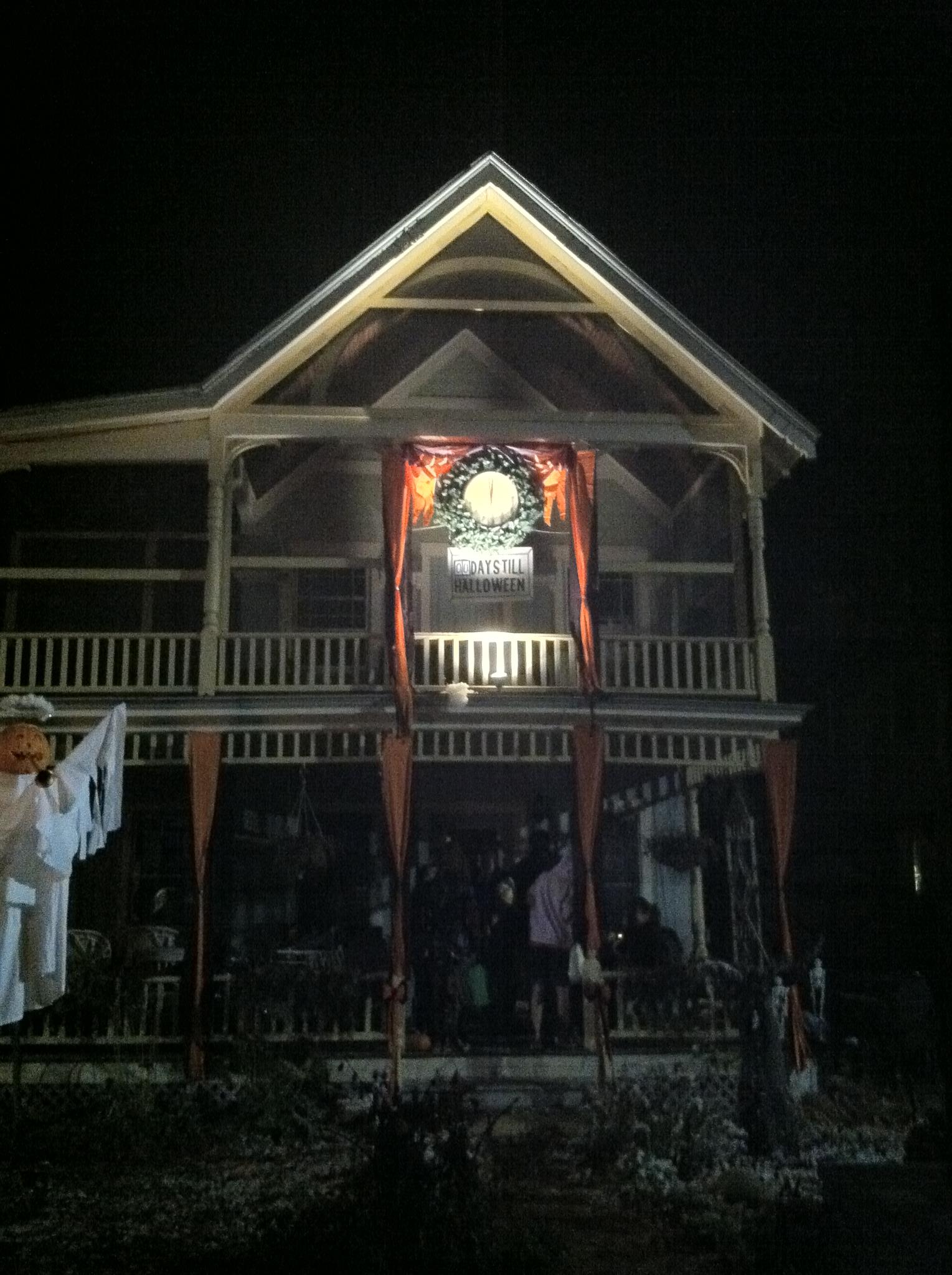
We live in an old Victorian village of the type that inspires the imaginations of people like Tim Burton. It is truly the epicenter of Halloween. Houses are old enough to provide residence to a few generations of real ghosts, tiny streets with closely packed houses draw hundreds of trick or treaters from miles around–and our next-door neighbors are deranged, wonderful folk who do things like this and this (video).

Their preparations are usually quite furtive, though they say things to me like, “Did we tell you we got a snowmaking machine?”, or ask, “Do you have a fire extinguisher? Good.”

So, heeding Zena’s words, and not even knowing where to buy hundreds of bags of Scarrots; and not convinced kids would really use the cutesy pencils that trees gave their lives for, I backed down. Still, I knew I personally would not be able to buy the drugs–I mean candy–nor distribute it. In cowardly fashion, I assign the purchasing to my husband, Pete or to the friends I invite for the festivity of the evening; and the distribution to whatever available child or visiting foreign exchange student I can find.

Figuring out the amount we need requires a complicated quadratic equation and often we have miscalculated. This means that we have to indenture our own children and recycle the booty they have worked hard for, or we have to run upstairs and hide in the dark, pretending we are not home.

Halloween evening was perfect this year. The weather was gentle with only a touch of autumn’s crisp bite in the air. At the witching hour, all the creatively-costumed children emerged from their homes and took immediately to their task. As we were simultaneously welcoming friends, warming the cider, finishing the pumpkins, adjusting costumes and oohing and aahing at the little munchkins crowding the porch–we realized we were going to be in trouble early.

As I was frantically emptying the bags into the cauldron, trying to appease the munchkins turned monsters now knocking down the door, one of my guests said that the contents of candy bags had gotten smaller. He was right and this was seriously offsetting the math. Later, with the cauldron barren, we found ourselves sitting with the lights out–considering giving away some of our tchotchkes, artwork, cats and used pencils.

Early in the evening, a Jedi knight informed Pete that he required two offerings. His headless horseman friend explained that he was making up for last year. Amused, Pete was about to challenge this request, but the Little Red Ridinghood mother bared her big teeth, said he was in the hospital then and snatched a candy for herself. Next year we may ask for discharge papers or a gnawed off wrist band.

So, once again, we gaped at our neighbors’ amazing creation– which draws hordes of happy revelers–spun through the few hours of insane madness, walked the streets with our friends–and it all eventually quieted down. We were reverse trick or treated, and there was actually some healthy and adorable popcorn to be found.

At the end of the night, I removed my Bob Cratchet ba-humbug costume, enjoyed a Reese’s Peanut Butter Cup or few and imagined that everyone will be needing a nutritionist come morning’s tolling of the bells.

What does Halloween bring up for you?

Thank you for listening, sharing, following and supporting my writing. Please subscribe in the sidebar to receive notice of new posts. Comments and greetings always welcome.

In health, Elyn

Related Posts: Post Halloween Post; The Eye of the Newt; So, How Did It Go?

Related Recipe: Pumpkin Muffins by Cookie+Kate


Halloween My Plate


My Plate Haiku

Eat the Pumpkin

Let the candy rot on the porch.

by the guy in Georgia