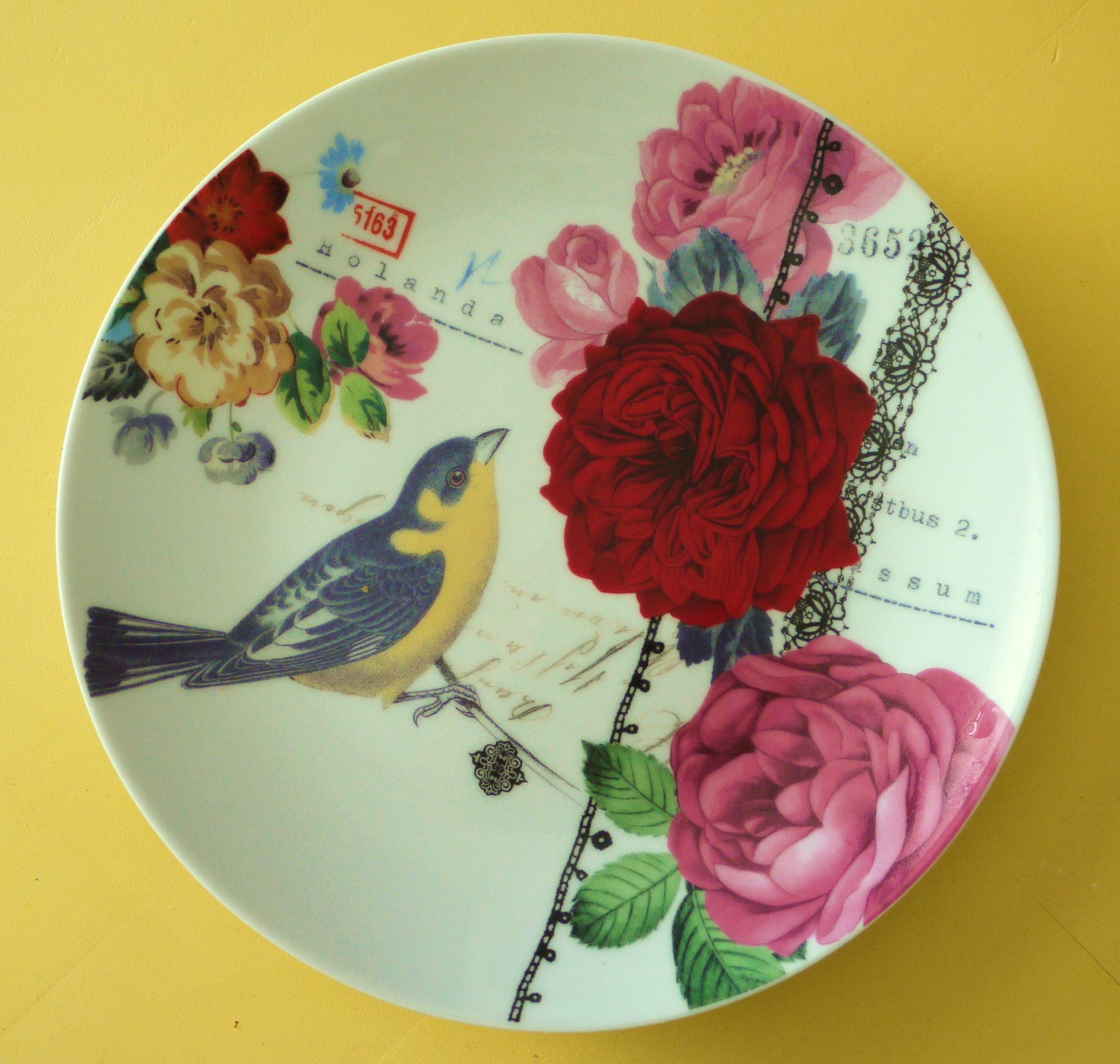
Happy Valentine’s Day. My day started out with a visit from Ms. Henry. Now, if she is not the true expression of this global love fest, I don’t know who is. One might almost expect for her to leave a trail of rose petals behind as she spreads love wherever she goes. Ms. Henry always has some story that both surprises and delights.
Today, she told me that she had informed everyone, that in no way were they to get her any chocolate this holiday. If they wished to get her anything, she would gladly accept red foods. And, wouldn’t you know it, her six-year-old godson and his mom gifted her with apples and pomegranates. And, the little boy told her that they had shopped for the fruits at the food coop. It was only 9:15 in the morning and I felt my heart open wide.
The rest of my workday was filled with more touching moments as I had some other clients tell of their own personal blossomings and awakenings on this lifetime eating adventure. I was feeling light in spirit as I raced out of the office to tend to some mothering duties–and the late afternoon sun granted me enough warmth that I shed my dark winter coat and threw it in the back seat of the car.
Come evening, I was grateful to join a circle of friends who were gathering for a cozy showing of the movie Moonstruck, thanks to the abundant and incredible hospitality of Heidi, whose love flows out through her wonderful culinary gifts and the pouring of the perfect glass of wine. Tonight’s Italian theme-based dinner was baked ziti, (meatballs on the side) and rapini. Rapini is a green and Brassica rapa vegetable, rich in Vitamins A, C, and E, folate, potassium and detoxifying indole-3-carbinol compounds dear to my heart–of course. Oh, and beautiful, homemade individual heart-shaped flavanoid-blessed chocolate cakes. How sweet is that?
So, though my main squeeze was out of town, and all cuddling was reserved for Chico the cat, it was still a special Valentine’s Day. In its honor, I want to take a moment to share a list of some of the (not previously referenced) amazing people I love whose work informs and supports my own and who inspire me by the generous sharing of their wisdom, wit, intelligence, passion and pure love for keeping us all a little healthier and happier.
Nutritional Wisdom: Andrea Nakayama: AnFunctional Nutrition Alliance; JJ Virgin: Exercise Physiologist and Holistic Nutritionist; Paula Owens: Holistic Nutritionist and Functional Health Practitioner; Lisa Nelson: Heart Health Made Easy
Gentle Approaches to Dietary Self-Management and Body Acceptance: Angela Minelli: Stop Emotional Eating and Compulsive Overeating; Deah Schwartz: Resources for Every Body Every Size
Environmental Toxins and our Personal Health: Lara Adler: Environmental Toxin Education
Parental Amusement: Honest Toddler: (I just love when Zena reads me these tweets!) (Updated 2020: Twitter feed was taken over by their mom.)
Please take a moment to check these out. I hope they will lead you somewhere helpful. Share with me anyone you love whose message is also along these lines.
With full heart, I call it a day–loving you. Like this post or forward me some love by way of comment, subscription or sharing. Or, a My Plate Haiku (or other expressions) or My Plate Plate.
Recently, having taken the commuter bus to work, I walked past a low-income housing complex that is on the way to the Health Center from the bus stop. As I approached the complex, I saw two women standing on the sidewalk in front of the buildings. I would guess they were both in their sixties. One of them was blind and holding her white cane. The other stood very close to her, ready to guide her if necessary.
Bissau, Guinea-Bissau
I was quickly scurrying along, gauging my pace on my need to arrive at my office on time. As I only take the bus on occasion, I was aware that my mind was taking in very different impulses along this route than when I drive. As the two women came into view, I processed thoughts about the nature of their relationship, kindness, the burden of poverty coupled with blindness, and a reminder to myself to work on my gratitude list. Just as I was passing them, the blind woman said, “And I heard that sugar substitutes aren’t that good for you and that they make you crave more sugar.” The sighted woman replied, “Yes, I heard that too.” (Resources: Sweet Deception, Sweet Misery)
I often say that it does not take long in the course of my day for some nutrition-based message to filter into my consciousness. Yet, this was an unexpected source. By the time the women exchanged the two sentences my steps had already taken me just past them. For a split second, I thought to stop to engage them in a conversation, to inform them of my nutritional proficiency and expound on the topic of artificial sweeteners, affirming what they had heard. Instead, I felt my lips turn into a mild smile that was intended to be for them, but that neither would ever see.
I think I absorbed the experience as a quiet lesson that one never knows how or where new information flows. In this regard, it related to my own work of attempting to expand nutritional consciousness and yet not always knowing how or where my own or others’ efforts are reaching. I internally thanked the women and carried their story into my day–and referenced them as my teachers with some of my clients.
This story also has meaning for me as I come full cycle of having written this blog for two years–and as I contemplate beginning a third. Looking back, I see that I have written seventy-five posts on various nutrition-related issues. I see them as vignettes that describe the milieu that defines eating in this current and complicated time; the challenges that dictate and mutate our food culture and the experience of the real and humble people who eat in response and reaction to this environment. I hope others see them in this way too.
I often wonder if my stories have resonance and purpose and whether they are instructive. Or, if they need be. Many people out there are doing incredible work and informing in clear and beautiful ways on how to address and improve human nourishment. It is not infrequently that I have doubts about the service of my writings and if they justify the time they demand. Are my words flowing into any cracks and crevices that may be helping others that I may never know about? Or, as my wise friend Lisa Dungate, who writes Lion’s Whiskers suggests, if my writing serves to fulfill some need of personal expression, that is adequate as well. Sometimes I don’t know.
But here are a few things I do know:
Every day a small but real number of people from all over the globe are reading my blog. Thanks to the amazing stat collecting abilities of WordPress, I know that people from eighty-four countries have seen The Nutritionist’s Dilemma. Just yesterday I had readers from Poland, Bangladesh, India, Pakistan, and Saudi Arabia. People in Azerbaijan, Mauritius, Guinea-Bissau, Estonia, and Oman have crossed paths with my ideas as well.
My blog is listed in Healthy Living Blogs and I get some nice readers from that connection. This site offers a very vital community for people writing on many diverse topics devoted to health. I encourage anyone interested in writing and reading about these issues to visit and support the members of this site. I give thanks to Lindsey Janeiro and the staff at HLB for creating this exciting space and offering all the amazing opportunities that they do.
That my blog was also chosen by Marc David and the Institute for the Psychology of Eating as one of the Top 50 Emotional Eating Blogs of 2012. Check out #47. This was a big surprise and very exciting. It is particularly meaningful as Marc David’s work has been phenomenally inspirational to me on my own path. I have shared my feelings about the importance of Marc’s contributions in Three Good Mark(c)s.
And finally, that I have a circle of subscribers who do follow me and who offer words of kind support along with relevant insights of their own; as well as a few hundred clients a year who I am privileged to work with and who always inspire me with their courage and capacity for change.
So, though the anniversary date of my blog just happened to occur during one of the most intense of times–in the post-Superstorm Sandy and pre-election week; and, while my own dining room table was still littered with hurricane preparedness supplies and Halloween trappings; and my head swam with thoughts about health care reform and the millions affected by the storm for whom eating had suddenly taken on a new meaning regarding survival, I committed to continuing the blog that I had birthed into being one fall day, two years ago. For the occasion, I have dressed it up with a new decorative theme that I think is very nice and makes for a cleaner read. If you are a subscriber and usually receive my posts via email, do go to my home page to see its new threads. I hope you like it.
My commitment includes my decision to allow myself greater voice and visibility. In my tiny corner of the world, in the confined spaces of my offices, I bear witness to some big and powerful stories. If I can participate in the larger conversation and in turn can give expression to someone’s experience that may help others–then that can be a good thing. Who knows? Maybe a person standing on a sidewalk in Baku, Port Louis, Bissau, Tallinn or Muscan, or even in my own community will help carry the information or inspiration forward.
As always, comments, clicks on the like button, subscribing, sharing, stories, feedback, my plate haikus–and any suggestions for improving the quality, content or technological capacities of my work are greatly appreciated. No, let me amend that–deeply craved. Let me know you dropped by for a virtual cup of tea with me. Thanks.
It is a modern dance though it has its roots in classical forms. It was originally choreographed for just a handful of dancers but now it is staged for many. In recent years it has been performed all around the world. I have seen it many times.
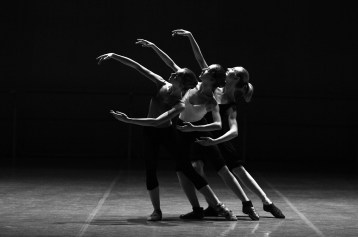
The curtain rises and the stage is empty. Slowly, alone and in pairs, the dancers enter–men and women. They are dressed simply in tights and leotards, all in tones of soft browns and grays, with one wrist wrapped in a band of red fabric. The dancers inhabit their space with sparse yet defined movements, engaged with each other, but each portraying a distinct set of steps.
Suddenly, one of the dancers contracts his center and extends one arm forward, palm facing upward. While he curiously studies the fingers of the upturned hand, his other arm reaches behind and then quickly arcs overhead coming full circle its palm slapping down against the other. As palms meet, the dancer deepens the contraction, a pained look grabs his face. Grazing his fingers along the wristband it unfurls in a flutter of scarlet fabric. He straightens and assumes his previous movements–the colored cloth now flowing behind his every step.
This contraction of the body, where the torso curves forward over the controlled pelvic area is a fundamental movement in modern dance. Martha Graham–the mother of modern dance– developed the gesture from observing the physical manifestation of grief in the body.
Soon, another dancer stops. This time a woman. She too contracts her center, contemplates the fingers on her upturned palm and follows also with the circling arm, the jolting slap and the unfurling of the scarlet rivulet of cloth. And, so it goes. In syncopated rhythms, new dancers initiate the pattern while those already afflicted repeat it over and over. Their eyes now remain fixed on their upturned hands that lead them forward.
As the tempo of the music intensifies so does the frenzy of the dancers now marked in red–about 10 percent of the performers. They respond to the dissonant notes that punctuate the melody while the others maintain a more composed presence. The noise of the slapping of the hands amplifies. Sporadically, they also clasp fist in hand drawing their arms in toward their torso or legs. Again the contraction of their bodies and the grimaced faces. Continually, they return to their earlier movements but always with one palm upturned and leading their way.
As the dancers’ paths intermingle, the rivers of red become intertwined among all of them. There is a flurry of color amid the neutral gray and brown hues. Some of the grieved are gently lifted up and held in the air or are tenderly embraced while others dance quietly alone extending their arms upwards calmly or angrily beseeching the heavens. A few tuck the wounded hand behind their backs, tethering its gestures and move on without it–though the red trail remains.
Eventually, the music regains a slower pace. The dancers all resume the steps of the first part of the piece regaining semblance of movements of everyday life and common interactions. Slowly they each quietly walk off stage. The lights dim.
This is the representation of the experience of diabetes. Its steps are hard to master and its care is tempting to ignore. Unsuspecting individuals in unprecedented numbers, an abrupt diagnosis and suddenly a life marked by the demands of modern blood-letting. Rather than preferring to allow one’s life fluid to course through the body unseen and uninterrupted, diabetes requires a more intimate relationship.
The hand must reluctantly but gracefully present itself. Fingers must be pricked, poked and squeezed multiple times a day begging the deliverance of the droplets of our inner essence. The sacrificial digit must be chosen and its offering must then be measured with precision to determine blood sugar levels. Numbers digitally displayed on a meter determine one’s destiny for the day as well as for the tomorrow. Medications are quickly and somewhat arbitrarily prescribed–some of which are delivered by measured injections to various parts of the body.
Food becomes more enemy than friend and each bite becomes suspect and open to investigation. Kidneys, eyes, and toes–and yes, hearts, are no longer private property but are open to the purview of medical technicians. And yet, the dance of life must go on. Interestingly, Martha Graham once stated that the mission of her work was to “chart the graph of the heart”. In essence, diabetes monitoring requires the same.
Not everyone appreciates modern dance. This is an unsettling piece. But, diabetes can be re-choreographed as its treatment is improved and, more importantly, as its causes are prevented.
Sharings on the experience of managing diabetes respectfully welcomed.
Thank you for listening, sharing, following and supporting my writing. Please subscribe in the sidebar to receive notice of new posts. Comments and greetings always welcome.
I was hoping not to have to work today. It is Sunday and I promised myself a little repose. So there I was actually lounging on the couch this morning when the news of New York City Mayor Michael Bloomberg’s announcement of the New York City Health Department’s Latch on NYC breastfeeding initiative filtered into my airspace from an NPR podcast.
breastfeeding (Photo credit: sdminor81)
Clearly, the launch of this voluntary program for New York City’s hospitals was timed to coincide with World Breastfeeding Week. The story started off nicely enough with a rational presentation of the benefits of breastfeeding and informed that 27 out of 40 New York City hospitals have already signed on to the recommended policy. But, it then whacked me with a tirade of the backlash (and responses) to the initiative–bemoaning that women do not want to have their parenting decisions enforced, especially by a man–and specifically not by health policy promoting Mayor Michael Bloomberg.
I rolled over and groaned into the cushions. My hopes for a relaxing day were shattered. I intended to glue my attention to the Olympics–one of the rare times I surrender to watching TV– but this report was going to interfere. Having discussed the topic of breastfeeding previously, I had no choice but to respond to this in a timely manner. Water polo and volleyball could wait, but this must be addressed before track and field and gymnastics takes to the screen.
In brief, Mayor Bloomberg did not make up these policies, and in fact, they are not mandated. These are recommendations consistent with the guidelines of the Baby-Friendly Hospital Initiative. Other larger jurisdictions have already implemented these policies. The intention is not to take choice away from women or to impound life-giving nourishment. It will not send women back into the kitchen chained to the stove with babes pulling on the teat as some editorials that I read implied.
Instead, it is a long-overdue remediation of a situation that separated the human species from their species-specific milk and compromised in both subtle and profound ways the health of many moms and babes. The superiority of human milk, as compared to artificial milk or formula, for human babies is not disputed and its immuno-protective properties are well established. There are many other benefits as well of mother’s milk as a substance and breastfeeding as a method.
What is not as well-known is that formula companies have participated in the disruption of this mother and child feeding relationship for many years and that this has promoted a cultural ignorance about the benefits of breast milk and a communal lack of wisdom regarding supporting women in this most natural of human behaviors. Big corporations have been the beneficiaries of immeasurable profits by influencing infant feeding using extreme measures by literally getting invited right into the hospital.
Pregnant women are wooed with coupons, samples, and free merchandise. New moms are given goodie bags with loyalty promoting formula brands. What formula a baby is started on has nothing to do with the baby or the doctor, but by whatever company got their hands on those tiny sucking lips first. Where else does this marketing intrusion occur so blatantly in matters related to health?
Women’s efforts to nurse have been sabotaged in hospitals for decades by babies being given sugar-water or formula without consent. Birth attendants including doctors and nurses not educated in lactation have also impeded the mother’s success at nursing. The result is a society that for decades has been led to believe that nursing is difficult, inconvenient and an impediment to maternal freedom. What has created barriers for mothers choosing to nurse is not nursing, but a lack of education, limited support, pathetic maternity leave policies, lack of comfortable places for nursing and pumping and a prudish culture that has turned to feed at the breast into a lascivious act aggravated by laws that even make nursing in public illegal in some places.
If you wish to discuss enslaving factors as regards women’s choices, this is what people should be concerned with–not the new policies. Of course, there will be some situations where babies will require formula, and there will be women who will choose formula feeding for a multitude of reasons. But, I am pretty sure the locked cabinet that the policy suggests will not be in the hospital basement by the janitors’ supplies and that women won’t be found dragging their IV poles down the hall in desperate search of a contraband formula to sate their starving babies. And, I strongly doubt that nursing staff will be utilizing methods of intimidation to enforce breastfeeding.
This is just an opportunity to fully educate and inform and to take the profits out of our babies’ bellies. It is one of a long series of efforts by many health care professionals to enhance the health of women and children in both the short and long-term. This is not rocket science nor is it evidence of a nanny state. If we as mothers have to choose our battles–this is not the one to wage.
Thank you for listening, sharing, following and supporting my writing. Please subscribe in the sidebar to receive notice of new posts. Comments and greetings always welcome.
When last I left off in, By the Time I Got to Woodstock, I was chewing blissfully on arugula while practicing mindful eating in a cafe in Woodstock. Well, right after that little sweet outing, I began working with a new client who had recently had gastric bypass surgery–and so, since, the concept of mindful eating has taken on some new dimensions.
Holding someone’s hand as they enter into an entirely new relationship with food and eating relative to digestive restructuring is a fascinating and fragile task. Recognizing how many people are now undergoing these procedures, makes me realize this is a societal shift as profound as online dating. According to my quick search, more than 200,000 people in this country are undergoing some type of weight loss surgery in a year and the numbers are growing steadily.
My client had the Roux-en-Y procedure, which is currently the industry’s gold standard. It was one of the earliest procedures developed and ensures some of the best long-term success. It can now be done laparoscopically through small incisions in the abdomen thereby further decreasing complications and post-surgical discomfort. In the Roux-en-Y procedure, the stomach is stapled to create a smaller food pouch about the size of an egg and is then reattached to the small intestine further down, bypassing the upper portion. Most people who undergo the procedure lose pounds fast and furiously for the first few months and ultimately seem to shed about 65% of their excess weight–though this number can be higher as well. Additionally, serious medical conditions like diabetes, hypertension, sleep apnea and arthritis that plague this population significantly abate.
These surgeries and their aftermath, of course, entail some serious risk (including death) and have many profound physical, emotional and nutritional implications as well. However, highly remarkable are the changes in eating behaviors that these procedures both impose and demand. From the moment an individual awakens from the anesthetic stupor through the rest of their life, the relationship with food is forever changed. Some foods will be kissed a sad goodbye, while others will be reduced to tiny portions of their former selves. Sugary and fatty foods once-beloved will wreak severe and painful havoc on the altered innards; gas-forming foods will even more so make their presence known far and wide; proteins will demand front row seating at every meal and something as innocent as the skin on a tiny blueberry can pose a gigantic digestive problem. But, that is not all. Very big men and women will perforce be required to eat like little toddlers.
The refeeding path will wander from clear liquids to pureed foods and then to very carefully chosen solids. Liquids will be sipped slowly in frequent timed intervals throughout the day to prevent dehydration and they will not be taken at mealtimes. Bites will be teeny tiny, as teeny and tiny as a pencil eraser and sometimes tempted to the mouth on little baby utensils. Each mouthful will be so carefully chewed, quietly and consciously until fully emulsified. There is no room for feeding error as severe pain or vomiting easily can ensue. Portions per meal will be a mere quarter cup, then a half cup and eventually up to a one-cup maximum more or less for good. An ounce of food (or two tablespoons) will require about ten minutes to consume and a full one cup meal greater than an hour. Often fullness will set in before the meal is done.
I have turned to various readings lately to get a deeper appreciation of this extreme and tedious process from people who have experienced it– because it is difficult for me to fathom it on my own. I have taken to trying to eat one, just one, eraser sized bite per meal and to chew it consciously in some kind of solidarity with those who have chosen this path as a means to ameliorate years of physical and emotional pain. The decisions to undertake what these procedures required are not taken lightly.
Exploring this world more fully is challenging some of my own hesitancy regarding these procedures and I have been recalling my reactions to the bariatric conference I attended last fall and wrote about in How Can You Say No to a Brownie? Though there are at least two sides to every story, a recurring theme for many who have chosen weight loss surgery seems to be that despite all the attendant problems and adjustments–and there are many–eventually the new lifestyle is one that they become accustomed to and when the initial difficulties resolve–they feel so much better and have no regrets.
It is difficult but not impossible to imagine. But even in so considering the benefits, I have been struck by a certain irony. Is not the insistence or instruction of these procedures essentially mindful eating? Choosing food with care, approaching it respectfully, chewing it slowly, tasting it thoroughly and giving the body time to say enough and thank you–like I did with my meal in Woodstock? Interestingly, I just came upon an interesting clue regarding this.
Well, I am not positive, but I think that is what mindful eating does too. I don’t know what we will come to find when we look back at this period of extreme procedures for weight loss or review its long-term results. Surely, newer weight reduction methods will be developed that won’t be as invasive and extreme as those that are currently being employed. Hopefully, we will find a gentler solution, but, maybe we will come to realize that there has always been a simpler way.
What do you think?
For an enlightening understanding of the physiology of eating, check out Marc David’s book, The Slow Down Diet.
In health, Elyn
*Nicholas Stylopoulos, Nicholas, Hoppin, Alison G., Kaplan, Lee M (2009), “Roux-en-Y Gastric Bypass Enhances Energy Expenditure and Extends Lifespan in Diet-induced Obese Rats”, Obesity 17 10, 1839–1847. doi:10.1038/oby.2009.207
**It is actually amazing that I don’t write about Chico more. He really is the most remarkable cat as his large fan base can attest to. He does have some food and eating issues yet has actually lost weight through a diet, therapy and exercise program. He enjoys cantaloupe and cucumbers, takes walks with me and waits outside when I visit my neighborhood library. Here he is reading the Count of Monte Cristo upside down!
There I was having a mindful eating moment. Though I teach others the importance of this technique frequently, I rarely slow down enough to practice it myself. What it took for me to have my own blissful experience–where you sit in total oneness with a food or a meal fully attuned to the multi-sensory act of eating–was the result of a harmonic convergence between my teenage daughter and not one, but two teenage boys.
It was a beautiful warm Friday in April when Zena and I found ourselves perfectly aligned to spend the afternoon together on the last day of her school spring break. Easily, the legendary village of Woodstock presented itself as the mecca for our little excursion. Morning obligations tended to, we hopped in the car and headed out. About a third of the way there, Zena decided to see if she could reach her summer camp friends, Ethan and Josh, who live there. Despite the fact that the two had school that day, and were actually in it when she contacted them, in vague teenage boy fashion they arranged that they would meet her somewhere after track practice.
It was the kind of day where you celebrate shedding the cumbersome clothing of winter and first drive with the car windows down. Whenever I go to Woodstock, the songs of The Band drift easily into mind, as I was once fortunate to see them perform there–in their adopted hometown. Little did I know that just a few days later, word of band member and Woodstock resident Levon Helm‘s death would pass a cloud over this sunny musical epicenter. But that day, it was all sunshine as Zena and I browsed the little shops, bought T-shirts and sunglasses and walked our way into that wonderful space where appetite is earned and asks to be rewarded with something special. We checked out a few little spots, yet in Goldilock fashion, it was not until we came to the Garden on the Green did we find the cafe that was just right.
Though the beautiful outdoor garden area was closing down for the afternoon, inside provided just as warm and welcoming a place to please my palate. Every inch was aesthetically charming. Ah, but there was more. The menu consisted of purely vegan offerings created from local provisions. We were giddy. Though I am no stranger to vegan and vegetarian restaurants when available, eating out in most places usually entails rapid eyeball movement over the menu to find the few non-meat selections. Here, every choice was seductively available.
We sat at the table by the large front window overlooking Woodstock’s little village green and ultimately decided to share a warm lentil pecan pate with sage, Tuscan arugula, and white bean salad and a wonderful black bean and roasted corn quesadilla. We settled in looking at all the pretty things that surrounded us. However, just as the food arrived, Zena said, “Oh, there’s Ethan!” and went running out the door to greet him. I turned to find her in that kind of exuberant silly hug that teenagers enjoy with one of those Skinny Boys. She ran back in and asked if I would mind that she go hang out with him, concerned about leaving me alone to eat. I said I didn’t mind. We asked the waitress for a to-go container and I packed up a little picnic box for her to take outside–complete with the nice silverware–which we returned later.
So there I was, alone with this beautiful food. Right away, I knew what I needed to do to fill my time. I had already embraced my surroundings–taking in the other diners, the waitresses and trying to interpret the Spanish conversation coming from the kitchen. I now needed only to address all of my attention to this amazing meal. With each sense engaged, I looked at, smelled, and lingered over every single bite. I considered the textures–the creaminess of the pate along with with the crunchy crust of the bread it spread itself upon, the lovely bitterness of the arugula mixed with the tender softness of the white beans. I chewed incredibly slowly, which is not something I ordinarily do and really appreciated the unique meal. And, yes, as I tell my clients is apt to happen, I sensed my satiety rather quickly. I was actually a little bummed. I could have easily eaten all of the food that was before me while I waited for Zena to return, but with careful listening, my body said it had enough. I was determined to honor it.
Right about then, I looked out to the window and my maternal lens caught a view of Ethan loping away in one direction while Josh came bounding in from another. Zena came heading back into the cafe. She asked for more time, mentioning something about guitar lessons. On most other days or in some other place, my patience might have waned, but not there and not then. As she skipped out again I perused the very vegan dessert offerings and extensive tea listing and chose a Chinese Sencha Tea with which to extend my experience. I had recently read about specially harvested Sencha teas and was excited to try one. I stayed committed to my mindful intention and inhaled the pleasant aroma with each tiny sip.
Not too long after, a parent-propelled car pulled up in front of the cafe and whisked Josh away–and Zena rejoined me. Though the teenage boys had vanished with a cinematic flourish, my satisfaction lingered. Since then, I have been more conscious to calm myself and to eat more slowly when I bring myself to the table.
Time and again in my work I am reminded how important mindfulness is in regard to eating. Mindfulness, or simple but exercised awareness, is essential for a balanced relationship with food. In the big dietary gestalt, we tend to focus the problem on what we are eating and to seek answers in changing dietary content. I myself am apt to tend and mend in this way as well. However, commonly what is revealed in the real story of eaters, is that a deeper conflict exists. Even in those whom I assume must have their inner compasses precisely calibrated and their plates all balanced, I eventually divine the agita, angst, stress, and shame that accompanies how people feel about how, why and how much they eat. This is often more so the problem that is seeking attention and assuaging. These principles are ably addressed and applied at the Institute for the Psychology of Eating.
Slowing it down and paying profound attention ultimately can change the patterns, often dysfunctional, that repeatedly dictate our feeding relationship. From thoughts to actions, mindful eating can be a powerful tool for increasing compassion towards ourselves, helping to reassign food to its proper place and for improving physical health. In its most simple sense, it will increase the ability to truly taste and savor food. More profoundly, it can provide more information than most diets do; affords permission to eat and decreases deprivation feeding behaviors that usually backfire. Ultimately, it allows one to derive more pleasure with less intake. It can be practiced with one tiny piece of chocolate or with an entire meal. It can be explored casually or studied diligently.
Two books that are in my midst these days that address mindful eating are, Eat, Drink and Be Mindful a workbook by Susan Albers; and Peaceful Weight Loss Through Yoga by Brandt Bhanu Passalacqua. I recommend them both. I also invite you to choose a moment this week to eat mindfully. I would love to hear about your experience if you care to share it in a comment. Who knows, you may find that you shall be released and or that you begin to know better the shape you’re in.
Where shall I start? To begin with, on Wednesdays, I am not at the Health Center, and on that particular morning, my private client needed to reschedule. So, though I receive an onslaught of topic-related information constantly, I had on that day more time than usual to slowly digest these matters that are so relevant to what I do.
Frances Moore Lappe receiving the 2008 Humanitarian Award from the James Beard Foundation (Photo credit: Wikipedia)
Ragen’s offering attracted my attention first. I have referenced her work previously. She is a committed activist and a powerful voice in distinguishing the difference between health and weight issues, preventing fat-shaming, and, shining light on the lies and manipulations of the weight loss industry. I can always count on her to keep me informed of something meaningful. Here, I learned that Michelle Obama was planning to go on the show The Biggest Loser to thank the contestants for being role models. Ragen’s reaction was quite pointed and the story of what happened when she and filmmaker Darryl Roberts (America the Beautiful) tried to field a response to the media is quite interesting. However, it was this comment that contributed to the theme of my day.
The worst thing is that all this focus on the weight of individuals is distracting us from the systemic issue of lack of access. Many people do not have access to the healthy foods that they would choose to eat–including foods that are not genetically modified or full of hormones or government-subsidized high fructose corn syrup. Many people do not have access to safe movement options that they enjoy, or to affordable evidence-based health care. But as long as we focus on little Johnny’s BMI, we don’t have to address the real problems here and we can just keep shaming and blaming fat kids and adults and misinforming them and everyone else about the odds of becoming permanently thin.
I strongly share these sentiments and it took only a few clicks on the Alliance for a Healthier Generation’s website to confirm this dismissal of the larger issues. The articles in their In the News column included, Schools Find Active Kids Make Smarter Students and Virginia Legislation Calls for School PE Guidelines. Both are sad statements about the current state of affairs on such seemingly obvious matters. I applaud the work of the Alliance which I have discussed before in Diet for a Small Caterpillar, but I am often sad to see their amazing talents and resources going toward efforts to repair an intuitive intelligence that was broken by bad policymaking and vested interests disenfranchising the well-being of our citizens.
I also have a visceral reaction to the term the fight againstchildhood obesity. Obesity is not the only consequence our children are suffering–it is just one of the manifestations of poor nutrition and the ignoring of all the ingredients that contribute to both physical and emotional well-being in the early stages of development. If this were only about obesity, my daughter would not have had to, unfortunately, participate in a lock-in drill. Furthermore, fierce language is not what is needed even when details may make us wish to brandish our childhood obesity-fighting swords.
Thankfully, on that Wednesday morning, I was also fortunate to hear a really beautiful interview with Frances Moore Lappe, who has certainly had a strong influence on my own path. I will leave you with her words.
“We don’t have a shortage of food, we have a shortage of justice. As we shift to focus on our relationships with each other, and with the earth, as we align our lives and our economy with what is true about our nature and is harmonious with the wellbeing of nature, we find answers to so many of the questions we face today. Hope is not what we find in evidence, it’s what we become in action.”
So, I hope the connections make some sense and perhaps my title of this piece suggests such a shift of intention toward the task at hand.
Thank you for listening, sharing, following and supporting my writing. Please subscribe in the sidebar to receive notice of new posts. Comments and greetings always welcome.
My dilemma was really excited. We hadn’t been to a conference in a while. Usually, I try to keep my nutritional dilemma quiet and out of sight. But, last week as I was heading to a meeting of the New York State Public Health Association I figured nothing would be too controversial, so I relaxed my grip on it a bit as we headed out. It was an unusually warm morning and as I rolled down the car windows, my dilemma, riding shotgun, stuck its head out into the fresh air, giddily taking in all the sights and smells like a golden retriever.
We arrived at the hotel, easily found a parking space and the right room, and settled in. I applauded the availability of Tazo Tea and forgave the choice of bad white bagels. I knew there was some consciousness on the part of the Association to be mindful of the food so I appreciated that there was an alternative to the usual sugar-laden breakfast pastries.
The title of the conference was “Transforming Communities through Public Health Practice”. The keynote speaker was Michelle Davis, Deputy Regional Health Administrator for the US Department of Health and Human Services.
As I sat through the morning, I checked the program to remind myself of the focus of the day and why I had chosen to apply my limited continuing education benefits here. Though I mainly do my nutrition and health thing privately within the confines of my small offices, working with one member of the public at a time, I also try to promote health messages to a larger audience as well. I practice what I term stealth health–introducing information or programs that enhance well-being in both supportive and unsuspecting ways. Here was an opportunity to listen and learn from others who are out there doing community transformation. This is what motivated my choice–to be with my peeps–like-minded people doing great things in this arena.
As an attendee I learned of the new goals of the Healthy People 2020 initiative; I heard about some worthy activities happening on the local scene; and, I sat in on an interesting session that reviewed a relatively well-funded menu labeling education campaign that encouraged consumers to choose fast food meals containing 600 calories or less. The initial results were apparently somewhat disappointing though the evaluation data was limited. The research ironically showed that those who did not receive the message curtailed calories more than those who did.
I thought I had my dilemma well-leashed, but in retrospect, I realize it was already starting to whimper and whine. However, it was not until I attended the first session of the afternoon, “Development and Implementation of Formal Policies and/or Local Legislation to Increase the Availability of Non-Sugar Sweetened Beverages in Public Buildings: Reports from the Field” that its bark became disruptively loud. The session was facilitated by two women who had overseen a project of the NY State Association of County Health officials wherein monies and other resources were allocated to a handful of county health departments to assist their county governments in achieving this goal.
They effectively reviewed how the different counties applied their efforts–which really were intended to decrease the availability of sugar-sweetened beverages (SSBs). They described media campaigns, seltzer water promotion activities, revenue concerns, working with government officials from the top down and with procurement managers from the bottom up. They discussed vending contracts and how these are virtually impossible to change until the contract runs out. They explained the challenges, push back and resistance that each county encountered and the small changes that were made. This was an absolutely positive action, but it required that they had to play nice politics with these good public dollars.
I suppose I know this is how the process works but the cumulative view of the public health community working so hard for such small gains–even in the public sector–turned my dilemma rabid. It circled wildly, foamed at the mouth and even raised its hand and expressed its opinion. To calm it back down, I had to go get it a fruit kabob at the next break.
Who do we still have to convince at this stage of the game that vending machine revenues will not outpace health care spending? Who do I need to invite into my office to hear the daily stories of health compromised by tepid health care policies and timid action? How many cases of people addicted to Mountain Dew, Pepsi, and other such SSBs must I detail as evidence to show how they suffer from rotted teeth that cannot be repaired; ravaged digestive systems bandaged with a plethora of damaging antacid medications; excessive weight that has literally brought them to their knees; anxiety propelled by excessive caffeine; and, destroyed glucose control that relegates them to a life with diabetes? Is it not tragic how many are children and young adults are already affected?
I always say that if I was the ruler of the food planet, I would remove sodas immediately. There is a heavy toll on health from such irresponsibly marketed products available for consumption with the clink of just a few coins in most public places–not only here but around the globe. And, though soda addiction knows no boundaries, as usual, the economically poor, are disproportionately affected. Recently, a client of mine told me that the school bus company that he works for removed soda vending from the employee break room. Cannot our own government agencies venture such a commitment? Bearing such witness, I am perforce required to display the amount of sugar in various SSB bottles wherever I may be. Right now in the lobby of the health center, I have such a display with associated handouts. People truly gasp when they see the load of sugary stuff that otherwise stays dissolved in the highly acidic medium.
This week, just a few days after the episode at the hotel, a fifteen-year-old boy who has lived a large part of his life in a home for troubled youth was brought to see me–ostensibly for his high weight problems. He was accompanied by a case manager–and another boy who came along. We had a pretty good chat and among other things, we talked about his soda drinking. I told him I really felt sodas were toxic substances that deserved some type of poison label. He asked me if I had a Sharpie. I said, of course, dug it out for him–and he drew me a page full of well-executed skulls and crossbones. I thanked him profusely for his contribution to my crusade. Who knows, perhaps through this experience of participation, he will become a stealth health advocate. When we were done, I gave him and his little buddy two water bottles that I had actually picked up at the conference.
Afterward, I realized my dilemma had been watching the whole encounter from under my desk. It pawed at me and looked me squarely in the eye. It bemoaned that private health is truly a deeply public health matter and vice-versa, and with its tail between its legs, it quietly crawled away.
Let me know what you think about this issue. Thanks.
The other day I took a walk around my picturesque village. I was thinking about it being Eating Disorder Awareness Week and wondering what I would write about. I knew I wished to offer something for this annual recognition week that starts in the last week of February–but I wasn’t sure what. Passing the old Victorian houses that line the narrow lanes of this old place, I was feeling perhaps more like a gothic romantic than a modern nutritionist.
This year, the theme that informs the week is “Everybody Knows Somebody”. This speaks to the fact that given the high prevalence of eating disorders in our society, chances are everybody most likely does know someone–whether they realize it or not. Eating disorders are intangible in their essence. They share many elements of an old gothic novel–a vampire story perhaps.
When eating disorders tighten their grip on an individual–as undernourishment and starvation deepen–they can figuratively and literally suck out the lifeblood. But, outward appearances usually do not identify those with any of the different complex types of eating disorders which we simplistically categorize as anorexia, bulimia, and binge eating. Related and variant disorders exist as well. And unfortunately, just as with vampires, we may not realize until it is too late, that we actually know someone who is affected. Recognition of these conditions and resources dedicated to their treatment are abysmally low and this is why Eating Disorder Awareness Week is extremely important.
Though my job is to help people re-nourish, balance intake and make peace with food and eating, I recognize that sustenance needs to occur on many levels. Working with those who suffer, I get to be privy to the underside of these debilitating conditions. When I am up close and personal with my clients, I more easily see that they are not fully embodied, as their illness has detached them from their physical form. It is subtle of course, but they have a fragile, ethereal quality. This does not dismiss the fact that people with eating disorders tend to be extremely intelligent, highly productive, deeply empathic and exceedingly capable.
What is most painful for me to witness is the profound isolation, loneliness, and secrecy that these disorders engender. This cruel disease finds its oft very lovely victims scrounging for food at markets alone late at night; avoiding the pleasure of sharing satisfying meals with friends; preparing meals for their children yet not partaking themselves; and, loathing self so profoundly that they apologize for the space they inhabit. The survival of these disorders depends ferociously on the preservation of deep and dark secrets.
Frustrated by my knowing that there are many right in my little community who suffer alone and invisibly and that there is a serious dearth in services–even more so since New York State cut funding to eating disorder programming a few years ago–I recently formed a small program in conjunction with a local holistic health center. I forced myself through my own usual hesitation and trepidation led by one strong intention–to see if I could create a space where people could find a place for a moment of peace, where they could allow themselves to be safely seen–and to share in a cup of tea. The first session was attended by seven courageous people who came out of the woodwork where they usually hide.
The work of two women inspired me to even consider this. One is Shannon Cutts, a survivor of her own 15 year-long battle with anorexia and bulimia, who wrote the book Beating Ana and started the program MentorConnect. She brought to the table the healing component that emphasizes the importance of social relationships as an antidote to the pervasiveness of these illnesses. I recommend her work highly as a complement to other care.
The other is Mary Ellen Clausen (and her husband Dan) whose own lives were touched by their daughters’ eating disorders. On a wing and a prayer, they created a welcoming space called Ophelia’s Place, where people can just come for some coffee, chocolate, comfort, and care. From the ‘Our Journey’ page on their website, “We are learning to listen harder, “fixing” less, and believing that the struggle is where the healing begins. We are learning to “model” healthy behaviors and challenge the “norm”. We are learning to replace blame and judgment with love and unconditional support. We are learning forgiveness. We are learning that recovery is a process and part of that process is an understanding that living life can and must co-exist through the eating disorder.”
This message is important for me to touch base with as I continually try to anchor my own work in this area. Today, with a client of mine I tried to fix too much. This is a frequent challenge for me–meeting the mandate of reaching for adequate nourishment with some sense of urgency and being prescriptive–while also trying to provide that crucial piece of support and mirroring forgiveness. I find this work very humbling and it demands leaps of faith for all involved.
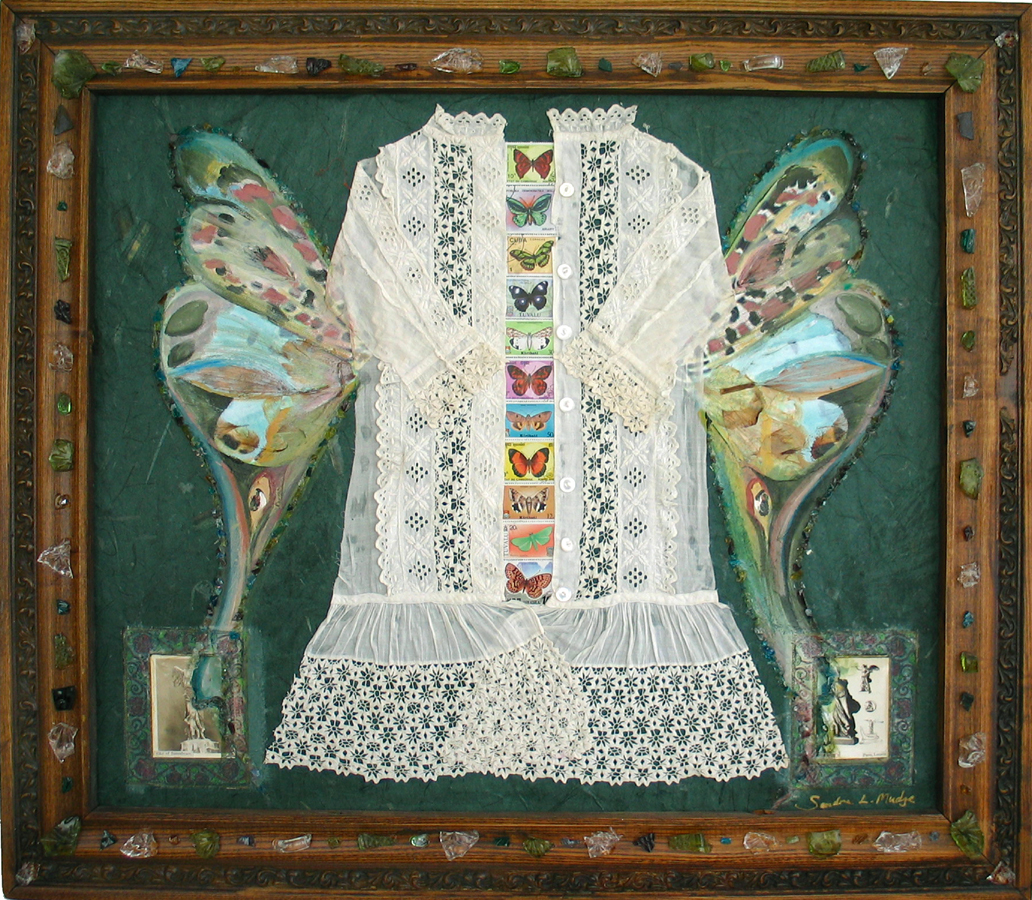
When I returned home from my walk, I happened to check my little Facebook page. Someone I know had posted a link to the website of my old friend, Sandra Mudge. who I had not been in touch with for many years. One click led me to her fantastic, whimsical, provocative and sacred artistic creations.
With a portfolio of paintings, collages and photographs–and some other media–Sandra’s heavenly work seems to captures the delicate and ethereal essence of eating disorders–exactly that which I was trying to express–something more representational than descriptive. In her fine art section are a series of pieces of beautiful dresses–doll clothes of taffeta, silk, and lace adorned with fragile firefly and butterfly wings–but they are empty of the little girls who should be wearing them –who should be fleshing them out with life, vitality and childhood innocence.
As Sandra, Mary Ellen, Shannon, and many others continue with their powerful talents to ‘transform helplessness to hopefulness’; and, when faith is summoned, and stories of recovery are shared, more ‘dolls’ can be restored to their full life potential–and they can then take flight.
So this week, stop for a moment to think about the somebody who you may know. If this is you, please seek help, have faith and never give up hope.
Thank you for listening, sharing, following and supporting my writing. Please subscribe in the sidebar to receive notice of new posts. Comments and greetings always welcome.
Linsanity. I am all over it. Jeremy Lin–Harvard graduate, undrafted player, turned New York Knicks phenomenon. Like I just learned that he’s a point guard. And, no, I haven’t seen him play yet–but that’s due to us not having much accessible TV in my home and something about a broadcasting contract between MSG Sports and the local cable company. So then, what do I know? I know he grew up playing basketball at his local YMCA; his other favorite sport was soccer; he does yoga; he has a charitable foundation; and, most importantly–what he eats per day to meet his protein requirements. Oh, and that he has a weakness for In-N-Out Burgers.
This 6-foot-3 and 205-lb rookie player has come charging onto the scene fueled with 205 grams of protein per day–as recommended by his personal trainer. Regular humans need about .4 to .7 grams of protein per pound depending on a variety of factors which include activity, age, state of health and a degree of imprecision in calculating optimal protein requirements. However, superlative athletes can extend their intake higher, and Lin’s 1.0 gram of protein per pound is probably both generous and acceptable. Sports that involve a lot of impact and pounding necessitate a large degree of repair nutrients which protein delivers–and with the compacted NBA season this year resulting in less rest between games, it seems like the players are taking quite a beating.
This means that to start him on his way each day, Lin aims for 50 grams of protein at breakfast. To reach this amount, he eats five eggs along with a serving of another protein like ham or turkey. The rest of his daily diet includes lean proteins from chicken, fish and milk-based protein powder, lots and lots of vegetables which he derives often from big salads, and a modicum of starchy carbohydrates. I was surprised at the lack of more carbs but I think they were just not clearly described in the plan that I saw.
I did not really intend to write about what Mr. Lin is chowing down–despite my being very interested in athletes’ diets. I enjoy hearing about those who credit their success or long, injury-free careers to their attention to nutrition–and will gladly delve into any Sports Illustrated Magazine that makes me privy to some piece of information about a sports celebrity’s care and feeding of their body. And, with professional sports’ fierce competition, more athletes are turning to such measures to improve their edge. I am also a champion of such stars who use their celebrity to promote healthy behaviors and give back to their communities such as Celtic’s Paul Pierce’s Truth on Health Fund.
I would love to be a sports nutritionist for a professional organization. I did once serve in that role for a college women’s basketball team. When I joined them for a team-building day–which included games and a high ropes course–my life felt a bit endangered. These tall amazon women felt entitled to some payback for my moderating their carefree college eating experiences. They were only Division 3. Maybe, if they were more assured of a high paying basketball contract they would have better appreciated my input and might have caught me in that game where you stand in the middle of a circle, lean back with your eyes closed and trust that the others will gently receive and carry your weight.
I digress. Anyway, since I am not a highly paid sports nutritionist, my attentions go to the more pedestrian aspects of how the mere mortals are eating. The little tidbit that really led me into this Linsanity was a NY Times article this week about Jeremy’s grandmother, 85-year old Lin Chu A Muen. Though she lives in Taiwan, when Jeremy was a baby and young child, she came here and cared for him in the California home where he was raised. Apparently, one of the budding basketball star’s favorite dishes that she prepared for him was fried rice with egg and dried turnip. For me, right there was the story.
I extrapolated from this one sentence mention a whole message about childhood feeding–and grandmothers. I thought I would just use it to advance my personal theory that the whole ruckus about feeding kids is overblown and that kids will just eat good healthy food if that is what is presented to them–without a myriad of choice and being catered to and if served with love–just as Lin Chu did for little Jeremy–dried turnip and all.
This seemed like a good way to present my adopt a grandmother feeding initiative. I have long observed that there are many from the older generations who really know how to cook–but no longer have anyone to cook for. Connecting these grandmothers (and grandfathers) with households that lack such important know-how would be a brilliant solution to the current childhood culinary and nutritional crisis.
My thesis was advanced when quick research revealed that Lin’s family doesn’t cook much and so he eats out for most of his meals. I assume that this describes the situation when living at home with his parents–after Grandma returned to Taiwan. It seems like once Lin Chu left, this family of ninth-generation descendants of immigrants from the Fujian province in southeast China, like many other American families, became clueless in the kitchen and In-N-Out Burger replaced the dried turnip dish.
One could probably argue that little Jeremy might not have grown so tall without the addition of such burgers to his diet and that a continued dietary of dried root vegetables, starch and a touch of egg protein could have deprived the New York Knicks of the divine lintervention he seems to be providing. His current protein intake far exceeds that of his ancestors. However, that raises other philosophical, ecological and nutritional issues.
I suppose he is living on his own now somewhere in the vicinity of New York City. Though he can probably afford it, his new-found fame probably makes it difficult for him to frequent the local burger joint, and besides, I don’t think we have In-N-Out Burgers here in New York. Jeremy might just have to take his eating back into the home and to find a grandmother who can prepare for him the sustenance he requires. Unfortunately, it looks like it’s too late for him to draft his own grandma for the program. Apparently, Lin Chu is too busy hanging out in sports bars in Taipei watching her grandson play basketball.
Knicks fans and Michelle Obama, what do you think?
Sunday’s stats: Knicks 104–Mavericks 97; Jeremy Lin 28 points and 14 assists (7 turnovers–and that doesn’t mean apple)
Thank you for listening, sharing, following and supporting my writing. Please subscribe in the sidebar to receive notice of new posts. Comments and greetings always welcome.










 the nutritionist's dilemma