Archives

Stopping Traffic

“The public is silent when young women die.” charges Naomi Wolf, author of The Beauty Myth.

I have just returned from an annual conference that I attend on Eating Disorders. The conference, in its eleventh year, is sponsored by The Nutrition Clinic and Sol Stone (Update 2020: Upstate New York Eating Disorder Service); Clearpath Healing Arts Center; and Ophelia’s Place who work together to form a strong, sensitive and progressive treatment network in central New York.

woman-639420_1280

Image by Mystic Art Design at Pixabay   

Each year, near the end of the conference, a handful of individuals in the recovery stage of their eating disorder are invited up to share some part of their story. This is, of course, the most enlightening and always most emotional part of the day. The wisdom acquired in overcoming such a strong opponent is very deep and these very intelligent women articulate it beautifully.

This day, a young woman in her mid-twenties, stood before the two hundred or more attendees and shared that in the darkest days of her eating disorder, she almost walked into traffic–but only stopped herself because she felt it would be immoral to place such a horrible burden on whoever might have killed her. To witness someone so young describe such a depth of despair was both bone-chilling and deeply heart-opening.  

On some level, we know that there are people who are suffering from eating disorders, but essentially they are invisible. However, when one is privy to the stories of those who have had one of these crippling conditions; and you couple that with statistics like one in 100 individuals has an eating disorder—it is imaginable that there are truly some “walking dead” amongst us.

To offer some response to this young woman who had the courage to expose her pain and vulnerability and who has found the strength to persevere and to heal, I bring to this conversation– about the realities of eaters and eating– a discussion about eating disorders. I know that it does not do justice to the topic. It is a contorted and rather incomplete version of something I have written before. But, it seems a fitting time for me to introduce this part of the story. In honor of that woman and the four others who stood before me a few days ago, please consider the following.

We may have seen or heard about someone who is nibbling on only lettuce and carrots at mealtimes; wearing heavy clothing in moderate temperatures; exhibiting extreme weight loss; exercising excessively or appearing listless at a team practice or dance class.  But, to the inexperienced eye, even extreme physical changes or behaviors can be overlooked or ignored. We may have even encountered someone who we suspected was suffering from an eating disorder, but we did not know what to do or say.

Most definitely, we have all had dealings with eating disordered individuals whose behaviors escaped our radar screen. The very nature of eating disorders is secretive and manipulative. Average-weight or over-weight individuals may be suffering as much as their noticeably underweight counterparts; older persons as well as younger ones; and men as well as women. Compounding the issue is that in certain environments like high schools and college campuses—but in the larger world as well—there is a “culture of thinness”. In such environments, underweight individuals can appear almost normal looking. Responses to eating disorders can include, “Oh, I wish I had that problem”, or “Why don’t they just eat?”

Even when we are cognizant and concerned about eating disorders, it is impossible to consider or measure the loss of potential and achievement, the degree of nutrient deficiencies, the magnitude of depression and anxiety, the potential for long-term health problems, and the possibility of sudden death from complications or suicide that eating disorders engender.

Eating disorders tend to leave people feeling frustrated, confused and helpless. Despite this normal reaction, it is really important that our society and our public health policymakers begin to better acknowledge, support and treat those with these disorders.  Without intervention, chances for a full recovery are slim for those with severe conditions.

I have discussed my concern about the panicked way in which we are “battling” obesity.  For many, overeating is an eating disorder–as deserving of a very sensitive and holistic approach to care as does “undereating”. We have the opportunity, and perhaps the obligation, to create an environment and dialogue that challenges the attitudes that make individuals feel bad about their bodies and that feed the medium in which all eating disorders thrive.

We can only hear the wisdom of those who have confronted an eating disorder if we are very quiet. If we can move the lens away from the obesity issue and reframe the disgust we harbor about fat, we may realize there is a gentler and more important conversation to be had about feeding, eating, and nourishment.

Frances Berg writes, “Our children, our daughters, and sons, are growing up afraid to eat, afraid to gain weight, afraid to grow and mature in normal ways. They are desperate to have the right bodies, obsessed with the need to be thin and fearful they won’t be loved until they reach perfection. This is the point to which our weight-obsessed culture has brought us. Our children are innocent victims.”

Thank you for listening, sharing, following and supporting my writing. Please subscribe in the sidebar to receive notice of new posts. Comments and greetings always welcome.

Related Resources: Bulimia.com; Becky Henry, Hope Network; Moonshadow’s Spirit

In health, Elyn

Related Posts: Dolls with Faith, Muse of the Girl, Nourish Thyself Well Day, A Meteorological Change of Plans, Size Me Down

Related Resources: Bulimia.com; Becky Henry, Hope Network; Moonshadow’s Spirit

Are you the 1 in 4?

Some serious news has crossed this nutritionist’s desk. A new study published in Obstetrics and Gynecology and reported by Science Daily shows that 25% of overweight women do not know they are overweight! C’mon. I can see maybe not knowing if you have high blood pressure or an obnoxious personality, but I am pretty sure overweight women are not walking around too delusional.

Image from Pinterest

Of course, once again it is those Black and Hispanic women who seem to be most in the dark about their weight status, along with women who hang with other fat women. But, it could happen to anyone–even you. Do you know your body mass index (BMI)? If not, it is quite possible that you too are a misinformed blob.

This type of media messaging drives me insane. The study involved asking ‘childbearing-aged women’ (oddly, only those aged 18-25) some objective and out-of-context multiple-choice type questions about a very subjective issue. The responses were matched to the (once again) imperfect BMI and the results were interpreted to show that 25% of overweight and obese women didn’t realize they were fat. The study authors conclude from this that this misperception will “lead women to continue to eat poorly, to gain more weight and to eventually develop the complications of obesity”. As opposed to those who are fully aware of their corpulence? If you didn’t deem your body ugly and problematic and its BMI was any higher than a 25–the threshold of gluttony–you clearly have had your head in the ice cream freezer for too long. Tell me, who gets these research dollars? I want some.

The study authors say that they were not surprised by the results based on their belief system that “as the nation’s obesity rate grows, it becomes more socially acceptable to be overweight and the truth becomes obscured.” Those who can no longer see their toes must now be mightily perplexed.

The lead study author says, “people compare themselves to those closest to themselves”. I am not really sure what that means. I presume she is reiterating this other new belief, that if all your friends are fat, and if you are fat, you think that is normal. I thought I was a “normal” weight woman, but, now I’m wondering if maybe I just think I’m “normal” because I spend my days with high-weight people–and can no longer assess my own size.

I work with some real heavyweights. My clients have BMIs in the thirties, forties, and fifties. I realize the privilege and responsibility I have in talking to people about the very intimate topic of weight and body size. Having done this work for many years, I think I have a deep respect for the territory, but on occasion, I too may overstep the boundaries. Sometimes, I am compelled to inform someone that their health may be at risk when it is my conjecture and not their truth.

My days are filled with having very insightful and meaningful conversations with very reality-based individuals–each with their own profound story about eating, diet, and self-care. And all that has influenced these. Most usually, my clients seem to appreciate having an opportunity to safely talk about these sensitive issues. Most are interested in change not because they suddenly realized they were fat, but because something else is impacting their physical or emotional experience. Some have had previous efforts trying to melt away their fat–others, are trying to figure out where to even start.

When they are with me, my clients are very nice, but for all I know, behind my back, they are probably calling me skinny, undernourished, or bony. Perhaps it is time for fat people to reclaim normal and to expand the derogatory language used to describe skinny people. I offer hyperactive, self-absorbed, or neurotic. However, mind you, many are just genetically under-endowed. Overlooked in the dialogue about appropriate weight is that the vigilance, self-scrutinizing. attaining and maintaining required is much more of a privilege associated with socioeconomic status than is acknowledged generally or by the study’s authors.

I would like to advance the Peter Paul Rubens standard of sensual Rubenesque beauty and health. A standard that allows people to feel comfortable in their bodies in the way that much classical art portrays. It’s likely that when we were created in the great creator’s image, a little pudge was part of the package. The correlation between weight and health is not a black-and-white issue as we have been led to believe. Some fat reserves may even be protective.

It should be noted that some of the subjects included in this study were indicated to be postpartum, a particularly complicated, specific, and weight-shifting metabolic period. This mix of non-post-partum and post-partum women, along with other aspects of the study design and its assumptions, makes me leery of its conclusions. Particularly when it also states that “normal weight misperceivers”, or those whose BMI fell within the normal range but perceived that they were overweight, were more likely to engage in unhealthy behaviors including dieting, meal skipping, smoking, and carbohydrate restricting than the overweight subjects.

I am not dismissing that there are serious health issues associated with excessive weight. But, at this point in the game, I would expect a more sophisticated and nuanced understanding of the situation such as that presented by Cara Kulciwki in The Curvature. Based on studies like these, I am just praying that car mechanics don’t start handing out a questionnaire to childbearing-aged women about auto maintenance beliefs and behaviors. When that happens, watch out suburban white women, for we will be royally humiliated. I bet at least 1 in 4 of us mistakenly believes that our tires are properly inflated and that our oil crankcase is full.

Thank you for listening, sharing, following, and supporting my writing. Please subscribe in the sidebar to receive notice of new posts. Comments and greetings are always welcome.

In health, Elyn

Your Pyramid

As a nutrition professional, I would like to share with you some tips on eating well.

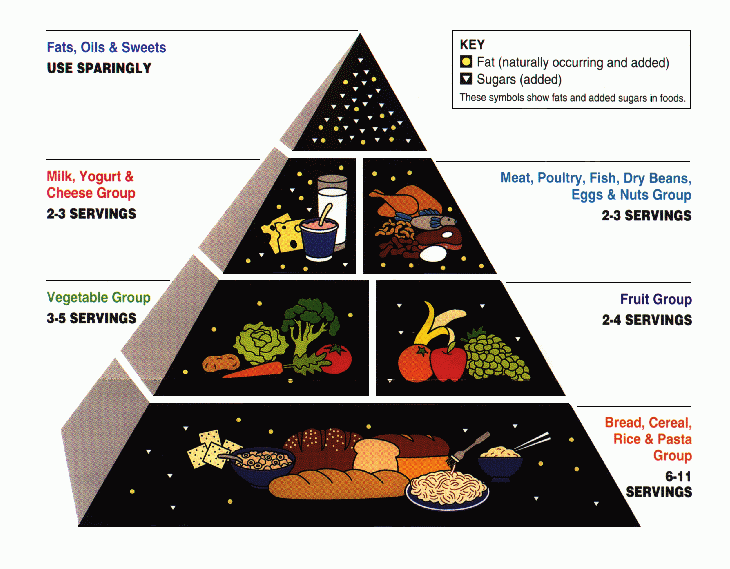
For today, let’s start with a simple tool that is available to all Americans, brought to you by the US Department of Agriculture. You can probably find it right in your own kitchen–check your cereal boxes–the MyPyramid. Yes, that is your pyramid folks. Your tax dollars have paid for it–it would be a shame to see it go to waste. To the untrained eye, it appears like a triangle decorated with multi-colored vertical sections of varying bandwidths– with an alien climbing up some stairs on the side. However, hidden in that simple representation, is the culmination of US Dietary Policy.

The MyPyramid has been personalized just for you. Very obtusely, it suggests moderation, proportionality, variety, activity–and if your version happens to say on the bottom, Steps to a Healthier You–gradual improvement. Boy, you are lucky I am here.

Our government has been trying to figure out how to inform the masses about good nutrition since about 1916. Granted, this is not easy. I imagine those who’ve been assigned the task have resorted to some serious stress eating. From 1956 through 1992, using a minimalist approach, the Four Food Groups, which I grew up on, became the model of nutritional dictate. (This was proceeded by the more comprehensive– and rather rational–Basic 7 model introduced during wartime in 1943–a period of food rationing.) The four defined food groups–chosen to prevent nutrient deficiencies–were fruits and vegetables; meat; dairy; and, grains and breads. Many people still adhere to this model–but having forgotten what those four groups actually were, instead, make up their own. My husband’s preferred groups are ethnic food, ice cream (dairy), popcorn (whole grain), and carbonated beverage.

In the late 1980s, having a few years of nutrition counseling experience under my belt, I took a sabbatical to do some focused research in two distinct areas–both of an anthropological nature. The first included infant and toddler feeding with my son as the subject; and the second involved serving lots of burritos and chimichangas to gringos in a very popular Mexican restaurant. The first was more adorable–though the latter was more lucrative.

When I returned to the field a few years later, I learned that we were soon to be blessed with a long-awaited update of the dietary guidelines–with the experts busily designing what was soon to be ubiquitously known as the Food Guide Pyramid. After years of deliberation and millions of dollars, it was officially released in 1992–smack with 6-11 servings of essentially refined carbohydrates literally forming the base of its recommendations.

Having recognized that the American diet was somehow connected to a plethora of chronic diseases, and using evidence that cultures who ate traditional diets–which included some high fiber, carbohydrate foods like manioc root, taro, and sorghum–were not plagued by heart disease, colon cancer, and diabetes, the experts interpreted this to mean we should increase dietary attention to carbohydrates. (Needless to say, there were many other cultural differences as well.) Fats became increasingly vilified, and giant bagels and bowls full of pasta were elevated to celebrity status.

I was there. I witnessed it all–and I rubbed my forehead in disbelief. You see, I come from a long line of bagel eaters. Don’t get me wrong. Bagels are very good. They contribute to comedy and to cream cheese. However, it is obvious that this is not the foodstuff of those who epitomize physical prowess and longevity. If obesity and chronic disease prevention or lean and mean was what we were seeking, why were we not promoting the Hunza, Masai or Okinawa Diet?

But, so it was. By 1996, just four years after the introduction of the Food Guide Pyramid, the unprecedented increase in obesity, childhood obesity, diabetes, along with some other surprising health concerns was making the headlines. In 2005, after a mere thirteen years in existence, it was to be declared obsolete. President George W. Bush, as part of his Healthier US Initiative, introduced the dumbed-down version of the pyramid, that we are now fortunate to have at our disposal today.

Really, I do not wish to appear so cynical. But, when I look at that colorful triangle, I see what is hidden behind. Not a line drawing but real flesh and blood citizens seriously affected by the lack of a meaningful food policy in this country. I see a populace who was sufficiently seduced and ate what it was fed–regardless of what it may have read in the iterations of these dietary guidelines. Particularly in these most recent decades.

This may seem a moot discussion. It could be argued that few people even pay attention or that the situation will change shortly with the soon to be released 2010 Dietary Guidelines. Many are already aware of the competing interests that influence our health and nutritional policies. However, the reality is that it says a lot that that triangle says so little. And, it still represents the foundation of many dietary organizations’ precepts. I am shocked that the basic understanding of the feeding of human beings is still so conflicted and poorly understood. How could it be so difficult?

If you are holding a cereal box, take a deeper look. If it is a highly processed, artificially colored, multi-sugar sweetened, perversely marketed candy imposter–put down the box, back away and wonder what right the triangle has being on there anyway.

Thank you for listening, sharing, following and supporting my writing. Please subscribe in the sidebar to receive notice of new posts. Comments and greetings always welcome.

In health, Elyn

Update January 2026: The most recent revision of the Dietary Guidelines for Americans and its Food Pyramid have just been released. Take a look. If you are seeing it for the first time at sometime in the future, when things may have changed again, do know things are quite contentious in the here and now.

Also, I don’t know how I have not been aware until now of the brilliant work of food historian, Sarah Wassberg Johnson, and her writings and recorded series on The Food Historian: Food History Blog. She presents some fascinating information that informs how we partially arrived at where we are today, on her talk, When Sugar Was Good For You: The Development of Nutrition Science in America.

kicking butt with krispy kreme

I must strike on this one while the iron is still hot. Or, I should say, while the frying oil is still 375 degrees. That is the temperature for frying doughnuts–and extreme frying is exactly what Krispy Kreme doughnuts is up to. A few years back I gave old Krispy Kreme a piece of my mind when they expanded their territory into my neighborhood. I thought they backed off when I wrote a scathing little article, Magic Doughnuts–The Nutritionist’s Nemesis, showed it to some friends and put it in my drawer. Actually, right after that, the company did suffer some setbacks and had to close some of their stores. But, it appears that they have just reconnoitered. They are back with a vengeance.Image result for krispy kreme cheeseburger

According to my trusty Parade Magazine, they are now cooking up a Krispy Kreme bacon cheeseburger–a cheeseburger with chocolate-covered bacon on a glazed donut– that weighs in at 1000 calories. I am not exactly sure– they or some regional fast-food chain seem to be pushing these in the midwest. They have got to be kidding me. How do these people go to sleep at night? How do they look at themselves in the mirror? The only explanation as far as I can tell is that they may be up to no good.

Our military has had to turn down interested recruits because they are too heavy or can’t pass entry fitness exams. Meeting recruitment quotas is getting more difficult because of this. I’m probably just being paranoid but something seems fishy shall we say. The company’s vision statement actually states “to be the worldwide leader in sharing delicious tastes and creating joyful memories”. Hah! See? Operation Krispy Kreme bacon cheeseburger could quite stealthily advance any plan of domination.

If this explains supply, then what about demand? They could not be using such deceptive weaponry without a corps of unwitting subjects ready to gobble these things up. Who is buying these things? Are they my species-mates? Or, are they lemmings, disguised and accessorized? If they are lemmings, they may think this is a much more fun way to go than just marching off a cliff–but oh boy, do I have news for them. Doughnuts of this ilk are not something little mammals should be messing with. Note to lemmings–Undergoing kidney dialysis as a result of diabetes is not joyful.

Well, last time I wrote a little whiny story. This time, what they don’t realize is that I have been doing the Mark Bittman How to Cook Everything Vegetarian Diet and Weightlifting Program. At a $35 cover price, it beats most other products on the market and you get two tools in one. I am now fit and buff while they are downright doughy. Licensed to save the masses from their own mouths I must be more aggressive now. So, I am going to post that article I wrote a while back and hope that it scares Krispy Kreme– and all the other food companies that are creating caloric catastrophes and nutritional nightmares–into a full-scale retreat. If not, there will be no other option but to call Homeland Security–just to be safe.

Thank you for listening, sharing, following and supporting my writing. Please subscribe in the sidebar to receive notice of new posts. Comments and greetings always welcome.

Related Posts:  Magical Doughnuts-The Nutritionist’s Nemesis and So, What’s the Dilemma?

In health, Elyn

the importance of teaching kids about nutrition

She comes flying into the room and perches herself on the chair facing me. Three minutes ago she had been minding her business sitting in class, unaware that she was one of the anointed ones. Due to her high body mass index (BMI) she was selected to come to chat with me, the visiting nutritionist.  eat-547511_640

Fearless, she presents herself ready for the challenge–with no idea what it may be. I introduce myself and tell her that I am a nutritionist. I ask her if she knows what a nutritionist is. Tentatively she says, “Someone who talks about being healthy?” I praise her response, refine it by adding the food part and tell her that most nine-year-old children don’t know what a nutritionist is. She clarifies that she is almost ten.

Now that we understand the context of our being together, I offer her a carrot. She scrunches up her nose like a rabbit. “No way”, she says. I ask when was the last time she had tried one. Apparently, it was not since she was a little kid and that was a long, long time ago. When I beg a favor and ask if she would try one for me, the terms include placing the garbage can in close proximity. Fair enough. I knew that the carrots I had brought were not the sweetest. However, the girl I had sat with just prior had enjoyed them well enough, so I ventured a try with my new guest.

One bite, one chew and into the garbage it went. “Ewww! It tastes like it came out of the ground!” In educator-fashion, I ask, “Do you know where carrots come from?” “From out of the ground,” she says, in educator-fashion, having proudly proved her point.

OK, moving onward. We discuss what she has eaten today. She is now well into our game and ready to play. For school breakfast–only an institutional plastic cup of juice. There were bagels too, but she hadn’t been hungry. For lunch–a piece of pizza–the every Friday and frequent random day of the month menu item. She only had a few bites though and mainly ate the little cup of cubed pears along with chocolate milk.

Then, as if she had been born and raised in this cramped little space we are sharing, she reaches down to the computer printer that is positioned behind her, deftly removes a piece of paper, takes a colored marker from the case I have on the desk and proceeds to draw me the piece of pizza. She indicates where she took half-mooned bites from around the edges and includes the carton of milk and pears in the picture as well.

I ask her about hunger and how and where she knows she is hungry. With a touch of condescension, she tells me she just has an instinct about when she is hungry. OK, I concede. Whatever the game, I seem to be losing.

She continues her diatribe that though she likes fruits, she does not like vegetables except for corn and lettuce. But, she eats ketchup, and as if daring me, says ketchup is made from tomatoes, so it is a vegetable. It is subtle, but I mutter some consent. She is obviously right as was Ronald Reagan on this issue. I am not about to argue– she is in full control by now. “Peas?”, I meekly ask. “Gross, like little eyeballs.” I had set myself up for that one.

And so it goes. What does she like? The usual culprits she admits–hot dogs, pizza, chicken nuggets, french fries, Hi-C and Kool-Aid. She drinks low-fat milk because her mom gets it on the WIC program for her younger sister. Her mom has diabetes–so she knows that food matters. I begin to ask her, that given our talk would she be interested in trying something new for herself and, before I can even finish the sentence, she says, no she will not try a new vegetable. At this point, I inform her she is killing me. “How did you know this is exactly what I was going to ask?” “I just knew.” I have now officially been schooled.

Finishing up, she says, “Can we meet next week?” Obviously, she thinks I need some serious remedial work. I tell her I won’t be back until next month, to which she sweetly replies that we can meet then. In closing, she adds that she will try to eat less of her unhealthy choices.

Though I am already completely won over, she is not done. She signs the pizza picture for me and offers it over as a truce. She wants me to see how well she writes her name and informs me that she reads above grade level. I thank her deeply, tell her she is a very amazing kid, and we agree that we both had fun.

On a growth chart, this young girl will plot out in the 98th percentile of BMI for her age. Her school will forward her measurements to the state health department and she will be counted as an obese kid. In body, she is, as my mother would have said, a little pudgy. In being, she is lively and lovely and in full possession of her priceless childhood innocence and instincts.

What my conversation with her and others teaches me, is that this area of nutrition education requires a large degree of humility. The story is not only about the weights and measures which is the current focus. And, while I don’t mean to dismiss nutrition education, what our children really need is nutrition provision. We don’t expect children to childproof their own homes–why should we be asking them to childproof their own bodies?  

Our children deserve the birthright of both health and being valued for all that they are. Attention to good quality food in the world inhabited by our kids is what is required. I wish I could submit to the state an algorithmic index similar to that which assigns one’s BMI, but that would instead measure a child’s confidence, grace, and sense of self-worth–a self-esteem index (SEI). This girl’s SEI would be very high–but it might not be for long. I hope I did not cause any damage that day and that instead, it was more of an educational experience. Maybe it is true that teaching kids about nutrition is really important. I do seem to learn something every time.

Thank you for listening, sharing, following and supporting my writing. Please subscribe in the sidebar to receive notice of new posts. Comments and greetings always welcome.

In health, Elyn


so, what’s the dilemma?

While musing about my blog and trying to decide how to best begin to describe what my dilemma is, a copy of chef Mark Bittman’s, How to Cook Everything Vegetarian blocked my path. I say blocked, because at 995 pages and weighing in at about 5 pounds, it is a boulder of a book and boulders don’t simply cross paths. How to Cook Everything Vegetarian : Simple Meatless Recipes for Great Food: Mark Bittman

Last week, despite a 30-plus year vegetarian lifestyle, I was seeking some inspiration– as I was to be soon hosting my neighborhood vegan week dinner. One day, just prior to closing, I ran into my local library looking for a good cookbook, and Bittman’s book insisted that I choose it. I could not argue and lugged the tome home and curled up with the most comprehensive compendium of my culinary clan that I had ever laid eyes on. One does not flip through the pages. Instead, one takes about a one-inch chunk of paper and hurls it over to see what else lies within.

An idea came flashing. Perhaps instead of my ponderous and not very amusing idea to outline the conundrums and frustrations I face in my profession, I could instead, a la Julie Powell who made her way through every recipe in Julia Child’s, Mastering the Art of French Cooking, start cooking and blogging my way through Bittman’s vegetarian bible. Page 38, the first page of actual recipes–simple green salad. Sounds easy enough, but there are then three sub-recipes for greek, lyonnaise, and endive salad. Would I have to prepare all of those too? That could really slow things down if I had to get to page 907. Should I call it Elyn and Mark? Would it take me three years or four? These seem like rightful dilemmas, do they not?

By the next morning’s dawn, reality came slapping me in the face. 6:30 am. Bleary-eyed and making my daughter’s avocado, cheese and spinach sandwich for lunch, an NPR reporter in lighthearted radio voice informs me that 84% of parents fed their kid (ages 2-11) fast food in the past week according to a new report published by the Yale University’s Rudd Center for Food Policy and Obesity. I grabbed for the closest writing implements–pen and paper napkin. Here’s what I hastily got down: advertising geared to children by fast food companies has increased 34% since 2003; despite the increased availability of healthier options, 80% of diners are given french fries automatically; marketing promises have not been kept; something about apple dippers; and, many kids meals still tally up to 1400 calories.

Oh boy, another day at the office. But, I wasn’t even at the office yet. By the time I did arrive, a co-worker had forwarded me additional gory details of the report in a Wall Street Journal article. The reality is though, I don’t need to read such reports. The data presents itself to me on an almost daily basis. By 10:45, a 13-year-old girl weighing 284 lbs. and with frighteningly high insulin levels portending diabetes was sitting before me. There I was outlining the grim details to this middle schooler and her mom. They got it. They weren’t idiots. But, they were up against some heavy outside forces–including billions of advertising dollars. So am I. And that is a big part of my dilemma.

So, for now, I will assign the Bittman project to the back burner. I have other work to do, other people’s stories to tell and other battles to fight. Perhaps best for the moment, I can just gently heave over a copy of Mr. Bittman’s book to this family. It could serve as both a nutritional guide and exercise weight in one. Now there’s a marketing idea. Diet and exercise. That’s all it takes, right?

Thank you for listening, sharing, following and supporting my writing. Please subscribe in the sidebar to receive notice of new posts. Comments and greetings always welcome.

In health, Elyn

(Update 2020: Mark Bittman has released the revised 20th Anniversary edition of How to Cook Everything. At only 960 pages, it features beautiful color photos and recipe updates mindful of sustainability concerns.)