Archives

have it your way at Red Chinese Sorghum Mutton Noodle

Happy Chinese New Year. It is the Year of the Rabbit, but things may not be so cute in bunny land no matter what astrological system you ascribe to. Last month there were reports of a shift in the astrological alignments apparently due to an Earth wobble or precession. This wobble or twist of the Earth’s axis is caused by the gravitational attraction of the moon on Earth’s equatorial bulge. I may not know a lot about astrology, but I do know about anatomy, and with the sudden burgeoning of obesity amongst 325 million people in China, I suspect that equatorial bulges may, in fact, explain the wobble.

About twelve years ago I caught a segment on television, perhaps on 60 MinutesLay’s Potato Chips were being imported to China for the first time and a massive marketing campaign was underway to introduce these thinly sliced, deep-fried and salted tubers served in a colorful and crinkly bag. One early morning as millions of people in some enormous city were bustling to work on foot and bike, a very large display of cardboard boxes was stacked at the entrance of a market.  The boxes were marked with lots of Chinese letters–and Lay’s. People were being stopped in their busy tracks and asked to sample this wonderful new product. Many of them were holding small paper bags of peanuts–their centuries-old “on the go” breakfast. The chips got a mixed review.

This segment was followed by a piece on the rapid increase in childhood obesity in China. Apparently, within ten years of the introduction of American fast food into China, ten percent of urban youth were overweight. Featured was a military boot camp-like program where about one hundred rank and file uniformed kids were being led sternly through a highly supervised exercise program.  This did not look particularly fun, but to the Chinese government, this was no laughing matter.

Five years ago, I attended a conference sponsored by the American Heart Association on obesity. A Chinese physician who now practices in the US was one of the speakers. He said, that twenty years prior–about 1985–when he attended medical school in China, it was extremely rare to encounter diabetes. For his training, he had to travel to a far off province to find a study case. He explained that now, diabetes is so rampant in China, that it is a significant drain on the Chinese health care system, and subsequently on its total economy.

As I sat to write this, my original thesis was that the US had purposefully set out to fatten up, sicken and slow down the industrious Chinese with fast food as an economic dominance tactic– but my research now makes me wonder if it was payback for what the Chinese had done to us–in retaliation for what we had done to them. Chinese cooks and restauranteurs had long ago figured out how to alter their cuisine to meet and oversatiate the American palate– happily to their own economic advantage. Consider that the first privately owned restaurant only opened in Beijing in 1980; while the first Chinese restaurant opened in this country in San Francisco in 1849. According to http://factsanddetails.com/china, there are more Chinese restaurants in the US than the top three large fast-food chains combined. Can that be?

I am often apt to echo Eric Schlosser’s Fast Food Nation rant against food additives and flavorings and how their application to our food supply has fostered an epidemic of food addiction that afflicts even very young children. But, was not the MSG that peppered our Chinese take-out and addled our brains perhaps the grandfather of all such flavor enhancers? Had the Chinese immigrants who were so mistreated here, literally found a way to have us eating out of their hands? Nowadays, Thanksgiving is the only day of the year that Chinese restaurants here are not busy–apparently, it’s a big day for Chinese weddings.

One of the more difficult parts of my work is weaning folk off of General Tso’s Chicken, Beef and Broccoli, and pork fried rice. Big grown men look at me with sad puppy dog eyes and whimper like puppies too. They whine, well how come Chinese people aren’t fat–(or didn’t use to be)? I respond harshly, make them do a hundred jumping jacks and tell them to walk home.

The second that China loosened its restrictions on the West, American fast food conglomerates were ready to flood its shores with a deluge of the additive-enhanced foods we specialized in–and the modern, more prosperous populace was ready and eager to be seduced. The first American fast-food chain to set up shop was Kentucky Fried Chicken in 1987. Apparently, what has been attractive to the Chinese diner is the cleanliness, efficiency, and courtesy of the western establishments where customers get escorted to their tables. This gesture (perhaps along with the under 5-yuan menu) has put western establishments way above their Chinese competitors who actually serve food more accommodating to the Asian palate. However, once exposed to our mischievously enhanced food products, there is no looking back. Even the big Chinese national chain, Red Chinese Sorghum Mutton Noodle could not withstand the heat. Perhaps Confucius say: Kill enemy softly.

Though I know this is not breaking news, it is still hard for many people to fully comprehend the effects of these “manipulated” foods on our bodies. They have contributed to the alteration of the global waistline and median blood sugar level. It is really difficult for me to explain this to the many kind and gentle adults and children who sit before me as clients. How could we imagine that we are sold food that fosters a profoundly unnatural, addictive relationship? But, we are.

Well, I have a few more people in this country to tend to and then I may have to head over to China. Until I arrive, they may need to use some of those ghastly Chinese manufactured plastic food models that they ship here to teach us about food and proper portion sizes. Once there, I’ll have to convince them to reclaim their own cultural snack food of peanuts–or hua sheng. I am told that they do still magically appear if you say pi-jin–the word for beer. One thing I won’t have to contend with there is fortune cookies-the alluring end to an Americanized Chinese meal. Apparently, they originated in Japan and are not at all part of China’s culinary traditions. Still, I must remember, the stakes are high. The wobble may just make this the Year of the Hippopotamus if they do not act quickly.

I leave you with an old Chinese proverb: Wherever smiles happen and happiness is celebrated you’ll find Lay’s Potato Chips. So tell me, how are you going to celebrate?

Thank you for listening, sharing, following and supporting my writing. Please subscribe in the sidebar to receive notice of new posts. Comments and greetings always welcome.

In health, Elyn

community-based nutritionist seeking michael pollan

The time has come for me to pay homage to the food and environmental journalist and writer Michael Pollan, whose book, The Omnivore’s Dilemma, partially served as the inspiration for my blog’s name. I say partially because I am fully aware that I have been waist-deep in food dilemmas way before his book came to be.

Many years ago, when I was a mere neophyte in this work, way before food and eating was the omnipresent topic that it is today, I was simultaneously working my first nutrition job with a WIC-Women, Infant and Children Program in some small-town communities while also serving at a hip vegetarian cafe in a cool college town–all the while trying desperately to figure out how to feed myself. By day, I talked the language of subsidized foods; by evening I enjoyed brown rice and salads with sunflower seeds, sprouts, and lemon tahini dressing; and, by night, I chowed down more than my share of the wonderful cookies we baked at the cafe.

Though I knew how to address pellagra and beriberi, I could barely identify, let alone address, my own anxious eating. Back then, in the late 1970s, I also had friends who were struggling with serious eating disorders–but the terms anorexia and bulimia were barely widely recognized. And, I still thought that the main problem with nutrition was hunger in remote places on the globe. Starving children in Biafra fueled my imagination and passion for helping when I was a kid and inspired my decision to become a nutritionist. Today, I don’t even know where Biafra is. Are there no longer starving children in the world or have they just gotten lost and forgotten in this modern feeding frenzy?

In 1981, my husband, Peter, and I found ourselves seemingly teleported to Dallas, Texas in my Oldsmobile Cutlass with our total life belongings and two cats–for the purpose of a new job. For us, it was a strange new world. Though I still held strong to my Frances Moore Lappe-inspired vegetarian lifestyle and its accouterments of grains and legumes, my heady purist beliefs were no match for that southern heat. One day while staggering around the city looking for an apartment, we stumbled into a Mexican restaurant. Suffering from heatstroke, we feebly ordered some food. I slipped back into consciousness just in time to see Pete about to dig into some dish covered in carne. Honey, I managed to say, we don’t eat meat. Though we did preserve our herbivorous habits in that cattle raising land, we dove headfirst into 7 Eleven’s newly christened, enormous 32-oz. Big Gulp in order to quench our super-sized thirst. It was just the beginning of the marketing of many super-sized offerings, and it was then that I began to realize that the food universe was shifting.

Within just four years of finishing my nutrition studies, I was working in a clinic addressing eating disorders; and only six years later, I found myself in another clinical setting witnessing the cusp of the obesity epidemic. Neither of these issues was ever addressed in my schooling. My nutrition education taught me about the functions of macro and micronutrients; gross deficiency states; approaches to some diseases and food chemistry–but it never really talked about food–where it comes from, how it itself is nourished, or about the importance of quality and vitality. Nor, how to eat it. Thankfully, by then, I had figured out for the most part how to separate my emotions from my eating, so I was a little better equipped to tend to the cares of others–just in time, for the food and eating tornado had really begun to swirl.

I am grateful then for the prolific body of work and its attendant context that Michael Pollan has so poetically brought to us–rounding out the story of understanding food. However, as it clarifies, it adds to the complexity of my work–and so too, to my dilemmas. Trying to translate this information for the folk I speak with on a daily basis is not easy.

Just the other day, I had a chat with my adorable new friend, Tomazeo, a kid in one of the schools where I work. At just eight-years-old, he is really smart and has good penmanship. He told me his teacher says he is a role model. When I told him that nutrition was a big word, and we were going to write it on his folder, he told me that he knows lots of big words, including especially, absolutely and scrumptious. I agreed that those were quite big words. I asked him if he knew what scrumptious meant and he said, “Especially yummy in the tummy”. I said, “Absolutely.” His big brown eyes then asked me, “Are hot dogs healthy?” Oh my, tracing a hamburger from bull to bun, is one thing–a hot dog is yet another. How do I break the news to this innocent child that scrumptious may actually not be so easy to define.

I am guessing that Michael Pollan got stuck in this quandary as well, which led him to publish his elementary primer, “Food Rules-An Eater’s Manual” which he describes as ‘samizdat’ nutrition. I am not familiar with that big word, and I doubt Tomazeo is either, but Pollan uses it to promote a cultural reference point “as an informal and unsanctioned way of negotiating our eating lives.”

If anyone sees or knows Michael, please let him know I am out here and I could use a big chunk of samizdat. To get his attention, tell him that I think he and I have sprung from the same natural island habitat. A vague mention on his website supports but does not confirm, my suspicion that we are from the same exit off of the big native walking path. We may have hunted the same forests, foraged the same fields–and maybe attended the same high school. Emphasize that I am down here in the trenches and need reinforcements to help me with those who are not yet in the choir. Just today, from Stephen Colbert, I learned that those 32-oz. Big Gulps had actually increased to 44-oz. since my last swallow so many years ago. Yikes!

But, mainly thank him for me. He has truly helped to change and widen our understanding of food and nutrition by leading us to understand what we are eating, where it has come from and its many implications for our health and environment. His investigations have accelerated the positive redirection of policies and practices that we are beginning to finally see come to fruition. And, I bet his writings are now included in most nutrition curricula.

And, just one more thing if I may. While only a few know this about me–and have now probably forgotten–I was a (junior) high school cheerleader–yes. Though I have certainly lost the school spirit thing, this may be a reason to revive my hometown pride along with some perky and breath-draining chants. So when you do speak to him on my behalf, can you add in a little — Goooo Michael!!!!– to help cheer him on? Thanks so much.

Thank you for listening, sharing, following and supporting my writing. Please subscribe in the sidebar to receive notice of new posts. Comments and greetings always welcome.

In health,

Elyn
Related Post: Wait, Wait, Michael Pollan

my plate my plate

My Plate Haiku

Don’t eat anything

Your great grandmother wouldn’t

Recognize as food.

by Michael (Pollan)

I Speak for the Fat People-last part

I heard a heartening story about a man and his joy-spreading tactic. Essentially, he spends half of his time acquiring special little chocolates and the other half, gifting them to people as morsels of universal love. I am either becoming a very cynical nutritionist or a very empathic human being. The collective psyche is longing for the morsel of joy even at the expense of the perfect waistline. The truth is that we have appetites and hungers because we are merely human, not because we are bad people. However, when all of these human tendencies accumulate into extra pounds, getting rid of that weight is very difficult.

A few years ago, I attended a conference on an obesity-related topic. During one of the workshops, the speaker, a physician and researcher at a major university, presented a case study of a postpartum woman with a body mass index (BMI) of 30–thus classified as borderline obese. He instructed the audience of professionals to brainstorm how to counsel this woman. The exercise had me squirming from the get-go. As the attendees were dead-ending in their attempts to describe a reasonable approach, the presenter intervened. He said, “Let me offer this idea. I am often in my office at my desk and on the phone. I could just sit there and talk on the phone, but instead I stand and pace as I am talking.” My agitated brain said, “Yes, let’s file that idea to use.” Not with my clients but in this article. I could picture Homer Simpson stuffing one more donut in his face while muttering “Ah, vigorous pacing. That’s the ticket.” I wondered when was the last time this guy got out of his office and realized the experiences of real people, including real fat people and real postpartum women.

TARTA DECORADA HOMER  Y BART SIMPSON

TARTA DECORADA HOMER Y BART SIMPSON (Photo credit: YOCUNA ARTE EN AZUCAR)

Hardly are all designated cases of overweight problematic. Some in the field maintain that the goal is for all individuals to attain an “appropriate” BMI.  Short of that, they will be at risk for various health problems. My intuition and much science beg to differ. Many people are fine–if not perhaps better off–with a little extra weight on them. Pavarotti once said, “The reason fat people are happy is that their nerves are well protected.” My own observations reveal that the neurotically thin tend to be more frayed than their rounder counterparts. Besides, BMI is just a tool. At times it is a cruel tool—or at least a not very nice one. It makes no allowance for age, fitness, or even natural body type–nor pregnancy-related metabolic changes. Whether we like it or not, our bodies will shift and change as we age. Nature, with no ill intent, seems to want to round us out a bit as we mature. That is how we get to be grandpas and grandmas. Appropriate BMI does not necessarily confer lack of health risks–only ones of a particular nature.

Do not get me wrong. I am not undermining the seriousness of the obesity crisis that we are facing. I understand its consequences perhaps more than most. I see the implications of weight that people struggle with on a daily basis and I strive to alleviate the challenges through educational, lifestyle and nutritional support. I bemoan the forces that are propelling our society into ever-expanding levels of girth, especially those that are now affecting our children.

Still, I feel a need to call TIME OUT! To stop the madness that makes those who are the statistics speechless. To stop pointing the finger merely at the individual without an understanding of the deeper forces that are at play.  There are multi-factorial causes that lie at the root of the weight gain epidemic. Many are so abstract or insidious that it is very difficult for the experts—let alone an ordinary individual–to understand what is going on. Though overeating, bad eating, food addiction, and poor lifestyle choices are definitely a part of it, the magnitude of the communal weight gain doesn’t seem to make sense based on calories alone. In the causative mix lie politics, hormones, pharmaceuticals, poverty, nutrition misinformation, dieting, food sensitivities, sensory science, profits, changes in the components of our food, environmental toxins, personal and spiritual alienation and lifestyles spinning out of control.  There are strange bedfellows in each and every fat cell.

Now, back to our friend the Lorax. For the record, the Lorax, our venerable spokesperson, was rather portly himself.  Based on his picture, I’d put him at a BMI of about 27. I’d describe him as neither apple nor pear-shaped but rather pickle-shaped.  According to Dr. Seuss, “He was shortish. And oldish. And brownish and mossy.” The final message of the Lorax in his plea to save the environment was UNLESS. “Unless someone like you cares a whole awful lot, nothing is going to get better.  It’s not.”

I too am rather shortish. Oldish, brownish and mossy may someday also describe me.  For now, my intention is not to imply an ultimatum. It is, however, to bring a greater sense of compassion and understanding–and a broader lens to the discussion and to the approaches to care.

I do not intend to deny the role of personal responsibility—be that for everyone. It is a big piece of the puzzle. Though it is critical that we address the current weight epidemic–we should not do it with an assault on the fat people. We must not slap everyone silly in an attempt to squeeze them into a size six dress or Speedo swimsuit. Besides, who would be left to sing the blues? And though I’d have been happy to find my grandmother at the gym, it could not replace the experience of cuddling up on her big, warm lap with wonderful smells wafting in from the kitchen.

Thank you for listening, sharing, following, and supporting my writing. Please subscribe in the sidebar to receive notice of new posts. Comments and greetings always welcome.

Related Posts:  I Speak for the Fat People: First Part and I Speak for the Fat People: Middle Part

In health, Elyn

my plate

my plate

My Plate Haiku

Hunger tiptoes in

From bellies, hearts or minds

Feed me now she calls.

by Eva

I Speak for the Fat People: middle part

Let’s put the issue of overweight into perspective. If we look at weight historically, I’m pretty certain that from the beginning of time, there have been fat people. We have all seen the pictures of early Cro-Magnon and Neanderthal men. Even those quintessential hunters and gatherers seemed capable of packing on a few pounds. After them came Confucius, King Henry the Eighth, Mamie in Gone with the Wind, Jackie Gleason, Pavarotti, Aunt Bea, and my grandmother. Chances are your grandmother was fat, too.

English: Luciano Pavarotti in Vélodrome Stadiu...

Pavarotti Image via Wikipedia

Since our early beginnings, human beings have come in varying shapes and sizes and large-size was not necessarily an aberration of medium-size. It is good that there are large-sized people. A world without them would mean a world with fewer great opera singers, chefs, women of ample bosom, football players, construction workers, and cuddly grandmothers.

It is not very difficult to become fat. You do not have to go out of your way to try.  If Chinese youth can become fat, then anyone can. Only about 4% of the population has naturally model-thin bodies. That means that many models are starving themselves in order to be models. It also means that the rest of the size 2 wannabes are expending a lot of physical and mental energy in the pursuit of thinness. Carolyn Knapp, in her book Appetites, tells the story of a woman who describes the angst she feels putting on her stockings every morning. She wonders what she could have accomplished in her life with the time she has spent worrying about her weight.

There are the naturally skinny–and then there are the neurotically and pathologically skinny; and the metabolically hyper-activated skinny–those who sustain themselves on a steady diet of excessive caffeine and nicotine—or maybe extensive exercise. For the rest of us, the possibility of becoming overweight is just around the corner. We are physiologically and neurologically wired to pack it on. The ability to store fat came in pretty handy a time or two during our multi-millenial evolution. We have about 107 compensatory mechanisms that prevent us from starving to death.  A bunch of those certainly kicked in to save our forefathers when they were unable to kill a bison. In people who attempt to starve themselves toward thinness, the body fights back–it regains the lost weight plus more, and then absolutely refuses to budge.

In addition, we are wired for comfort. Research shows that the food habits that sustain us are those that we developed while still wrapped in the loving veil of early childhood.  Whether that happened to be gazelle, chicken soup, mashed potatoes or cheeseburgers, you will probably turn to those foods as an adult. Believe me, the corporate world certainly knows this.  The Happy Meal ensures that today’s toddlers will become tomorrow’s adult fast-food consumers.  The concept of comfort foods is one I hear a lot about during my spy missions. Women have confessed to me that they would choose a good loaf of bread over sex. The quality of the sex is not indicated in this context.

Then, of course, there are our natural temperaments as well as good old genetics.  I listened once to the tender story of a woman who was adopted as a child.  She never met her birth mother, but she possessed a very old, poor quality home movie that she believes is of her mother. Though she struggles to see the face better in search of subtle resemblances, it is the woman’s thighs that confirm her finding.  She states, “Look at the thighs. Those are my thighs.”

On top of all this, let’s sprinkle on a life change, or just daily, chronic stress. Take your pick. Break-ups, abuse, graduate school, poverty, working long hours, caregiving, depression or menopause are possible choices. And, God forbid you should simply possess a deep sensuous life-affirming passion for cooking and eating.**  Throw any of these on your plate and if your primal wiring wasn’t enough to enlist you, then current circumstances will. Even the once-thins can become the now-fat–especially in this current milieu where food is literally out to get ya. Not even the high school cheerleader is immune. Any emotional state that is heightened, increases for many, the desire to seek food for a reward. When one is working their way up the weight chart, it is because they are possessed by physical or emotional hunger or physiological changes that they can neither understand nor control.

I can hear you begin to protest that it has to be more than just this. Aren’t we soooo bad?  We ate the piece of chocolate cake (and we loved it). How could we? How dare we?  That translates into four hours of floor mopping according to the calorie expenditure charts.  That must be fair penance for the crime. As a spy, my days are peppered with the monologues and dialogues of self-hate and recrimination that people utter like a mantra before and/or after each foray into eating. The guilt is palpable. We must have all been ____________ in a previous lifetime. (insert your own response.)

(one more segment to follow)

Thank you for listening, sharing, following, and supporting my writing. Please subscribe in the sidebar to receive notice of new posts. Comments and greetings always welcome.

Related Posts:  I Speak for the Fat People: First Part and I Speak for the Fat People: Last Part

In health, Elyn

Related Resources 2010: The end of overeating. Taking Control of the Insatiable American Appetite (David A. Kessler, MD); Born Round:  A Story of Family, Food and a Ferocious Appetite (Frank Bruni)


I Speak for the Fat People: first part

I speak for the fat people. Like Dr. Seuss’ Lorax who spoke for the trees, someone must speak for the fat people. Unlike the trees who needed a spokesperson because they had no tongues, you would think that the fat people would be able to speak for themselves. Of course, fat people have tongues. If they did not have that taste bud laden sensory organ, they would not be fat.  Given the current weight of the world, this group should not be particularly hard to hear. However, in the huge public dialogue about weight and obesity, the fat people are merely statistics. There are no real people behind the statistics, and this is where they have lost their voice.  Therefore, they are stripped of any ability to speak with authority on the topic.

I am not a statistic. Though I have had some years where I toed the chubby line, for the most part, I have done my part in tipping the scales toward societal svelteness. Besides my obligation as a citizen to keep the fat numbers down, as a nutritionist, it is my professional responsibility to pull people out of the fat pool and to keep them from falling in at all.

It is no big secret that the medical and nutritional community has not done a great job in their role as bariatric (the science of obesity) lifeguards. I myself do not have a great track record of turning people into mere shadows of their former selves. But, I have spent my career as a nutritionist hearing the stories and struggles of the fat people and observing the ways of food and eating that define this turn of the century. I am a spy in the house of girth.

The fat community does, in fact, have some spokespeople. There are magazines, journals, and websites edited by those (mainly women) who have spent one day too many in the deprived and depraved world of dieting. There are professionals and individuals who are doing incredible and poetic work about re-informing and re-educating on misconceptions about weight and health and respectful self-care. Still, many of these efforts are marginalized or featured in venues that only topic-obsessed people like myself pay attention to. Even Roseanne Barr once said, “It’s OK to be fat. So you’re fat. Just be fat and shut up about it.” For every individual or undertaking that sings the praises of fat, there are thousands of counter-voices screaming the imperative to whip it away.

Therefore, I believe I must use my credentials to speak out. I hope that the fat people can accept me, a thin person–who is often cold and prone to osteoporosis–and an ex-stress and emotional eater to be their voice. Born of thin mother and fat father, I will try to do the cause justice.

Thank you for listening, sharing, following and supporting my writing. Please subscribe in the sidebar to receive notice of new posts. Comments and greetings always welcome.

(to be continued)

In health, Elyn

Related Posts: I Speak for the Fat People: Middle Part and I Speak for the Fat People: Last Part

Related Resources (2010): (Frances M. Berg); Intuitive Eating  (Evelyn Tribole and Elyse Resch); Health at Every Size (Dr. Bacon); Dances with Fat(Ragen Chastain)


you ain’t necessarily misbehavin’-part 1

Why is this question of nourishing ourselves so difficult? We all know there are some basic concepts surrounding the care and feeding of the human being, but unfortunately, we are not equipped with an owner’s manual. Therefore, as we move through our lives requiring food for both emotional and physical survival, we respond to our needs with some twist based on our own experience; and clearly, some confusion often occurs along the way.

Looking at this question might enable us to have more compassion for ourselves and others in this realm where there is so much self-loathing and self-recrimination. There is probably no other activity that we do with so much community and yet such isolation as feeding ourselves. In the emotional terrain of eating, no feeding decision is made because we are a bad, weak or disgusting person. I use those words because that is how people feel and describe themselves.Image result for mom diner sign images

As a nutritionist, I sit in small rooms hearing people’s stories about their relationship with food, eating and their bodies. These stories are spilling over into the “street buzz” of daily conversation as people are being increasingly consumed by a fear of food and shame and loathing of their bodies. In workshops, I lead an exercise asking people to write down a negative thought they have had about their body that day. I then ask them to write a good quality about themselves that is not related to body image. Reconciling the two is hard to do. Realizing that such wonderful people could be feeling so badly about themselves is enough to make anyone cry.

The power and capacity for these feelings to diminish the human experience is profound and insidious, yet we rarely consider how complicated is the source of the issues. However, such consideration provides an important perspective and may shift where we point the finger. By separating out those aspects related to self-nourishment that we have control over, from those that we don’t, we can perhaps alleviate some of this suffering and can enhance prevention efforts which may be more effective than current remedial strategies.

To understand the distinctions, and to get just a glimpse of how many factors there are, entails a look at human development. Much of our food tendencies begin while we are still pickling in the brine of our mothers’ wombs. Our chromosomal template influences not only our adult body size and shape but more subtle biological processes as well. How efficiently our metabolisms will burn, how our brains will interpret satiety, and how and where we will store fat is all rather pre-programmed on one’s personal dance card—imprinted essentially when sperm meets egg. Our ability to resist a piece of chocolate cake is apparently even coded in our DNA. Some individuals are genetically better “resisters” than others. Who knew, right?

Likewise, women have more sensitive taste buds than men. That second X chromosome can translate into a tendency for food distaste and picky eating that is formed before we are even born. Other aspects of the maternal milieu–or in other words, our intrauterine environment–including our mother’s diet, blood sugar regulation, and calorie availability also will have an effect on our own taste inclinations and feeding behaviors after we are born. Our first eating experience really happens at Mom’s Diner. Pretty crazy.

And that is just the beginning. For now, just chew on this, and in the spirit of loving ourselves, consider how such an appreciation of how we have arrived where we are through very little fault of our own, can translate into some gentle acceptance instead of the usual flagellation with figurative wet noodles–be they whole wheat, gluten-free or basic semolina.

I do not intend to suggest that we absolve ourselves of responsibility for our health and eating behaviors, or that we should just throw in the towel, but perhaps such a reflection can help us to accept ourselves more for who we are and to put a lid on the negative self speak about our bodies. Such scolding and negative reinforcements will never lead to positive change.

Let us return food to its own natural place and let us reclaim our birthright of health. Remember that there is a beautiful light that shines in all of us. Believe that it is there.  Keep trying. We can create a new reality for ourselves.

Thank you for listening, sharing, following and supporting my writing. Please subscribe in the sidebar to receive notice of new posts. Comments and greetings always welcome.

Related Post: you ain’t necessarily misbehavin’-part 2

In health, Elyn

Stopping Traffic

“The public is silent when young women die.” charges Naomi Wolf, author of The Beauty Myth.

I have just returned from an annual conference that I attend on Eating Disorders. The conference, in its eleventh year, is sponsored by The Nutrition Clinic and Sol Stone (Update 2020: Upstate New York Eating Disorder Service); Clearpath Healing Arts Center; and Ophelia’s Place who work together to form a strong, sensitive and progressive treatment network in central New York.

woman-639420_1280

Image by Mystic Art Design at Pixabay   

Each year, near the end of the conference, a handful of individuals in the recovery stage of their eating disorder are invited up to share some part of their story. This is, of course, the most enlightening and always most emotional part of the day. The wisdom acquired in overcoming such a strong opponent is very deep and these very intelligent women articulate it beautifully.

This day, a young woman in her mid-twenties, stood before the two hundred or more attendees and shared that in the darkest days of her eating disorder, she almost walked into traffic–but only stopped herself because she felt it would be immoral to place such a horrible burden on whoever might have killed her. To witness someone so young describe such a depth of despair was both bone-chilling and deeply heart-opening.  

On some level, we know that there are people who are suffering from eating disorders, but essentially they are invisible. However, when one is privy to the stories of those who have had one of these crippling conditions; and you couple that with statistics like one in 100 individuals has an eating disorder—it is imaginable that there are truly some “walking dead” amongst us.

To offer some response to this young woman who had the courage to expose her pain and vulnerability and who has found the strength to persevere and to heal, I bring to this conversation– about the realities of eaters and eating– a discussion about eating disorders. I know that it does not do justice to the topic. It is a contorted and rather incomplete version of something I have written before. But, it seems a fitting time for me to introduce this part of the story. In honor of that woman and the four others who stood before me a few days ago, please consider the following.

We may have seen or heard about someone who is nibbling on only lettuce and carrots at mealtimes; wearing heavy clothing in moderate temperatures; exhibiting extreme weight loss; exercising excessively or appearing listless at a team practice or dance class.  But, to the inexperienced eye, even extreme physical changes or behaviors can be overlooked or ignored. We may have even encountered someone who we suspected was suffering from an eating disorder, but we did not know what to do or say.

Most definitely, we have all had dealings with eating disordered individuals whose behaviors escaped our radar screen. The very nature of eating disorders is secretive and manipulative. Average-weight or over-weight individuals may be suffering as much as their noticeably underweight counterparts; older persons as well as younger ones; and men as well as women. Compounding the issue is that in certain environments like high schools and college campuses—but in the larger world as well—there is a “culture of thinness”. In such environments, underweight individuals can appear almost normal looking. Responses to eating disorders can include, “Oh, I wish I had that problem”, or “Why don’t they just eat?”

Even when we are cognizant and concerned about eating disorders, it is impossible to consider or measure the loss of potential and achievement, the degree of nutrient deficiencies, the magnitude of depression and anxiety, the potential for long-term health problems, and the possibility of sudden death from complications or suicide that eating disorders engender.

Eating disorders tend to leave people feeling frustrated, confused and helpless. Despite this normal reaction, it is really important that our society and our public health policymakers begin to better acknowledge, support and treat those with these disorders.  Without intervention, chances for a full recovery are slim for those with severe conditions.

I have discussed my concern about the panicked way in which we are “battling” obesity.  For many, overeating is an eating disorder–as deserving of a very sensitive and holistic approach to care as does “undereating”. We have the opportunity, and perhaps the obligation, to create an environment and dialogue that challenges the attitudes that make individuals feel bad about their bodies and that feed the medium in which all eating disorders thrive.

We can only hear the wisdom of those who have confronted an eating disorder if we are very quiet. If we can move the lens away from the obesity issue and reframe the disgust we harbor about fat, we may realize there is a gentler and more important conversation to be had about feeding, eating, and nourishment.

Frances Berg writes, “Our children, our daughters, and sons, are growing up afraid to eat, afraid to gain weight, afraid to grow and mature in normal ways. They are desperate to have the right bodies, obsessed with the need to be thin and fearful they won’t be loved until they reach perfection. This is the point to which our weight-obsessed culture has brought us. Our children are innocent victims.”

Thank you for listening, sharing, following and supporting my writing. Please subscribe in the sidebar to receive notice of new posts. Comments and greetings always welcome.

Related Resources: Bulimia.com; Becky Henry, Hope Network; Moonshadow’s Spirit

In health, Elyn

Related Posts: Dolls with Faith, Muse of the Girl, Nourish Thyself Well Day, A Meteorological Change of Plans, Size Me Down

Related Resources: Bulimia.com; Becky Henry, Hope Network; Moonshadow’s Spirit

Are you the 1 in 4?

Some serious news has crossed this nutritionist’s desk. A new study published in Obstetrics and Gynecology and reported by Science Daily shows that 25% of overweight women do not know they are overweight! C’mon. I can see maybe not knowing if you have high blood pressure or an obnoxious personality, but I am pretty sure overweight women are not walking around too delusional.

Image from Pinterest

Of course, once again it is those Black and Hispanic women who seem to be most in the dark about their weight status, along with women who hang with other fat women. But, it could happen to anyone–even you. Do you know your body mass index (BMI)? If not, it is quite possible that you too are a misinformed blob.

This type of media messaging drives me insane. The study involved asking ‘childbearing-aged women’ (oddly, only those aged 18-25) some objective and out-of-context multiple-choice type questions about a very subjective issue. The responses were matched to the (once again) imperfect BMI and the results were interpreted to show that 25% of overweight and obese women didn’t realize they were fat. The study authors conclude from this that this misperception will “lead women to continue to eat poorly, to gain more weight and to eventually develop the complications of obesity”. As opposed to those who are fully aware of their corpulence? If you didn’t deem your body ugly and problematic and its BMI was any higher than a 25–the threshold of gluttony–you clearly have had your head in the ice cream freezer for too long. Tell me, who gets these research dollars? I want some.

The study authors say that they were not surprised by the results based on their belief system that “as the nation’s obesity rate grows, it becomes more socially acceptable to be overweight and the truth becomes obscured.” Those who can no longer see their toes must now be mightily perplexed.

The lead study author says, “people compare themselves to those closest to themselves”. I am not really sure what that means. I presume she is reiterating this other new belief, that if all your friends are fat, and if you are fat, you think that is normal. I thought I was a “normal” weight woman, but, now I’m wondering if maybe I just think I’m “normal” because I spend my days with high-weight people–and can no longer assess my own size.

I work with some real heavyweights. My clients have BMIs in the thirties, forties, and fifties. I realize the privilege and responsibility I have in talking to people about the very intimate topic of weight and body size. Having done this work for many years, I think I have a deep respect for the territory, but on occasion, I too may overstep the boundaries. Sometimes, I am compelled to inform someone that their health may be at risk when it is my conjecture and not their truth.

My days are filled with having very insightful and meaningful conversations with very reality-based individuals–each with their own profound story about eating, diet, and self-care. And all that has influenced these. Most usually, my clients seem to appreciate having an opportunity to safely talk about these sensitive issues. Most are interested in change not because they suddenly realized they were fat, but because something else is impacting their physical or emotional experience. Some have had previous efforts trying to melt away their fat–others, are trying to figure out where to even start.

When they are with me, my clients are very nice, but for all I know, behind my back, they are probably calling me skinny, undernourished, or bony. Perhaps it is time for fat people to reclaim normal and to expand the derogatory language used to describe skinny people. I offer hyperactive, self-absorbed, or neurotic. However, mind you, many are just genetically under-endowed. Overlooked in the dialogue about appropriate weight is that the vigilance, self-scrutinizing. attaining and maintaining required is much more of a privilege associated with socioeconomic status than is acknowledged generally or by the study’s authors.

I would like to advance the Peter Paul Rubens standard of sensual Rubenesque beauty and health. A standard that allows people to feel comfortable in their bodies in the way that much classical art portrays. It’s likely that when we were created in the great creator’s image, a little pudge was part of the package. The correlation between weight and health is not a black-and-white issue as we have been led to believe. Some fat reserves may even be protective.

It should be noted that some of the subjects included in this study were indicated to be postpartum, a particularly complicated, specific, and weight-shifting metabolic period. This mix of non-post-partum and post-partum women, along with other aspects of the study design and its assumptions, makes me leery of its conclusions. Particularly when it also states that “normal weight misperceivers”, or those whose BMI fell within the normal range but perceived that they were overweight, were more likely to engage in unhealthy behaviors including dieting, meal skipping, smoking, and carbohydrate restricting than the overweight subjects.

I am not dismissing that there are serious health issues associated with excessive weight. But, at this point in the game, I would expect a more sophisticated and nuanced understanding of the situation such as that presented by Cara Kulciwki in The Curvature. Based on studies like these, I am just praying that car mechanics don’t start handing out a questionnaire to childbearing-aged women about auto maintenance beliefs and behaviors. When that happens, watch out suburban white women, for we will be royally humiliated. I bet at least 1 in 4 of us mistakenly believes that our tires are properly inflated and that our oil crankcase is full.

Thank you for listening, sharing, following, and supporting my writing. Please subscribe in the sidebar to receive notice of new posts. Comments and greetings are always welcome.

In health, Elyn

Your Pyramid

As a nutrition professional, I would like to share with you some tips on eating well.

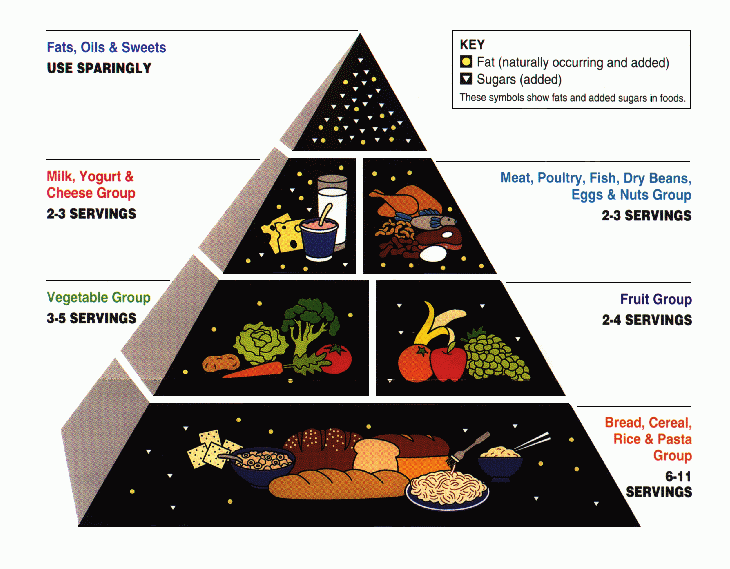
For today, let’s start with a simple tool that is available to all Americans, brought to you by the US Department of Agriculture. You can probably find it right in your own kitchen–check your cereal boxes–the MyPyramid. Yes, that is your pyramid folks. Your tax dollars have paid for it–it would be a shame to see it go to waste. To the untrained eye, it appears like a triangle decorated with multi-colored vertical sections of varying bandwidths– with an alien climbing up some stairs on the side. However, hidden in that simple representation, is the culmination of US Dietary Policy.

The MyPyramid has been personalized just for you. Very obtusely, it suggests moderation, proportionality, variety, activity–and if your version happens to say on the bottom, Steps to a Healthier You–gradual improvement. Boy, you are lucky I am here.

Our government has been trying to figure out how to inform the masses about good nutrition since about 1916. Granted, this is not easy. I imagine those who’ve been assigned the task have resorted to some serious stress eating. From 1956 through 1992, using a minimalist approach, the Four Food Groups, which I grew up on, became the model of nutritional dictate. (This was proceeded by the more comprehensive– and rather rational–Basic 7 model introduced during wartime in 1943–a period of food rationing.) The four defined food groups–chosen to prevent nutrient deficiencies–were fruits and vegetables; meat; dairy; and, grains and breads. Many people still adhere to this model–but having forgotten what those four groups actually were, instead, make up their own. My husband’s preferred groups are ethnic food, ice cream (dairy), popcorn (whole grain), and carbonated beverage.

In the late 1980s, having a few years of nutrition counseling experience under my belt, I took a sabbatical to do some focused research in two distinct areas–both of an anthropological nature. The first included infant and toddler feeding with my son as the subject; and the second involved serving lots of burritos and chimichangas to gringos in a very popular Mexican restaurant. The first was more adorable–though the latter was more lucrative.

When I returned to the field a few years later, I learned that we were soon to be blessed with a long-awaited update of the dietary guidelines–with the experts busily designing what was soon to be ubiquitously known as the Food Guide Pyramid. After years of deliberation and millions of dollars, it was officially released in 1992–smack with 6-11 servings of essentially refined carbohydrates literally forming the base of its recommendations.

Having recognized that the American diet was somehow connected to a plethora of chronic diseases, and using evidence that cultures who ate traditional diets–which included some high fiber, carbohydrate foods like manioc root, taro, and sorghum–were not plagued by heart disease, colon cancer, and diabetes, the experts interpreted this to mean we should increase dietary attention to carbohydrates. (Needless to say, there were many other cultural differences as well.) Fats became increasingly vilified, and giant bagels and bowls full of pasta were elevated to celebrity status.

I was there. I witnessed it all–and I rubbed my forehead in disbelief. You see, I come from a long line of bagel eaters. Don’t get me wrong. Bagels are very good. They contribute to comedy and to cream cheese. However, it is obvious that this is not the foodstuff of those who epitomize physical prowess and longevity. If obesity and chronic disease prevention or lean and mean was what we were seeking, why were we not promoting the Hunza, Masai or Okinawa Diet?

But, so it was. By 1996, just four years after the introduction of the Food Guide Pyramid, the unprecedented increase in obesity, childhood obesity, diabetes, along with some other surprising health concerns was making the headlines. In 2005, after a mere thirteen years in existence, it was to be declared obsolete. President George W. Bush, as part of his Healthier US Initiative, introduced the dumbed-down version of the pyramid, that we are now fortunate to have at our disposal today.

Really, I do not wish to appear so cynical. But, when I look at that colorful triangle, I see what is hidden behind. Not a line drawing but real flesh and blood citizens seriously affected by the lack of a meaningful food policy in this country. I see a populace who was sufficiently seduced and ate what it was fed–regardless of what it may have read in the iterations of these dietary guidelines. Particularly in these most recent decades.

This may seem a moot discussion. It could be argued that few people even pay attention or that the situation will change shortly with the soon to be released 2010 Dietary Guidelines. Many are already aware of the competing interests that influence our health and nutritional policies. However, the reality is that it says a lot that that triangle says so little. And, it still represents the foundation of many dietary organizations’ precepts. I am shocked that the basic understanding of the feeding of human beings is still so conflicted and poorly understood. How could it be so difficult?

If you are holding a cereal box, take a deeper look. If it is a highly processed, artificially colored, multi-sugar sweetened, perversely marketed candy imposter–put down the box, back away and wonder what right the triangle has being on there anyway.

Thank you for listening, sharing, following and supporting my writing. Please subscribe in the sidebar to receive notice of new posts. Comments and greetings always welcome.

In health, Elyn

Update January 2026: The most recent revision of the Dietary Guidelines for Americans and its Food Pyramid have just been released. Take a look. If you are seeing it for the first time at sometime in the future, when things may have changed again, do know things are quite contentious in the here and now.

Also, I don’t know how I have not been aware until now of the brilliant work of food historian, Sarah Wassberg Johnson, and her writings and recorded series on The Food Historian: Food History Blog. She presents some fascinating information that informs how we partially arrived at where we are today, on her talk, When Sugar Was Good For You: The Development of Nutrition Science in America.

kicking butt with krispy kreme

I must strike on this one while the iron is still hot. Or, I should say, while the frying oil is still 375 degrees. That is the temperature for frying doughnuts–and extreme frying is exactly what Krispy Kreme doughnuts is up to. A few years back I gave old Krispy Kreme a piece of my mind when they expanded their territory into my neighborhood. I thought they backed off when I wrote a scathing little article, Magic Doughnuts–The Nutritionist’s Nemesis, showed it to some friends and put it in my drawer. Actually, right after that, the company did suffer some setbacks and had to close some of their stores. But, it appears that they have just reconnoitered. They are back with a vengeance.Image result for krispy kreme cheeseburger

According to my trusty Parade Magazine, they are now cooking up a Krispy Kreme bacon cheeseburger–a cheeseburger with chocolate-covered bacon on a glazed donut– that weighs in at 1000 calories. I am not exactly sure– they or some regional fast-food chain seem to be pushing these in the midwest. They have got to be kidding me. How do these people go to sleep at night? How do they look at themselves in the mirror? The only explanation as far as I can tell is that they may be up to no good.

Our military has had to turn down interested recruits because they are too heavy or can’t pass entry fitness exams. Meeting recruitment quotas is getting more difficult because of this. I’m probably just being paranoid but something seems fishy shall we say. The company’s vision statement actually states “to be the worldwide leader in sharing delicious tastes and creating joyful memories”. Hah! See? Operation Krispy Kreme bacon cheeseburger could quite stealthily advance any plan of domination.

If this explains supply, then what about demand? They could not be using such deceptive weaponry without a corps of unwitting subjects ready to gobble these things up. Who is buying these things? Are they my species-mates? Or, are they lemmings, disguised and accessorized? If they are lemmings, they may think this is a much more fun way to go than just marching off a cliff–but oh boy, do I have news for them. Doughnuts of this ilk are not something little mammals should be messing with. Note to lemmings–Undergoing kidney dialysis as a result of diabetes is not joyful.

Well, last time I wrote a little whiny story. This time, what they don’t realize is that I have been doing the Mark Bittman How to Cook Everything Vegetarian Diet and Weightlifting Program. At a $35 cover price, it beats most other products on the market and you get two tools in one. I am now fit and buff while they are downright doughy. Licensed to save the masses from their own mouths I must be more aggressive now. So, I am going to post that article I wrote a while back and hope that it scares Krispy Kreme– and all the other food companies that are creating caloric catastrophes and nutritional nightmares–into a full-scale retreat. If not, there will be no other option but to call Homeland Security–just to be safe.

Thank you for listening, sharing, following and supporting my writing. Please subscribe in the sidebar to receive notice of new posts. Comments and greetings always welcome.

Related Posts:  Magical Doughnuts-The Nutritionist’s Nemesis and So, What’s the Dilemma?

In health, Elyn