Archives

diet for a small caterpillar

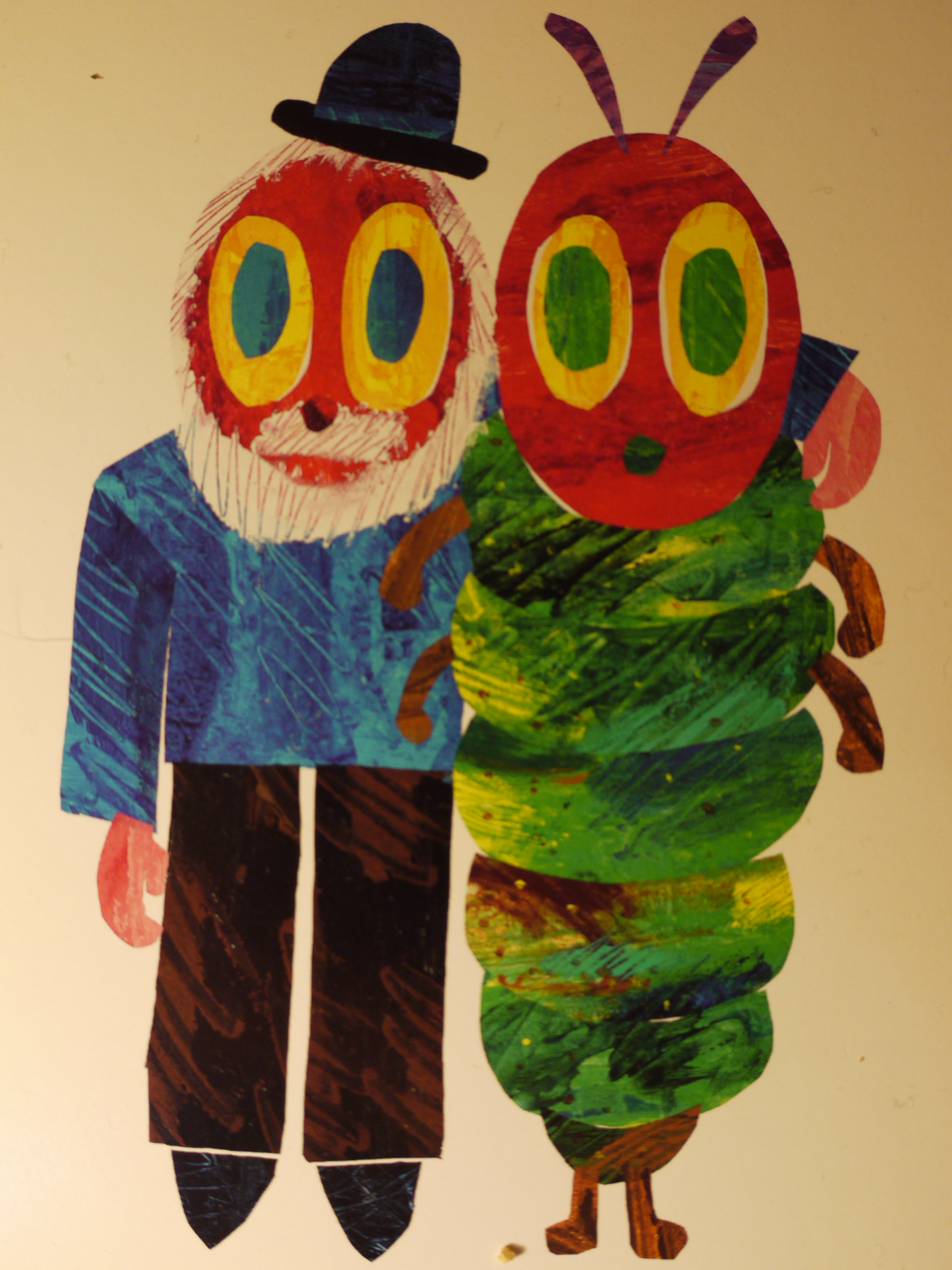
Eric Carle and his Caterpillar by Eric Carle

What reading materials are on my bedside table? I am honored you asked. Right now, I have the catalog for the Omega Institute for Holistic Studies and The Very Hungry Caterpillar by Eric Carle–the story of one caterpillar’s journey to butterflyhood. Though they both relate to personal development, their shared placement is causing me a moral dilemma. You see, I am rereading The Very Hungry Caterpillar because 17,000 copies have been distributed to pediatricians across the country. This is a joint campaign of the American Academy of Pediatrics, the Penguin Young Readers Group and the Alliance for a Healthier Generation.

The cynic in me is ready to rant on this initiative, but with a photo of Thich Nhat Hanh looking at me from the back cover of the catalog, and Omega’s plethora of courses with titles like Embodying Conscious Femininity, Gravity, and Grace and Freeing Ourselves from Negative Patterns oozing out from the inside pages, I am trying to temper my response.

My higher self is saying if you don’t have anything nice to say, don’t say anything at all, offer only constructive criticism, and asking, are you a compassionate, empowering new-tritionist or just a curmudgeonly old one? Well, I will try to open myself up and see what emerges.

Positively, let me say I love children’s literature and its illustration. Not too long ago I spent a wonderful day at The Eric Carle Museum of Picture Book Art in Amherst, Massachusetts. To see the originals of Mr. Carle’s tissue paper art was wonderful. The colors and intricacies of his pictures are even more amazing than they appear in his books. I am grateful that he has created a space to exhibit the collections of the many incredible artists in this genre.

Also, I respect the myriad efforts of the Alliance for a Healthier Generation. A collaboration between the American Heart Association and the William J. Clinton Foundation, its mission is to reduce the prevalence of childhood obesity and to empower kids to make healthy lifestyle choices. Their projects, which include the Healthy Schools Program, are far-reaching, community-based, and creative and colorful in their own way. I use their great materials in my work.

So, what’s my issue with this sweet little book-sharing promotion which is intended to encourage pediatricians to talk with their patients to help families learn about healthy eating habits? To be frank, I am on my thirty-fourth reading of this fourteen-page cardboard book and I am not convinced of its purpose or efficacy for teaching healthy eating.

For those of you who may not know the story, briefly, a caterpillar hatches out of an egg. It is hungry, and through its first five days of life, it eats a hole through increasing amounts of different fruits (one on Monday, two on Tuesday, etc.) but is still not satiated. Then, ignoring the numerical sequence, on its sixth day, it eats a hole through a slice of watermelon–along with eight human-produced high-fat, high-sodium, and high-sugar foodstuffs including salami, sausage, a lollipop, chocolate cake and cherry pie. And, it gets a stomach ache. On the seventh day, a Sunday, it eats through one nice green leaf and feels better. On my most recent reading, I suddenly see this as a religious allegory about sin, redemption, and resurrection, because right after that, all fattened up, he builds a cocoon, stays there for two weeks and emerges as a beautiful butterfly.

Regarding caterpillar growth and nutrition, here is what I know. The caterpillar increases its body mass several thousand times in a matter of weeks and each species has mainly one, and on occasion a few, host plants from which it must eat to survive. Predominantly, they eat only leaves–like from the milkweed family, but a few species can eat flowers and aphids. Analyzing the very hungry caterpillar’s eating behaviors, it has responded to his hunger and high growth needs in a manner similar to that of many teenage boys; problematically, it has partaken in eating foods not optimum for its own species and a lot of them. The messaging here between fruits and junk food along with hunger, satiety and body size is a bit confusing.

The promotional materials for this campaign instruct the parent to teach their child that the fruits are fruits; talk about how fruits are good for the body; discuss how overeating causes stomachaches; expound upon the concept of “sometimes” foods; instruct how green leaves are good for the body, and reinforce that it is important to eat healthy foods so that one can grow up healthy and active like a butterfly. My, that is a heavy load for one little book–let alone one small child.

Maybe I have forgotten a bit about early childhood development, but I think I read this book to my kids when they were about eighteen months old. Certainly, prior to the stage where we were discussing abstract concepts like hunger and health. Even prior to the stage where they might imaginatively embrace the idea that they would grow up and turn into a butterfly. There are many wonderful age-appropriate stories about food, gardening, nature, eating, etc. for young children, and though I am fine with metaphor, I don’t think this is what Mr. Carle had in mind. Now I must worry about children going out and plucking hemlock leaves for a little nibble.

I am glad to report that kids seem to know about and do eat their fruits, though vegetable education still needs a little more work–even for adults. I hope that we do not need to be spoon-feeding parents on such basic concepts; and, additionally, that pediatricians are opening to engaging parents on more specialized and sophisticated aspects of feeding our young than these simplistic measures. They are in a strong position to influence policy, to really support breastfeeding measures, to evaluate infant and early childhood feeding practices and to instruct on the principles of childhood nutrition and appropriate activity.

Might I respectfully suggest providing parents with a copy of Ellyn Satter’s Parent and Child Division of Feeding Responsibilitiesa clear and concise document that addresses the foundations of family eating. And, symbolically, a retreat at the Omega Institute. Their Omega Food Works Dining Hall consciously serves 300,000 vegetarian meals a year using local and organic ingredients. One delicious, nutritious meal like the ones offered there, can speak louder than a thousand words.

Thank you for listening, sharing, following and supporting my writing. Please subscribe in the sidebar to receive notice of new posts. Comments and greetings always welcome.

In health, Elyn

Update May 2021: Acknowledging the passing this week of Eric Carle. In this Eric Carle Commemorative Video, the artist discusses his own thoughts on the meaning of the story and why it captivates the attention of young children. Thank you, Mr. Carle, for opening children’s eyes to the beautiful world of color, art, nature and storytelling. 

Also, for reflections and support for parents regarding children’s health, weight concerns, and the impacts of the Covid-19 Pandemic, please look at the offerings of JoAnn Stevelos at her blog, Children at the Table, and her transformative program, Worthy!: Helping Your Child Be Their Healthiest Weight focused on a foundation of children and parents feeling loved, hopeful and safe. 


wait wait michael pollan

American science journalist and author Michael... Michael Pollan Image via Wikipedia

Oh, dear Michael Pollan. You got schooled–and on National Public Radio no less. I am so sorry. You must realize that nutritionists and comedians are not a good mix–even if you are really just a journalist. You should have known better. I hope you will be more careful the next time.

Here’s where I was when this public humiliation happened. In my kitchen concentrating fiercely on grout. Yes, grout. For the past few months, I have been held hostage by a kitchen renovation project. My release was imminent, but not until I finished grouting the backsplash tile. My contractor guy left me home alone equipped with a grout float, a grout sponge, a bucket and a milk carton-like container of powder with indecipherable directions.

Normally, my husband, Pete, provides me a task and temperament appropriate playlist of music before I undertake such projects–but not then. I just turned the radio on to find the weekly broadcast of the NPR game show Wait Wait Don’t Tell Me. I hear it occasionally, but I am not a regular listener. Just as I was trying to decide if I could really grout and listen to an inane game show at the same time, they announced the guest of the day–food and food economics guru, proponent of the sustainable food movement, and my blog name inspirationeven though he won’t admit that we are from the same once big potato farm–Michael Pollan. I now had no choice but to turn up the radio and begin mixing the grout powder with water.

The host touted Pollan’s accomplishments, listed The Omnivore’s Dilemma as one of his landmark works and asked him to describe some of the basic tenets of his nutritional philosophy. That is where the pounding began by none other than Paula Poundstone. Ouch. It pains me to recall the situation.

All serious-like, Pollan started out by saying we need to distinguish between food and edible food-like substances. Right off, Ms. Poundstone managed to get her mouth in. She announced to Mr. Pollan, that Ring Dings are one of her reasons for living. Were they not considered food? She informed him that they only have three ingredients–devil’s food cake, a creamy filling, and a rich chocolate outer coating. Pollan pathetically informed her that the creamy filling is not real cream. She retorted that it is C-R-E-M-E-Y and asked him, “What the hell’s the matter with you?”

Pollan stammered and began to comfort her that it is ok to have such a treat once in a while. She interrupted to remind him that she said they constituted a role in her reason for living and asked if he was suggesting that she save it for one day a year. Meekly, he said that he would not want to deprive her of that. This “Battle in Berkeley” as the show was called, taped in Pollan’s adopted hometown, was now calling for my attention at the risk of hardening my grout mixture. Poundstone, now ready to fully devour her prey, attacked with, “You may know a lot about food, but you don’t know the first thing about living, buddy.”

The host intercepted, trying to save his guest, and asked Pollan another question. This led Pollan to tell a little story about shopping at ‘The Berkeley Bowl’. The local crowd went crazy at the mention of this Berkeley food oasis. For the wider radio audience, he had to describe the large grocery store as full of all sorts of wonderful produce, grass raised beef, etc. He jabbed at Poundstone, that the store would be like her idea of hell, but the comment fell flat and got no response. The indignity finally ended only after Pollan was made to answer three questions about electronic Japanese Supertoilets. Forget the backsplash. At this, I felt the sclerosis of my own inner being.

This may have all been in the name of fun and games, but to us real nutritional professionals, this is the substance of what we do. The Paula Poundstones of the world are who fill the cracks and crevices of the story behind the dogma–though most are not nearly as funny. Right now, I am considering using a photo of Ring Dings as the graphic for my post. But, I know that mere visual suggestions of such foods can cue unhealthy feeding behaviors. I’d prefer not to feed into that so to speak. But, I will be torn. I am sure they will be more colorful and enticing than any stock photo I may find of Mr. Pollan.

If Ms. Poundstone was my client, we might explore such issues as food addiction, what role food is playing in her life, comfort eating, insulin resistance, effects of sugar, menopausal weight gain, food sensitivities, the seduction of chocolate and motivation for dietary change. Inside, I’d be grappling with the question of what do I know about living and the sacrifice of putting down the beloved Ring Ding and stepping away.

These are the things I muse about daily. The crossroads of food, health, the environment, and pleasure. I am an adherent to the pathways that Mr. Pollan promotes as essential for increased sustainability and to rescue our birthright of health. I am grateful for how his writings have advanced this work. However, I hope he has gleaned that it is one thing to write about this stuff, another to work it in the wild. Throughout my career, I have often joked that after a long day at the office, I am grateful to go out to the parking lot and find that there is still air in my tires. That I have not pissed off the Ms. Poundstones in my role as the messenger and that I have still maintained my sense of humor in this work.

Well, by now, the renovation is done. Fortunately, I have now added grouting and caulking to my resume. By my professional assessment, I think there will always be work to do in the proverbial kitchen.

Thank you for listening, sharing, following and supporting my writing. Please subscribe in the sidebar to receive notice of new posts. Comments and greetings always welcome.

In health, Elyn

The closest I come to comedians is that I keep an article about Drew Carey’s transformational weight loss on the bulletin board in my office. With that, I can trust that he can be solely a source of inspiration rather than nervous perspiration.

Related Post: Holistic, Intuitive Eating, Community-Based Nutritionist Seeking Michael Pollan

My Plate Haiku

Drink tea and nourish life.  With the first sip joy.

With the second, satisfaction.

With the third, danish.

by Jewish Grandpa

a shmear campaign

I really wish I didn’t have to write about this. Other more pressing issues in my brain are asking to be brought forward. However, it was another day in the schools for me, and checking out the cafeteria scene has become one of my pastimes. Here is what I stumbled upon today that I just can’t readily dismiss.

As usual, I approached the lunch line as the little kiddies were lining up, trays in hand.  The black styrofoam mystery boxes stood in formation on the big metal trays coming out of the warmers. I approached the lunch ladies with my pseudo-smile and asked–So what’s for lunch today? The response was, it is not lunch, it is brunch. I was a little taken aback. I admit it was one of the earlier lunch periods, but a quick glance at my surroundings confirmed that this was not Sunday morning at The Four Seasons.

I backed off and decided to see what the kids could tell me. I positioned myself near the little machine where they punch in their assigned lunch number, and then grab their chocolate milk container from the insulated fabric cooler. Really, Jamie Oliver, the cooler carried fifty containers of chocolate milk and two of white, plain, unflavored milk. (I am never sure what is the politically correct name for that milk. )

Image result for bagel-fuls

Bagel-fuls

I asked the kids what’s for lunch. As the meal was still hidden under its patterned plastic wrap, they too were still pretty clueless. All I could see was that there was something wrapped in cellophane with writing on it under the plastic wrap. I soon learned that brunch consisted of two turkey sausages lying on the bottom, appearing quite naked or a tad underdressed if you ask me, a hash brown square, and on top a squished Bagel-ful. Do you have the full picture–or are you stumped because like me you have no idea what a Bagel-ful is?

A Bagel-ful? I did not make this up. Subsequent investigation revealed that apparently Kraft has been marketing this for a few years now and I think you can actually buy these in stores. If you don’t know what a Bagel-ful is, it is a processed rectangular dough product injected with Philadelphia Cream Cheese.

Blasphemy! Is there not some standard of identity for a bagel? Is not a bagel by definition a boiled heavenly dough formed into a circle thereby having a hole in the middle blessed by some senior rabbi and ordained by God? Is a claim of propriety by a food manufacturer not something akin to idol worship? And, isn’t there some omniscient understanding that we should not be serving such meshuggah to children in our schools? How is this for product placement Morgan Spurlock? Is this an example of cost containment in our school lunch programs? Not to mention that the Bagel-ful got heated up in plastic?

Pondering the composition of this meal, I wandered the lunchroom. I think the kids are on to me. Some may be a little suspicious but very deep down I think they know I have their best interests at heart–so they are usually pretty friendly and quite adorable when I stop to chat with them about what they are eating. Today, a kid who chose a turkey sandwich instead of a hot meal asked me to help him to free the sandwich from its plastic bag. It was a good thing I was there. The tie thingy was the kind you can’t undo and you just have to brutally tear the plastic from its tight grip.

My market research showed that a number of kids thought the Bagel-fuls were nasty and did not eat them. However, other kids then asked those kids if they could have it instead. Oh well. The good news is the apples looked good and seemed to get a 100% approval rating. I wonder who made them.

Thank you for listening, sharing, following and supporting my writing. Please subscribe in the sidebar to receive notice of new posts. Comments and greetings always welcome.

In health, Elyn

Moving Day

As I leaned over to pick up the box on the chair, the already strained cardboard gave out and the books that it contained went tumbling all over the floor. So, there I was on my knees scrambling to pick up the books while my guests waited awkwardly in the cramped doorway looking down at me.

The day before, I moved into a temporary office in the basement of the Health Center, as my regular office was about to undergo renovation. It was now the first thing in the morning, my new office was still in serious disarray, and my computer told me that my first client had arrived. Though I do usually try to get a glimpse of some history before going out to greet my clients, I did not then have a chance to do so.

I climbed the stairs which brought me face to face with the people in the waiting area and called my client. Two women stood up and followed me back down to my office. I quickly learned that one of them–my client–was developmentally disabled, and the other was her case manager from the group home where she lived. Arriving back at my new space, I realized I needed to empty a chair so that they would both have a place to sit–and that was when the box of books broke.

I stood back up, welcomed them, tried to glean some history from the medical record as well as the case manager–but never fully regained traction. Frances was a thirty-year-old woman with bright eyes, nice teeth, high tight little pigtails, and a child-like demeanor.  And yes, she was plump.

Right off, she scanned my office with radar-like precision and asked me if I had any cookbooks. The case manager’s eyes widened in surprise. I asked her if she ever had the opportunity to cook. She said no, but that she really wished she did and still thought it would be nice to have a cookbook. I asked her what she would like to cook. She replied cakes, sausage and, macaroni and cheese. Always willing to oblige, I did manage to find a copy of a cookbook I sometimes give out that makes healthy revisions of common comfort food recipes. I read out the names of the listed recipes with enthusiasm. Her mood quickly deflated. Devil’s Food Cake or any other such confection was not mentioned. Still, she agreed to take the cookbook anyway–and said thank you.

I then saw she was a diabetic and was told that her blood sugar was tested two times a day. Frances and her case manager described some rather high blood sugar results, especially in the morning. I learned that she ate meals prepared at the group house, at the day program that she attended, and out at local food establishments. Seeking and procuring food was a frequent activity and overeating a common occurrence. I asked if she knew that being a diabetic meant that she would have to be mindful of eating sweets. Plaintively, she said yes. She went on to explain that when people tell her to not eat sugar she gets very angry. She informed me that she has an anger problem that she is working on, but this type of control provokes her.

She went on. Her father always gave her sweets when she was young, that’s just how she was raised and that’s why she likes sweets. Eating makes her happy. Yes, sometimes her stomach hurts if she overeats, but that doesn’t feel as bad as the emptiness she experiences when she can’t eat what she wants.

It was my turn to be deflated–the dilemma hit me smack in the face–once again. I was in the presence of a truth sayer. I just wanted to hug her and tell her yeah, it’s ok–lots of people are really angry at being told they can’t have their cake. Marie Antoinette might actually be a popular figure in this current milieu.

The next visit with Frances was not fraught with technical difficulties, but the story grew. When I asked the casual question, “How are you?”, she responded that actually today she was feeling rather sad. And, she added, she didn’t really like the cookbook I gave her. Ah, it was the early reminder I needed that I was with someone who did not cover thoughts or emotions. Being with someone like that brings a stark frankness to each moment. It heightened the consciousness that I was possibly apt to be benignly disingenuous or perhaps condescending.

This time she quickly eyeballed a colorful booklet sticking out on my desk that shows how many calories and grams of measurable nutritional components are in various fast- foods. I barely remembered it was there. We explored her eating, and I heard what I already knew, that her breakfasts–as is true for many, including those who are institutionalized in some capacity–consist of lots of pancakes with syrup, sugary cereals, bagels, and fried meats. It is a lot like a breakfast buffet at a hotel but on a daily basis.  She eats what is served and is aware that she eats even more of the tastier offerings. And, it is then, without prompting or apology, she says, “And I binge, because I realize I can’t just eat normally like other people can which makes me feel bad–and this is how I respond.”

Many people spend lots of time and money in therapy to arrive at that awareness. Frances understands the crux of the struggle about food. Food gladly serves in the moment to push down all the pain and sadness that is too hard to feel. Despite her clarity, I am not sure how to give her the options, resources, and resilience that she requires.

Despite my subterranean quarters, I look upward as I often do in this work, and ask for guidance. Dear Lord, do not make me show her how many grams of fat in a Big Mac. Must I utter nutritional pabulum or make her eat Bran Flakes? What have you got up there in the way of holy alternative sweeteners? How about a dose of Big Love? Amen. As always, seeking thoughts, reflections, and hugs.

Thank you for listening, sharing, following and supporting my writing. Please subscribe in the sidebar to receive notice of new posts. Comments and greetings always welcome.

In health, Elyn

breast feeding redux

Poster advertisement for Nestle's Milk by Théo...

Image via Wikipedia

So, here is what happened. Last week I wrote about breastfeeding. On one level I was addressing the possible connection between most babies’ first food and the increased incidence of weight issues in children. On another, I was speaking to the very low rates of breastfeeding in this country and the implications of that as well.

Right after I posted, my friend who is a wonderful adoptive new father responded that breastfeeding was not a viable option for his baby. I felt bad. I know a lot of adoptive parents. And, having worked in maternal and child health for many years,  I know there are some real situations that make breastfeeding not possible for some. There are many women who have really tried but for different reasons have not been able to nurse. I hope I did not appear insensitive. As a health counselor, I am very sympathetic to one’s personal experience– but I also know that our low breastfeeding rates are not caused by these exceptional types of cases.

In my discussion, I had decided to not make apologies or to outline the contraindications to nursing in the limited words I afford my writings. Most materials related to breastfeeding already do so. I had wanted to challenge the oft-repeated message that breastfeeding is challenging, but mainly I wanted to bring the topic of breastfeeding to the table. As a nutritionist, I consider breast milk a quintessential component of the human diet. Once I did, I  thought  I was ready to move on–but as I lingered in the post post aftermath and received some thoughtful responses, I considered that how we feed our babies is a way too overlooked issue in this huge conversation about food, culture, and weight. Breastfeeding is discussed in breastfeeding circles among women who are nursing. Beyond that, not many people ever think about this very important topic–even some parents to be. Most people in our culture have never really seen a baby nursing at the breast. I am highly attuned to watching for nursing babies–and I rarely get a sighting (except for my multi-cultural workplace that offers pre and postnatal care.)

I worry about what a world would look like that really no longer knew how to instinctually nurse its young. So, during the past week, I thought a lot about recent natural disasters where water and food supplies are not available–what happened to the formula-fed babies in the wake of Hurricane Katrina;  I considered the tragedy of the melamine-tainted formula in China that affected 300,000 babies; I wondered about the plastics that every formula feed involves through either bottle or artificial nipple; and, I lingered on antibiotic resistance and even genetic modification of formula. As I was doing all this a few things happened.

Firstly, quite coincidentally, I came upon an article called Cows Genetically Modified to Produce Human Milk. Writer Erika Nicole Kendall in her blog, the Black Girl’s Guide to Weight Loss does not seem to miss much regarding our confusing cultural cuisine–and one need be neither black, young, female or overweight to appreciate the topics she very thoughtfully explores and exposes. Here, she tells about a recent exhibition in China where technical achievements are touted as part of the country’s five-year plan.  Fascinatingly, in ancient China, emperors and empresses drank human milk throughout their lives. Apparently, presented at the exhibition were a herd of cows that have been genetically modified to produce human milk–which apparently contains the anti-microbial, anti-inflammatory agents and the hormones and digestive enzymes particular to the real stuff.  The milk purportedly will preserve and improve the immune systems and central nervous systems of children and will address decreasing breastfeeding rates in that country. Must I explain the irony here?  http://blackgirlsguidetoweightloss.com/news-feed/cows-genetically-modified-to-produce-human-milk/

Then, mon cher French ami who is always on topic in spite of mothering three young children–who she nursed in succession–sent me an article on breastfeeding in France. I learned that France has the lowest breastfeeding rate in the Western world. Mon Dieu. I was shocked and rather nauseated by the story. The nationwide gist is that breasts are for your husband–not your baby. French doctors apparently are in collusion with this imperative of preserving the sexual function of its countrywomen rather than supporting their maternal inclinations. Accompanying comments mocked those who promote breastfeeding as the breast police. Really? Does fighting tobacco advertising and helping people to quit smoking make one the lung police?  http://www.guardian.co.uk/commentisfree/2011/apr/01/france-breast-breastfed-baby-death

And, lastly, just Tuesday night, I watched the first episode of Jamie Oliver‘s second season of the Food Revolution. As he was stymied by the Los Angeles City School District to get into their schools for filming, he invited the public to bring him samples of the foods that the kids are being served there. In the opening scene, he is shown surrounded by a group of people who are presenting to him all types of horrific-looking junk that is splayed out on a table. A woman in the group is carrying a few month old beautiful baby girl. He reaches for the baby who gently accepts his arms. He reminds us how totally pure and perfect our babies come into this life. Seeing this gorgeous little being surrounded by this landscape of low-quality food was a powerful juxtaposition–it is the way I also see the situation.

Before school food, infant formula is the ingredient template that constitutes most of a child’s diet for most of its first year. Aside from added vitamins and minerals, the following are what milk and soy formulas are made of in some variation:  non-fat milk, lactose, vegetable oil, whey protein, high oleic safflower oil, soy oil, corn syrup solids, soy protein isolate, sugar, and coconut oil.  Interestingly, as most formulas now try to mimic the beneficial lipid profile naturally found in breastmilk–mortierella alpina oil and crythecodimium coluni oil are what are used to make them closer than ever to breast milk.

So, I decided, it was a worthwhile effort to pursue this conversation a little more–in the name of restoring, reviving, encouraging a resurgence–a redux of what I consider to be our natural birthright. The right of babies under most circumstances to be sustained on the foodstuff designed for their biology, presented in a form supportive of their neurological wiring and physiologically and hormonally consistent with that of the other member of the feeding dyad–their mother. The rest of the population may benefit as well–even the men.

And, in case some shared wisdom on this motherly art is sought, please check out this very thorough Breastfeeding Tips and Guide lovingly prepared by Sara Spencer. It contains some nice videos including a great one on feeding twins.

I am just wondering, were you breastfed?

Thank you for listening, sharing, following and supporting my writing. Please subscribe in the sidebar to receive notice of new posts. Comments and greetings always welcome.

In health, Elyn

Related Posts: Blessed Feeding; To She Who Loves Us Before She Meets Us; Oh MotherA Winning Goal; First Food

kyuushoku

Lunch in a Japanese primary/elementary school:...

School lunch in Japan Image by Currawong1 via Flickr

Though the menu indicated that today’s lunch was called “Mix It Up Day”, I was not sure what was getting mixed up. To me, it looked like school lunch as usual, except that pizza was not the main entree. Working with the School-Based Health Program, I am usually in one of three of the district’s elementary schools on Fridays which is always Pizza Day unless it is Pizza Bagel Day. But, today was a Wednesday.

I headed into the lunchroom to see what was being rearranged or diverging from the norm. “Good afternoon. What’s for lunch today?”, I politely asked the lunch lady placing the black styrofoam containers on the white styrofoam trays that the children clutched as they moved down the line. “Chicken and cheese”, was the response.

Unable to see the contents hidden beneath the patterned cellophane wrap, I tried another gentle inquiry. With no clearer answer, I realized I’d have to figure it out on my own. On my investigational forays into the school lunchrooms, I’ve learned I must always smile broadly, express benign interest and not ask too many questions.

A few steps down, another lunch lady was in charge of two additional meal components–applesauce and puce green overcooked broccoli mush. Using a metal measuring cup she slopped the oozing applesauce into one of the bare compartments on each of the children’s trays. The broccoli mush, considered an optional rather than a required component, just lay in its big tray, ignored. Reminiscent of poor Oliver’s experience in the orphanage in Dicken’s England, I wondered could there not even be a small effort towards more attractive food preparation and presentation.

Continuing my quest to better understand the school lunch scene, and still needing to discover what that main course consisted of, I moved to stroll among the children who were already seated to eat. I found them contending with a dinner roll, two or three battered half dollar-sized circles–which I think was the chicken, and three battered mozzarella cheese sticks. Only one girl’s tray contained the broccoli mush.

While making my way around and talking with some of these students, I surreptitiously surveyed the number of chocolate v. white milk containers, the contents of the lunches brought from home, what was actually being consumed and the waste filling the garbage cans. Finding the subject matter less than appetizing, I maturely suppressed my prone-to-gagging inner child and focused instead on digesting my observations. I could not discern how this day’s menu was mixed up in any noticeable way from others. Certainly, it was no better.

During my drive home, my attention was grabbed by the news being broadcast about the tragic events unfolding in Japan in the wake of the 9.0 magnitude Fukushima earthquake and resultant tsunami. Suddenly, Mix It Up Day took on a new ironic meaning. I began to think of all the children who would not be having school lunch there on this crazy day or for many days to come.

Listening to the news, I remembered that I’d recently received an online article describing school lunches around the globe. I felt certain that Japan must have been one of the highlighted countries. This country of such rich food culture and ritual could surely challenge the widely held belief that we must serve kids low-quality food because that is what they will eat. I arrived home and found what I was looking for.

School lunch in Japanese is called kyuushoku. The lunches are all prepared in the schools, often by mothers of students who serve in this role on a part-time basis. The meals are eaten in the classroom with the teacher. All parents contribute to the cost of the school lunch program and are invited for lunch at times throughout the year. The children, clad in clean aprons, rotate the job of serving the food and no one can start eating until all have received their share. This is in sharp contrast to the chaotic, cacophonous cafeterias or “cafeteriums”  that define school lunch programs in this country. Recently, I had asked a young girl what she thought about my coming to eat with her in the cafeteria. She astutely replied that I would get a headache.

In Japan, local foods are sourced with regional pride, children grow and harvest some of the vegetables that are used by the school, and everyone receives a printed menu that tells what food groups are provided by the meal. Typically provided foods include rice, rice noodles, miso soup with tofu, grilled fish, seafood stir fry, potato croquettes (korokke), stuffed omelette (omurice), daikon radish, sweet yams, bread, and milk. Forty-five minutes are allotted for lunchtime which is followed by recess. Kyuushoku is a well-planned, healthy, and respectful way of feeding the country’s children.

But now, in that topsy-turvy ravaged part of Japan, lunchtime will really be mixed up for millions of Japanese school children in a way more profound than whatever was intended by today’s menu makers. I pray that their bellies be filled with at least some warm rice or noodles. And, I honor the care and intention that defines how Japan tends to the feeding and nourishment of its young. It would serve us well to do the same.

Any school lunch experiences to share?

Thank you for listening, sharing, following and supporting my writing. Please subscribe in the sidebar to receive notice of new posts. Comments and greetings always welcome.

In health, Elyn

Related Posts: A Shmear Campaign, Pop Smarts, The Importance of Teaching Kids About Nutrition

Updates 2020/Related Resources: Kyushoku Confidential; Unpacking Japan’s Healthy School Lunches; Gohan Society – Japanese School Lunch (watch the video)

Related Resources: Blogger Eats 162 School Lunches In One Year; Healthy Hunger-Free Kids Act 2015

If you are still considering how to donate to relief efforts, please check out the Save the Children website at http://www.savethechildren.org. (inactive link)

IMG_0061 (1)

Japanese My Plate


My Plate Haiku

Did you really think

That you could hide fish in rice?

Oh, the green paste burns.

by Francesco Marciuliano 

from I Could Pee on This and Other Poems by Cats


i surmise with my little eyes

A few years ago, I worked at a college full of bright and creative students. While there, I was invited to serve on a panel for a discussion on “Food: Society and the Environment”. During the event, one young woman in the audience asked me to describe the conditions I encounter in my practice as a nutritionist. Then, and still, I consider this a very insightful and important question, relevant to the issue of how we are feeding ourselves–on the personal and societal level– and what are its implications.

I have worked in medical and community environments as a nutritionist for many years, during a period marked by an increasingly modified and aggressively marketed food supply. At the time of that panel presentation, I was working at both that small, predominantly female college and a large Ob/Gyn office– so my clients were mainly women, ranging in age from about eighteen to forty. And, at the Ob/Gyn office, many of them were pregnant.

A history of poor dietary habits exerts its influence on the health of a society in more subtle ways than the common indicators of end-stage problems like diabetes, stroke and heart disease—but those are the conditions that get the ink. However, increasingly and alarmingly, I see many health issues with dietary or nutritional antecedents affecting young and middle-aged adults. Likewise, I see conditions once only ascribed to aging, presenting in younger people. Perhaps to best appreciate this– if you are more fully ripened– imagine yourself sitting in a college campus student union or going to a Lil Wayne concert. You are not having lunch at the senior center.

I would rather present this in a more artistic format, but for now, I must submit to a mundane bulleted list–along with this lovely painting of Summer by Cezanne. It consists of the conditions that I encountered while serving this young adult population–and only those which knocked on my door with at least occasional frequency–not rare occurrences. 

  • High blood pressure
  • Type 2 diabetes and insulin resistance
  • Heartburn and reflux  (GERD)
  • Constipation, irritable bowel syndrome (IBS), and digestive disorders
  • Gall bladder conditions
  • Moderate to severe obesity
  • Menstrual irregularities
  • Thyroid dysfunction
  • Polycystic Ovarian Syndrome
  • Food allergies
  • Behavioral disorders
  • History of frequent illness in childhood
  • Eating Disorders
  • Depression and Anxiety
  • Toxemia of Pregnancy—a syndrome associated with high blood pressure and kidney involvement
  • Gestational Diabetes
  • Recurrent yeast infections
  • Severe skin inflammations
  • Orthopedic Problems

Bouncing between the two work settings, on most days I had at least one client starving and struggling with an eating disorder and one who weighed more than 250 lbs—who may also have been struggling with an eating disorder. As the numbers on the scale were both decreasing and increasing, so was the volume of the diatribe against the body. Both were distressing to witness–as was considering young, diseased gall bladders.

Some of these conditions are interrelated; and many are exacerbated by stress–another marker of dis-ease affecting our youth. The prevalence of these conditions also means that many of this millennium generation is on at least one medication, including those that treat depression, anxiety, blood pressure, heartburn, inflammation, behavior, and hormones. The use of these medications will result in increased prescriptions for erectile dysfunction and osteoporosis medications for this generation as well.

My contention is that young children who are exposed to processed foods, do not develop the ability to appreciate the more distinct and varied flavorings of more natural foods—especially those of the plant kingdom. Therefore, these more healthful foods are not incorporated into their food vocabularies. These young children grow into big kids and young adults, quickly accumulating the years that their bodies are exposed to altered, nutrient and enzyme-deficient foods.

Craving the whole foods that our bodies and brains require by design in order to function, an underlying “true” hunger festers and grows. The hunger is either pursued voraciously or feared and denied. Even in the middle ground, before too long, this compromised nutritional state can take its toll and the above conditions can manifest.

One of the difficulties of inspiring behavioral change in regard to eating and nutrition, and in explaining how food matters, is that it is not very easy to show direct cause and effect between food choices and health outcomes. Many might argue that they would prefer to just eat happily and without dictates—even at the cost of a possible slightly premature end.

Could considering the consequences that physically and emotionally damage us decades before the final blow serve to amend such an attitude? Attention to dietary change has become essential. Through positive food experiences may we begin to show that nutrition can prevent not only life-threatening conditions but life-limiting ones as well.

Any thoughts on this? Any reflections of how you eat/ate at this phase of your life? Please let me know.

Thank you for listening, sharing, following and supporting my writing. Please subscribe in the sidebar to receive notice of new posts. Comments and greetings always welcome.

In health, Elyn

you ain’t necessarily misbehavin’– part 2

A while back, in my post You Ain’t Necessarily Misbehavin’, I began to explore the topic of how we arrive at being the eaters we are today, and how we berate ourselves for so many things that we had little control over.

The last week of February marks the observation of National Eating Disorder Awareness Week–which also has been expanded to reach out to the many who live in daily distress from hating their bodies. I have not been sure what to add to the conversation which is so ably cradled by many wise people. However, as this struggle is so relevant to the story, and such a part of the fabric that we are all woven into, I offer a continuation of the examination of how our relationship with food and eating gets shaped. Last time, I left off, just as we were being born.

After we slide out or are plucked from our mothers’ tummies, the messages regarding food and security are profound. Influencing this stage are many factors: how our cries of hunger were responded to; if food was used to placate other needs; whether our cues of satiety were observed; or if we were encouraged to keep feeding according to some external measurement.Image result for crying babies images free download

The emotional state of our caregivers also colors our early feedings. A premature or reluctant feeding infant whose parent anxiously counts every milliliter consumed is having a different sentient experience than the content babe who nuzzles and guzzles while mother hums dreamily.

Whether we are breastfed or formula-fed also may affect us. A breastfed baby exposed to a wider palette of flavors based on mom’s diet may develop greater food acceptability than the formula-fed baby who gets the same recipe with each feeding. Also, fullness (and growth) may be appreciated differently, due to the difference in the composition of human and artificial milk.

Other subtleties influence this early feeding stage. Our innate temperaments reveal if we eat to live or live to eat. Some babies internalize the joy of clutching the breast or bottle as core to their being; others see the business of feeding as a mere requisite to the more important work of exploring the larger world. Certainly, much is anchored when we are merely minutes, days and months old.

Then, soon enough, we are small children. By the age of four, by my calculations, we have already had at least eight thousand, seven hundred and sixty eating encounters–and we are already pretty savvy little humans. We have begun to glean that food serves a greater purpose than fueling our bodies for play. It is somehow powerfully linked with love and affection and has powers way beyond its nutrient content. Candy can mend a hurt, ice cream can cool our heated outbursts of emotion and creamy, warm, familiar foods will bring comfort in a heartbeat. We know if food is abundant or if it is scarce.

Another message we receive at this time is that our own bodily sensations are secondary to behaving according to the rules. This ensues when we are told we must wait until mealtime to eat and that we must clean our plates; or, that we are eating too much or too little. These common parenting practices can serve to teach us that our own feelings are not valid and can begin to detach us from natural signals of hunger and fullness. Age-appropriate feeding should match and support the normal physiological and growth needs of young children. (An understanding of the principles of feeding dynamics are best gleaned by reading the work of Ellyn Satter, social worker and dietitian who pioneered research in this area. Her Division of Responsibility in Feeding should be the crux of all childhood nutrition education.)

When we are a little older we may begin to experience disconnects regarding food and our bodies. As little children, we do not differentiate ourselves from our environment. This sense of separation–and its attendant self-awareness–does not occur until a child reaches the age of eight or nine. But, with the early introduction of media and abstract reasoning in both schooling and socialization, this change is happening at an earlier age. I believe this is why eating disorders now manifest in younger kids.

Exposure to a barrage of images with distorted messages about feeding, body image, and personal values affects everyone, but it is particularly detrimental to at-risk individuals. Unfortunately, we cannot identify who is at risk. Interestingly, non-industrialized cultures only begin to show eating disordered behaviors after television becomes available.

With self-awakening, we are catapulted into self-reflection. Girls navigating through this time yearn to be let into the “club”. We enter the kitchen; we sidle up to our mothers, their friends, the aunties, and the older sisters. We listen to their rich stories and are sensitive to their attitudes and judgments. Often we hear women dissect and belittle their bodies, and the chant of the societal and personal mantra “I’m so fat” begins to penetrate our beings. We take all of this and figuratively stuff it into our new training bras and bikini underpants as our bodies begin to take on form and shape.

This is a very vulnerable period in the evolution of feeding behaviors. As a girl’s body begins to change rapidly, and she experiences the emotional and physical hunger that accompanies that growth, any chaos, fear, abuse or significant uncertainty in the outer environment can cause the body to become the battlefield for unexpressed emotions. We can stuff emotions down by overeating or we can deaden them by starvation. For some, negative comments from important male figures can solidify maladaptive behaviors that might have otherwise remained transient. Though girls may be more susceptible to this change, boys are by no means immune when they begin their maturation.

By adolescence, the stage is essentially set as the cascade of sex hormones takes up residence, settles in and rounds out the edges of our physical and emotional beings. After this huge developmental landmark, barring a few other components like what we eat, we just ride the waves, responding to food based on the summation of our earlier nature and nurture experiences.

Does this resonate with you? In honor of this week, please take a moment to think about your own story. No judgment, no blame, just acknowledge it. There may be much to actually appreciate. Practice replacing bitter feelings about your body with kind thoughts. Refrain from all trash talk about other people’s size as well as your own. If you suffer, or if you know someone who does, or if you just care about this subject, please find appropriate and supportive resources including the National Eating Disorder Association. Any sharings here will be deeply honored.

Thank you for listening, sharing, following and supporting my writing. Please subscribe in the sidebar to receive notice of new posts. Comments and greetings always welcome.

Related Posts: You Ain’t Necessarily Misbehaving, Part 1; The Tempted Temperament

In health, Elyn


Pop Smarts

Pop-Tarts Frosted Strawberry

Pop-Tarts Image via Wikipedia

Last week was a rather discouraging one for this persevering nutritionist. I knew it was bad, as on Friday I found myself contemplating stopping at a Dunkin’ Donuts and just drowning myself in one of those massive confectionery pond-sized drinks, weighted down with heavy donut shoes.

The final straw so to speak had occurred just moments before. On Fridays, I work in some elementary schools. As I was packing up my Mary Poppins basket musing on the students I had spent my day with, an announcement came over the loud-speaker. The principal was congratulating a boy for his lack of tardiness or absenteeism for the month of February. His reward was that he’d get to share a Burger King lunch with her.

Really? Why don’t you just shoot me in the foot? Well, maybe this boy was being given his fair reward. All the other slackers who had managed to show up on this day got a greasy, square piece of pizza, a cellophane-wrapped bag of carrots (which is more appealing than most of the veggie offerings) a blob of half-frozen mushy blueberries–the ice crystals were visible– and a chocolate milk on their non-recyclable styrofoam tray. That should teach them not to miss school.

The night before I had been at a charter elementary school. I was a presenter with two other speakers on healthy choices for school success. I had been excited that the school had focused a parent meeting on this important topic and was glad to have been invited. Despite good intentions on behalf of the school, only six parents out of a student body of 300 attended. Still, we did our thing.

Out of my Mary Poppins basket, I  passed around, along with some other nutrition shockers, a well-worn packet of Pop-Tarts with an attached baggie filled with the eight and a quarter teaspoons of sugar that it contains. I asked the participants to look at the long list of gruesome ingredients as I talked about nutrition and brain health. After the talk, a staff person approached me. She meekly told me, that if kids get to school late, and miss the provided breakfast, they are given Pop-Tarts. Given the rewarding of non-tardy behavior to only one recipient at the other school, I surmise that no small number of kids are getting their brains doused with such artificial intelligence here. I felt like I was going to cry.  (We did come up with some alternative ideas for the school though.)

Oh well, no biggie. Maybe I was just sensitive because the day before that I had a new eating disordered client who was restricting herself to three hundred calories a day. Or, maybe it was the young diabetic who I had spent many teaching moments with, who came in the day before that with a high blood sugar of 227 and told me that she had a beef patty, some Pringle-like potato chip I had never heard of, three Oreos and a large-sized can of Arizona Green Tea for breakfast.

Perhaps, most disheartening though was the doctor who totally ignored my concerns about the severe dietary deficiencies of a patient we shared–whose support I really needed to facilitate her care. Like the scenarios I described above, this is really nothing new to me. Doctors untrained in nutrition, give short shrift to diet, except for some lip service when it comes to blood pressure, weight, and cholesterol. I am rather used to being ignored by physicians.

I do not expect my clients, my students, and even school administrators to fully get this whole food and nutrition thing given current conditions. Those with eating struggles would not have them if they were easily understood. Individual schools are not easily able to remedy foodservice  and budget limitations. Teachers have many other matters to attend to.

But, I do really expect that by now, even conventionally-trained medical providers would appreciate the connection between diet and health and would give attention to meaningful dietary assessments in supporting the treatment of their patients. It is recognized that patients whose doctors inquire about their smoking habits and are told to quit have higher smoking cessation success. To help turn the tide on the nation’s health crisis, doctors’ true embracing of dietary health is essential. Last week, I really needed that doctor to express to our patient who was in the office, concern about her eating and to provide to her some basic nutritional support. Instead, out the door, the patient went, with a prescription for one more drug in hand and no mention of my recommendations. I slumped in my chair.

Usually, I can handle situations like this with more aplomb. Maybe I am just a bit depleted in B-vitamins which lowered my resilience. Never mind. Time to re-fortify. Onward.

Thank you for listening, sharing, following and supporting my writing. Please subscribe in the sidebar to receive notice of new posts. Comments and greetings always welcome.

In health, Elyn

wings of desire

I have been hiding under the covers since before the Super Bowl game. This was not the weekend for peace-loving nutritionists. Too much head bashing and too many food blitzes for my liking.

Dear Sweet Luna

A few days prior to the game I was at the supermarket. I saw a shopping cart filled with about twelve cartons of frozen pepperoni pizza. I thought it was being used to stock the freezer section, till I saw a guy proceed with it to the check-out line. It vaguely dawned on me that this might be due to the game. I then saw legions of 2-liter soda bottles marching out the door along with armored tanks of beer. Little bags of celery sticks were unwittingly running behind. Little did they know they would soon meet their fate, drenched in fat-laden dip, in mouths that mindlessly devour whatever comes near.

While often feeling like the nutritional equivalent of Florence Nightingale, ready to mend and tend with soothing bowls of oatmeal and blueberries, this is a battlefield I will not administer to. Spectators and players alike are not innocent victims. They participate in this bloody sport of gladiator gore and gluttony of their own volition. The players come to score while the spectators come to gape and gorge.

Being big is an asset in football. However, even that begs a hefty question. How big is big enough? In 1970, only one player in the NFL was over three hundred pounds. Now 532 players or 25% of the league claim that distinction. This excessive mass is detrimental to the players and to their opponents alike. It is well documented that these very large offensive and defensive linemen suffer serious health consequences related to their size and eating behaviors after the end of their careers, and increasingly, while they are still active players. Even in this well-padded professional sports league with all the resources in the world, it is only recently that nutrition is being carefully considered. How do you promote strength and power in these guys without jeopardizing their health, and prevent turning them out to pasture to fend for themselves–often sooner than later.

So, if the guys with the big contracts hardly get the support they need, the shlubs on the couch in the den eating with pure Pavlovian abandon are entirely on their own when it comes reckoning time. Is it just me, or has the ferocity of the Super Bowl Game Glutton Fest actually increased in the past few years? Genteel women– including some of my own friends– now converse about watching the game, what team they are for and what they are serving. We have now been seriously programmed with Big Brother intensity to associate this event with bingeing. The Bowl brimmeth over.

While under the blankets with a flashlight, I read that the day of the game is called “Restaurant Christmas”. An article in my newspaper about local food establishments anticipating the big day described a restaurant that “uses a computer spreadsheet to track orders and strategically positions 15 employees to produce and deliver the restaurant’s maximum capacity: 300 wings and seven pizzas every 15 minutes. They expect to churn out more than 5,000 wings and in excess of 100 pizzas.” I think that means 2,500 chickens and many tomatoes were sacrificed for the game plan just at this one place. Again I ask, can this possibly be?

I don’t mean to sound like a party pooper, though that’s not really a big problem ’cause I didn’t go to any party to poop on–though I did surprisingly actually have two invites. One was from someone who doesn’t really know me and should be glad I didn’t show. However, the whole scene just exaggerates our already extreme daily eating that severely compromises our health. If this was truly a one-day event that would be one thing, but sadly, it isn’t. Or, if our health care system just had to carry the weight of a few shoulder injuries and some bruised egos, but that is not the reality either.

So, like that other February icon, Puxatawney Phil, I must try to venture out from my hole. If I don’t see another major food holiday in sight, maybe, just maybe, I can just predict a salubrious spring. And, Happy Valentine’s Day. Enjoy the Dark Chocolate.

Thank you for listening, sharing, following and supporting my writing. Please subscribe in the sidebar to receive notice of new posts. Comments and greetings always welcome.

In health, Elyn

Related Posts: Peepin’ Out; Spring Cleaning and the NBA Finals; Skinny Boys

(Update 2020: Just in. The Frito-Lay U.S. Snack Index Report for Super Bowl LIV. This is quite a compendium of snacking statistics and financials. Retail sales data shows Super Bowl Sunday is the biggest day of the year for salty snacks, generating approximately $520 million in one day. Historically, Frito-Lay produces approximately 600 million pounds of snacks in the six weeks leading up to the game – nearly 20 percent of its annual snack production – and more than 67 million pounds of snacks the week of Super Bowl. If you’re looking for me, I’ll be back under the covers.)

Thank you for listening, sharing, following and supporting my writing. Please subscribe in the sidebar to receive notice of new posts. Comments and greetings always welcome.

In health, Elyn

Related Recipe: Vegan Keto Buffalo Jackfruit Dip