Archives

inventive incentive

To make bread or give love, to dig in the earth, to feed an animal or cook for a stranger—these activities require no extensive commentary, no lucid theology. All they require is someone willing to bend, reach, chop, stir. Most of these tasks are so full of pleasure that there is no need to complicate things by calling them holy. And yet these are the same activities that change lives, sometimes all at once and sometimes more slowly, the way dripping water changes stone. In a world where faith is often construed as a way of thinking, bodily practices remind the willing that faith is a way of life. Barbara Brown Taylor ~ (An Altar in the World: A Geography of Faith)

On a cloudy and dreary Saturday morning in October, I headed into Albany to catch up with the ever-busy Veggie Mobile in order to get a glimpse of the Veggie Rx Program in action. It had been almost two years since I began administering this program that I had helped establish at the Health Center, and as a concerned mom, it was time for a periodic check-up to see how it was doing. 

veggiemobile

Capital Roots Veggie Mobile


Veggie Rx is a “produce prescription incentive” wherein fruits and vegetables are “prescribed” to medically high-risk patients by their health care providers as a means to encourage healthier diets and to improve health outcomes. Similar programs have begun to emerge in the past few years, and are being considered as a model of a viable public health intervention for disenfranchised communities. This medically-housed approach provides powerful messaging, unique for an institution that traditionally proffers mainly pharmaceutical solutions and well-meaning but often weak recommendations for health behavior change. It affirms, “Let food be thy medicine.” 

Veggie Rx was initiated as a collaboration between Capital District Community Gardens (CDCG) (now known as Capital Roots) and the Whitney Young Health Center and funded by the NYS Department of Health’s Hunger Prevention and Nutrition Assistance Program. It was designed as a pilot to serve fifty persons with diabetes and/or hypertension. Once recruited and enrolled, the participants receive “prescription coupons” valued at $7 each, which can be redeemed once per week on the CDCG Veggie Mobile. They also receive an additional food bag valued at $4 provided as part of the Veggie Mobile’s Taste and Take tasting program each time they shop.

The bio-diesel fueled, hip-hop pulsing, “produce aisle on wheels” Veggie Mobile which I chatted about in No Passing, toodles around many Capital District neighborhoods most days of the week, year-round. It irrigates identified food deserts by arriving at a variety of community locations where anyone can shop, right on the truck. It is somewhat akin to an ice cream truck except that it hawks an impressive array of fresh fruits and vegetables, much of it from local farms. 

I met up with the Veggie Mobile that day in the city’s Arbor Hill neighborhood. Parked at the corner of a side street, it was a burst of color in a rather gray landscape. That brightly painted truck always shows up representing the rainbow, but it is the activity that it fosters that is the pot of gold. Among the customers were two Veggie Rx participants. One was a woman whom I had just enrolled in the program. She was there with her two young granddaughters. ‘Patient with diabetes’ instantly transformed into ‘loving grandma’ as I watched her solicit the girls’ advice for what to choose.

The other was a gentleman who had been enrolled for a while but who had not really participated. I had recently called him to discuss removing him from the program—but he asked for another chance. He explained that he had experienced a host of health problems but was feeling better and really wanted to have this opportunity to improve his diet. Sure enough, there he was like a kid in a candy shop–but instead of candy, he was purchasing a sophisticated assortment of produce.

After an hour at that location, the dedicated Veggie Mobile staff women closed up shop. I hopped in my car and followed them as they got back on and off the highway and made their way over to the next scheduled stop at a low-income housing complex—not too far from the Governor’s Mansion. Arriving there, about fifteen people were already waiting–men, women, and children–including two more Veggie Rx participants. They were surprised to see me and greeted me with smiles and hugs.

This was a busy site, so I assisted with bagging while anchoring myself at a good vantage point. Shopping on the Veggie Mobile begs some patience—but perhaps not any more than waiting in a fast-food drive-thru line. Here though, was connection, community and lots of conversation about good food. There was squeezing back and forth as people reached to add another sweet potato, banana or onion to their order. All forms of “monetary green” (cash, SNAP EBT cards, New York State Fresh Connect, and Farmer’s Market Coupons–along with the cute Veggie Rx coupons) were exchanged for “nutritional green” (collards, kale, green beans, green peppers, and broccoli). It was a beautiful sight to behold.

Despite my sheer love of this program, I am still not sure yet if these incentive initiatives are token, feel-good, short-term experiments–or the templates for a new health and food revolution. Are they worth the effort for the few that they serve? Can they put even the tiniest dent in the massive and complicated problem they are trying to solve, and might a few fruits and vegetables a week really affect change?

What I  do know is that I have seen Veggie Rx change the behaviors and well-being of many of those in the program. Let me strengthen that. I have witnessed some profound changes. There has definitely been some powerful “medicine” going down. Participants have started juicing, making smoothies, and taken to more plant-based diets. Many have attested to feeling better and have noticeably become more enlivened. While I have also noted improvements in individuals’ health markers (weight, blood pressure, hemoglobin A1c)–to see these markers shift in a significant way for this highly health-challenged population will take time. I caution not to base the success of these types of programs solely on those indicators–it is too myopic a lens.

Veggie Rx offers more than just food access and is about something greater than fruit and vegetable intake. Relationship building is the true foundation of this program. This power of relationship–between participants and the Health Center and Veggie Mobile staff–is not to be underestimated. Having undertaken an evaluation of this program and through my direct contact with the participants, I know that they feel better valued as both patients and consumers which increases their engagement in both roles. I also know that they consider this program to be a blessing in their lives–those are their words, not mine.

Participation comes with some requirements which asks something deeper of its recipients–like standing out on street corners in the cold, shopping in cramped quarters, finding a specific time and place to shop, and committing to follow-up medical appointments. Not everyone enrolled has taken advantage of the program, but the majority have–and some quite extensively.

As a metaphor for, or a substitute expression of the universal yearning to return to the land, the capacity to access the bounty of the earth perhaps subconsciously reminds us of the connection to our source and our birthright of health. The mere act of showing up and filling one’s bag with beautiful produce yielded from the soil reflects a powerful commitment to one’s self. Standing witness on that morning shed light on what a new paradigm of healthcare could look like–particularly in response to the problems associated with health disparities–but in the larger context as well. I returned home with a reassurance that my little toddler-aged program was doing well. I can’t wait to see it grow.

Thank you for listening, sharing, following and supporting my writing. Please subscribe in the sidebar to receive notice of new posts. Comments and greetings always welcome.

In health, Elyn

2024 Update: “We are not going to ‘wellness’…our way out of a…health crisis that is a direct outcome of structural and economic violence and inequality.” Yolo Akili

Related Resources: Food Trust/Policy Link:  Access to Healthy Food and Why it Matters;

IMG_2051

J’s My Plate

My Plate Haiku

Food is medicine

Farmers are doctors, Cooks priests

Eat, pray, eat, pray, love.

By Gordon
dominique et moi

November was Diabetes Awareness Month. Or, so I am told. For me, every month is diabetes month and every day is diabetes day, as nary an hour goes by without my sharing sacred space with someone who has diabetes. Sometimes this is the shell-shocked newly diagnosed, other times, it is the weary veteran of the disease.

So, a few weeks ago when my dear friend and favorite Diabetes Educator, Marie, handed me a flyer of some local events in my community, sponsored by the American Diabetes Association, I agreed to distribute copies to my patients. Looking it over, I caught sight of something interesting. Tucked among the listings for some talks at a nearby hotel on various dietary topics, like Healthy Eating for the Holidays was mention of a presentation to be made by Dominique Wilkins–the former NBA All-Star who played primarily with the Atlanta Hawks. My inner basketball jones, relatively well-tuned from my life with Pete and Morgan perked up.

photo (2)

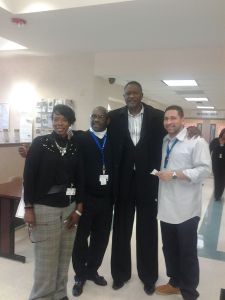
Former NBA Champion and ADA Ambassador Dominique Wilkins at the Health Center

Dominique Wilkins, who was born in France, was diagnosed with Type 2 Diabetes in 2000, just shortly after retiring from his long career. He is now a committed ambassador for the cause, passionate about helping others. While I doubted if many of my patients would travel across town for the other events, I thought some of them might be excited by the prospect of seeing the man with the moniker Human Highlight Film enough to make the effort. I asked Marie to get the date posted on our electronic message board.

A few days later Marie called me into her office and said, look at this email. Our CEO was informing her that the basketball legend’s PR folk had offered us a drop-in appearance at the Health Center and was wondering if we could garner interest with only a few days’ notice. Go for it, I exclaimed giddily, anxious for the opportunity to present some celebrity inspiration at our humble clinic. I quickly found a few other employees who shared my excitement and called a few of my “guys”, apologizing for making any assumptions about race, gender, age, and sports interest. When a 13-year-old patient of mine who I mentioned it to seemed quite aware of Mr. Wilkins’ basketball legacy and excitedly understood the significance of such a visit, I maintained my enthusiasm.

At the appointed day and time, wearing sensible high heels to enhance my own short stature, I walked through the doors to the waiting room and there was Dominique Wilkins–graceful and stunning. I went right up to him, looked way up, introduced myself and shook his hand. We were now on a first-name basis. I told him my husband taught me to enjoy the game of basketball by watching him play. I appreciate sport for its expression of the human body and its choreography, and Dominique certainly embodied both. He seemed touched.

The crowd in the waiting room was small but attentive. Some were there to see him. Others were just innocently waiting for their medical appointments. Dominique addressed his mixed audience. Basically, his impromptu message was that diabetes is a serious but manageable disease. Do what you have to do to deal with it. He matter-of-factly listed the basic dictates: do some physical activity that you enjoy for at least thirty minutes on most days, give up the sweets, stop drinking juice and soda and follow your doctor’s advice.

Apparently, as he was talking his talk, a woman sitting behind me was reacting with noticeable disbelief. He challenged her discomfort and questioned her about what she was thinking. She essentially said she thought he was talking crazy stuff–mere mortals could not do what he was suggesting. These simple declarations which are easy to espouse, are unfathomable and overwhelming to many–no matter who is delivering the message.

Diabetes is crazy-making. It pulls the rug right out from under you when you thought you were just minding your own business. No other health condition asks so much of so many. The multiple actions required for ‘self-management’ are daunting. Once the blood is commandeered by an excessive army of sugar molecules, it demands some pretty strong sacrifice and extreme behavioral changes in a bargain to help assure that you get to keep all your digits. Minions are condemned for just starting the day with that big bright sunny glass of OJ and satisfying thirst with one of those ubiquitous caramel-colored cola elixirs. No one said anything about diabetes and how it damages the heart along with the kidneys, nerves, eyes, and brain, did they? As Dominique gently goaded the woman to challenge her resistance, I saw in her face the communal shock of the masses, the same shock that had evidently once brought this Adonis of a man to his own knees when he received his own diagnosis.

I then raised my hand to ask a question. I was interested to know his thoughts about celebrities–and celebrity athletes in particular–who endorse products known to be detrimental to health. I did mention a player’s name and I did mention a beverage product. Dominique’s defense was a little weak as he responded with “Who wouldn’t do that for a million dollars?”  I don’t know–millionaires, people who know their messages matter, someone who might spend a day with me in my office seeing the onslaught of diabetes–its victims increasingly both younger and more significantly laden with this burden of glucose metabolism gone awry? He rebounded by saying that many athletes give a lot of their time and money to supporting important causes. Yes, this is true, but nonetheless, there it was–the constant contradiction.

Yes, the contradiction that favors and forgives corporate irresponsibility while individual and societal health is decimated in its wake. Another example of the kind that leaves our government and the rest of us pathetically pawing the ground trying to find and fund ways to clean up the mess. Per year, the company that makes the product I referred to, spends something like 1.7 billion dollars–could that be right–on advertising just its beverages; and the athlete will earn about $60 million. May I add that the companies that market diabetes drugs are also raking in some big bucks. Meanwhile, my patients and many like them sit among the rubble of a broken health care and food system often without two good glucometer strips to rub together.

Dominique’s response did not diminish my admiration for his work or for his play. He is doing something valuable in bringing his efforts to diabetes awareness. He showed up and talked to my patients. They and I appreciated it. Still, I sighed deeply. Diabetes can be a grim disease–especially for those without some modicum of financial resources, intelligence or fortitude–and access to good quality food and medicine defined in its truest sense.

Interestingly, Dominique, well endowed with more than a modicum of these necessary ingredients, shared that the most challenging part for him to do in order to address his own condition was exercise. After eighteen years as an elite athlete in top physical form, peeling his body back off the couch and wrangling it back into servitude, was the last thing he wanted to do.

Well, here’s to all the things I would do in service to the public health if I had just a few of those millions of dollars. What do you think? What would you do? Let me know.

Thank you for listening, sharing, following and supporting my writing. Please subscribe in the sidebar to receive notice of new posts. Comments and greetings always welcome.

In health, Elyn

Related Post: Spring Cleaning and the NBA Finals

IMG_5703

Keith’s My Plate

My Plate Haiku

Food is medicine

Farmers are doctors, Cooks priests

Eat, pray, eat, pray, love.

by Gordon

set the twilight reeling

Lou Reed died on Sunday. This was strange to me because my relationship with him had only begun on Saturday night. I am a little embarrassed that I was not fully informed about the music of this artist. Of course, I knew some of his songs and was aware of the Velvet Underground and their being part of the Andy Warhol scene, but I think I was just a little too young and a lot too unhip to have accessed more of his music in its time. When I was just a little older and a touch hipper, I did become a fan of Laurie Anderson’s work and got it when she and Lou Reed later became an item.

Being attached to the elements of time, sound and place that Lou Reed inhabited, I would have responded with some curiosity and sadness upon hearing of his passing. But, having been in his presence just the night before, made the news resonate through my being. 

English: Lou Reed performing Berlin at the Globe Annex in Stockholm July 9 2008  (Photo credit: Wikipedia)

What had happened was that on Saturday night, Pete and I found ourselves still adjusting to being parents without boarders. This is what my daughter called us when she moved out recently to start college, leaving us with no kids living in the house. Simultaneous with that event, by means of some cable wire, our computer had become magically capable of projecting things onto our television set–thus widely expanding the viewing opportunities at our disposal. So, giddy with this new means of entertainment against the backdrop of a quiet house, Pete turned me onto a show called Spectacle, where Elvis Costello interviews an array of musical guests. Though this was big news to me, the episodes were recorded between 2008 and 2010. The show is a combination of storytelling and casual performance which I love.

Comfortably curled up for a night of relaxation, we started with Elvis Costello’s interview with Elton John. Right away my rock and roll pulse began to quicken. Next, we chose the one with Lou Reed. With Costello’s thoughtful and serious questions and Reed’s droll but meaningful answers, the segment just began to unfold like a walk through a park. Reed was iconic but also gracious and familiar-seeming. He discussed lyrics, the influence of the Beat poets, songs as stories and the effectiveness of minimal chords. Then, the artist Julian Schnabel joined them on stage. A very close friend of Reed, he told a touching story about loss that brought out the richness of their relationship. He recited Reed’s Rock Minuet as if he were Hamlet. Costello and Reed performed a perfect duet of A Perfect Day and they ended the segment with Set the Twilight Reeling. The combination of the scorching guitars and contrasting vocals was beautiful. I turned to Pete and said that I felt that I had just had a spiritual experience.

So, when on Sunday, as I was home working on some frustrating and soul-constraining activities and then saw the news that Lou Reed had died, I was strangely affected. How could that be? I just saw him the night before. He seemed ok–his heart was full and he treated us to some of Sweet Jane. I texted Pete–who was at a conference–the news. He wrote back agreeing that was very weird. Throughout the rest of the day, in between tending to my mundane tasks, I gobbled up the various contents of the musician’s cholesterol-rich oeuvre by reading articles and listening to his music. When Pete returned, he played me some more. I felt kind of empty. I regretted the loss to the world of a sensitive artist.

My own clinical work can frequently feel quite vapid to me–I am reactive to when there is too much science, too much medicine, too much judgment, and too little soul. The lyrics of my day are littered with mean or inflamed words like hypertension, arthritis, hypertriglyceridemia, gout, GERD, diabetes, obesity, and diabesity. Diabesity–actually sounds like it could be the name of a Lou Reed song. While Lou Reed’s lyrics can be ugly, angry, and crass sometimes too, they are also tender and romantic.

I am always longing for the lyrical and the poetic–and am grateful for artists and their art. For the lives and stories that I am privy to, I imagine something I call Diapoetry–where the impersonal becomes personal, where healing becomes love. This is any artistic or humanistic expression of matters related to health and the conditions that support or hinder it. It has applications wider than its name. There are beautiful renditions of illness and loss; there are healing practitioners whose science is art, there is life-giving food prepared with love and there are acts of service. It can be pretty or not–but it touches emotions and represents our fuller selves. Diapoetry can be represented in many ways. My observation is just that the collective psyche is weary of the bombastic and literal when it comes to our bodies.

So, it was additionally strange when on the following night, Pete said, “El, read this“. He handed me a New York Times article about Lou Reed having diabetes. Apparently, as Reed struggled with what to eat in response to it, the restaurateurs and chefs he knew throughout his little village of New York City began to create special menus for him and helped him to become interested in food for health. I was shocked. Here I am following the life and times of this legendary artist who was known for his often alienating and transgressive behaviors–and he ends up with the same humbling condition that brings many to their knees, praying for culinary and nutritional redemption. Suddenly, Lou Reed who traveled in realms quite foreign to me landed in a place I know a little something about.

The article concluded with a quote from Reika Alexander, the owner of one of the restaurants that nourished him. She said, recalling a strong final hug, “Even a couple of weeks ago he told me that he loved eating our food because it made him feel really healthy. He was really sweet. I really miss him. I was hoping I could see him again.”

That story, that food, that hug and Lou Reed himself–I think that is Diapoetry. It may be a fitting ending for this man who obviously fed the collective psyche. Maybe this beautiful tribute by his friend, Patti Smith, best reflects this sentiment.

Anyway, send word, love and any expressions of Diapoetry you may wish to share.

In health, Elyn

Happy Birthday to my dear husband Peter, who brings a lot of music to my life. Really– jazz, classical, post-rock, electronic, some really weird stuff–and always rock and roll. This video is for you, my love.

My Plate Diapoetry

As the twilight sunburst gleams
as the chromium moon it sets
As I lose all my regrets
and set the twilight reeling
I accept the new found man
and set the twilight reeling.

by Lou (Reed)

the new food revolution, food stamp cuts and health disparities

My Dilemma cuddled up next to me in bed and rested its head on my shoulder. “What is coconut palm sugar?”, it asked. I explained tenderly while rubbing its dear little head, that it is a natural product made from the nectar of the coconut palm tree. There are several different varieties of palm, and “coconut palm” specifically refers to the coco nucifera plant. It possesses a low glycemic index making it a healthier choice than sugar refined from sugar cane or beet sugar and is an option for diabetics. My Dilemma looked at me with the pure innocent eyes of a child.

English: Coconut Palm tree on the beach in Nus...

English: Coconut Palm tree on the beach in Nusa Dua Bali Indonesia (Photo credit: Wikipedia)

“And what about goat’s milk kefir?”, it then asked. I answered, “Oh, you know. Kefir is a fermented milk product that originated centuries ago in the Caucasus mountains, made from the milk of any ruminant animal–in this case, goat. The various types of beneficial microbiota contained in kefir make it one of the most potent probiotic foods available.”

I thought it might be drifting off to sleep, but then it muttered, “Can you tell me the story about chia and hemp seeds, lukuma, stevia and mesquite sweeteners, oh and kombucha and cacao nibs?”. Try saying kombucha and cacao nibs five times fast. Wait a minute. Looking its way, I noticed a little smirk on its face.

I realized then it must have been looking through some of my papers that I have lying around among all of my resources. It was getting late and I was not in the mood to be playing games–even the one apparently called, describe the recently sourced foods deemed essential to a really healthy diet and that are alternatives to the substances compromising our health. Really, it is getting hard to keep up with these emerging products. I could have been annoyed but instead just planted a kiss on its little cheek. Besides, my Dilemma is always incredibly patient with me as I stagger about waving my sword attempting to slay the conundrums of our modern world’s feeding debacle. It is essentially the Sancho Panza to my Don Quixote–forever loyal.

I plumped the pillow, pulled up the covers and made sure it was quite comfy. It puffed a little sigh, the kind that signals the final controlled exhale of the day, but then it managed one last exertion. “Do you tell your patients at the Health Center to eat these foods?” I remained still and didn’t say anything. I knew if I ignored it, sleep would blanket its cares and it would choose sweet dreams over reality-drenched answers.

I was glad to lay the matter to rest and tucked myself in for the night. But still, I knew my innocent-seeming Dilemma was playing me. It knows that every day as I walk into my office, I pray that I may not alienate my clients by making totally unrealistic suggestions and that I am grateful as I leave that there is still air in my car’s tires. It is quite aware that I oft apologize when I utter things like extra virgin olive oil, stevia, quinoa, almonds, and organic milk. It knows I choke and can’t say grass-fed, locally raised beef and heirloom tomatoes, and that I break out in hives when considering presenting the advantages of a gluten-free diet for certain individuals.

My economic assessments must be made fast and furiously and I cannot instantaneously calculate what a person’s monthly social security income, low wage earnings and varying food stamp dollar allotment translates into in terms of a daily food budget for themselves and their family. I have no lab values measuring the degree of food insecurity. Many of my clients depend on the graces of food pantries–especially at the end of the month; some live in shelters or at rehabilitation centers with absolutely no control of their food choices.

If quizzed, I would say the majority of my patients know the price, more or less, of white rice, corn or vegetable oil, hamburger meat, chicken and twelve-packs of soda–and messing with their math by offering well-meaning alternatives does not make for good calculus. Though food budgeting education is valuable, most of whom I work with are already experts in that regard. I can’t surmise how much wiggle room someone has in order to make their diet more of a priority, but I must venture in and gather and glean some sense in order to gauge what is possible. At the end of the day, I can only hope that I was close if there is to be any hope of meaningfully promoting diet for health.

A shelf in my office contains food boxes and wrappers, non-perishable examples of “consider this” and “please, whatever you do, try to avoid this” foods. The shelf is not big enough. My patients are kind as they pick up from the floor the items that have fallen as I search for something from my display to show them. For those with grass-fed dreams but ground beef budgets, I have a few things to suggest, though I lament that it is nary enough. These include beans, oats, sardines, milk substitutes, flax seeds, teas, lemon juice, spices, dried apples, low-sodium chicken broth, canned salmon, whole grain pasta, boxed tomato sauce, sunflower seeds, and apple cider vinegar. When I can, I offer little samples. On some days I have coupons for the farmer’s markets, the local food coop, and manufacturer’s products to share-and I do have a small group of patients tucked under my wing participating in Veggie Rx, a Produce Prescription Program that provides free fruits and vegetables on a weekly basis.

Almost everyone is thoughtful, attentive and appreciative and willing to try to do something. Hardly anyone looks at me and yells, “Are you kidding me?” as I proffer a baggie of cinnamon. Still, I need a lot more to ameliorate the consequences of the nutritional junkyard that litters the land and to which those living in poverty are most vulnerable. With sugar at 62 cents a pound and coconut palm sugar going for about $5 for that same amount, what I could really use is a more level playing field if I am going to accomplish my goal of minimizing health disparities.

In the morning, I found my Dilemma curled up on the couch with a cup of coconut palm sugar-sweetened teeccino caffeine-free herbal coffee alternative and the newspaper. “Good morning”, it greeted me. “Just reading about the cuts to the food stamp program.” “Have a good day!”, it shouted after me, as I ran out the door to work.

If you have any suggestions or would like to hear what I think my patients could really benefit from, drop me a line.

Thank you for listening, sharing, following and supporting my writing. Please subscribe in the sidebar to receive notice of new posts. Comments and greetings always welcome.

In health, Elyn

P.S. Please take a moment to watch this beautiful video, Place Matters, by Clint Smith

Related Post: Inventive Incentive

IMG_0316

My Plate Cup

My Plate Haiku

Hunger tiptoes in

From bellies, hearts or minds

Feed me now she calls.

By Eva

summer’s end

Before summer goes leaping into fall, as it can tend to do in these parts, I want to offer homage to it and to those who tend its landscape.

In early June, before the sun had reached its northernmost point in the sky and summer’s arrival in this hemisphere had not quite yet been heralded, I was lamenting in “Obesity, oh wait a minute“, about the “collective abdication” of societal nourishment due to the blurry division between culture and corporation. This was written in response to my learning about a local community sacrificing its citizenry for some petty reward from Arby’s–the fast food roast beef chain. The insidious mutiny of our taste buds and natural hungers by corporations who have invested deeply in behavioral psychology, flavor and gene manipulation and marketing in order to usurp our birthright of health, always makes me feel pretty yukky.   

susan fowler's friendship garden The Friendship Garden

I quoted Dr. David Katz who asked, “If you know it’s important to control your weight and attend to your health, but almost everything in your environment and your culture conspires against such efforts- how responsible are you, personally? Are you truly personally irresponsible if you go with the prevailing flow?

When one is swirling about in the prevailing flow, it is hard to either remember or to imagine a different current of possibility. For context, I remind that my work entails helping those who have not just gone with the flow, but who are drowning in it. While much about our modern food situation lurks in shadow, thankfully the enlightening sun continues on its ecliptic journey along the celestial sphere in spite of ourselves. When it reaches the right ascension: 6 hours; declination: 23.5 degrees on June 21st–the longest day of the year, the light shifts, the air warms, and we are blessed with the advent of summer. This is the season that offers the opportunity to paddle over to the river bank and to rest for a while.

At the solstice, the denizens of summer appear. Having spent months in preparation for this precious moment, this is when the sowers and reapers take to the fields, playing midwife to the earth’s fertile bounty that the warm sun beckons forth. One must move slowly and sit quietly to see them. Like little gnomes, hunched low to the ground or up in the trees, they are busy with their work, often in the early hours of the day. They tend to be wary and shy of the noise and bustle of the big cities and crowded highways. Sometimes they commune better with their animals than with people.

But, they are gentle and caring folk, and eventually, they step through the veil of the misty morning and come forth with their beautiful harvest–raspberries, blueberries, currants, peaches and plums, big bunches of leafy chard, heads of tender bibb lettuce, peas, and beans, luscious tomatoes, beets, and carrots pulled from the dirt, melons of many varieties, eggs laid from happy chickens, cheeses curdled from the milk of frolicking goats and tiny bundles of fragrant herbs.

As if awakening from a midsummer’s night dream, when we behold these offerings we are a bit uncertain at first about what is real–are we truly enamored of the jackass or are we brought to our senses by being reminded of what is truly beautiful and deeply nourishing? Can we actually claim this amazing food for ourselves and for our children as well? May we feel more resolute to decry the fodder that misrepresents itself by masquerading as food? It is possible.

Summertime provides me with many wonderful examples that creating new paradigms of food and feeding exist. Two urban, youth-focused programs include the Student Produce Project run by my friends at the Capital District Community Gardens; and the magical school-based Friendship Garden fertilized by many years of hard work and the amazing love of my dear friend, Susan Fowler. Susan is also a wonderful teacher and a whole lot more. Her students call her Mrs. Flower. With her corps of elementary students in her heart and at her side tending the crops, she has been an early crusader in the school gardening movement.

CDCG Produce Project CDCG Produce Project

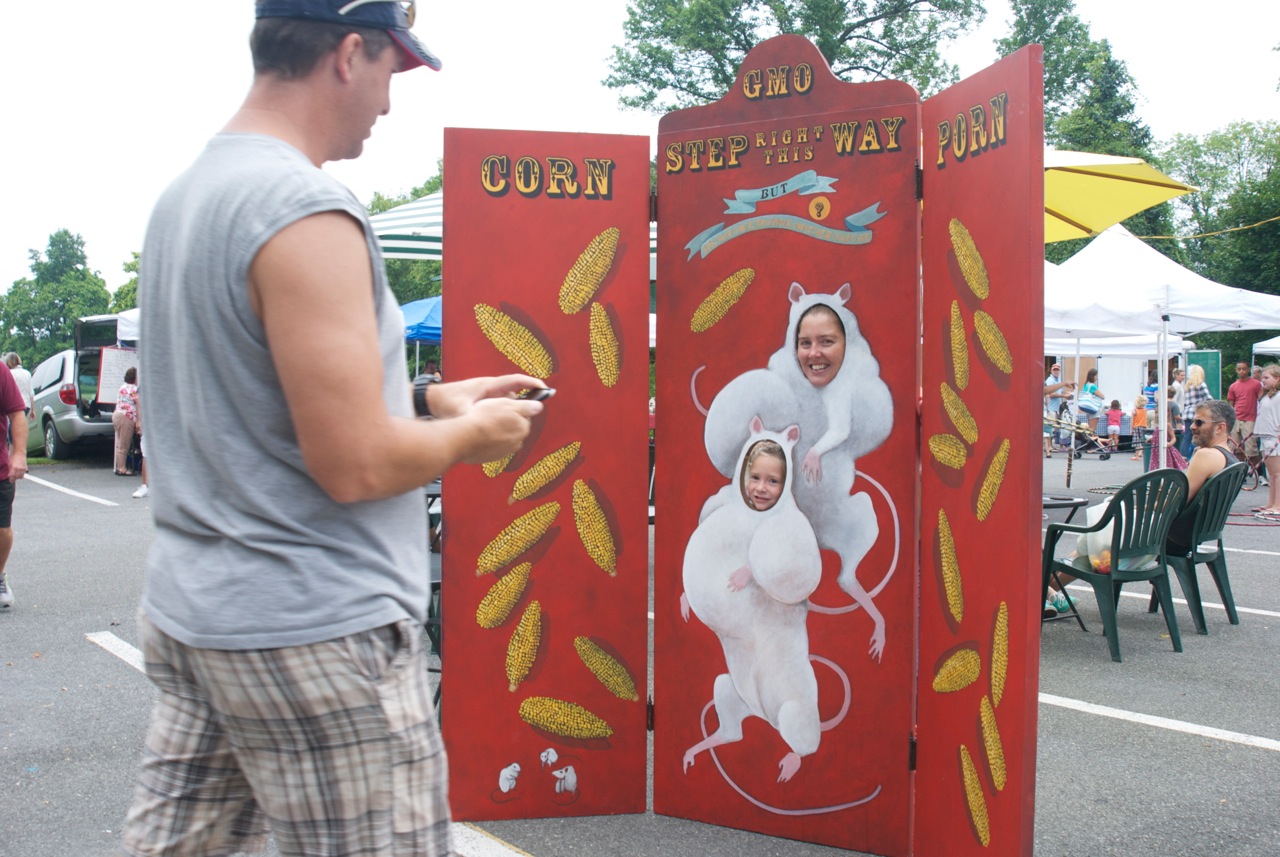
Farmer’s markets also always inspire. This summer, a day trip led me and Pete to the Saugerties Farmer’s Market in the beautiful and bountiful Hudson Valley. There, near the wonderful assemblage of growers, bakers and jelly makers I came upon an educational and artistic display about the health effects of genetically modified organisms (GMOs) in food. Later, I kept wondering how did science meet such creative expression, so I traced my way to the work of the person responsible, Claudia McNulty. Claudia is a painter, designer, sculptor and seemingly, environmental activist as well. Her work is beautiful and thought-provoking. Claudia has provided some links to very important information through her Corn Porn GMO project. These include the Seralini GMO Rat Study and a video interview with an MIT scientist on the effects of the increased use of the herbicide RoundUp required by GMO crops. To appreciate our current health crises, it is essential to understand the influence of GMOs.

front side gmo displayfront side gmo display

But, the earth tenders who most personally influenced my own summer were my friends Justine and Brian Denison, and their crew, the farmers at Denison Farm, providers of my Community Supported Agriculture share. They not only grew but also delivered the amazing produce that graced my own table and fed my family. The film, Radical Roots: Reawakening the Local Food Movement, by Patricia Lane, features their farm. The elements captured in this story really colored my thoughts and inspired me through these long sunny days. I hope it may do the same for you.

So, to all of summer’s tenders who work so hard as stewards of the land and take care to feed us all, I offer deep and profound thanks, and hope that the fall provides some well-deserved rest. And to summer itself, it is always sad to see you go, but thanks for giving respite from our busy year and for illuminating the ways we can re-route the prevailing flow that permits corporate control of our health and environment.

Thank you for listening, sharing, following, and supporting my writing. Please subscribe in the sidebar to receive notice of new posts. Comments and greetings always welcome.

In health, Elyn

Related Baker: Tess Beatrice at Sow Good Bakery--creatively conceived and beautifully presented delicious morsels all gluten-free, refined sugar-free, sometimes raw confections laced with unusual spices and topped with tender flower petals.

IMG_2591

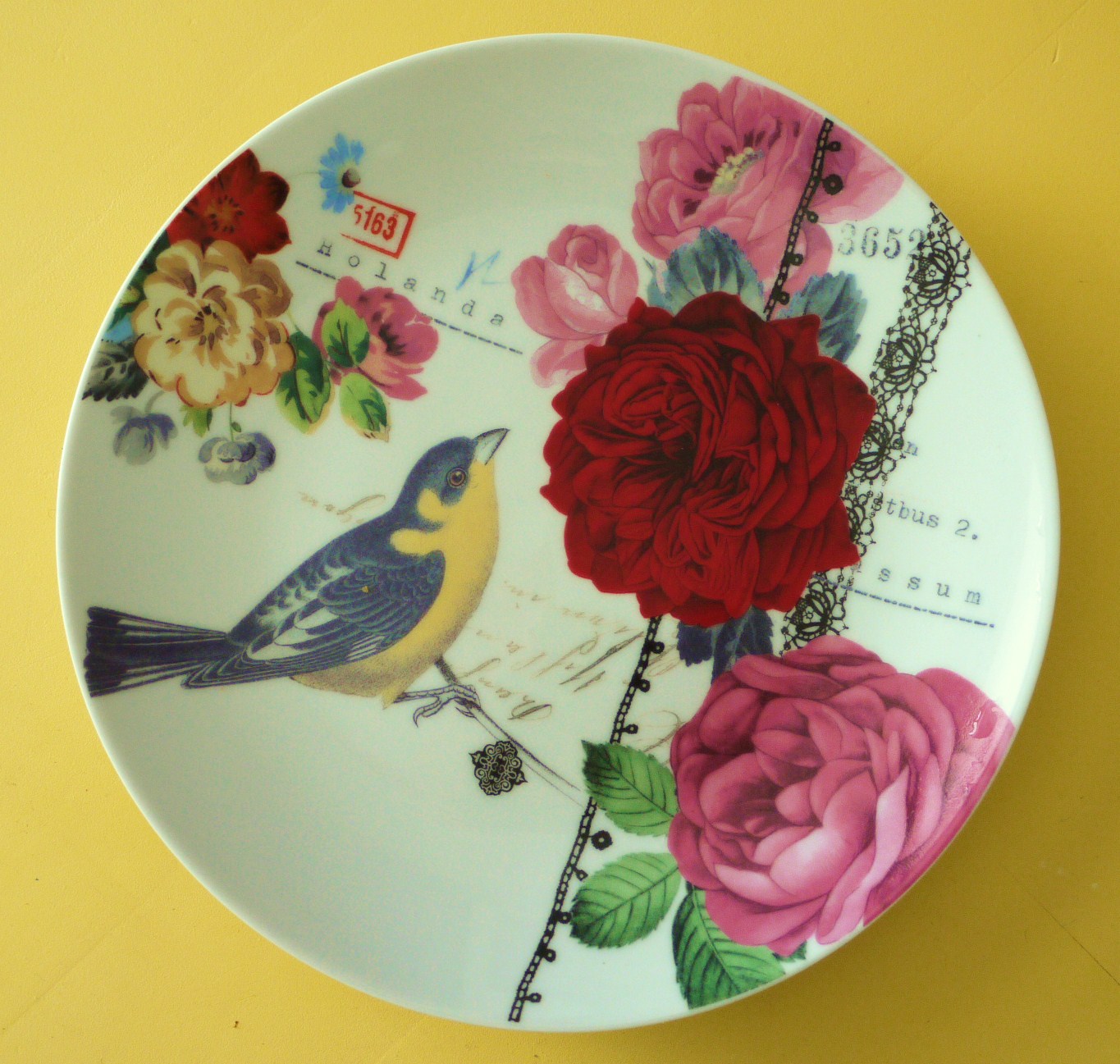
Farmers’ My Plate Plate

My Plate Haiku

Strawberries are too delicate to be picked by machine. The perfectly ripe ones even bruise at too heavy a human touch. It hit her then that every strawberry she had ever eaten — every piece of fruit — had been picked by calloused human hands. Every piece of toast with jelly represented someone’s knees, someone’s aching back and hips, someone with a bandanna on her wrist to wipe away the sweat. Why had no one told her about this before? by Alison Luterman, “What They Came For” (from The Sun magazine)

confluence

This is about confluence–where different streams of my life all flowed together in one special day–today. To start with, it is my birthday. And, twenty-five years ago today, my first child, Morgan, was born and I had my first experience of nursing a baby. Giving birth on my birthday was pretty special, and a big enough confluence in itself, one which was only considered at about 7 pm the evening before, after returning home from seeing the movie, “A Fish Called Wanda” and realizing I was in labor.

But there is more. Today is also part of World Breastfeeding Week which is celebrated during the first week of August. As a nutritionist concerned with the feeding of the species and maternal and child health issues, I do like to honor the week and spend time advocating and educating about breastfeeding in my work. I like that my birthday and nursing day coincide with this annual event. This year, I am using some of the well-produced materials from the U.S. Department of Health and Human Services Office on Women’s Health’s It’s Only Natural campaign as part of my activities at the Health Center and I am continuing to address it as I have done in my previous writings.

imagejpeg_3 (1)

World Breastfeeding Week Display

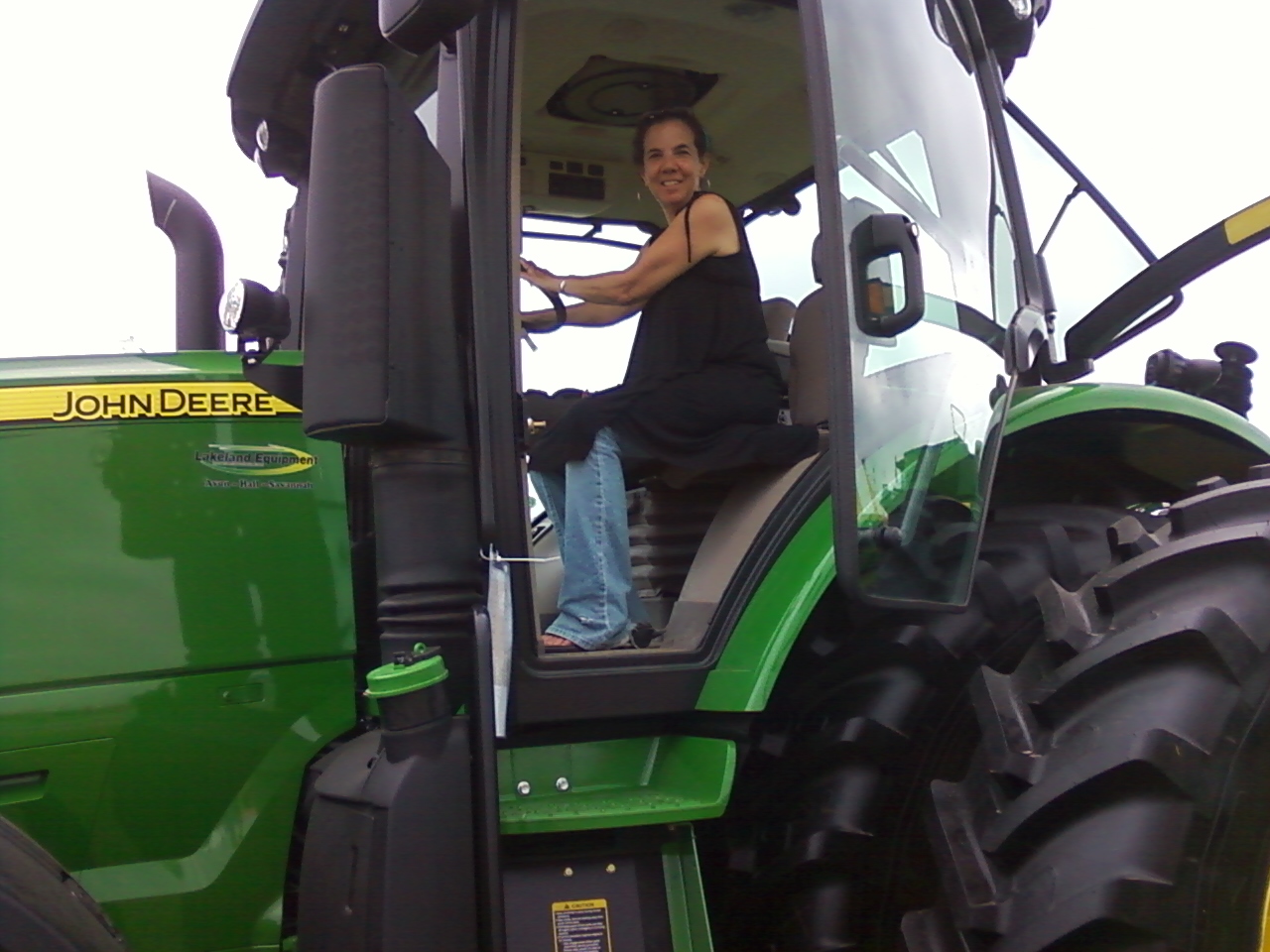
Also today, Pete and I are in Seneca Falls, New York for Empire Farm Days, the largest agricultural trade show in the Northeast. This show has also taken place during these same dog days of summer for the past eighty years. It is a nice birthday gift to be in the midst of these many farmers whose business it is to grow and raise amazing foodstuff for the masses and for me to have a chance to more fully appreciate their concerns. Food off the farm has a very abstract quality, quite remote from its actual origins. But, being at this show, one can see that farming matters such as soil health, pest management, plant hardiness, marketing and the raising of animals are quite real.

imagejpeg_2 (9)

Yep, me driving the big tractor. Empire Farm Days

As today unfolded, it was no surprise to find my alma mater, Cornell University, with a large presence here. Both Cornell and Seneca Falls sit upon the shores of Cayuga Lake, and Cornell’s College of Agriculture and Life Sciences plays a large role in the state’s agricultural initiatives. My nutrition studies took place inches from the ‘Ag School’. I walked miles through its vast acreage, bought college-made ice cream at its Dairy Barn, spent hours studying in its Mann Library, barely survived its microbiology course– and, it was where I met Pete.

The Cornell exhibit was displaying a video called Birth on the Farm. Starting with birds, it shows bluebird babies hatching from their eggs, barn swallows being fed by their parents, and then it moves on to mammals. A sheep, a horse, a dog, and a cow give birth, each baby emerging with amniotic sac intact. Once licked clean by their mama–with a little help from the farmer–these newborns quickly find their way to the nipple or utter and begin to feed.

Witnessing the wildly innate behavior of the mother/infant nursing dyad in the animal world heightened my wonder about how that behavior has become so disrupted among humans. Human babies, like their mammalian cohort, will find their way to the breast as well, when placed on their mama’s tummies. I just finished a research project on breastfeeding, scratching my perpetual itch to understand the modern-day hindrances to feed our infants in the biologically prescribed way that has sustained humanity for millennia. How has something that a puppy can figure out within minutes of birth become something that is culturally perceived as more difficult than rocket science and as contentious as climate change? How has the concept of species-specific milk become so foreign?

I put those questions aside in order to make sure I had time to head over to the nearby Women’s Rights National Park and Museum and Women’s Hall of Fame. This was the icing on my birthday cake. The exhibits are awe-inspiring and provide a really deep appreciation of how arduous the fight for women’s rights has been. Immersed in this incredible history, I picked up my previous thoughts again and mused over the sometimes expressed contention that breastfeeding further chains women to their domestic duties and inhibits their participation in the workplace and in the larger society where they may wish or need to be. Walking in the footsteps of these courageous women bolstered by my feeling that this argument misses the point. It is not breastfeeding, but instead, the lack of mandated maternity leaves, workplace supports and other inequalities in this country that are prohibitive. The exhibits themselves provided some proof.

For example, Norway, the country with the highest breastfeeding rates in the world, also leads in regard to the number of women in parliamentary positions. And this year, Ina May Gaskin is being inducted into the Women’s Hall of Fame. Ina May is the modern “mother of authentic midwifery”. Though midwives had assisted with childbirth since ancient times, their role had been essentially obliterated with the professionalization of male-dominated obstetrics in the early twentieth century. Her efforts sparked a revolutionary movement which not only opened the way for the re-emergence and popularization of midwifery-guided and women-empowered birth but also contributed to the re-establishment of some breastfeeding practice in this country. Interestingly, Ina May perfected her motherly arts at a commune community called The Farm, and her grandmother was an avid admirer of Elizabeth Cady Stanton and the suffragettes.

imagejpeg_2 (11)

Declaration of Sentiments Seneca Falls Women’s Convention 1848

At the end of the afternoon, Pete rejoined me and we went for dinner. A nice end to a very special day. As we sat at the restaurant overlooking the water where the Cayuga-Seneca Canal flows into Seneca Lake, I thought about how my day all flowed together–birthday, college, nutritional work, food and farming, women’s rights, birth, and breastfeeding. All pretty big themes in my life.

Considering this confluence, I contemplated its meaning. Could it be, that if when enough babies are born welcomed and sustained by the mother’s touch, natural nipple, and warm nutritionally complete milk; when women’s capacity to nurture and nourish is deeply valued and protected; and, when our farmers are supported to grow healthy food and to protect the land–that the world may be a safer, healthier and softer place? I hope someday.

Please, let me know what you think and do send greetings! Happy Birthday, Morgan. Love, Mom.

In health, Elyn

My Plate

My Plate

My Plate Haiku

When, in the course of human events, it becomes necessary for one portion of the family of man to assume among the people of the earth a position different from that which they have hitherto occupied, but one to which the laws of nature and of nature’s God entitle them, a decent respect to the opinions of mankind requires that they should declare the causes that impel them to such a course. by Elizabeth Cady Stanton, et. al.


I Speak for the Fat People

Although I’ve taken a little writing hiatus, the nutritional discourse continues unabated. The stories of our communal incarnate experience resonate with frustration, guilt, and misunderstandings. This is an older piece that I published previously in three parts. I hope it offers some response with a bit of healing balm. Some of its points have been raised and debated among those in the scientific community rather recently. Here it is mended back together. It is longer than my other posts but I think it reads best together.

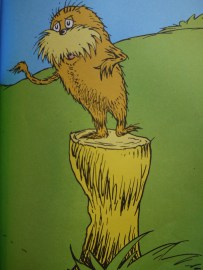
I speak for the fat people. Like Dr. Seuss’ Lorax who spoke for the trees, someone must speak for the fat people. Unlike the trees who needed a spokesperson because they had no tongues, you would think that the fat people would be able to speak for themselves. Of course, fat people have tongues. If they did not have that taste bud-laden sensory organ, they would not be fat. Given the current weight of the world, this group should not be particularly hard to hear. However, in the huge public dialogue about weight and obesity, the fat people are merely statistics. There are no real people behind the statistics, and this is where they have lost their voice. Therefore, they are stripped of any ability to speak with authority on the topic.

I am not a statistic. Though I have had some years where I toed the chubby line, for the most part, I have done my part in tipping the scales toward societal svelteness. Besides my obligation as a citizen to keep the fat numbers down, as a nutritionist, it is my professional responsibility to pull people out of the fat pool and to keep them from falling in at all.

It is no big secret that the medical and nutritional community has not done a great job in their role as bariatric (the science of obesity) lifeguards. I myself do not have a great track record of turning people into mere shadows of their former selves. But, I have spent my career as a nutritionist hearing the stories and struggles of the fat people and observing the ways of food and eating that define this turn of the century. I am a spy in the house of girth.

The fat community does, in fact, have some spokespeople. There are magazines, journals, books, and websites–written mainly by women–who have spent one day too many in the deprived and depraved world of dieting. There are individuals who are doing incredible and poetic work about re-informing and re-educating on misconceptions about weight and health and respectful self-care. Still, many of these efforts are marginalized or featured in venues that only topic-obsessed people like myself pay attention to. Even Roseanne Barr once said, “It’s OK to be fat. So you’re fat. Just be fat and shut up about it.” For every undertaking that sings the praises of body love and acceptance, there are thousands of counter-voices screaming the imperative to whip this fat away.

Therefore, I believe I must use my credentials to speak out. I hope that the fat people can accept me, a thin person–who is often cold and prone to osteoporosis–and an ex-stress and emotional eater to be their voice. Born of thin mother and adult weight-accumulating father, I will try to do the cause justice.

Let’s begin by putting the issue of overweight into perspective. If we look at weight historically, I’m pretty certain that from the beginning of time, there have been fat people. We have all seen the pictures of early Cro-Magnon and Neanderthal men. Even those quintessential hunters and gatherers seemed capable of packing on a few pounds. After them came Confucius, King Henry the Eighth, Mamie in Gone with the Wind, Jackie Gleason, Pavarotti, Aunt Bea, and my grandmother. Chances are your grandmother was fat, too.

English: Luciano Pavarotti in Vélodrome Stadiu...

Luciano Pavarotti in Vélodrome Stadium, Marseille, France, le 15 juin 2002. (Photo credit: Wikipedia)

Since our early beginnings, human beings have come in varying shapes and sizes and large-size was not necessarily an aberration of medium-size. It is good that there are large-sized people. A world without them would mean a world with fewer great opera singers, chefs, women of ample bosom, football players, construction workers, and cuddly grandmothers.

It is not very difficult to become fat. You do not have to go out of your way to try. If Chinese youth can become fat, then anyone can. Only about 4% of the population has naturally model-thin bodies. That means that many models are starving themselves in order to be models. It also means that the rest of the Size 2 wannabes are expending a lot of physical and mental energy in the pursuit of thinness. Carolyn Knapp, in her book, Appetites, tells the story of a woman who describes the angst she feels putting on her stockings every morning. She wonders what she could have accomplished in her life with the time she has spent worrying about her weight.

There are the naturally skinny–and then there are the neurotically and pathologically skinny; and the metabolically hyper-activated skinny–those who sustain themselves on a steady diet of excessive caffeine and nicotine—or maybe extensive exercise. For the rest of us, the possibility of becoming overweight is just around the corner. We are physiologically and neurologically wired to pack it on. The ability to store fat came in pretty handy a time or two during our multi-millenial evolution. We have about 107 compensatory mechanisms that prevent us from starving to death. A bunch of those certainly kicked in to save our forefathers when they were unable to kill a bison. In people who attempt to starve themselves toward thinness, the body fights back–it regains the lost weight plus more, and then absolutely refuses to budge.

In addition, we are wired for comfort. Research shows that the food habits that sustain us are those that we developed while still wrapped in the loving veil of early childhood. Whether that happened to be gazelle, chicken soup, mashed potatoes or cheeseburgers, you will probably turn to those foods as an adult. Believe me, the corporate world certainly knows this. The Happy Meal ensures that today’s toddlers will become tomorrow’s adult fast-food consumers. The concept of comfort foods is one I hear a lot about during my spy missions. Women have confessed to me that they would choose a good loaf of bread over sex. The quality of the sex is not indicated in this context.

Then, of course, there are our natural temperaments as well as good old genetics. I listened once to the tender story of a woman who was adopted as a child. She never met her birth mother, but she possessed a very old, poor quality home movie that she believes is of her mother. Though she struggles to see the face better in search of subtle resemblances, it is the woman’s thighs that confirm her finding. She states, “Look at the thighs. Those are my thighs.”

On top of all this, let’s sprinkle on a life change, or just daily, chronic stress. Take your pick. Break-ups, abuse, graduate school, poverty, working long hours, caregiving, illness, depression or menopause are possible choices. And, God forbid you should simply possess a deep sensuous life-affirming passion for cooking and eating. Throw any of these on your plate and if your primal wiring wasn’t enough to enlist you, then current circumstances will. Even the once-thins can become the now-fat–especially in this current milieu where food is literally out to get ya. Not even the high school cheerleader is immune. Any emotional state that is heightened, increases for many the desire to seek food for reward. When one is working their way up the weight chart, it is because they are possessed by physical or emotional hunger, or physiological changes that they can neither understand nor control.

I can hear you begin to protest that it has to be more than just this. Aren’t we soooo bad? We ate the piece of chocolate cake (and we loved it). How could we? How dare we? That translates into four hours of floor mopping according to the calorie expenditure charts.  That must be fair penance for the crime. As a spy, my days are peppered with the monologues and dialogues of self-hate and recrimination that people utter like a mantra before and/or after each foray into eating. The guilt is palpable. We must have all been ____________ in a previous lifetime. (insert your own response.)

I was heartened once to hear a man describe his joy-spreading tactic. Essentially, he spends half of his time acquiring special little chocolates and the other half gifting them to people as morsels of universal love. I am either becoming a very cynical nutritionist or a very empathic human being. The collective psyche is longing for the morsel of joy even at the expense of the perfect waistline. The truth is that we have appetites and hungers because we are merely human, not because we are bad people. However, when all of these human tendencies accumulate into extra pounds, getting rid of that weight is very difficult.

A few years ago, I attended a conference on an obesity-related topic. As a group, we were to brainstorm how to counsel a postpartum woman with a Body Mass Index (BMI) of 30. The exercise had me squirming from the get-go. As the attendees were getting rather dead-ended in their attempts to master this case-study, the presenter, a physician and researcher at a major university said, “Let me offer this idea. I am often in my office at my desk and on the phone. I could just sit there and talk on the phone, but instead, I stand and pace as I am talking.” My agitated brain said, “Yes, let’s file that idea to use.” 3889254107_2383b9acea_cNot with my clients but in this article. I could picture Homer Simpson stuffing one more donut in his face while muttering “Ah, vigorous pacing. That’s the ticket.” I wondered when was the last time this guy got out of his office and realized the experiences of real people, real fat people.

Hardly are all defined cases of overweight problematic. Some in the field maintain that the goal is for all individuals to attain an “appropriate” BMI.  Short of that, they will be at risk for various health problems. My intuition and much science beg to differ. Many people are fine–if not perhaps better off–with a little extra weight on them. Pavarotti once said, “The reason fat people are happy is that their nerves are well protected.” My own observations reveal that the neurotically thin tend to be more frayed than their rounder counterparts. Besides, BMI is just a tool. At times it is a cruel tool—or at least a not very nice one. It makes no allowance for age, fitness, or even natural body type. Whether we like it or not, our bodies will shift and change as we age. Nature, with no ill intent, seems to want to round us out a bit as we mature. That is how we get to be grandpas and grandmas. Appropriate BMI does not necessarily confer lack of health risks–only ones of a particular nature. Last long enough, and we tend to eventually shrink back down.

Do not get me wrong. I am not undermining the seriousness of the obesity crisis that we are facing. I understand its consequences perhaps more than most. I see the implications of excessive weight that people struggle with on a daily basis and I strive to alleviate the challenges through educational, lifestyle, and nutritional support. I bemoan the forces that are propelling our society into ever-expanding levels of girth, especially those that are now affecting our children.

Still, I feel a need to call TIME OUT! To stop the madness that makes those who are the statistics speechless. To stop pointing the finger merely at the individual without an understanding of the deeper forces that are at play. There are multi-factorial causes that lie at the root of the weight gain epidemic. Many are so abstract or insidious that it is very difficult for the experts—let alone an ordinary individual–to understand what is going on. Though overeating, bad eating, food addiction, and poor lifestyle choices are definitely a part of it, the magnitude of the communal weight gain doesn’t seem to make sense based on calories alone. In the causative mix lie politics, hormones, pharmaceuticals, poverty, nutrition misinformation, abuse, dieting, food sensitivities, sensory science, profits, changes in the components of our food, environmental toxins, personal and spiritual alienation and lifestyles spinning out of control. There are strange bedfellows in each and every fat cell.

Now, back to our friend the Lorax. For the record, the Lorax, our venerable spokesperson, was rather portly himself. Based on his picture, I’d put him at a BMI of about 29. I’d describe him as neither apple nor pear-shaped but rather pickle-shaped. According to Dr. Seuss, “He was shortish. And oldish. And brownish and mossy.” The final message of the Lorax in his plea to save the environment was UNLESS. “Unless someone like you cares a whole awful lot, nothing is going to get better. It’s not.”

I too am rather shortish. Oldish, brownish, and mossy may someday also describe me. For now, my intention is not to imply an ultimatum. It is, however, to bring a greater sense of compassion and understanding–and a broader lens to the discussion and to the approaches to care.

I do not intend to deny the role of personal responsibility—be that for everyone. It is a big piece of the puzzle. Though it is critical that we address the current weight epidemic–we should not do it with an assault on the fat people. We must not slap everyone silly in an attempt to squeeze them into a size six dress or Speedo swimsuit. Besides, who would be left to sing the blues? And though I’d have been fine to find my grandmother at the gym, it could not replace the experience of cuddling up on her big, warm lap with wonderful smells wafting in from the kitchen.

Thank you for listening, sharing, following, and supporting my writing. Please subscribe in the sidebar to receive notice of new posts. Comments and greetings always welcome.

In health, Elyn

Related Resources (2010): Women Afraid to Eat (Frances M. Berg); Intuitive Eating (Evelyn Tribole and Elyse Resch); Health at Every Size (Dr. Bacon); Dances with Fat (Ragen Chastain)

The end of overeating. Taking Control of the Insatiable American Appetite (David A. Kessler, MD); Born Round:  A Story of Family, Food and a Ferocious Appetite (Frank Bruni)

erin's plate

Erin’s My Plate

My Plate Haiku

Adirondack lake

Soothes us  from the heat–weightless

We float like feathers.

By Elyn

reporting from the rim of the sinkhole

A few months ago, at about 4 PM, Pete sent me an email saying something about soul food. I was rushing to end my day so I overlooked the attachment that would have filled me in on the details and why he thought this might be of interest to me. I dismissed the message quickly.

That evening though, as fate would have it, I got another message on my email informing me that I had a new follower on Twitter. This was big news given that it is a rare occurrence. As Pete assures me that I am right behind Lady Gaga in terms of followers, I must assume that she might have like twenty-eight. So, I decided to check out my ignored little bird account and see who my new follower might be.

Once there, I stumbled upon a flurry of activity on the feed from someone I follow–chef and food activist Bryant Terry, author of Vegan Soul Kitchen and Urban Grub. The excited conversation was about a PBS documentary Soul Food Junkies which was apparently being aired right then. The praise was pouring in for this film by Byron Hurt, about his exploration of the historical and cultural roots of soul food cuisine and its relationship to the current health crisis with its impact on the African-American community.

Image result for soul food junkies

A documentary by Byron Hurt

Ah, now I got it. I ran upstairs to the TV room and grappled with the remote. Attempting to master its controls, I pushed that channel button frantically. I must mention that I have about as limited a relationship with the television as I do with my Twitter account–and relying on an old antenna like apparatus, have access to about seven channels. Still, I knew I did get PBS. Round and round I cycled through those seven channels, three PBS stations and still could not find the show I was looking for.

Instead, what I found was a program about a guinea worm eradication program sponsored by Jimmy Carter’s Carter Center in Africa. It was rather fascinating though quite gruesome to watch. Apparently, water-borne guinea worm disease which has plagued a wide swath of Africa and Asia for thousands of years is poised to be eradicated. In 1986 when the Carter Center began its campaign with the partner countries, there were an estimated 3.5 million cases in 21 countries. By 2012 there were 542 cases left in just four African countries.

Guinea worm disease is contracted from drinking unclean water contaminated with larvae that once inside the human abdomen grow into worms up to three feet long. These worms eventually emerge from the body through excruciatingly painful blisters on the skin. I guardedly watched as health workers painstakingly exorcised these worms from the legs of screaming children and stoic adults, wrapping the worms around little sticks that were slowly turned. One worm, one person at a time. The success of this amazing eradication program has been due to water treatment and filtration programs and community education at a very grass-roots level.

A few days later I was able to watch Soul Food Junkies on pbs.org. It is an excellent film and I have been talking it up with a lot of my clients–and others as well. Many of my clients are African-American and my daily consults revolve around discussing this interface between food as cultural identity and health. Soul food is not the only problem area. Many cultural cuisines that have sustained people for millennia are causing problems in the context of our modern existence. This is due to various reasons including agricultural alterations in the actual foodstuffs that form the basis of these cuisines, more processed versions of these dietary staples being substituted for the real foods, traditional diets being padded with the excess of sugars, concentrated carbohydrates and other addictive substances that infiltrate our beings and a massive increase in sedentary lifestyles and stress. The vulnerable communities that are more exposed to poverty and its attendant health disparities are experiencing greater discord between their food and their health.

This is multi-layered stuff that claws at the core of who we are as eaters and which reveals how deeply connected we are to our heritage. Food is clearly not just an extrinsic matter. It communicates intimately with our cellular makeup. And, it is a heavenly sacrament. I remember as a child listening to my mother and my aunties trying to sever the relationship between my hypertensive grandfather and the heavily salt-cured foods of his Russian roots. Little did I know I would one day be standing between an African-American man and his beloved fried chicken or an Asian woman and her dear little grains of rice.

But yes, there I am. Standing tall at five feet one, holding firm with my big professional tweezers before every diabetic who sits in my office. With exact precision, I try to extract each granule of sugar that has gone rogue in the bloodstream, wreaking havoc on the body–sort of like a guinea worm. Just as guinea worm disease takes hold in unsuspecting individuals so does diabetes. Persons consuming available foods for the purpose of sustaining survival and attaining some pleasure, awaken one day to learn that they are infested with massive globs of excess glucose.

I have been doing this work for a long time and I can tell you that the diabetic epidemic is getting worse. My daily roster is full of newly diagnosed cases of diabetes. This morning I woke up to some crazy NPR story about the woes of candy makers due to the relatively high price of sugar–the price regulated by the Farm Bill. Apparently, the makers of Dum Dum lollipops require 100,000 pounds of sugar for the daily manufacture of ten million Dum Dums–and they are having a hard time affording it. Can those numbers be for real? Well, please don’t tell Dum Dum that I have some sugar stockpiled in my office–mounds of the stuff that I have removed from my clients. I know they will just try to recycle it right back into the very folk I took it from.

Diabetes might not seem to be as bad as guinea worm–but one can actually make many metaphorical if not actual comparisons. Diabetes leaves many physical and emotional scars. My clients look at me through eyes that plead to spare them from this scary disease–that comes complete with implements that stab and jab and symptoms that pain and worry–depleting the soul. I scurry furiously to help pull them out of the sinkhole of this very complicated condition. If a disease caused by a swarm of microscopic larvae can be eradicated from the planet, it is hard to believe we can’t do better to minimize the incidence or increase the reversal of diabetes. The methods employed essentially would seem to be the same–access to ‘clean’ food, governmental responsibility, respect for human dignity, caring, education, and cultural adaptation.

And so, that is why the work of Bryant Terry and the film of Byron Hurt are so important–and why folk should watch Soul Food Junkies and align it with their own food foundation. Time is of the essence and Jimmy Carter deserves a rest.

Thank you for reading, really. As always, thoughts, tweezers, and twitter followers welcomed.

In health, Elyn

Related Recipe: Bryant Terry’s Citrus Collard Greens with Raisins Redux

(Update February 2020: Bryant Terry has just published a gorgeous cookbook, Vegetable Kingdom: The Abundant World of Vegan Recipes. From the Introduction: Vegetable Kingdom is inspired by my daughters, Mila and Zenzi. They have blessed this book like my ancestors blessed meals, by humbling me to that which is greater than myself.)

(Update June 2020: Bryant Terry prefers that his book(s) be purchased from independently-owned bookstores (check indiebound.org & bookshop.org) and ideally, from Black-owned bookstores like: @marcus.books@esowonbooks@peoplegetreadybooks, and @unclebobbies.)

(Update February 2021: Check out Byron Hurt’s continuing efforts @byronhurt and support completion of his new film, Hazing.)

shutterstock_275107754

Bryant’s My Plate

My Plate Haiku

This isn’t steroids

It’s Collard Greens.

from Ballin’ at the Graveyard (Documentary on an Albany, NY neighborhood basketball game)

“It includes the authentic voices of men working to do what’s right—for themselves, their families, and for the larger community. If you want to better understand our City’s character and come away feeling good about it, this film is a must-see.” Albany Mayor Kathy Sheehan

under the waning gibbous moon

Tonight, as sleep calls to me, while the waning gibbous moon that illuminates the night sky is 88% full, I take an excerpt from a previous post, Muse of the Girl, in recognition of Eating Disorder Awareness Week. A gibbous moon is one of the phases of the Moon when the size of the illuminated portion is greater than half but not a full Moon.

Waning gibbous moon. Français : Lune gibbeuse ... Waning Gibbous Moon (Photo credit: Wikipedia)

I want to discuss the war that doesn’t get covered, that wages within many girls and women–of all ages and sizes–who hate their bodies and therefore deny a large part of their selves. Or, who, by not loving themselves, direct a lot of abuse toward their physical temples in both thought and action. Though they often wish they were invisible, we see them walking around in all sizes– including those we deem acceptable and those we envy. Persons, whose self-worth has long been determined by the numbers on a scale or by an image in a mirror.

The war, where the collective pain and problems are as profound as those we ascribe to obesity–and the physical consequences are often more severe or deadly. Here, confusion and dictates about food and eating scar the bountiful landscape. Here, much potential is lost and much love is denied. I think we all have wandered into and many have lingered in this place where reality is distorted and self-flagellation and deprivation seem deserved.

This is the ignored epidemic. Not many resources are designated, but I have apparently been assigned to cover this front. My field notebooks are filled with stories and quotes that are usually too intimate for me to share. But, they reflect the reality that too many females (and increasingly, males) believe that without perfection they cannot be whole and should not take up much space on this generous planet. It is heartbreaking to witness this.

Having been touched by the lives of so many amazing, intelligent, gorgeous, creative, warm, gentle, caring and funny individuals who have been broken in this battle of self and body, these are some things I wish would receive front-page headlines:

Bodies change, contours soften, bellies round, babies fill, bloat happens, hunger informs, weight is not absolute, judgmental words injure, beauty shines, food nourishes, wisdom evolves, body protects, hormones ebb and flow, pleasure is permissible, fat is often just a feeling in one’s head and restriction revolts.

If you are living this, put down the staunch resistance, begin the surrender and trust your inner feminine voice. Please know you are all so beautiful and you possess that which really matters. Take a moment to put your hand on your heart and belly and send love to yourself. Take a deep slow breath and be thankful to your body. Send a healing thought out to other women, because I assure you, you are so not alone. Hold the daughters and ask to be held. Reclaim your place. Change the internal tapes. Know there are many paths to healing available. The world needs everything you have to offer.

How fully illuminated is your feminine moon? What else might you wish for others to know and trust? Any sharings will be welcomed and respected.

Thank you for listening, sharing, following and supporting my writing. Please subscribe in the sidebar to receive notice of new posts. Comments and greetings always welcome.

In love and health, Elyn

Related Posts: Stopping Traffic, Muse of the Girl, Dolls with Faith, A Meteorological Change of Plans, Size Me Down, Nourish Thyself Well Day

my plate My Plate Plate


My Plate Haiku

Deep scarlet red beets

Reveal your sweetness to me

Slip out of your skins

by Elyn

who do i love?

Happy Valentine’s Day. My day started out with a visit from Ms. Henry. Now, if she is not the true expression of this global love fest, I don’t know who is. One might almost expect for her to leave a trail of rose petals behind as she spreads love wherever she goes. Ms. Henry always has some story that both surprises and delights.

Today, she told me that she had informed everyone, that in no way were they to get her any chocolate this holiday. If they wished to get her anything, she would gladly accept red foods. And, wouldn’t you know it, her six-year-old godson and his mom gifted her with apples and pomegranates. And, the little boy told her that they had shopped for the fruits at the food coop. It was only 9:15 in the morning and I felt my heart open wide.

photo (1)

The rest of my workday was filled with more touching moments as I had some other clients tell of their own personal blossomings and awakenings on this lifetime eating adventure. I was feeling light in spirit as I raced out of the office to tend to some mothering duties–and the late afternoon sun granted me enough warmth that I shed my dark winter coat and threw it in the back seat of the car.

Come evening, I was grateful to join a circle of friends who were gathering for a cozy showing of the movie Moonstruck, thanks to the abundant and incredible hospitality of Heidi, whose love flows out through her wonderful culinary gifts and the pouring of the perfect glass of wine. Tonight’s Italian theme-based dinner was baked ziti, (meatballs on the side) and rapini. Rapini is a green and Brassica rapa vegetable, rich in Vitamins A, C, and E, folate, potassium and detoxifying indole-3-carbinol compounds dear to my heart–of course. Oh, and beautiful, homemade individual heart-shaped flavanoid-blessed chocolate cakes. How sweet is that?

So, though my main squeeze was out of town, and all cuddling was reserved for Chico the cat, it was still a special Valentine’s Day. In its honor, I want to take a moment to share a list of some of the (not previously referenced) amazing people I love whose work informs and supports my own and who inspire me by the generous sharing of their wisdom, wit, intelligence, passion and pure love for keeping us all a little healthier and happier.

Nutritional Wisdom: Andrea Nakayama: AnFunctional Nutrition Alliance; JJ Virgin: Exercise Physiologist and Holistic Nutritionist; Paula Owens: Holistic Nutritionist and Functional Health Practitioner; Lisa Nelson: Heart Health Made Easy

Gentle Approaches to Dietary Self-Management and Body Acceptance: Angela Minelli: Stop Emotional Eating and Compulsive Overeating; Deah Schwartz:  Resources for Every Body Every Size

Environmental Toxins and our Personal Health: Lara Adler: Environmental Toxin Education

Parental Amusement: Honest Toddler: (I just love when Zena reads me these tweets!) (Updated 2020: Twitter feed was taken over by their mom.)

Please take a moment to check these out. I hope they will lead you somewhere helpful. Share with me anyone you love whose message is also along these lines.

With full heart, I call it a day–loving you. Like this post or forward me some love by way of comment, subscription or sharing. Or, a My Plate Haiku (or other expressions) or My Plate Plate.

In health, Elyn

Honest Toddler My Plate

My Plate Haiku

Do not tell someone that you love them

And then six hours later

Make them quinoa.

by Honest Toddler