Archives

be kind to animals

It is Vegan Week in my anachronistic village. Almost a year ago, when I first began to dispense my little stories about food and eating, I was about to join with a few neighbors in adhering to a foodscape that did not include any animal products for one week. To celebrate this intention, we were to share dinners–with a different person hosting each evening.

This idea had sprung from the fruitful minds of two of my neighbors–extraordinary women though just ordinary carnivores. One beautiful, sunny summer day, Carrie and Sharon had taken a day trip to the Culinary Institute of America, where it just so happened that in the bookstore, or perhaps more aptly, cookstore, of all things mind you, it was a vegan cookbook that caught their eye and nipped them in the tongue. The drive home stirred up their giddy excitement of deciding to live in the colorful, ingredient-rich world of the herbivore–for a week. They laid out the table and one night invited me–the vegetarian next door–over for a beautiful and delicious repast.

We all live within the confines of some dietary codex whether we are conscious of it or not and we get quite cozy there. My own vegetarian diet has certainly lost some of its philosophical punch throughout the decades that I have been living it and my food choices can be mundane. So, even though I have many days where my eating may be vegan, when the opportunity arose to be part of the spontaneously conceived next seasonal Vegan Week, I chose to participate.

Our little neighborhood group now has a few Vegan Weeks under our belts. We stroll leisurely over to each other’s homes, sit and relax, eat amazing food, discover nuances and ingredients that a truly vegan dietary requires, hear how badly someone is dreaming of a big, juicy burger and home we go–with no dishes to do. We once shared a vegan picnic at our local performing arts venue.

I realize that for the meat-eaters in the group, going vegan is a big and abrupt change–and they have all been really good egg-replacement-products about it. They have to plan all their meals differently, buy some special ingredients and do without that big chunk of flesh on their plate. By week’s end, they begin to feel the effects of the dietary change usually in a positive way. They seem to appreciate the change though admit that it is not easy.

However, even for me, for whom the omission and inclusion of these foods are not as extreme, the very act of dietary consciousness applied to each bite is profound. Ordinarily, one does not experience this, unless related to a religious ritual like Lent, Ramadan, keeping Kosher or fasting. Or, when going on a diet.  Personally, this week brings up a lot for me to think about.

To begin with, it heightens my vegetarian consciousness. It makes me think about my relationship with the animal world as it relates to the procurement or processing of eggs, dairy, and even honey. How many big resources of the animal kingdom does it take to bring me the little gifts my vegetarian choices allow?

It then makes me wonder about choosing to eat for health, kindness, philosophy or sustainability; and the difference between feeding my mind, my taste buds or my body.  Is there compatibility or dissonance between these concepts? Though I am a very happy plant-eater, I must see if my body feels it needs some of the energy provided by animal food; and, I have to decide if I am comfortable with some of the substitution processed foods sometimes used in a vegan diet.

Lastly, it makes me very mindful of the fact, that every day as a nutritionist, I am asking each and every client who sits before me, to make a commitment to some form of conscious dietary change–and usually, not just for a week, but possibly for the rest of their lives. As Vegan Week was approaching I was doing a lot of doubting. I’d had a lot going on lately and was not sure that I had it in me to pull up the resources I would need to get it together for hosting, extra cooking, special shopping–let alone the sacrifice and consciousness required. This made me appreciate that this is the same resistance that even just the thought of scheduling an appointment with a nutritionist raises.

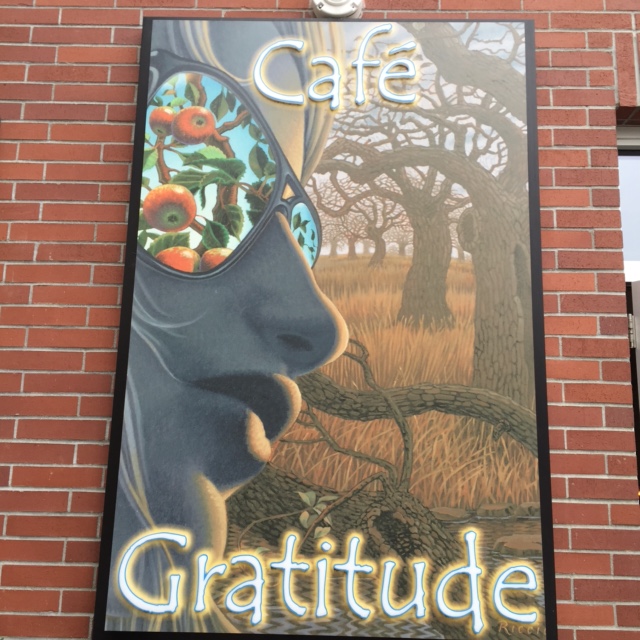
Interestingly, last November, just after my first Vegan Week, Carrie and I went to see the film, May I Be Frank, about a guy from Brooklyn, whose life is changed when he accidentally steps into a raw food, vegan cafe called Cafe Gratitude in San Francisco. I wrote about this in Meditation v. Medication. A few months later, Carrie was in San Francisco. She ate at the restaurant, texted me a photo of her gorgeous meal and came home with a copy of the cafe’s beautiful cookbook, I Am Grateful.

As my resolve to do the week was weak, I curled up with my now own copy of the cookbook for some culinary inspiration–much like I had done with Mark Bittman’s How to Cook Everything Vegetarian and shared in So, What’s the Dilemma? The story of this film, the restaurant, the cookbook and the people behind it, Terces and Matthew Englehart is quite remarkable and I invite you to get a glimpse or a taste of what they present as a possibility for both eating and living. As the restaurant’s name suggests, gratitude is the foundation of their purpose. Each recipe is named with some affirming attribute like I am Ravishing, I am Whole, and I am Courageous.

Thus informed, I planned my menu which included the cafe’s I Am Giving Marinated Kale Salad and was on my way. I am glad to have the question of what am I grateful for placed before me right now. At this moment, I am grateful for all who share their stories with me and who are open to some dietary consciousness change; of incredible food and the creative people who know what to make with it; and, for my charming neighbors for choosing a culinary theme that includes and nourishes me on many levels.

Is there any particular diet or food change you would like to consider being conscious of making now? Would you like to know what we ate this week? What are you grateful for?

Thank you for listening, sharing, following and supporting my writing. Please subscribe in the sidebar to receive notice of new posts. Comments and greetings always welcome.

In health, Elyn

Related Resource: LIVEKINDLY

Related Post: Vegan Envy

IMG_1672

My Plate Plate

My Plate Haiku

Food made joyfully

As a gift of time and self

Feeds body and soul

– Anne Marie

Dietary Haiku

japanese maple

Japanese Bonsai Plant      Image by cskk via Flickr

Here are a few things that happened in my nutritional life this past week. First, I had a client come into my office bummed out about being fat. She sat down and immediately pointed to different parts of her body that she deemed fat. Of utmost disgust were her arms and her big belly. They definitely had to go. She quieted a little as she said she didn’t mind being big in the thighs and butt, and she thinks her hubby actually likes her like that. I asked about her eating habits. A number of issues presented, including the fact that her husband is incarcerated.

I asked how she felt about me making some suggestions. Without skipping a beat, she replied that she would think it was none of my business and I should leave her alone. Despite her distress, she was not ready for a change–a common human experience. Most often I find some traction, but I did not try too hard in this instance and gave her space. (She did eventually come back and see me again.)

Next, my very own brother, in a comment on my recent post, Diet for a Small Caterpillar informed me that only a small percentage of people actually care about nutrition. I wanted to protest, but he is my big brother and he does seem to know about a lot of things.

And, then, the very next day, the United States Government, without giving me very much notice, obliterated the Food Pyramid and issued the newest expression of the most up to date dietary guidelines–the USDA MyPlate.

Briefly, here is my initial response to the MyPlate. Though I appreciate the challenge and consider it an improvement, its teaching concept has been around for a while now, so I am surprised it is being touted as something unique and innovative. While hailed for its message to eat more fruits and vegetables, I think that is also old news. It is overly simplistic as our national food icon.

It does not really relate to how people eat breakfast and lunch and is not relevant to how many even eat dinner. It does not align with most cultural cuisines and supposes a basic meat and potatoes dietary structure. My dinner plate rarely resembles it. It evades many deeper nutritional questions about protein, dairy, fats, and digestion. Disconcertingly, right under the plate, it says, “Balancing Calories: Enjoy your food but eat less.” This makes a broad assumption about all eaters and ignores the serious issues of those who may need to eat more for various reasons.

Essentially, this model has convinced me that it is time to abandon such efforts. If what my brother says is true, that few people even care; or as my client suggests, that not everyone wants to hear it, why do we keep trying to promote this short shelf life, stale message with such a stagnant image? Maybe it is time to try something new to spread meaningful dietary practice.

I sometimes enjoy a line of iced teas from a Japanese company called Ito En. On their bottles, they offer a nice little haiku. Haiku is a Japanese form of provocative poetry that provides a sense of sudden enlightenment simply, intensely and directly. The bottle I now hold says: ten heron heads blow as pampas grass in the morning fog. Lovely, even though it doesn’t stick to the 5–7–5 traditional haiku structure. Maybe because the tea is distributed in Brooklyn or because it is a form that is flexible. Gazing at this bottle, I am inspired to suggest that we should develop Haikus with various themes to promote nutritional messages with greater nuance. Or, perhaps it would be more American to create some jingles. This could employ many creative artists, and I am sure their output would be funnier or more beautiful than anything produced by our governmental agencies. Michael Pollan’s missive, Eat Food, Not Too Much, Mostly Plants, could be turned into a catchy dance number.

Just as I was about to declare the week a washout, one other thing happened. On Friday, I was at one of the three schools where I work with the School-Based Health Program. It was my last visit before summer vacation. I prepared a little healthy snack for the kids I had met with during the year and called them down individually to say good-bye. The message I try to instill in these young children is that they each have an amazing and wonderful body. They are all smart enough to choose to care for their bodies in various ways and can make many decisions for themselves about what and how they choose to eat.

In this closing session, I asked these adorable nine to thirteen-year-olds, what have they been paying attention to based on things we had previously talked about. Without much explanation, they each understood this vague question and all had at least a small answer. Some had big impressive answers. My dimming faith was ignited once again. So, maybe this is the relevant dietary inquiry–What are we paying attention to? There is a lot to choose from in this crazy, nutty, nutrition world.

What message would inspire you or what do you think we need to hear? Is the truth of the matter that our governments’ policies are incongruent with an appropriate dietary promotion or our personal experience as eaters? What are you paying attention to?

Please allow yourself a creative moment to pen your own dietary haiku, jingle or other poetic expression and send it along in a comment. Let’s see what emerges.

Thank you for listening, sharing, following and supporting my writing. Please subscribe in the sidebar to receive notice of new posts. Comments and greetings always welcome.

In health, Elyn

Related Posts: Your Pyramid; Diet for a Small Caterpillar; Haiku for You; Accepting Haikus

My Plate Haiku

Eat Food. Not Too Much. Mostly Plants. by Michael (Pollan)

by george, i think he’s got it!

Thorazine, Seroquel, Paroxetine and Lipitor. It looked like a good case of schizophrenia with a touch of high cholesterol. Unless I am very busy, I usually get a glimpse of my client’s history on the electronic medical record before I call them in. This is usually a good idea.

There is a set of double doors and a short hallway separating my office from the waiting room area where patients wait. As I pushed through the doors, a tall gentleman was anxiously waiting right at the other side, surprising me. James? I ventured. Yes, indeed.  Well, that was touching. Not all my clients are quite so eager to see me.

baked bread on plate near mug with coffee

Photo by Sarah Boudreau on Unsplash

James began excitedly talking before we even made it back to my office. Persons with mental health problems are no strangers on my schedule. Often the powerful medications they are on have high side effect profiles–most of which include weight gain. In addition to this, many in this population cannot work and live on the very limited fixed incomes provided by their disability payments. The capacity to access and prepare good food is pretty low–and coping behaviors like cigarette smoking, coffee drinking, and pastry eating are high.

I admit that sometimes, as I am doing my ritualistic walk from office to waiting room, premature assumptions rotate my eyeballs upward and I internally utter something like, Dear Lord, really? Is my job as a nutritionist not already hard enough? Couldn’t you have made me a psychiatrist or neurosurgeon or something easy like that instead? This was one of those times.

James is 45-years-old. He lives in a studio apartment by himself. His meager kitchen consists of a refrigerator, microwave, and hot plate. He smokes close to a pack of cigarettes a day. And, he is a baker at a local cafe and bakery. So, every morning, James is at the bakery, not only surrounded by but preparing mouth-watering temptations–and an always fresh pot of brewed coffee. Together, that popular combination has been the foundation of his diet for many years. He confides that he loves his Folgers and has 2-3 big cups per day with sugar and powdered creamer.

About three weeks ago, James’ doctor informed him that his cholesterol levels were high and prescribed the usual statin Lipitor. Of course, that scenario is exceedingly common.  Most people are generally just told to take the medication; some are given lip service on eating a low-fat diet; and a few who may be fortunate to have a doctor who knows of a nutritionist a few doors down, are told, “Go see the nutritionist”.

James says he doesn’t want to have health problems like this and that he has already made some changes. He’s not really sure if what he is doing is right though, and he’d like some input. He proceeds to tell me that instead of just having coffee and a sweet in the morning, he is now eating a bowl of instant oatmeal at home; leaving the pastries alone and waits till late morning when the head cook prepares for him a bowl of her well-regarded freshly made soup. Also, he has stopped going to McDonald’s; has cut down his coffee intake and is drinking more water. And, when he wants to snack at night he is having some peanuts. Impressively, he is trying some new vegetables which he admits is hard for him. Almost apologetically, he explains he never ate any of that kind of stuff when he was growing up.

I am praising, affirming and singing hallelujah. Then, he says that with his next paycheck he is planning on buying a steamer and a countertop grill. He imagines that he has room for those and they wouldn’t be that expensive. He asks if I think that is a good idea.  Suddenly, he is the Eliza Doolittle to me, Professor Higgins, and though I haven’t done anything, I could not be more proud.

By these simple changes, James has already cut his consumption of dangerous refined sugars and carbohydrates,  increased soluble fibers, decreased trans fats and improved his hydration status. When I weigh him he is already down three pounds. This pleases him. But, most incredibly, he says that he already feels a little better– not just physically, but mentally as well. Yes. This is a very profound statement for someone who has been medicated for most of his adult life. James has gleaned what most have never considered–the relationship between nutrition and emotional and behavioral health.  As we finish, he acknowledges that he is not ready to address his smoking, but he is really thinking about it. Though there are changes I will still recommend–and some things that I will not be able to change–James is on his way.

This story is typical of instances I am privileged to encounter on most days and which really keep me going– people like James, who despite very difficult circumstances, find some way to respond to an inner impulse to find a better way. As often as I may wish for easier work, I do look upward and say thanks for some incredible inspiration and beautiful encounters in the name of health. Now that wasn’t so hard, was it?

Thank you for listening, sharing, following and supporting my writing. Please subscribe in the sidebar to receive notice of new posts. Comments and greetings always welcome.

In health, Elyn

meditation v. medication

Once upon a time, like this past Monday, I was walking down the hall of the Health Center where I work. Passing a closed exam room, I heard the doctor who was inside with a patient say, “Here’s a meditation for you.” Ah, meditation. Instantaneously, I felt my spine lengthen, my breath deepen, and my third eye got a nice little buzz.

But wait. Which of the Young Living Essential Oils that I frequently use had I just inhaled? Was it the oil blend Hope or Dreamcatcher? I must have been hoping or dreaming. By the time my foot that was in the back had overstepped the other one and placed itself in front on the cold, hard and very clean commercial tile, I realized she hadn’t said meditation. She said medication. Of course, silly of me. Where did I think I was?  cafegratitude

I must digress for a moment. The floors in the Health Center are incredibly shiny. Every day, they are cleaned in Zen-like fashion by a woman named Pam. After dancing with the waxing machine, she traces every seam with a long stick with a tennis ball attached to the end, and then with tiny little tools, she meticulously erases every scuff mark with the hands of a surgeon. The place glistens.

Perhaps my momentary delusion was fueled by the fact that the night before I saw this amazing film called, May I Be Frank. It is the true tale of transformation on the physical, emotional and spiritual planes of an overweight, lonely, ill, middle-aged ex-addict named Frank, living in San Francisco. His soul yearning unexpectedly leads him into a raw food restaurant named Cafe Gratitude and the story begins. Through the use of whole foods, affirmations, holistic health modalities, and the receiving of love, true and profound healing ensues. In the film, there is a scene where he goes to a massage therapist. The massage unleashes a deep emotional release in Frank that simultaneously relieves his chronic back pain. I noticed that on the table in the massage room was a collection of Young Living Oils that I am sure were used. I tell you, these oils are powerful.

How many times a day is the word medication used in the Health Center? I even say it about eleven times — and  I am mainly talking about green beans and sardines. Venturing a guess–seven hundred and nine times. No, I don’t think I am exaggerating. If anything, I am underestimating. There is a lot of medication going down.

Imagine if we could subliminally say meditation instead of medication this many times. What meditation are you taking? I am going to prescribe you some meditation. What’s that? You are calling for a refill on your meditation? Which one? You can pick it up at the sanctuary–along with your wheatgrass. That would simply and certainly alter the medical paradigm.

We would do well to consider our health facilities more so like holy temples with acolytes arriving for sustenance and to promote meditation as a veritable ally in the healing of ills. Though the practice of integrative medicine is growing in acceptance and availability–my yearning is to see it accessible and as a model of care in high-risk communities. I encourage everyone to take a look at the film, May I Be Frank. You will be inspired by being witness to possibility. Pam’s devotion to her task has prepared the sacred ground. When the time comes, may we be ready.

Thank you for listening, sharing, following and supporting my writing. Please subscribe in the sidebar to receive notice of new posts. Comments and greetings always welcome.

In health, Elyn

she weighs how much?

I present this as a Zen Koan. A Koan is a paradoxical question, the meaning of which cannot be understood by rational thinking. It derives from the Japanese words “ko” for public and “an” for ‘matter for thought’. This is clearly a public matter for thought in the current dialogue on childhood obesity. How do we best serve a seven-year-old girl whose high weight highly challenges notions of normal growth patterns?

pond-3046592_1280

Image by Debi Brady

This girl is not a nameless, theoretical child. Tanazia is an amazing girl who I know. She has keen inquisitive abilities, deep empathy for others, and sophisticated insight for someone so young. She is deeply connected to her family, respects her elders, and helps care for her three-year-old brother and emotionally reactive two-year-old foster-sister who she shares a room with. She excitedly tells me that when she grows up she would like to do something to help others. When her grandmother mentions the Peace Corps, she responds that there are people right here in her own community who are in need.

Tanazia—who is just one of many children who are accumulating weight in an inconceivable short amount of time–is in a relatively good situation. She now lives with a set of very caring grandparents who love her dearly. She has a stable roof overhead, and there is a modicum of food security. While some family members are overweight, her grandmother, who had gastric bypass surgery a few years ago, is generally food-savvy and keeps a relatively healthy home. Plus, she has a back yard–one large enough and safe enough to play in—a rare commodity in this part of the city.

Despite this, she has already had to armor her body with layers of body fat against many emotional wounds. She was born to a 15-year-old mother who has since had two more babies and is now pregnant again. Her father has died, and she was at an early age exposed to and a victim of domestic violence. Her grandmother has chronic health problems. And, she herself, has asthma–another player in the childhood obesity conundrum. Her mom has supervised custody and gets to see her daughter every other Saturday for just a few hours. Equipped with few ways to show her love, during their time together she usually takes Tanazia out to eat somewhere. It’s usually Chinese food or pizza with soda and candy.

This sweet child has already endured the taunts of kids. Going to school-squeezed into her charter school uniform skirt—is something she is already leery of by second grade. Though her grandma does give her breakfast at home and provides her with lunches to bring to school, controlling the intake at school is hard to do. Unfortunately, the meals provided by the school lunch programs do not meet nutritional recommendations and are a sad source of the low-quality foods and excessive fats, sugars and calories that are contributing to the problem. Turning down a free meal or two in a day would be hard for anyone to do, especially for those to whom the secure availability of food is not a given.

Declining the morsels of joy to be found in the cheap junk foods that easily find their way into all the cracks and crevices of our lives–cupcakes, bags of chips, Rice Krispie treats, fruit punch– is nearly impossible for those with easy and happy lives let alone for those who excessively use food as an easy and legal pursuit to push down painful life experiences.

And, although Tanazia has a backyard, the physical activity levels of young girls who live in vulnerable neighborhoods are amongst the most limited. Add in the cold winters in this part of the country and the possibility of expending calories diminishes even more.

Despite these challenges, this beautiful child tries hard to do what I—her nutritionist—have recommended. She drinks mainly water, she listens to her belly to see if it is really hungry—a task most adults find hard to do– and has only a small piece of cake at birthday parties and church functions.

My heart breaks at having to impose such harsh restrictions on such a young life. I know restriction breeds hunger. I know parental strategies require fortitude, patience, non-judgment, and structure. I don’t have many options nor enough solutions to fight all the forces that prey upon this innocent child and countless others like her. Current anti-obesity initiatives come far too late and offer little. Cute and catchy names of new programs belie the gravity of the situation and chew at my cynical side—the part of me who knows too many stories of real children’s lives. Societal weight stigmatization adds to the burden. I pray for this young girl to grow up healthy and whole, equipped with all she needs to be a powerful adult. Hopefully, size alone will not get in her way.

Thank you for listening, sharing, following and supporting my writing. Please subscribe in the sidebar to receive notice of new posts. Comments and greetings always welcome.

In health, Elyn