Archives

vegan envy

“As some of you already know, it is Meat Week here on Morning Edition“. So starts Steve Inskeep in a report on NPR last week– which means that a few million people did actually know. But, coincidentally, or as I prefer to think, karmically, it was also Vegan Week here in my little village, and my, what a Vegan Week it was.

For a little background on Vegan Week, visit my post, Be Kind to Animals, which gives the history of this event– which was until recently known to about seven people. However, this time around, the Village Veganistas took on a few new cocktail-concocting guests. One evening we were barely contained in our host’s small home as our table grew to eleven. And, the next night we literally spilled out onto the porch as our numbers increased even more–along with the temperature. The word was out. Our giddiness, fueled by the exquisiteness of the meals–plus the fresh strawberry cosmos and daiquiris–could no longer be contained. The curious fringe came circling, like lions ready to pounce on some new meat–but alas, all that they found was some kale salad with fennel and cannellini beans, vegan egg rolls, and some rice stuffed cabbage. Ah, but they pleaded to stay and begged for more.

As I listened in on Meat Week’s offerings with its stories of the evolution of carnivores in America, my single compartment stomach churned and felt a little queasy. Reported was that Homo sapiens evolved as meat eaters– which apparently accounted for the increased size of our brains. Even so, eating meat was essentially a game of catch as catch can for many a good year. The advent of animal husbandry increased access to and consumption of meat, but for the most part, it was tendered to the reigning aristocracy. It was here in America, due to the vast amount of pastureland plus some good old ingenuity, that meat became amply available–and at a cheaper price– thus elevating meat-eating to a national pastime.

The rest is a mere hundred plus-year-old history that brings us to today and the 30 million cows we now have in this country. Some standard meat factoids are that: it takes 20-30 pounds of feed to produce one pound of beef; it takes 53 gallons of water to produce one hamburger; one-third of all crops grown are fed to animals; two-thirds of the water that we use is for agricultural purposes; cattle raising contributes to vast deforestation and air and water pollution; and, Americans eat 270 pounds of meat, per person, per year.

Two hundred and seventy pounds? Per person? Per year? That is like 10 ounces per day. The world average is 102 pounds and all those people in India are consuming only about seven pounds. Only folk in tiny Luxembourg eat more, but Australians are right up there as well. Though people are eating less beef, chicken has quickly taken its place because of the work of Frank Purdue and others who fostered industrialized chicken production only a few decades ago.

Apparently, though, there is a turnaround trend occurring and people are starting to eat less meat. It seems that this is mainly due to economics but also to concerns about health, the environment, and animal welfare. This news left me ruminating. How primal is this need for meat? Could a week of eating a diet entirely devoid of animal products provide some answers to this evolutionary debacle?

This is about our seventh seasonal celebration of Vegan Week. We are usually corralled to gather when my next-door neighbor Carrie clears a spot on the table of her own busy life to find the space for our culinary, dietary and social intention. I was actually quite surprised then when the summoning email arrived this time, as Carrie is a candidate for the NY State Assembly. She is already busy campaigning around our district, making appearances at various, sometimes hot dog hawking, events. But true to her commitment to community, she did not forget the Veganistas.

This Vegan Week held now the excitement of  Carrie’s candidacy. We sometimes had to save a plate for her as she arrived late due to some campaign work. But that was not the only thing that marked this week. All the meals that we share are incredibly good, prepared by some excellent cooks. However, on Thursday night, unassuming and sweet Danielle, a relatively recent addition to the circle, brought Vegan week to new culinary heights. Her menu began with a vegan version of the traditional Italian soup Pasta Fagioli. She used those adorable little ditalini noodles accompanied by a homemade, perfectly fennel-seasoned gluten sausage. We were just getting over that flavorful experience when we beheld her main course, a Seitan Picatta.

This dish consists of a baked potato cake, topped with a tofu-based creamed spinach and a seitan cutlet with a lemon and caper wine sauce. She obtained the recipe from “Chef’s Table, The Kitchen of Angel Ramos” the head chef at Candle 79, a vegan restaurant in Manhattan. Danielle’s execution was exquisite. She made her own seitan cutlets which were the most tender I have ever tasted. The presentation was beautiful as well. After our first bites–we squawked like happy free-range chickens. Oh, and yes, dessert. A perfect chocolate cake. Our newbie guests were amazed.

Couldn’t this great fare appease us modern Homo sapiens? Exquisite taste with a  slightly chewy bite? Might less meat possibly expand our “knowing man” taxonomy to also include “homo ecologicus, homo amans, and homo poetica”–ecological, loving and makers of meaning?  Let’s chew on that at the Interdependence Day BBQ.

According to Meat Week, 7 billion hot dogs will be eaten in the US this summer. Given that about twelve ordinarily carnivorous individuals consciously chose to avoid any animal-derived products on this last week of June, let’s make that 6,999,999,988.

Thank you for listening, sharing, following and supporting my writing. Please subscribe in the sidebar to receive notice of new posts. Comments and greetings always welcome.

In health, Elyn

Related Resource: LIVEKINDLY

Related Recipe: Seitan Picatta

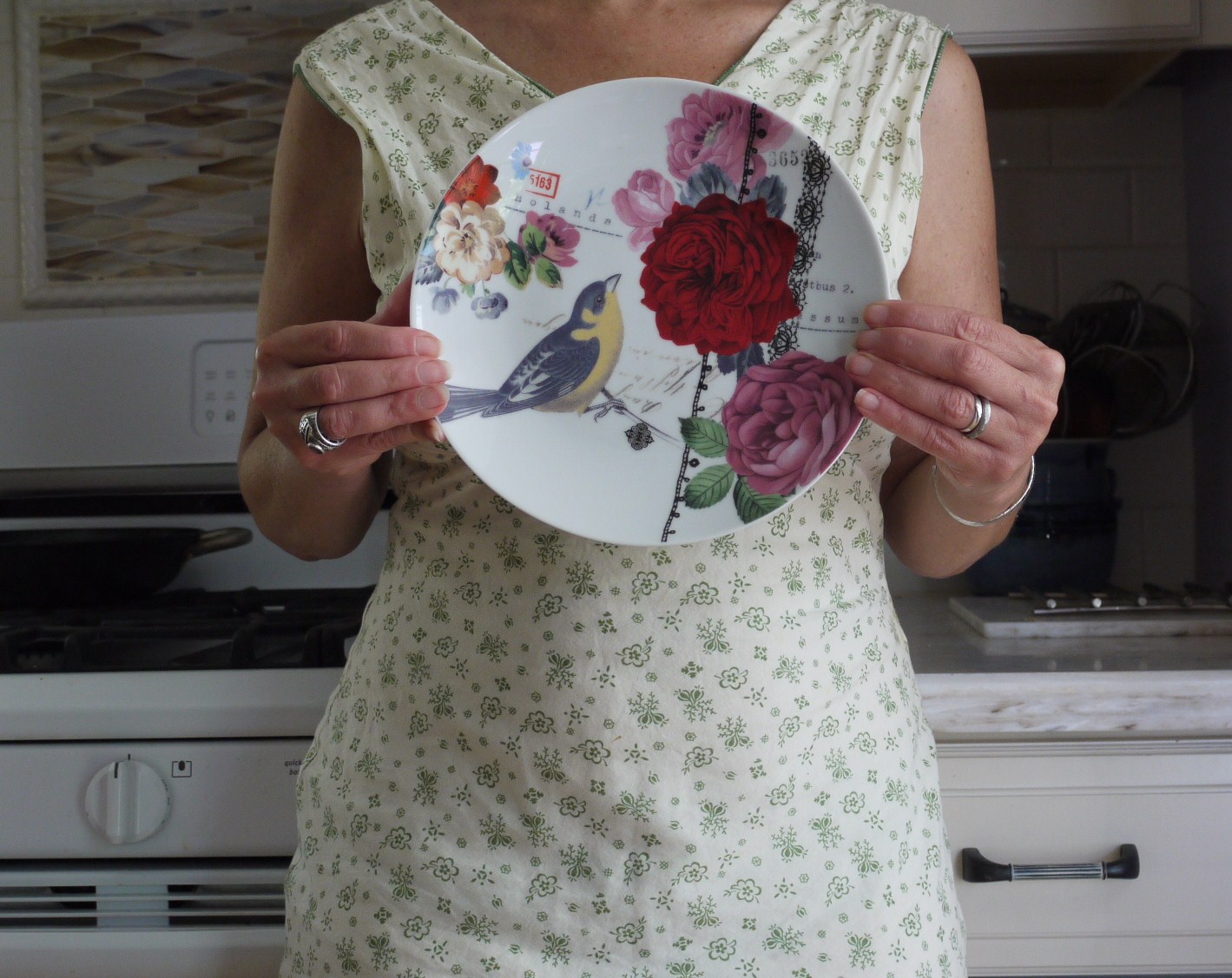
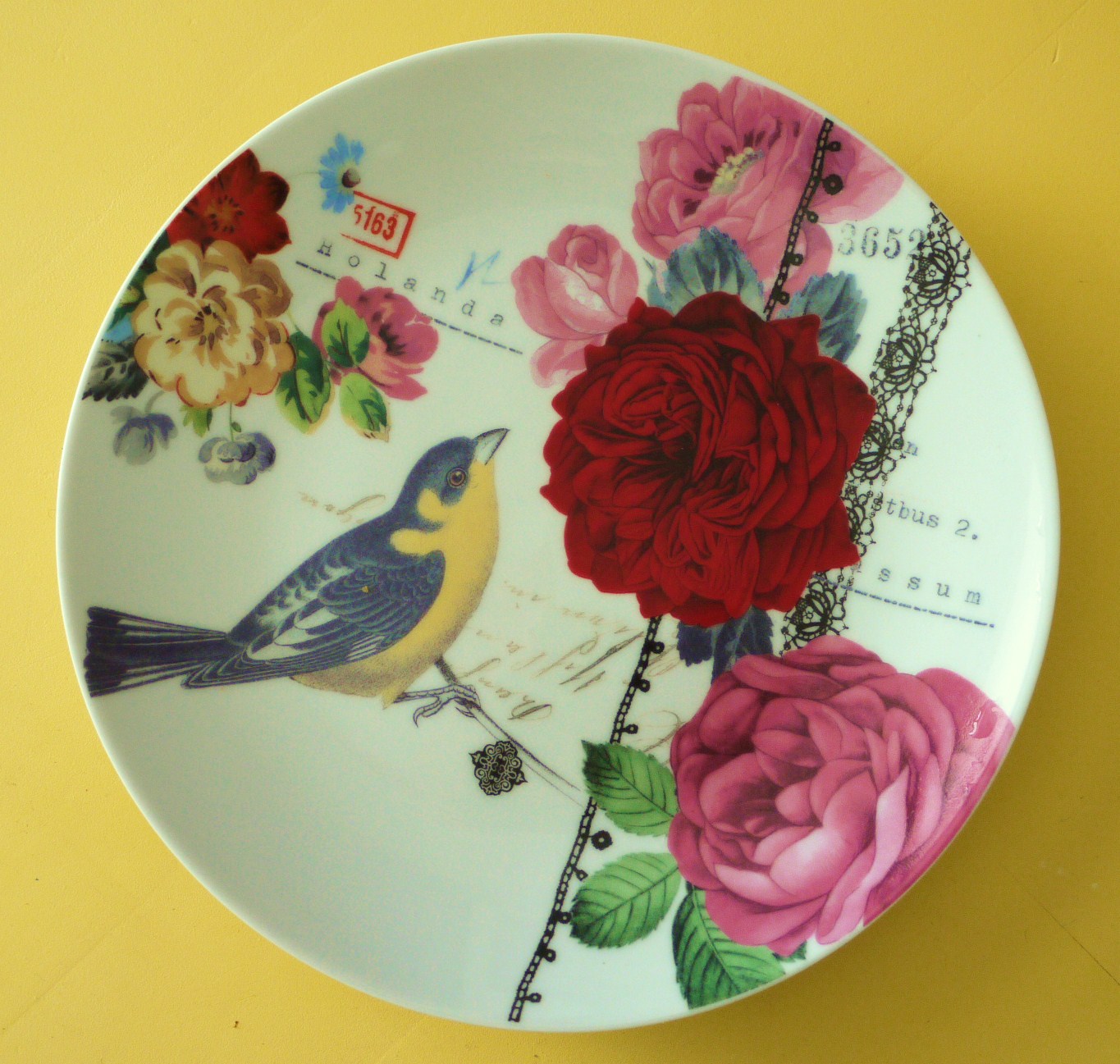
Danielle’s My Plate Plate

My Plate Haiku

Grasses, grain, fruit, wine

Garden flowers produce joy

Kitchen flours bread. By Gordon


private health

My dilemma was really excited. We hadn’t been to a conference in a while. Usually, I try to keep my nutritional dilemma quiet and out of sight. But, last week as I was heading to a meeting of the New York State Public Health Association I figured nothing would be too controversial, so I relaxed my grip on it a bit as we headed out. It was an unusually warm morning and as I rolled down the car windows, my dilemma, riding shotgun, stuck its head out into the fresh air, giddily taking in all the sights and smells like a golden retriever.

golden retriever

We arrived at the hotel, easily found a parking space and the right room, and settled in. I applauded the availability of Tazo Tea and forgave the choice of bad white bagels. I knew there was some consciousness on the part of the Association to be mindful of the food so I appreciated that there was an alternative to the usual sugar-laden breakfast pastries.

The title of the conference was “Transforming Communities through Public Health Practice”.  The keynote speaker was  Michelle Davis, Deputy Regional Health Administrator for the  US Department of Health and Human Services.

As I sat through the morning, I checked the program to remind myself of the focus of the day and why I had chosen to apply my limited continuing education benefits here. Though I mainly do my nutrition and health thing privately within the confines of my small offices, working with one member of the public at a time, I also try to promote health messages to a larger audience as well. I practice what I term stealth health–introducing information or programs that enhance well-being in both supportive and unsuspecting ways. Here was an opportunity to listen and learn from others who are out there doing community transformation. This is what motivated my choice–to be with my peeps–like-minded people doing great things in this arena.

As an attendee I learned of the new goals of the Healthy People 2020 initiative; I heard about some worthy activities happening on the local scene; and, I sat in on an interesting session that reviewed a relatively well-funded menu labeling education campaign that encouraged consumers to choose fast food meals containing 600 calories or less. The initial results were apparently somewhat disappointing though the evaluation data was limited. The research ironically showed that those who did not receive the message curtailed calories more than those who did.

I thought I had my dilemma well-leashed, but in retrospect, I realize it was already starting to whimper and whine. However, it was not until I attended the first session of the afternoon, “Development and Implementation of  Formal Policies and/or Local Legislation to Increase the Availability of Non-Sugar Sweetened Beverages in Public Buildings: Reports from the Field” that its bark became disruptively loud. The session was facilitated by two women who had overseen a project of the NY State Association of County Health officials wherein monies and other resources were allocated to a handful of county health departments to assist their county governments in achieving this goal.

They effectively reviewed how the different counties applied their efforts–which really were intended to decrease the availability of sugar-sweetened beverages (SSBs). They described media campaigns, seltzer water promotion activities, revenue concerns, working with government officials from the top down and with procurement managers from the bottom up. They discussed vending contracts and how these are virtually impossible to change until the contract runs out. They explained the challenges, push back and resistance that each county encountered and the small changes that were made. This was an absolutely positive action, but it required that they had to play nice politics with these good public dollars.

I suppose I know this is how the process works but the cumulative view of the public health community working so hard for such small gains–even in the public sector–turned my dilemma rabid. It circled wildly, foamed at the mouth and even raised its hand and expressed its opinion. To calm it back down, I had to go get it a fruit kabob at the next break.

Who do we still have to convince at this stage of the game that vending machine revenues will not outpace health care spending? Who do I need to invite into my office to hear the daily stories of health compromised by tepid health care policies and timid action? How many cases of people addicted to Mountain Dew, Pepsi, and other such SSBs must I detail as evidence to show how they suffer from rotted teeth that cannot be repaired; ravaged digestive systems bandaged with a plethora of damaging antacid medications; excessive weight that has literally brought them to their knees; anxiety propelled by excessive caffeine; and, destroyed glucose control that relegates them to a life with diabetes? Is it not tragic how many are children and young adults are already affected?

I always say that if I was the ruler of the food planet, I would remove sodas immediately. There is a heavy toll on health from such irresponsibly marketed products available for consumption with the clink of just a few coins in most public places–not only here but around the globe. And, though soda addiction knows no boundaries, as usual, the economically poor, are disproportionately affected. Recently, a client of mine told me that the school bus company that he works for removed soda vending from the employee break room. Cannot our own government agencies venture such a commitment? Bearing such witness, I am perforce required to display the amount of sugar in various SSB bottles wherever I may be. Right now in the lobby of the health center, I have such a display with associated handouts. People truly gasp when they see the load of sugary stuff that otherwise stays dissolved in the highly acidic medium.

This week, just a few days after the episode at the hotel, a fifteen-year-old boy who has lived a large part of his life in a home for troubled youth was brought to see me–ostensibly for his high weight problems. He was accompanied by a case manager–and another boy who came along. We had a pretty good chat and among other things, we talked about his soda drinking. I told him I really felt sodas were toxic substances that deserved some type of poison label. He asked me if I had a Sharpie. I said, of course, dug it out for him–and he drew me a page full of well-executed skulls and crossbones. I thanked him profusely for his contribution to my crusade. Who knows, perhaps through this experience of participation, he will become a stealth health advocate. When we were done, I gave him and his little buddy two water bottles that I had actually picked up at the conference.

Afterward, I realized my dilemma had been watching the whole encounter from under my desk. It pawed at me and looked me squarely in the eye. It bemoaned that private health is truly a deeply public health matter and vice-versa, and with its tail between its legs, it quietly crawled away.

Let me know what you think about this issue. Thanks.

In health, Elyn

My Plate

My Plate Haiku

Lagoon watercress

Peppers my tongue

With spring joy.

by Roxanne

faur faur away

Recently, I read about someone who was working on an environmental project in the Maldives. After a day of difficult fieldwork, the writer said the group enjoyed kicking back by relaxing on a boat and enjoying a snack of faur. Ah yes, faur, that local favorite made from betel leaves, cloves, and nuts.

Now, of course, we here–here being the US of A–do snack on some natural foods like fruits and nuts. But in thinking about the Maldivians floating in those beautiful turquoise waters of the Indian Ocean, and about other cultures as well, I got to wondering, what would be our native snack if one day all of the giant snack food manufacturers just got so sick of themselves they just fell down belly up.

What soothed and satisfied us before a certain Mr. Herman W. Lay began hawking his wares? Around here, I suppose we had products made of maple syrup like maple cream which is yummy; and, had apples and pumpkins made into pies–and beef made into jerky. And, what about the potato chip? A nice tuber scrubbed clean of its earthen sod, sliced thinly and cooked to a crisp in a pot of oil. Could that not count as native fare?

Legend has it that the potato was first chipped by a Native American chef quite close to where I live. I could bike to that sacred ground–or walk there in pilgrimage if really gastronomically inspired. The story goes that George Crum, annoyed by a customer’s complaint about the dinner potatoes being cut too thick, responded with a plate of very thinly sliced, translucent, barely-there taters. The rest is history.

It turns out that the first product Mr. Lay began to sell was the potato chip–about sixty years after that restaurant mishap. So, one could argue that the potato chip–along with the corn chip–were indigenous snacks until they were co-opted by Frito-Lay. They may, in fact, have originally had some nutritional benefits as might faur– though my brief research suggests that betel leaves are not without their own significant set of problems when consumed in excess.

Somehow, with the mass introduction of packaged snack foods, we began to seriously stray from our more nut, seed, and fruit-eating behaviors. While families in Afghanistan still relax–if they can–with pistachio nuts and dried apricots, things here have never been the same since the arrival of  Bugles. I remember seeing my first bag of Bugles at my childhood friend Susan’s house. Once trumpeted onto the communal palate it seemed there was no turning back. I suppose the same could be said for all of our modern snacks including the once seemingly indomitable Twinkie which is eighty years old already.

Surprisingly, I don’t encounter the Twinkie much on my nutritional beat. It is either so ubiquitous that it doesn’t register on my radar screen or it does not command valuable prime shelf placement anymore. And, amid the thousands of diet recalls I demand from my clients, I hardly ever hear mention of them. Little Debbies seem the more popular portable snack cake these days. Now that I think about it, the Twinkie despite its iconic reputation is rather tame and boring in comparison to more obscene or more seductively marketed snack newbies. I guess this explains why it may be on the smush-ing block–and not because it has 37 artificial ingredients.

However, it is the chemically-laden nature of most of our snack foods that have granted them predominance and permanence in our lives. If you doubt this issue of purposeful manipulation by the food and flavoring industry, take a look at this 60 Minutes segment, or, at this dissection of a Twinkie by Fooducate.

But, getting back to my original query, if just say, Bugles, Twinkies and all the other thousands of products that dominate the snack manufacturing world were suddenly to go extinct, what would we do? What could we reach for that would be grown from our regional environments and get the nutritional seal of approval? Could a chomp on some Eastern White Pine needles substitute for pretzel sticks? They are an excellent source of Vitamin C and can be made into a tea as well. Would we dig our teeth into some bark which was actually a food source for the native tribe for which the glorious Adirondacks that tower nearby was named? Adirondack literally means bark eater for the sustaining dietary practice the tribe was known for.

It turns out my musing about what we are munching on is not without some precedent. Recently, I was so glad to reconnect with a college friend, Roxanne, who was in my nutrition program. Even way back then, I knew she was a wise woman. Now, she works with a company called, Real Wild Foods, Inc. As part of the wild foods movement, the company promotes the preservation, tasting, and enjoyment of North American indigenous foods and is dedicated to sustainable harvesting methods. The assortment of these micro-nutrient rich foods include preserves, jellies, syrups, mushrooms, teas, vegetables and vinegar made from some familiar and many unfamiliar but common vegetation. It presents possibilities in how we could be deliciously nourishing ourselves with nature’s natural snack foods.

Neither is it without some prescience. I have just seen some writings of Mayan elder, Carlos Barrios, a ceremonial priest and spiritual guide who is learned in the interpretation of the Mayan calendar. In his clarification of the 2012 prophecy, he states it portends a time of transformation rather than an end of the world– and that we need to be prepared for this by focusing on acts of unity. Amid his recitation of a few required actions, I was a bit surprised to see him advise, “Eat wisely–a lot of food is corrupt in either subtle or gross ways. Pay attention to what you are taking into your body.”

Sounds wise to me. Sometimes I wonder if just like peak oil will we reach peak adulterated food which will necessitate that we find our way back to what the native Hawaiians call Aloha ‘Aina—the love of the land that feeds us.”

In health, Elyn

Related Post:  The Twinkie Affair

      MyPlate Plate

         My Plate Haiku                                                                                           

          Lagoon Watercress                                                                           

          Peppers my tongue                                                                               

         With spring joy.   By Roxanne

Update: November 12, 2012:  Faur Faur Away Liquidated

With the story in today’s news of Hostess Brands threatening liquidation of its company and the future of the 500 million Twinkies that are baked–I mean manufactured–each year at stake, I refer again to this post about our snack food lives. I wrote this in January 2012 when Hostess filed in bankruptcy court for Chapter 11 protection. On the surface, the story is about labor costs, unions, workers’ rights, and the economy, but mixed into the batter are issues about our health care costs (once again) and changes in American food consciousness and its effects on the industry and the economy. However, it still remains to be seen if Ding Dong, the Twinkie is truly dead. I dare to say I doubt it, but still, Carlos Barrios’ interpretations of the 2012 Mayan prophesies deserve heeding as the calendar is shortly set to begin its next cycle.

Comments:

Beautiful article about the interpretation of the Mayan calendar. –Anne Marie

Popcorn! as simple, native, and easy as can be–and a whole grain! –Lisa Nicholson                                            Dear Lisa, Oh, yes. Absolutely. –The Nutritionist’s Dilemma

Perhaps for Thanksgiving, we should experience at least one dish which features bark or pine needles. That could not have been fun. I like “smushing block”. –Peter S. Glassman
“Smushing block” is funny, isn’t it? Love you. –The Nutritionist’s Dilemma

 IMG_3282 (1)


The Twinkie Affair

Today, I was about to sit and write about a little train of thought that had been following me around this week. I thought I had some more serious things I wanted to discuss, including returning to the subject I raised in To She Who Loves Us Before She Meets Us, on the consequences of taking away women’s power in the birthing of babies. But, I figured I would just tap out this other idea first even though I was questioning its relevance, significance, and general cohesiveness.

I had planned on talking about the very interesting work of an old friend of mine, whom I had recently reconnected with. Quite coincidentally, just as I had cleared away my other duties of the day and was gearing up for a mid-afternoon snack to fortify my writing, I got an email from this very friend, asking if I had seen Mark Bittman’s tofu recipe in the NY Times today. She sent me the link.

After returning from snacking, cleaning the cat litter box, emptying the compost and bringing in the spring water, I curled back up on my computer and found myself in the Dining and Wine section of the Wednesday Times. I did not see the tofu recipe but was quickly sucked in by a few other articles.

One was about a spontaneously created cafe in the Hurricane Irene flood-ravaged town of Schoharie, NY. My life was touched by the hurricane so the story of survival in nearby Schoharie is meaningful to me. Miraculously, food prepared and provided by angels from near and far has swirled its way into the town, first amassing under a cluster of trees and then with the coming of winter at a local DAR Hall. These offerings give those whose homes and lives were affected a free lunch and a sense of continued community. Just as spontaneously as this epicenter of nourishment created itself, so did a sign that named the cafe, Loaves and Fishes.

Next, was an amusing piece about a vegetarian New Yorker on assignment in the Midwest–the meat capital of the country; and, also–though still no mention of tofu–a Mark Bittman editorial on the decrease of meat consumption in the past few years. Of course, those would speak to me.

Just as I was about to get back to work, one more thing caught my attention. By the time I hit the publish button tonight, this may already be old news to you, but apparently, Hostess Foods is declaring bankruptcy and the fate of the Twinkie is in serious jeopardy. Before my eyes, I could tell the food world was in a tizzy. The article, musing about a world without Twinkies, actually interviewed a renowned baker and pastry chef who I know from my own little community. That seemed silly. What would he have to say about Twinkies?

English: Hostess Twinkies. Yellow snack cake w...

Image via Wikipedia

But for me? Don’t I have to say something academic, relevant or amusing about the Twinkie affair? And, don’t I have to say it really soon or my writings will be considered as fresh as a stale pastry? Unlike Twinkies, my words do not contain the ingredients that will ensure their shelf life into the next millennium. Instead, they will be moldy by Monday. Well, here it is. You have heard it here probably second, third or fourth. I have no quick or witty assessment of the situation and I will probably defer to those who do. Like to Michael Pollan discussing Twinkies vs. Carrots.

It is a dilemma that stories from the food, nutrition and eating world amass very quickly. My queue of articles that I want to address or reference gets longer and longer every day. Pete saves podcasts for me or reads me articles straight from his Kindle; friends from afar send me links to interesting or absurd articles; radio stories infiltrate my driving commute; my professional networks post really relevant material; and, blogs I follow are deserving of mention. On top of that are the real-life stories that I am privileged to hear from my clients every day. No story is purely personal. There is always a larger cultural context such as explored in this powerful and sensitive NPR story about a woman’s struggle to lose weight. There is much to react to. I cannot keep up.

So, for now, I must continue at my own small-town pace. I thank you for your patience. I’ll get back to the piece that includes my old friend, a Mayan elder– and, actually, now that I think about it, it may have everything to do with Twinkies; back to the mommas–and, as I have promised before–all the menopausal women. Time for dinner.

In Health,  Elyn–A once upon a time Twinkie eater. How about you?

Related Post: Faur, Faur Away

my plate

My Plate Haiku

Spread peanut butter

On whole grain sweet dark bread

Raspberry jam-yum.

by Barb–who is currently doing an Ayurvedic cleanse and dreaming of this.

walt whitman and mark bittman

Pete and I went to New York City last week–or as we nutritionists call it, the Big Apple. It was the day after Christmas and things were really quiet down there on the usually bustling island. Walking from Grand Central Station to the water’s edge below the United Nations we hardly saw a soul.
Hoping to catch the East River Ferry we waited on a deserted dock. Pete loves alternative modes of transportation, so we’d been excited to learn one could now take a commuter ferry across the river to points along the shore of Queens and Brooklyn.

DUMBO Archway

Soon enough, we watched as an adorable little ferry-boat tooled across the river to retrieve us.

On an ordinary weekday, it would have been very crowded, but instead, it was so empty that the ferry boat driver was making small talk with us. I am pretty sure he would have let me steer the boat if I just asked. He seemed like that kind of guy.
We walked outside onto the deck. It was a pretty cold day, quite freezing actually, and the wind on the river was strong. But, it was exhilarating to take in the views from that vantage point. There we were under the Williamsburg, Manhattan, and finally the Brooklyn Bridge with the city surrounding us on all sides. We were like tiny seeds in the core of that big Pyrus Malus.
Our first destination was DUMBO, the Brooklyn neighborhood Down Under the Manhattan Bridge Overpass. Debarking from the ferry, I was surprised again to see so relatively few people–but was more struck by the surroundings and the sensation of being under the massive structures that I had only previously experienced from above.
We quickly came upon a massive stone edifice with a large plaque on its front wall. I think it said that Walt Whitman had worked there as an editor for the newspaper, The Brooklyn Eagle. I am certain about the Walt Whitman part, but not positive about the other details as my attention was quickly distracted. Across the street, breaking the flat topography of virtually empty sidewalks, was a line of about sixty people–like they were stuck to some invisible flypaper that had lured them and trapped them. My nutritional antenna was quickly activated and I had an idea of what was going on. These people were standing outside–in the freezing cold–in a line that would move glacially slow, waiting for pizza–Grimaldi’s pizza.
To be honest, I didn’t know about Grimaldi’s fame but I do have some basic DNA intelligence about NYC pizza. How good could this pizza actually be that one would stand outside for that long when frostbite was a possibility? I mean this was the epicenter of the pizza universe–not someplace where it would be really hard to come upon a decent slice. Maybe all the other pizza eateries were closed, exhausted by holiday festivities.
Ready to move along, my dilemma suddenly appeared out of nowhere and tugged me by the sleeve. It rattled off a series of questions in its frenetic way. How deep is the desire of my planetary co-eaters? Would they risk losing a digit or two to frostbite for something that could extend beyond the definition of good pizza by only so far? Aren’t opposable digits necessary to even properly eat pizza? Did Dionysus himself twirl that dough and stir that sauce? Should we inquire and obtain some anthropological data for a study someone would pay me good money for? And, could we get some?
I informed my dilemma that we were only observing and not undertaking a research project. It was a vacation week and I did not need to assess if these food passions were bona fide expressions of life’s pleasures or surrogates for other unfulfilled desires. Besides, I was developing a good robust ‘been out on the water in the cold air’ hunger that would not abide such a wait, so, no, we could not get some. We turned the corner only to find a little pizza place with no line, empty tables and oven-generated warmth. The pizza there was pretty good and appeased both my dilemma and my appetite. Requiring no wait nor sacrifice of blood flow, I wondered, how much better could that Grimaldi’s pizza really be. Interestingly, my later online search revealed some rather disappointing Grimaldi reviews.
Refueled, we returned to the still empty streets and wandered about. We passed through a plaza under a beautiful archway right beneath the Manhattan Bridge Overpass. The only other people within sight were a man and woman being guided by, I swear to God, I am pretty positive it was my pretend best friend in food, one of my Three Good Mark(c)s, Mark Bittman!  Well, I’m not really sure at all. It could have been any other tallish, baldish, vegan-ish guy from NYC.
Still, I got that starstruck feeling. What if it was actually him? Would I tell him I’ve adopted a Middle Eastern culinary theme for Hanukkah returning the celebration to its geographical and spiritual origins? Or, that I’d been thinking about Christmas dinners and what would Jesus eat–kind of a WWJE existentialist question. Surely, Mark would be interested in this kind of holiday food discussion. Better yet, he’d know what was up at Grimaldi’s! I’d have to ask him. But, just as quickly as the trio appeared, they vanished in a Twilight Zone DUMBO kind of way.
So, there it was. One quick trip to DUMBO and two passing literary encounters–Whitman and Bittman. For Bittman’s take on local and global food issues, have a look at what he’s writing about these days. As for Whitman, it turns out that wonderful spiritual naturalist was really quite the urbanist.
Happy New Year. Deep and awe-filled blessings. And, if you have ever eaten at Grimaldi’s or have an amazing pizza place, let me know.
In health, Elyn
Update 2020: Big news. There is a Brooklyn Pizza Tour that includes a visit to Grimaldi’s with skipping the long lines.

my plate

My Plate Haiku

Give me the splendid silent sun, with all his beams full-dazzling;
Give me juicy autumnal fruit, ripe and red from the orchard;
Give me a field where the unmow’d grass grows;
Give me an arbor, give me the trellis’d grape;
Give me fresh corn and wheat–give me serene-moving animals, teaching content. by Walt

no passing

Today, I awoke to a landscape that looked like a poorly iced cake. A wet, mushy, disorganized snow fell overnight and pathetically covered the ground, leaving crumbs of grass unattractively exposed. Now, a cold, icy rain is falling and I am glad that I don’t have to go out for a while. So, I am curled up warm and cozy, just chillin’ with my dilemma. We are wondering where is the art in the science of nutrition.

photo by Jennifer O’Conner

Sometimes, the standard approaches used in this field seem as dreary to me as this grey day. Reducing food to its macronutrient content; shaping diets to conform to a square, triangular or circular configuration; indicating proper serving sizes by comparing them to a computer mouse, a golf ball or a dissected thumb tip; helping decipher rather indecipherable food labels, or interrogating the true source of our hungers–objectifying these practices can leave me as uninspired as a plate of overcooked green beans.

I seem to prefer something a little juicier with more feeling, color, passion, and heart in this pursuit of health promotion. A tad annoyed with me, my dilemma poses that I should have just become an art historian, museum curator–or an artist–if I wished to find Picasso, Rembrandt or Gauguin in my daily work. Or a chef or a farmer, it grunts. It is right of course.

My dilemma reminds me that I know darn well where this work comes alive–where it jumps off the page-turning from black and white into full technicolor; where it brightens from canned pea puce to fresh green pepper emerald; and from hamburger helper to the tastiest, soul-nourishing food that one can ever imagine. I know where palette meets palate.

One of the most inspiring aspects of my own work is the collaboration I am able to do with an organization called the Capital District Community Gardens (CDCG)–(update Capital Roots). This non-profit is committed to irrigating food deserts with a vengeance through a variety of projects. It is responsible for forty-seven food gardens in the local community, a farm-to-market program for youth, an initiative that enables local corner stores to appropriately stock and effectively sell a variety of fresh produce, and, a program that serves childcare programs. In addition, it is the mother of the Veggie Mobile–the healthy answer to the ice cream truck–a produce section on wheels.

This brightly painted, bio-diesel and solar-powered retrofitted truck winds its way–playing Beatles, Motown, and Hip Hop–through underserved neighborhoods in four nearby urban centers. It brings its well-stocked bounty of wholesale priced fruits and vegetables, locally grown when available, to public and senior housing units, schools, neighborhood centers and–I am thrilled to say–the health center where I work. When I called them about two years ago and asked them to help promote the message of food as medicine, they expanded their schedule to accommodate my request. It is amazing for me to watch every Tuesday as patients, doctors, nurses, staff, clients of the center’s substance abuse program and neighbors take their turn in line to shop. Most times I witness some beautiful gem of nourishment. Recently, I was touched by observing an elderly gentleman speaking to his wife on his cell phone telling her what was available and filling his bag per her requests.

photo by Jennifer O’Conner

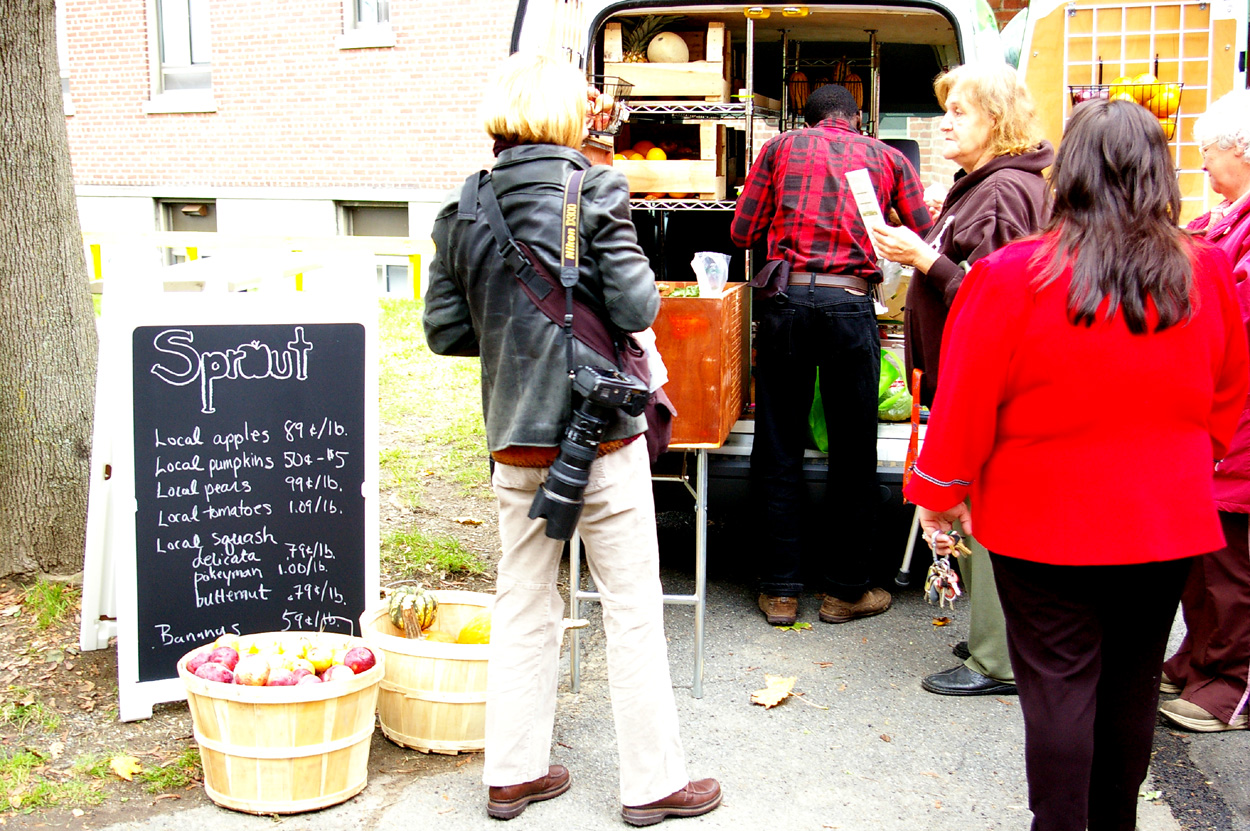
A few weeks ago I went to the rolling out party of the CDCG’s newest baby. A smaller version of the Veggie Mobile–called Sprout–was ready to take to the streets to expand their service area. As I was on the highway heading to the event, a big McDonald’s truck got ahead of me as it sped in from the on-ramp. As I wrote about in Morose Meals and Human Bites, McDonald’s tries to get my goat–so I knew this was no ironic coincidence. The back panel of the truck pictured a giant-sized box of french fries, with the words NO PASSING. Don’t they think they’re clever with their subliminal messaging? However, I know what those starchy sticks are made of. Potatoes, vegetable oil, canola oil, hydrogenated soybean oil, natural beef flavor made from wheat and milk derivatives, citric acid, dextrose, sodium acid, pyrophosphate, and salt will not seduce me. Neither will the canola oil, corn oil, soybean oil, hydrogenated soybean oil, with TBHQ, citric acid and dimethylpolysiloxane that they are cooked in. Immune to their tactics, I switched lanes, put the pedal to the metal and passed that truck right by.

As I arrived at little Sprout’s press conference, I got all choked up. There it was–the art and poetry. It was the most beautiful and colorful canvas. Bright greens, reds, oranges, and yellows were everywhere from the painting on the truck to the gorgeous apples, yams, bananas, squash and collards that filled it. County Supervisors and other local politicians were there to welcome this new addition to the fleet, stating that only 44% of people in this city had access to healthy food. Sprout’s efforts would help to increase that number. How wonderful is that? So, take that you big giant McDonald’s truck. You are no match to this little mighty David.

photo by Jennifer O’Conner

After the speeches were over, local residents who were present began to shop. I took an apple that was being offered and grabbed a big juicy bite. Here, a few blocks from the very Hudson River that had informed the palette of a whole school of artists, was a veritable Garden of Eden–in a backstreet parking lot. This is where nutrition leaves science behind and becomes a thing of true beauty.

Two other projects have recently come to my attention which also remind me of the color of nourishment. One is the work of Gina Keatley, a chef and nutritionist, who witnessing malnutrition in East Harlem, founded a non-profit called Nourishing NYC.

The other is a fascinating documentary called Urban Roots, by filmmaker Mark McInnis about Detroit’s urban agricultural movement. It captures a grass-roots revolution in its truest sense that is impacting the access to food and hence the nutritional status of a largely disenfranchised population in a post-industrial era.

Please check out all of these groups and their work. I am sure donations would be welcomed.

So, in celebration of our harvest feast, rich with the hues of autumn, I give thanks to all who grow and help bring food to the table–for there lie the most important nutritional lessons of all. And, deep gratitude to my readers, Haiku poets, friends and family. Inspired by you, I strive to bring creativity and love to my own purpose.

Happy Thanksgiving.

In health, Elyn

my plate

My Plate Haiku

Food is medicine

Farmers are doctors, Cooks priests

Eat, pray, eat, pray, love.

by Gordon

dear you, the readers

It has been one year since I first birthed my blog.  One intention, many fears, countless hours and fifty posts.

Having mothered my blog through its infancy, I now must ponder its future as a toddler-staged blog which I call a blogger. My little bloggler is learning to stand on its own and is getting fed some nice comments and words of support. But, mothering a bloggler raises new developmental issues and it is important to have a philosophy of care. Sometimes, one must look for support and feedback from others in order to persevere.

Honest Tea Cap

Honest Tea cap

So, my dear subscribers and readers, as the days grow shorter and as those of us up here in the northern climes prepare to go inward and grow pensive, I ask you for a moment of your time in the form of a click on the “like” box, a few words in the “comment” box, a share of a post, a decision to subscribe or to follow me on Twitter, a submission of a haiku, or a message in an email to let me know what you think.

Are my writings of interest, is there a resonance in the stories, is my exploration of the experiences of real eaters meaningful for you? Are my musings too long or convoluted in their message; do they not offer the hands-on suggestions and answers that we so often seek in this vast landscape, or, are they, as my brother recently told me, intriguing but rather depressing? And if they are, might they also be, as I hope, a bit funny.

Are there topics you would like me to address more, was I remiss in not discussing National Food Daylike Michael Pollan did, should I post more photos of my cat Chico? Have I not discussed menopause enough– which really, I still plan to do?  Am I too cutesy or not cutesy enough? Would you care to know that today I ate a nice nori roll for lunch and that I tried a new flavor of Honest Tea that I really liked called Heavenly Lemon Tulsi–tulsi being another name for Holy Basil which you should really check out? And, while sitting outside on this unusually warm November day, I ventured some deep gulps of the mineral spring waters that flow freely from the fountains that immortalize my nearby town? Would it be good if I included some recipes like many other food bloggers do? Should I change my template or alter the background color? Am I too pink or does my cynicism tinge the blog a light shade of tan?

Should it matter to you that this week I worked with a 41-year-old woman who weighed 78 pounds? And, then, immediately following, a 39-year-old woman who weighed 310 pounds? That a woman at my daughter’s crew event told me that getting her house ready for the real estate agent to show was so stressful, that she needed three scoops of ice cream at Friendly’s? That yesterday, a nine-year-old told me that she feels different from everyone else, and trying on clothes that say Plus Size in the store is very embarrassing? That next week I will see a two-year-old who weighs 65 pounds? Or, that a mere few hours ago, a beautiful 18-year-old college student shared with me that being thinner than 100 pounds would make her less ugly than she already is and that she has never loved her body?

It has been a number of years now since I ended my subscription to Mothering Magazine and I am certainly feeling a little lost without it. So, any input, advice or inspiration would be greatly appreciated. Gotta run. Time to put the little bloggler to bed.

Thank you for listening, sharing, following and supporting my writing. Please subscribe in the sidebar to receive notice of new posts. Comments and greetings always welcome.

In health, Elyn

my plate

My Plate Haiku

Grasses, grain, fruit, wine

Garden flowers produce joy

Kitchen flours bread.

By Gordon

attacking the causes of obesity, really?

I have been having what I suppose you could call a blog clog lately, or maybe a blogade. Lots of stuff and stories going around in the brain but they are experiencing a log jam while trying to get out in some type of orderly fashion.

Howard Johnson's Restaurant

Howard Johnson’s Restaurant

This seems to have started when Pete showed me a Jane Brody article from the New York Times a few weeks back called, “Attacking the Obesity Epidemic by First Figuring Out Its Cause”. I should probably just have considered it a moot subject and ignored it, but it wrapped its little serifs around me and wouldn’t let go. You mean we haven’t already figured this out? Apparently not. And, this is the missing piece that has still been feeding the epidemic so to speak?

According to Ms. Brody, an impressive team of experts spent the last two years investigating the big O and published their conclusions in a series of reports in The Lancet. I will assume that what she goes on to describe is a reflection of their findings and not a cover-up for some obscure but shocking discoveries that will remain hidden in a boring medical journal.

Apparently, the impressive experts determined that the demise of the following is responsible for the puddle of fat we now find ourselves in. From the 1940’s through the 1970’s more or less– the years that preceded the epidemic–we played, walked and biked more; watched less TV, ate meals prepared at home by moms who mainly did not work, ate out only for special events, downed mainly hot or cold cereal for breakfast, had fewer mass-produced convenience foods, and consumed fewer refined carbohydrates as well as fewer calories.

I will try to keep my cynicism to a minimum but remember I did warn you about this side of me in Diet for a Small Caterpillar. Maybe this is breaking news or perhaps fascinating ancient history to those born after those more svelte decades, but two years of research, really? Those impressive experts could have just come and asked me, or better yet could have paid me. I’d love to be a paid impressive expert. I was actually one of those referenced skinny, cereal eating, hop-scotching kids on a bike, who occasionally ate out at Howard Johnson’s with my family when my non-working mother was too tired to cook. Wait, how old are those exalted researchers, anyway?

With all due respect to Drs. Gortmaker and Swinburn, et al who were cited in the article– unless I am remiss for not reading the source material, this is superficial and obvious stuff. A lot has changed since that time and the changes have had many effects on the human experience besides causing obesity. I think it is myopic to put the attack and hence the shame and blame only on those walking around with the visible consequences of our societal shifts or imbalances. Many things have increased since the 1970s besides weight like rates of divorce, cancer, childhood poverty, autism, learning disabilities, alcoholism, underage drinking, the perverse pursuit of thinness and high school dropout rates–and all carry a high cost as well–but these conditions are invisible in the rising tide of humanity. Still, even if we are to keep our attention just on the problem of obesity, one could identify other significant and more profound influences.

One of my impressive experts, Marc David, who I introduced previously in Three Good Mark(c)s, meaningfully and sensitively addresses this topic in his article, ‘A New Way to Lose Weight–Listen to It’. Moving beyond the easily observed poor food choices that plague us, he explores causes of the emotional hunger we face these days that propel people to overuse or abuse food. These are very important, and when personified, they are what present in my office every day–repressed feelings, unmet needs, self-doubt, chronic stress, disconnection from one’s body and loneliness.

These are associated as well with the larger cultural issues that he dares expose. These are not new, but the ramifications are coming to a head, perhaps similar to global warming. He speaks of a nation that has valued excess and overconsumption; a culture that values speed and ease; a world filled with fear, anxiety, and mistrust; and, a people separated from their spiritual source.

Though I don’t fit their demographic, I have come to enjoy reading the magazine, Outside. It is for those who live the active life–in a rather bold way–and is a tad less dry than The Lancet. In a recent issue, there was an article, Jamie Oliver Will Work 4 Food about renegade British chef, Jamie Oliver, who is sincerely trying to clean up our country’s food mess. I admire Oliver’s means and message. I share his penchant for crying. The author, Jeff Gordinier, describes the obstacles Oliver is facing here in America. He writes, “As one wag put it, Oliver “just doesn’t get the fact that excessive consumption is woven into our national DNA.” This concurs with some of what Marc David is saying.

If a lack of identifying causes is impeding solving the problem, then acknowledging our national and personal constitutional makeups is as important as looking at what we are eating for breakfast now, well, compared to in my day. Doing so would help to explain why we lay down reason in the feeding of ourselves and our children.

My own causative list would go even further. It implicates the usurping of the practice of medicine by the pharmaceutical industry, unethical corporate practices and the disempowerment of women in pregnancy and birth for starters. I’ll leave it there for now. As I’ve hopefully unclogged the blog, I will be able to pick up on those topics soon.

Stay posted. I promise that will be fun. And tell me what would be on your list.

Thank you for listening, sharing, following and supporting my writing. Please subscribe in the sidebar to receive notice of new posts. Comments and greetings always welcome.

In health, Elyn

my plate

My Plate Haiku

Hunger tiptoes in

From bellies, hearts or minds

Feed me now she calls.

By, Eva

touched by the tempted temperament

Last week, I wrote about The Tempted Temperament. Just days later, I had a related experience I just want to share.

A sweet, 8-year-old girl came to see me along with her mom. She was a beautiful child with long, dark black hair and piercing eyes that carried the wisdom of her ancients. She was rather quiet. And, yes. She was overweight and has already endured bullying by other children.

IMG_3309

Healthy Eating Art

The mom, a tall, slender woman told me part of her child’s story. They have just returned back in the area after living for a year near San Antonio, Texas. I did not get a lot of the family’s history during this consult, partly due to the fact that not all can be disclosed in front of a child, but it was not difficult to glean that there were problems.

I learned that this child is the youngest of four children. Her oldest sister who is nineteen has a more full-bodied figure. The mom, is a loving parent and provides generally well-prepared foods and has nicely established boundaries on fast food and the watching of television. The child has no health problems. I did not, as I would write in my progress note, assess any significant dietary indiscretions.

The mom’s concern is that her daughter is not inclined to want to go out and play much and resists her mom’s offers to go exercise with her. They live in a cramped house in a difficult neighborhood.

This is not an environment for the outdoor spontaneous combustion of calories that should be the birthright of all our children. I learned that the girl enjoys eating and adores musicals, swimming and doing artwork. I knew I was in the company of a pleasant phlegmatic.

Together we discussed community resources, walking to school, school lunches and simple options for play. We addressed the preservation of her self-esteem which her mom already had a good handle on. I then looked into the deep eyes of this dear girl, deciding what to offer her that would be respectful of who she is. As always, and as I hope I am conveying in my stories, there is a deep responsibility in this task of balancing the societal scales, to honor the individual and the circumstances of their lives. And, I usually only have a few minutes to do so.

I glanced around the meager library, medicine cabinet and market basket that metaphorically describes my office. Though I wished I had something richer, I handed her a calendar book that comes with two types of stickers. One sticker is of a fun pair of sneakers, the other of a fork, knife, and spoon in a happy face kind of configuration. It’s designed to encourage a child to keep note of their healthy choices, hopefully in a fun way. Kids generally like it because they tend to love stickers.

The child’s face lit up. After having been rather reserved throughout the meeting, she perked up and said, “I know what I can do with this.” I asked her what that was. She replied, that instead of using the stickers if she ate healthy food or played something, she would draw a picture of that instead. I breathed a sigh of relief. The world will be a more beautiful place graced by the gifts of this young artist.

Thank you for listening, sharing, following and supporting my writing. Please subscribe in the sidebar to receive notice of new posts. Comments and greetings always welcome.

Also, big news this week. I am now on Twitter at http://www.twitter.com/lifeseedsnutrit. You can follow my little bird there and share my stories.

In health, Elyn

My Plate Haiku

Peach baskets brimming

Raspberries ripe on the bush

Apples soon to come.
by Crystal

lose 14 pounds in three years

The Red Dress The Red Dress Image via Wikipedia

It is always a blessed day when one is seeing Miss Henry. Miss Henry usually comes to see me early in the morning, so she is often already in the waiting room when I arrive at work. Sometimes, she is sitting alone with a book, but more commonly, she is engaged with someone nearby who she may or may not know. Many people in the community know Miss Henry. For those who don’t, it will only be a matter of time until they do.

Miss Henry should be staying at home writing her fascinating life story, but it is hard to keep that woman in one place. For someone reliant on a walker due to a  very bad knee and whose abdominal girth way exceeds her height, you might imagine that getting around would be difficult. However, when one has many kind words to say and good deeds to do, staying at home is not an option.

I have been working with Miss Henry for three years and she has lost fourteen pounds. That is about 4.6 pounds per year or .09 lbs per week! I am very proud of her and she is tickled pink too. I know what you are thinking–these are not very impressive results and that this is not headline-making news. Pounding down the pounds are the hallmarks of success in this business and the goal of effective nutritional counseling.

However, if you sat where I sit every day, you might see a different picture. When we focus only on the numbers we miss a lot of important subtleties and positive changes that occur in the process of optimizing our health. To ignore these is a serious disservice to both the individual and the model of care.

Miss Henry is 65-years-old. She was born and raised in the south as one of ten children and has raised children and grandchildren of her own. She has been responsible for the care and feeding of more people than most of us can even fathom. She still babysits, walks someone’s dog, tends to her partner, serves her church, cooks for others and takes a bus a few times a week to go visit her 91-year-old mother. She is black, and also Cherokee, Irish, and Jewish. Besides the bum knee, she has high blood pressure; and she has survived breast cancer. When I first met her she weighed about 300 pounds and used her shopping cart as a walker.

Through the time I have spent with her, she could have easily given up, and I could have too. Just for the record, in case you haven’t noticed, weight loss does not happen or sustain itself easily for most people–and some circumstances make it extremely difficult. It takes a lot of momentum and the attainment of a certain critical mass to move mountains so to speak, no matter what someone’s size.

Miss Henry knows food. She loves cooking it, sharing it, and shopping for it. For someone without a car, she always amazes me how she gets around for the best deals. Three supermarkets, Walmart, the Asian market, and the food coop are all within her domain. Oh, and she loves talking about it. For three years we have talked a lot about food. Even if I have not seen her for months, she will come in and tell me what she made for dinner yesterday or what she is planning for the next day. We have discussed eating more of some things, less of others and ways to support cleansing and elimination.

Miss Henry has had much to consider over the course of these three years including why she chose to overeat for much of her life. She has come to realize that she can care for herself as she has always cared for others. She asked for some support from her spiritual community, began to see the possibility of herself in a smaller body, focused on a red dress she so wished to fit into–and she watched Dr. Oz. Again and again, she slipped back into eating habits that she had hoped were behind her. Eventually, her excuses for overeating and her hunger began to decrease. She is now choosing to eat mainly vegetables two days of the week. Most powerful for me to observe was when she decided she no longer needed to say yes every time someone asked her to cook for a family, church or holiday event.

At first, she began walking the hallway outside her apartment and then joined an exercise program offered in her building. She started using some step machine that she had, and soon she was walking all over the city. Her frequent aches and pains began to lessen, her body became less puffy, her fat stores began to shift making her clothes fit more loosely, her blood pressure decreased and amazingly she began to rely on her walker less and less. If I had not been inquiring about these changes, and if we had not honored these transformations, the stubborn scale would have proved too discouraging.

When Ms. Henry next sees her doctor, the slightly lower number of pounds will hopefully give some modest proof of her efforts. However, for me, the important measurement that is often overlooked is how someone feels physically and mentally. I find that encouraging healthy practices is more beneficial than focusing on weight loss. Though by no means the biggest loser, this week, as Ms. Henry fit more comfortably in the chair in my office, she joyfully described just feeling lighter and having more energy. She is still the same beautiful and amazing woman but her face is glowing a little brighter.

Miss Henry always ends our visits with two exhortations. She says, Miss Elyn, whatever you do, don’t get fat. And, Miss Elyn, you have a blessed week. Bless you, too, Miss Henry.

How fine do you think the line is between health and weight?

Thank you for listening, sharing, following and supporting my writing. Please subscribe in the sidebar to receive notice of new posts. Comments and greetings always welcome.

In health, Elyn

My Plate Plate

My Plate Haiku

Hearts are not

Just reserved for romance

Every living thing is in love. by Kat