Archives

a cinderella story

Yesterday, at 2:00, I had my last client guest of the year. I was visited by the young Haitian princess Atabei. I have had the pleasure of working with her over the course of the past year. I was granted permission to be in her highness’s presence because her royally endowed figure put her by age sixteen very close to 300 lbs. Now, she is almost eighteen. She is not the heaviest of my young clients but I do particularly worry about her because she has Type 2 diabetes.

HISTORY | Her Serene Highness Princess Olive, Daughter of Emperor Soulouque. Haiti C. 1858

Haitian Princess

As we know from many fairy tales, life is not always easy for the crown-wearing crowd. Atabei has had a not so rosy past and has been fending for herself for a very long time. She has a queen mother and an older prince brother who love her–but who are caught up in their own problems to have much time for her. She navigates most of her medical care essentially on her own. Unfortunately, Medicaid doesn’t pay physicians for castle calls.

Like many royals and commoners alike, Atabei was used to eating in a bacchanalian fashion and was not subscribing to my pedestrian nutritional guidebook. She mainly craved and consumed foods that in her own giggly adolescent words were magically delicious. For those of you who may not know what that means, Lucky Charms, Toaster Strudels, and Dunkin’ Donut Munchkins are magically delicious, while whole wheat bread and oatmeal are not.

Progress was very slow, but she got a lot of credit for what we call just showing up–despite multiple challenges and limited ability to change her food environment; and she was succeeding at what I like to refer to as weight gain stabilization–she wasn’t losing weight but she wasn’t gaining either. Being evicted from the castle and landing in a motel does not usually lend itself to being able to focus on one’s eating habits and feeling good about oneself. Still, despite a few missed appointments here and there, she kept coming and she kept journaling. She was never too shy to hide her utter disgust at some of my suggestions and held tight to the foods that comforted her.

Eventually, I began to encourage her to get over to the local YMCA, where I have a partner in crime–Ben. Ben’s a little wiry guy, but as the wellness director responsible for youth programming and as a trainer, he is deeply committed to catching any kid–no matter how big- I can throw his way. Patiently, he serves to help re-knit the self-esteem that has been unraveled from so many through the art of attention and physical activity.

After a few failed attempts, Atabei gathered her horses, got in her coach, and proceeded over to the Y. Yesterday was the first time I had seen her in a while. She arrived in her radiant beauty, sans tiara, more alert and positive than I have ever seen her. She has only been going to the Y for a month, but she is already enjoying that her endurance and strength have increased. She is drinking a lot more water, is less obsessed and possessed by her old magically delicious foods, and is shocked to realize she can now choose to leave food behind. Gradually, she has made some significant diet changes which will help heal her insulin resistance. I had to almost stand on my desk and shout for her to acknowledge this. But, when the scale confirmed what I already had, her beautiful princess smile widened even more.

At the end of the session, I helped her set some of her goals for the new year. She had never before been able to even imagine that there was a possibility for change that she could empower herself. Now she finally could. What did I ask of her? That she keeps really listening to her body and seeing what it actually needs; and that she does not give up on herself. She will try–she does like to humor me.

When the clock struck three and she stepped off the curb in front of the building, she may have looked like just another poor, black, fat kid– but things are not always as they appear in the kingdom. Blessed be. Tres Bonne Annee, Atabei!

Please acknowledge the health and dietary impacts resultant from our huge cultural and environmental challenges and inequities–and honor your own small victories. Cheers.

Thank you for listening, sharing, following, and supporting my writing. Please subscribe in the sidebar to receive notice of new posts. Comments and greetings always welcome.

In health, Elyn

Stopping Traffic

“The public is silent when young women die.” charges Naomi Wolf, author of The Beauty Myth.

I have just returned from an annual conference that I attend on Eating Disorders. The conference, in its eleventh year, is sponsored by The Nutrition Clinic and Sol Stone (Update 2020: Upstate New York Eating Disorder Service); Clearpath Healing Arts Center; and Ophelia’s Place who work together to form a strong, sensitive and progressive treatment network in central New York.

woman-639420_1280

Image by Mystic Art Design at Pixabay   

Each year, near the end of the conference, a handful of individuals in the recovery stage of their eating disorder are invited up to share some part of their story. This is, of course, the most enlightening and always most emotional part of the day. The wisdom acquired in overcoming such a strong opponent is very deep and these very intelligent women articulate it beautifully.

This day, a young woman in her mid-twenties, stood before the two hundred or more attendees and shared that in the darkest days of her eating disorder, she almost walked into traffic–but only stopped herself because she felt it would be immoral to place such a horrible burden on whoever might have killed her. To witness someone so young describe such a depth of despair was both bone-chilling and deeply heart-opening.  

On some level, we know that there are people who are suffering from eating disorders, but essentially they are invisible. However, when one is privy to the stories of those who have had one of these crippling conditions; and you couple that with statistics like one in 100 individuals has an eating disorder—it is imaginable that there are truly some “walking dead” amongst us.

To offer some response to this young woman who had the courage to expose her pain and vulnerability and who has found the strength to persevere and to heal, I bring to this conversation– about the realities of eaters and eating– a discussion about eating disorders. I know that it does not do justice to the topic. It is a contorted and rather incomplete version of something I have written before. But, it seems a fitting time for me to introduce this part of the story. In honor of that woman and the four others who stood before me a few days ago, please consider the following.

We may have seen or heard about someone who is nibbling on only lettuce and carrots at mealtimes; wearing heavy clothing in moderate temperatures; exhibiting extreme weight loss; exercising excessively or appearing listless at a team practice or dance class.  But, to the inexperienced eye, even extreme physical changes or behaviors can be overlooked or ignored. We may have even encountered someone who we suspected was suffering from an eating disorder, but we did not know what to do or say.

Most definitely, we have all had dealings with eating disordered individuals whose behaviors escaped our radar screen. The very nature of eating disorders is secretive and manipulative. Average-weight or over-weight individuals may be suffering as much as their noticeably underweight counterparts; older persons as well as younger ones; and men as well as women. Compounding the issue is that in certain environments like high schools and college campuses—but in the larger world as well—there is a “culture of thinness”. In such environments, underweight individuals can appear almost normal looking. Responses to eating disorders can include, “Oh, I wish I had that problem”, or “Why don’t they just eat?”

Even when we are cognizant and concerned about eating disorders, it is impossible to consider or measure the loss of potential and achievement, the degree of nutrient deficiencies, the magnitude of depression and anxiety, the potential for long-term health problems, and the possibility of sudden death from complications or suicide that eating disorders engender.

Eating disorders tend to leave people feeling frustrated, confused and helpless. Despite this normal reaction, it is really important that our society and our public health policymakers begin to better acknowledge, support and treat those with these disorders.  Without intervention, chances for a full recovery are slim for those with severe conditions.

I have discussed my concern about the panicked way in which we are “battling” obesity.  For many, overeating is an eating disorder–as deserving of a very sensitive and holistic approach to care as does “undereating”. We have the opportunity, and perhaps the obligation, to create an environment and dialogue that challenges the attitudes that make individuals feel bad about their bodies and that feed the medium in which all eating disorders thrive.

We can only hear the wisdom of those who have confronted an eating disorder if we are very quiet. If we can move the lens away from the obesity issue and reframe the disgust we harbor about fat, we may realize there is a gentler and more important conversation to be had about feeding, eating, and nourishment.

Frances Berg writes, “Our children, our daughters, and sons, are growing up afraid to eat, afraid to gain weight, afraid to grow and mature in normal ways. They are desperate to have the right bodies, obsessed with the need to be thin and fearful they won’t be loved until they reach perfection. This is the point to which our weight-obsessed culture has brought us. Our children are innocent victims.”

Thank you for listening, sharing, following and supporting my writing. Please subscribe in the sidebar to receive notice of new posts. Comments and greetings always welcome.

Related Resources: Bulimia.com; Becky Henry, Hope Network; Moonshadow’s Spirit

In health, Elyn

Related Posts: Dolls with Faith, Muse of the Girl, Nourish Thyself Well Day, A Meteorological Change of Plans, Size Me Down

Related Resources: Bulimia.com; Becky Henry, Hope Network; Moonshadow’s Spirit

Your Pyramid

As a nutritional professional, I would like to share with you some tips on eating well.

For today, let’s start with a simple tool that is available to all Americans, brought to you by the US Department of Agriculture. You can probably find it right in your own kitchen–check your cereal boxes–the MyPyramid. Yes, that is your pyramid folks. Your tax dollars have paid for it–it would be a shame to see it go to waste. To the untrained eye, it appears like a triangle decorated with multi-colored vertical sections of varying bandwidths– with an alien climbing up some stairs on the side. However, hidden in that simple representation, is the culmination of US Dietary Policy.MyPyramid

The MyPyramid has been personalized just for you. Very obtusely, it suggests moderation, proportionality, variety, activity–and if your version happens to say on the bottom, steps to a healthier you–gradual improvement. Boy, you are lucky I am here.

Our government has been trying to figure out how to inform the masses about good nutrition since about 1916. Granted, this is not easy and I imagine those who’ve been assigned the task have resorted to some serious stress eating. By 1956, using a minimalist approach, the four food groups, which I grew up on, became the model of nutritional dictate. Many people still adhere to this model–but having forgotten what those four groups actually were, actually make up their own. My husband’s preferred groups are ethnic food, ice cream, popcorn (whole grain) and carbonated beverage.

In the late 1980s, having a few years of nutrition counseling experience under my belt, I took a sabbatical to do some focused research in two distinct areas–both of an anthropological nature. The first included infant and toddler feeding with my son as the subject; and the second involved serving lots of burritos and chimichangas to gringos in a very popular Mexican restaurant. The first was more adorable–though the latter was more lucrative.

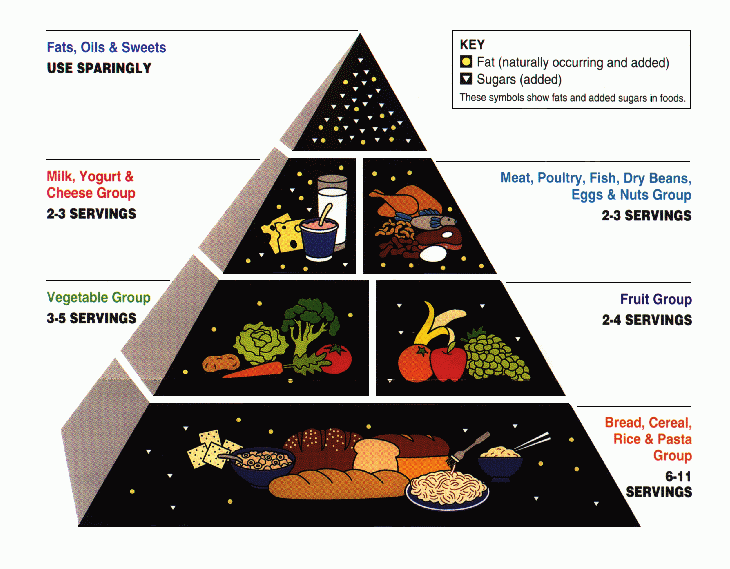
When I returned to the field a few years later, I learned that we were soon to be blessed with a long-awaited update of the dietary guidelines–with the experts busily designing what was soon to be ubiquitously known as the Food Pyramid. After years of deliberation and millions of dollars, it was officially released in 1992–smack with 6-11 servings of essentially refined carbohydrates literally forming the base of its recommendations. Having recognized that the American diet was somehow connected to a plethora of chronic diseases, and using evidence that cultures who ate traditional diets–which included some high carbohydrate foods like manioc root, taro, and sorghum–were not plagued by heart disease, colon cancer, and diabetes, the experts interpreted this to mean we should increase dietary attention to carbohydrates. Fats became increasingly vilified, and giant bagels and bowls full of pasta were elevated to celebrity status.

I was there. I witnessed it all–and I rubbed my forehead in disbelief. You see, I come from a long line of bagel eaters. Don’t get me wrong. Bagels are very good. They contribute to comedy and to cream cheese. However, it is obvious that this is not the foodstuff of those who epitomize extreme physical perfection and longevity. If obesity and chronic disease prevention or lean and mean was what we were seeking, why were we not promoting the Hunza, Masai or Okinawa Diet? Modern, western scientific orientation would continue to dismiss cultures who have powerful food beliefs or view food as medicine.

But, so it was. By 1996, just four years after the introduction of the Food Pyramid, the unprecedented increase in obesity, childhood obesity, diabetes, along with some other surprising health concerns was making the headlines. In 2005, after a mere thirteen years in existence, the Food Guide Pyramid was to be declared obsolete. President Bush, as part of his Healthier US Initiative, introduced the dumbed-down version of the pyramid, that we are now fortunate to have at our disposal today.

Really, I do not wish to appear so cynical. But, when I look at that colorful triangle, I see what is hidden behind. Not a line drawing but real flesh and blood citizens seriously affected by the lack of a meaningful food policy in this country. I see a populace who was sufficiently seduced and ate what it was fed.

This may seem a moot discussion. It could be argued that few people even pay attention or that the situation will change shortly with the soon to be released 2010 Dietary Guidelines. Many are already aware of the competing interests that influence our health and nutritional policies. However, the reality is that it says a lot that that triangle says so little. And, it still represents the foundation of many dietary organizations.

If you are holding a cereal box, take a deeper look. If it is a highly processed, artificially colored, multi-sugar sweetened, perversely marketed candy imposter–put down the box, back away and wonder what right the triangle has being on there anyway.

Thank you for listening, sharing, following and supporting my writing. Please subscribe in the sidebar to receive notice of new posts. Comments and greetings always welcome.

In health, Elyn