Archives

To she who loves us before she meets us

To she who loves us before she meets us. Inscription on the Monumento a la Madre in Ciudad de Mexico.

The story of how women birth babies in this country has many chapters. In brief, it is a story that begins with essentially all births being attended to by midwives from various traditions in women’s homes or designated places and leads to the current paradigm of almost all births being managed according to a pathology-oriented medical model in hospitals.

The change was effected by the professionalization of obstetrics at the end of the 1800s; the advent of charity hospitals that lured women with the promise of improved care but essentially were intended as training grounds for a profession that had no actual experience–and that resulted in a significant rise in maternal and infant mortality; and the influence of physicians who changed labor and delivery from a natural process to one that required the routine use of a series of interventions. By the 1940s, the vast majority of births took place in hospitals. This trajectory was not the same in most other industrialized countries.

The introduction of “twilight sleep” which used morphine and scopolamine defined mid-20th century birth. The combination of these drugs left women powerless, with no memory of their labor or delivery. Problems associated with this cocktail led to its discontinuation but gave rise to other substituted interventions.

The late 1960s and 1970s saw a counter movement with women recreating options for more natural births. This resuscitated the profession of midwifery and ushered in the establishment of free-standing birth centers, more comfortable birthing rooms in hospitals and even expanded possibilities for women to deliver their babies back in the sanctity of their own homes. However, the persistent culturally held belief system that medically guided births are safer and the seduction of pain-free birth–promised now by the wide-spread use of epidurals–has maintained the predominance of a medical model. A midwifery model of care is still marginalized–though it is quite alive and kicking.Image result for monumento a la madre

In Attacking the Causes of Obesity, Really?, I discuss how I believe some very powerful influences regarding our current health situation including the weight problem have been seriously overlooked. To me, dismissing the consequences of dissociating women from the birth of their children is a glaring oversight. It seems rather obvious that as women were lulled into surrendering their most primal potent power that there would be other negative sequelae. Try not to interpret this on a personal level but rather on the larger societal level where these insidious changes occur.

Birth is a very divinely tuned natural process where a precise cascade of hormones allows for a woman to orchestrate the birth of her baby. It benefits from attendant security, guidance, and support. Right after a normal delivery, a woman is alert and aware, able to hold, bond, nurse and care for her infant. Imagine, coming out of an induced stupor to find yourself alone with no baby to immediately see–let alone to hold. With medications and fear impeding the ability to breastfeed, it is also no coincidence that formula feeding quickly obliterated nursing at the same time that these interventions were implemented. This period of medically controlled birth was also marked by weight gain fear being instilled in women and the withholding of food during labor. Those practices are still the norm today.

Over the course of a few decades in this country, we abruptly dissolved the innate wisdom of women on how to trust their instincts in the care and feeding of their young. Ironically, it happened just as women were gaining other rights. It has now been about seventy years since that big SNAP, CRACKLE  and ultimate POP of male-dominated modern obstetrics felled the tree that rooted women to their maternal wisdom. Our infant and maternal maternity rates are abominably high–along with our C-Section rates, and, our breastfeeding rates are pathetically low. Chronic illnesses are common and increasing in our children.

With a few generations of women now lacking communal wisdom and thereby, confidence in their ability to give birth; and, with doctors who are not trained in nutrition and the motherly art of breastfeeding conducting our obstetric and pediatric care, is it any wonder that we no longer know what to do? That we no longer know how to cook and prepare real food for our children, that drugs are offered like candy, that a huge percentage of our infants and young children have hardly ingested a morsel of non-processed or non-adulterated food and, that we barely know and trust how to nourish our own selves?

In that prior post, I state that I want to be an impressive expert–a paid one. Here, I will boldly lay claim to my area of expertise. I have had the very unique experience of providing nutrition care in clinical and community settings for almost thirty years. In my next post, I will share my observations and experiences.

Until then, as always, I welcome your thoughts and comments. And, I share my deep gratitude for all the incredible midwives, many of whom I know personally, some who have birthed my own children, others who are out there fighting for the rights of women and children on a daily basis.

A special thank you to my midwife Helena who brought me boxes of organic vegetables the summer I was pregnant with my daughter. And to Leslie and Jennifer.  Please check out BirthNet and Every Mother Counts.

Thank you for listening, sharing, following and supporting my writing. Please subscribe in the sidebar to receive notice of new posts. Comments and greetings always welcome.

In health,  Elyn

Related Posts: Blessed Feeding, Breastfeeding Redux, To She Who Loves Us; Oh Mother
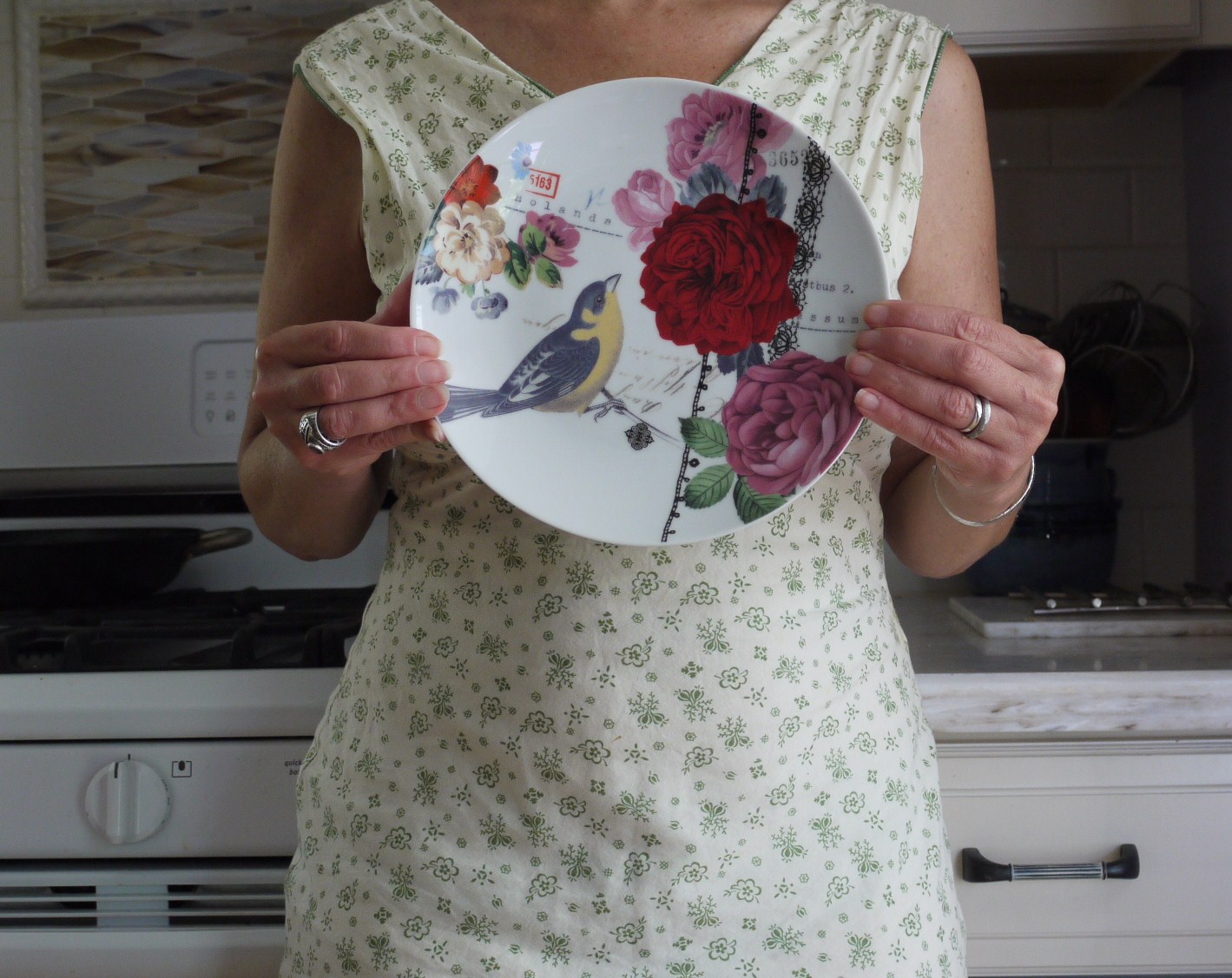
My Plate Haiku

Craving for pickles

And German chocolate cake

My friend is pregnant.  By Gretchen

where it all began

Last week, I dug out the dark green heavy plastic bin that resides at the bottom of one of my storage closets. It’s not easily accessible, but not too hard to get to either. Years can go by without my opening it, but I like to know where it is among all of my stored stuff. It contains the artifacts of my formative years and preserves that nascent stage of my existence.

Stuffed in the bin is mainly personal correspondence of my life from pre-junior high through post-college. They are written on bright flowery stationery, thin and wide-lined loose-leaf paper, odd scraps and postcards from near and far. Some are hammered out on yellowing typing paper. They document boring summer days, summer camp activities, courses taken, teenage-angst, young love and declarations of forever friendship. There are also some official documents like my school report cards, SAT scores and college tuition bills which seem quite cachectic compared to the full robust ones of today.

On the rare occasions when I open the bin, it is easy to get lost in there, randomly opening envelopes to see what long-forgotten piece of soul revealing information lies within. On my recent excavation, I tried not to linger too long. I was looking for some particular letters to give to an old friend who had authored them many years ago–and found them pretty quickly.

However, to my surprise, I happened to dredge up a scribbled draft of my college application essay describing my intention to embark on the study of nutrition. In my once prized small script, amid the many cross-outs, the blue ink asserted that “For many years I have been concerned about my own diet and now, I have become increasingly aware of problems and inadequacies in the public’s diet due to social conditions and the lack of proper nutritional information.” It goes on to say that having worked for a summer in a local health food store, I came to understand that I wanted to pursue the field of nutrition. Every day was a learning experience as I gained knowledge from both my employer and the customers. I add that I have an interest in the social sciences and have a desire to help people. And, that I think the program I am applying for is one of the best.

It was rather embarrassing to read this declaration of purpose from my unformed self and to see my simplistic writing. It also made me wonder if I have evolved much since then, as I seem to still be living an old vision. I know it is time for me to manifest something new. Still, I was struck by my awareness at that point of the inadequacies of the American diet and its effects on our health. This was 1977. Dietetics at that time was still essentially practiced in the caverns of hospitals, nursing homes, and school cafeterias. It was also a few years before high fructose corn syrup and other chemically-transformed concoctions tsunamied their way into our entire food supply, altering the contours of the human physique which pulled the alarm bells–and margarine and saccharin were still considered rather benign.

As I mentioned in Holistic, Intuitive Eating, Community Nutritionist Seeking Michael Pollan, I thought my early intentions were focused on global hunger issues. I did not remember that health and personal feeding concerns inspired my path.

Looking back, I now know that Hy, the owner of that health food store–ironically located next to a pizza shop in a tiny row of stores in a largely industrial area–was way ahead of his time. He was a round, bespectacled man already in his late sixties who had retired from a career with the famed Harry Winston Jewelers.

Hy was self-taught, having studied the work of other nutritional gurus. From him, I learned about health issues that are only recently becoming widely accepted. He talked about the dangers of sugar, how bad it was to eat when stressed, and the importance of exposure to natural light. He knew about the healing properties of herbs. He quietly assisted customers with unorthodox treatments and kept some special products in the backroom. A few years later when I was struggling with some serious irritable bowel symptoms, I desperately sought him out. He readily guided me to a simple herbal supplement right on the shelf, and my condition was almost immediately improved. Maybe that is when my perspective changed from the global to the personal. It clearly began my departure from conventional medicine.

Little could I have imagined then where this interest would lead me. Though I have done community nutrition work, and have had some short-term experiences doing public health work in both Guatemala and Peru, my work has been very local and essentially contained within the vast personal geography of the individual.

Interestingly, the friend whose letters I was looking for was overweight as a teenager. Her frank comments about herself and her struggles with weight were a constant part of our adolescent conversations. I remember once during high school her parents went away for the weekend. Left to our own devices, she and I made a beeline to the store and giddily filled a shopping cart with boxes of junk food.

In one of the letters, she writes about being in love with some guy who she met when she started college. She describes her realization that her years of constant hunger and adoration of food had for the first time, amazingly diminished. She acquires, at that moment, an important knowing that is still barely recognized in the big chat room of culinary chastisement and dietary deprivation–that pleasure is a vital nutrient. Trying to beat down the desire to overeat without nurturing other areas of pleasure in one’s life will only foster continual frustration and unsuccessful weight loss or healthier eating attempts.

This is a very important concept that I never learned in my academic studies but which is now being beautifully presented to the world by some lovely wise women–Jena La Flamme, Tonya Leigh, and Angela Minelli. Please check out their offerings.

Right now, I am sitting on the couch taking one more glance at this old college essay before I go upstairs to pack it back in the bin. So much has changed since then. I wonder what would have happened, what would have been different if I had not been accepted to that college nutrition program. Who knows.

I’d love to hear about what sparked your interest or passion in this area.

In health, Elyn

my plate

My Plate Haiku

Food made joyfully

As a gift of time and self

Feeds body and soul.    By Anne-Marie

no passing

Today, I awoke to a landscape that looked like a poorly iced cake. A wet, mushy, disorganized snow fell overnight and pathetically covered the ground, leaving crumbs of grass unattractively exposed. Now, a cold, icy rain is falling and I am glad that I don’t have to go out for a while. So, I am curled up warm and cozy, just chillin’ with my dilemma. We are wondering where is the art in the science of nutrition.

photo by Jennifer O’Conner

Sometimes, the standard approaches used in this field seem as dreary to me as this grey day. Reducing food to its macronutrient content; shaping diets to conform to a square, triangular or circular configuration; indicating proper serving sizes by comparing them to a computer mouse, a golf ball or a dissected thumb tip; helping decipher rather indecipherable food labels, or interrogating the true source of our hungers–objectifying these practices can leave me as uninspired as a plate of overcooked green beans.

I seem to prefer something a little juicier with more feeling, color, passion, and heart in this pursuit of health promotion. A tad annoyed with me, my dilemma poses that I should have just become an art historian, museum curator–or an artist–if I wished to find Picasso, Rembrandt or Gauguin in my daily work. Or a chef or a farmer, it grunts. It is right of course.

My dilemma reminds me that I know darn well where this work comes alive–where it jumps off the page-turning from black and white into full technicolor; where it brightens from canned pea puce to fresh green pepper emerald; and from hamburger helper to the tastiest, soul-nourishing food that one can ever imagine. I know where palette meets palate.

One of the most inspiring aspects of my own work is the collaboration I am able to do with an organization called the Capital District Community Gardens (CDCG)–(update Capital Roots). This non-profit is committed to irrigating food deserts with a vengeance through a variety of projects. It is responsible for forty-seven food gardens in the local community, a farm-to-market program for youth, an initiative that enables local corner stores to appropriately stock and effectively sell a variety of fresh produce, and, a program that serves childcare programs. In addition, it is the mother of the Veggie Mobile–the healthy answer to the ice cream truck–a produce section on wheels.

This brightly painted, bio-diesel and solar-powered retrofitted truck winds its way–playing Beatles, Motown, and Hip Hop–through underserved neighborhoods in four nearby urban centers. It brings its well-stocked bounty of wholesale priced fruits and vegetables, locally grown when available, to public and senior housing units, schools, neighborhood centers and–I am thrilled to say–the health center where I work. When I called them about two years ago and asked them to help promote the message of food as medicine, they expanded their schedule to accommodate my request. It is amazing for me to watch every Tuesday as patients, doctors, nurses, staff, clients of the center’s substance abuse program and neighbors take their turn in line to shop. Most times I witness some beautiful gem of nourishment. Recently, I was touched by observing an elderly gentleman speaking to his wife on his cell phone telling her what was available and filling his bag per her requests.

photo by Jennifer O’Conner

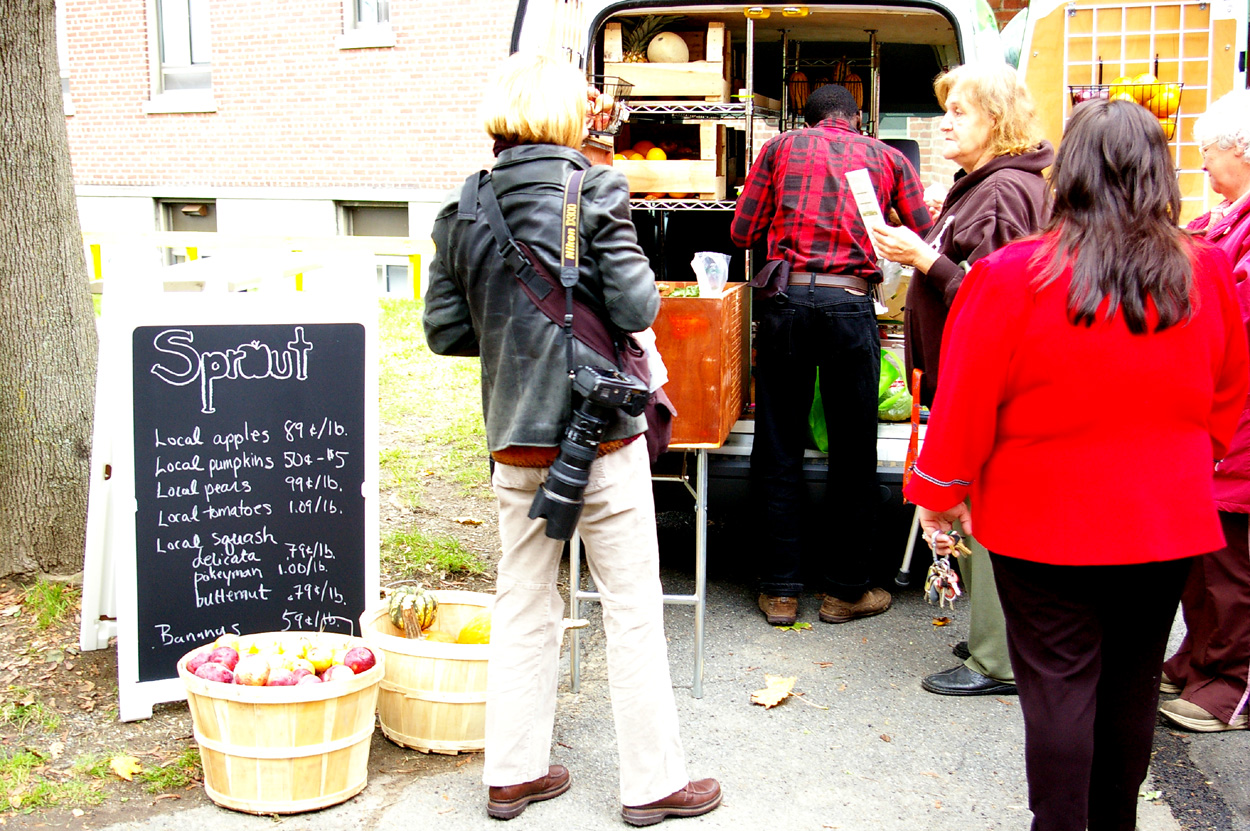
A few weeks ago I went to the rolling out party of the CDCG’s newest baby. A smaller version of the Veggie Mobile–called Sprout–was ready to take to the streets to expand their service area. As I was on the highway heading to the event, a big McDonald’s truck got ahead of me as it sped in from the on-ramp. As I wrote about in Morose Meals and Human Bites, McDonald’s tries to get my goat–so I knew this was no ironic coincidence. The back panel of the truck pictured a giant-sized box of french fries, with the words NO PASSING. Don’t they think they’re clever with their subliminal messaging? However, I know what those starchy sticks are made of. Potatoes, vegetable oil, canola oil, hydrogenated soybean oil, natural beef flavor made from wheat and milk derivatives, citric acid, dextrose, sodium acid, pyrophosphate, and salt will not seduce me. Neither will the canola oil, corn oil, soybean oil, hydrogenated soybean oil, with TBHQ, citric acid and dimethylpolysiloxane that they are cooked in. Immune to their tactics, I switched lanes, put the pedal to the metal and passed that truck right by.

As I arrived at little Sprout’s press conference, I got all choked up. There it was–the art and poetry. It was the most beautiful and colorful canvas. Bright greens, reds, oranges, and yellows were everywhere from the painting on the truck to the gorgeous apples, yams, bananas, squash and collards that filled it. County Supervisors and other local politicians were there to welcome this new addition to the fleet, stating that only 44% of people in this city had access to healthy food. Sprout’s efforts would help to increase that number. How wonderful is that? So, take that you big giant McDonald’s truck. You are no match to this little mighty David.

photo by Jennifer O’Conner

After the speeches were over, local residents who were present began to shop. I took an apple that was being offered and grabbed a big juicy bite. Here, a few blocks from the very Hudson River that had informed the palette of a whole school of artists, was a veritable Garden of Eden–in a backstreet parking lot. This is where nutrition leaves science behind and becomes a thing of true beauty.

Two other projects have recently come to my attention which also remind me of the color of nourishment. One is the work of Gina Keatley, a chef and nutritionist, who witnessing malnutrition in East Harlem, founded a non-profit called Nourishing NYC.

The other is a fascinating documentary called Urban Roots, by filmmaker Mark McInnis about Detroit’s urban agricultural movement. It captures a grass-roots revolution in its truest sense that is impacting the access to food and hence the nutritional status of a largely disenfranchised population in a post-industrial era.

Please check out all of these groups and their work. I am sure donations would be welcomed.

So, in celebration of our harvest feast, rich with the hues of autumn, I give thanks to all who grow and help bring food to the table–for there lie the most important nutritional lessons of all. And, deep gratitude to my readers, Haiku poets, friends and family. Inspired by you, I strive to bring creativity and love to my own purpose.

Happy Thanksgiving.

In health, Elyn

my plate

My Plate Haiku

Food is medicine

Farmers are doctors, Cooks priests

Eat, pray, eat, pray, love.

by Gordon

dear you, the readers

It has been one year since I first birthed my blog.  One intention, many fears, countless hours and fifty posts.

Having mothered my blog through its infancy, I now must ponder its future as a toddler-staged blog which I call a blogger. My little bloggler is learning to stand on its own and is getting fed some nice comments and words of support. But, mothering a bloggler raises new developmental issues and it is important to have a philosophy of care. Sometimes, one must look for support and feedback from others in order to persevere.

Honest Tea Cap

Honest Tea cap

So, my dear subscribers and readers, as the days grow shorter and as those of us up here in the northern climes prepare to go inward and grow pensive, I ask you for a moment of your time in the form of a click on the “like” box, a few words in the “comment” box, a share of a post, a decision to subscribe or to follow me on Twitter, a submission of a haiku, or a message in an email to let me know what you think.

Are my writings of interest, is there a resonance in the stories, is my exploration of the experiences of real eaters meaningful for you? Are my musings too long or convoluted in their message; do they not offer the hands-on suggestions and answers that we so often seek in this vast landscape, or, are they, as my brother recently told me, intriguing but rather depressing? And if they are, might they also be, as I hope, a bit funny.

Are there topics you would like me to address more, was I remiss in not discussing National Food Daylike Michael Pollan did, should I post more photos of my cat Chico? Have I not discussed menopause enough– which really, I still plan to do?  Am I too cutesy or not cutesy enough? Would you care to know that today I ate a nice nori roll for lunch and that I tried a new flavor of Honest Tea that I really liked called Heavenly Lemon Tulsi–tulsi being another name for Holy Basil which you should really check out? And, while sitting outside on this unusually warm November day, I ventured some deep gulps of the mineral spring waters that flow freely from the fountains that immortalize my nearby town? Would it be good if I included some recipes like many other food bloggers do? Should I change my template or alter the background color? Am I too pink or does my cynicism tinge the blog a light shade of tan?

Should it matter to you that this week I worked with a 41-year-old woman who weighed 78 pounds? And, then, immediately following, a 39-year-old woman who weighed 310 pounds? That a woman at my daughter’s crew event told me that getting her house ready for the real estate agent to show was so stressful, that she needed three scoops of ice cream at Friendly’s? That yesterday, a nine-year-old told me that she feels different from everyone else, and trying on clothes that say Plus Size in the store is very embarrassing? That next week I will see a two-year-old who weighs 65 pounds? Or, that a mere few hours ago, a beautiful 18-year-old college student shared with me that being thinner than 100 pounds would make her less ugly than she already is and that she has never loved her body?

It has been a number of years now since I ended my subscription to Mothering Magazine and I am certainly feeling a little lost without it. So, any input, advice or inspiration would be greatly appreciated. Gotta run. Time to put the little bloggler to bed.

Thank you for listening, sharing, following and supporting my writing. Please subscribe in the sidebar to receive notice of new posts. Comments and greetings always welcome.

In health, Elyn

my plate

My Plate Haiku

Grasses, grain, fruit, wine

Garden flowers produce joy

Kitchen flours bread.

By Gordon

the nightmare before halloween

It has been one year almost to the date that I first began my blog. Just as I was ready to celebrate having come full circle, I realized that there was one more event in the liturgical feeding cycle to attend to in order to truly do so. Halloween.

Halloween is this nutritionist’s nightmare. It makes all my dilemmas go screaming wildly around in the scary darkness like a gathering of roaming ghosts. Starting in mid-October, I began to see discussion of these hair-raising topics appear in various articles. Some people were writing about Halloween as a sanctified binge-eating holiday. Commentary ensued on memories of guilt-encompassed candy hoarding and gorging. Then guilt- minimizing strategies were presented–instructions were offered on how to partake but not overdo; and, suggestions were given on organic, high cacao content, lower sugar, chocolate alternatives.

Then, there was the issue of the politics of chocolate–the problems of impoverished cocoa farmers, environmental degradation and the use of forced child labor on cocoa farms. With one-quarter of all candy sold annually in the US being purchased for Halloween–this is no small matter. EqualExchange, the producers of organic, fairly-traded chocolate products, sponsors a Reverse Trick or Treating Program. Trick-or-Treaters give a piece of Fair Trade chocolate attached to an informational card as a mass action to educate the public about this.

Finally, the childhood obesity issue surfaced as well. I learned of a dad from Georgia, David Soleil, whose activism was inspired by being fed up witnessing too many Halloweens–overweight parents driving cars around his neighborhood unloading their children at intervals to gather the loot; pillowcases loaded 3/4 full with candy and the endorsement of multiple pre-Halloween events. He launched a response with a movement called Healthy Halloween House where people pledge to provide a healthy trick or treat alternative. I love his slogan–“Eat the pumpkin and let the candy rot on the porch.”

So, with my own inner pillowcase filled to the brim, I informed my daughter Zena–as I do every year–that for the holiday we would be distributing some Skarrots (baby carrots packaged in fun inducing wrappers) and pencils–and that she would be doing reverse trick or treating. In her kind, gentle way she asked me to sit down. She assured me lovingly, that every other day of the year I do my part to encourage healthy eating and I have spared many children many pounds of sugar–but, she does not want to be one of those “weird” houses on the T&T trail. And then, she asked me if I have forgotten where we live.

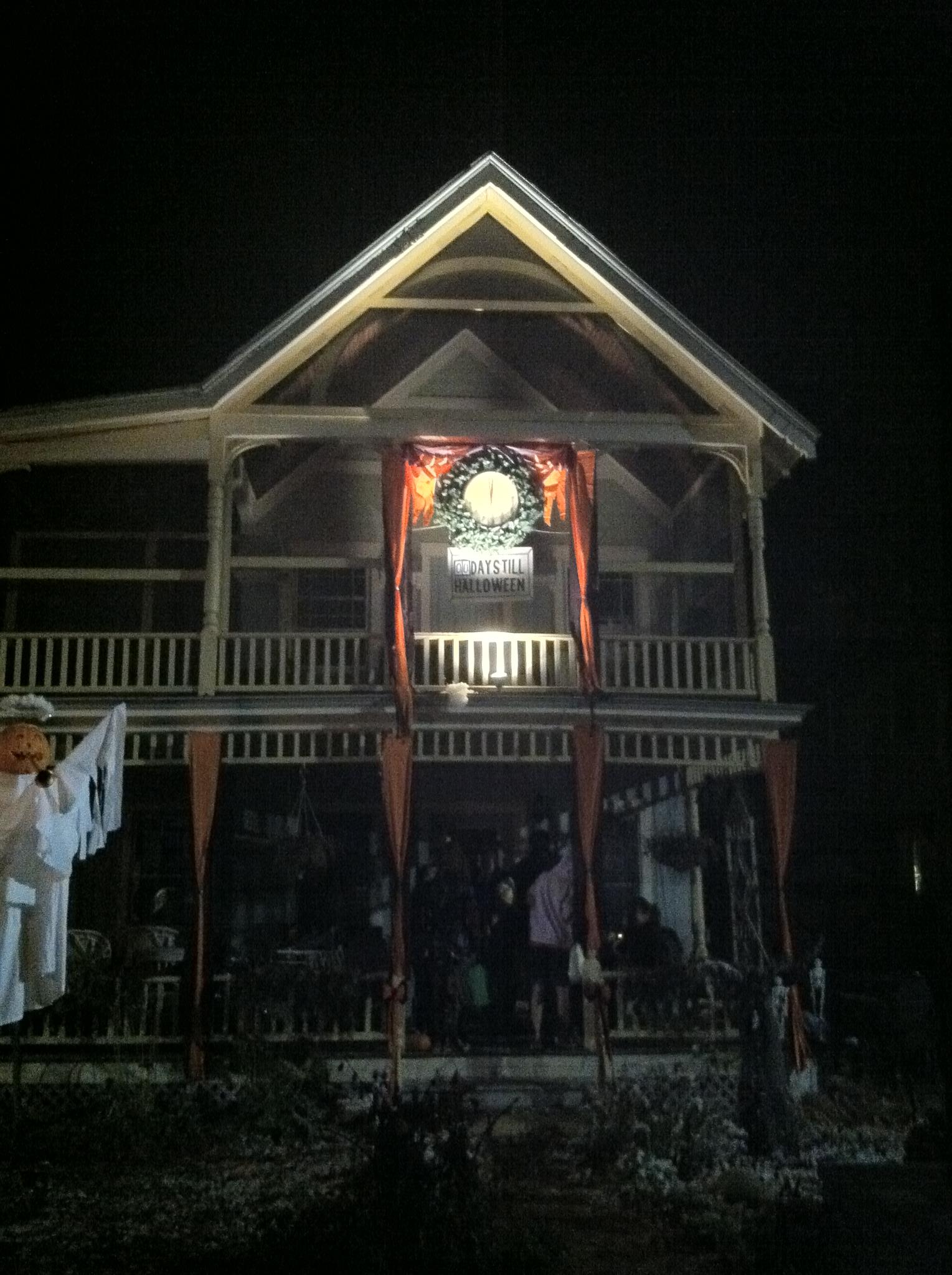
We live in an old Victorian village of the type that inspires the imaginations of people like Tim Burton. It is truly the epicenter of Halloween. Houses are old enough to provide residence to a few generations of real ghosts, tiny streets with closely packed houses draw hundreds of trick or treaters from miles around–and our next-door neighbors are deranged, wonderful folk who do things like this and this (video).

Their preparations are usually quite furtive, though they say things to me like, “Did we tell you we got a snowmaking machine?”, or ask, “Do you have a fire extinguisher? Good.”

So, heeding Zena’s words, and not even knowing where to buy hundreds of bags of Scarrots; and not convinced kids would really use the cutesy pencils that trees gave their lives for, I backed down. Still, I knew I personally would not be able to buy the drugs–I mean candy–nor distribute it. In cowardly fashion, I assign the purchasing to my husband, Pete or to the friends I invite for the festivity of the evening; and the distribution to whatever available child or visiting foreign exchange student I can find.

Figuring out the amount we need requires a complicated quadratic equation and often we have miscalculated. This means that we have to indenture our own children and recycle the booty they have worked hard for, or we have to run upstairs and hide in the dark, pretending we are not home.

Halloween evening was perfect this year. The weather was gentle with only a touch of autumn’s crisp bite in the air. At the witching hour, all the creatively-costumed children emerged from their homes and took immediately to their task. As we were simultaneously welcoming friends, warming the cider, finishing the pumpkins, adjusting costumes and oohing and aahing at the little munchkins crowding the porch–we realized we were going to be in trouble early.

As I was frantically emptying the bags into the cauldron, trying to appease the munchkins turned monsters now knocking down the door, one of my guests said that the contents of candy bags had gotten smaller. He was right and this was seriously offsetting the math. Later, with the cauldron barren, we found ourselves sitting with the lights out–considering giving away some of our tchotchkes, artwork, cats and used pencils.

Early in the evening, a Jedi knight informed Pete that he required two offerings. His headless horseman friend explained that he was making up for last year. Amused, Pete was about to challenge this request, but the Little Red Ridinghood mother bared her big teeth, said he was in the hospital then and snatched a candy for herself. Next year we may ask for discharge papers or a gnawed off wrist band.

So, once again, we gaped at our neighbors’ amazing creation– which draws hordes of happy revelers–spun through the few hours of insane madness, walked the streets with our friends–and it all eventually quieted down. We were reverse trick or treated, and there was actually some healthy and adorable popcorn to be found.

At the end of the night, I removed my Bob Cratchet ba-humbug costume, enjoyed a Reese’s Peanut Butter Cup or few and imagined that everyone will be needing a nutritionist come morning’s tolling of the bells.

What does Halloween bring up for you?

Thank you for listening, sharing, following and supporting my writing. Please subscribe in the sidebar to receive notice of new posts. Comments and greetings always welcome.

In health, Elyn

Related Posts: Post Halloween Post; The Eye of the Newt; So, How Did It Go?

Related Recipe: Pumpkin Muffins by Cookie+Kate


Halloween My Plate


My Plate Haiku

Eat the Pumpkin

Let the candy rot on the porch.

by the guy in Georgia


some big feet to fit

My first pair Image by deshanta via Flickr

Yesterday, my first patient, Harry, was late and my second patient, Dan, was early. As I went out to the waiting room to call Dan, I saw Harry checking in with the receptionist. I had worked with him a few years back and remembered him well. He greeted me warmly and said he understood that he would have to wait. He assured me that this was not a problem.

This is a story about these two men. It probably should be two different stories. But, since the lines of their lives intersected on that morning, and since they share many commonalities–though Harry is black and Dan is white–merged, for now, they will be.

Harry and Dan are both 52-years-old. They are both over six feet tall and over three hundred pounds, though Dan dwarfs Harry in height and weight. They both are caring fathers. Harry has some older boys while Dan has an adorable non-biological three-year-old son he is raising. They are unemployed and poor, have had difficult lives and confront stress on a daily basis. They have diabetes and the usual laundry list of related issues. Impressively, and not commonly seen, they have both successfully and proudly quit 35 year-long cigarette addictions–Harry in the past two years, Dan about three months ago. You can see they were both once very handsome. Harry’s good looks are better preserved. Dan’s are more difficult to perceive due to his lack of teeth, long dirty stringy hair and enormous belly, but his pretty blue eyes and sculpted face tell me he once broke a few hearts. Oh, and they both like ginger ale.

I started working with Dan a few months ago. The loud-talking, heavy-walking, gentle giant stomped into my office in June feeling lousy. He had just been diagnosed with diabetes. He described to me a life marked by serious fatigue and inertia. He spent most of his day splayed on the couch watching television while keeping an eye on his preschool son. He started his day with coffee containing a mountain of sugar, drank iced tea throughout the afternoon and despite his lack of teeth, mainly ate an enormous dinner of starchy, fatty food which he said could probably feed five. At 380 pounds and smoking at least a pack a day, he could barely climb a flight of stairs. His ability to do the odd jobs he got paid for like mowing lawns and shoveling snow was becoming too difficult.

He presented with the common combination of desperation and despair but with a twinkle in his eye. I am always looking for some sign of the life force because making change necessitates pulling something out from the inside. Being illiterate and impoverished as Dan is, can profoundly dampen if not obliterate that inner will, but an eye twinkle is a good indicator that there is still fire within. Illiteracy and diabetes education are not a great combination but he has persevered and has made some amazing changes for someone who has only known mainly one path for half a century. He has literally and figuratively awakened recently and expresses his gratitude for the wake-up call. Though some of his work has been championed from my wonderful little office support team, he actually greatly surprised me by undertaking to quit smoking essentially from his own initiative.

At this week’s visit, he told me that his son just started a daycare program at a local YMCA. He and I had discussed his getting a Y membership which would now be great since he has to take his son there every day. He told me that he had tried to apply for a scholarship as I suggested, but that required bringing in some documentation and filling out some forms. Even as I handed him some free trial membership coupons I have for my clients, I knew that even this simple step requires filling out some paperwork at the other end.

At the end of our meeting, I brought him to the scale. I asked him to remove his old, worn-out heavy steel-toed boots that barely had a lace left between them. I weighed him and I weighed his boots at 4.2 pounds. Cumulatively, that is a lot of weight to drag around. Knowing the answer, I asked if he had sneakers.

With my steps already weary, I then walked back out to the waiting room to call Harry who I knew was waiting. I was still thinking about Dan–wondering how much a pair of good, supportive sneakers for his very large feet would cost. Being able to read and write and having some good sneakers sure would help this man to get moving.

I was abruptly brought back to the moment upon encountering Harry. There he was sitting at an empty table usually reserved for insurance representatives–about to dive into a take-out container of eggs, bacon, home fries, and toast. Though just last week I had to confiscate the bag of Swedish Fish a patient had brought into my office, in all my years I had never experienced catching anyone with a full-blown meal. “Where did you get that?” I asked in shock. “From the diner,” he replied. “How did you get it since I last saw you just a few minutes ago?” “I called them and they delivered it,” he explained somewhat surprised by my reaction and naiveté. “Am I busted?” he asked. No wonder he hadn’t minded earlier if I took my time. I dragged him and the breakfast into my office.

Harry actually has a lot more personal and community resources than Dan, but right now his blood sugar and health markers are much worse–and his situation had deteriorated since I had last worked with him a few years ago. I expressed my concern. He said that he had a lot of personal and family problems recently–though he was not making excuses. He lives alone and barely cooks at home. He is a personable guy and when I asked if there are a lot of local restaurants that know him by name–he confirmed my suspicion. Though he still has his teeth, he could soon not have working kidneys.

We looked at pictures from an old Parade Magazine about the comic Drew Carey’s diet and weight transformation. I told him the story of the film “May I Be Frank” that I discussed in Meditation v Medication. He put down the bacon and he told me he wanted his health.

I suppose I tell these tales to give a face and a fake name to the real people behind the current health crisis. Sometimes, I am hoping to inspire with stories of how people do overcome serious health and dietary challenges. Today though, I am wondering how to really help  Harry and Dan a little more. I can assist Dan with the Y application and can call Literacy Volunteers of America; I will loan Harry my DVD copy of the film. But what would those who dream, think and act big do? Who should I call? Oprah, Shaquille O’Neal, Michelle Obama, Drew Carey, the Tom Shoes guy? What do NBA players do with their Nike’s and and1’s after they have worn them on the courts a few times? Is there a healthy food delivery service for patients left languishing while waiting in doctors’ and hospital waiting rooms?

If you have any ideas let me know. Besides, these guys deserve something. They have taken the biggest step to health by quitting smoking. I am thinking of lauding them by posting their photos in the Health Center. Maybe we could write them a Haiku? What do you think?

Thank you for listening, sharing, following and supporting my writing. Please subscribe in the sidebar to receive notice of new posts. Comments and greetings always welcome.

In health, Elyn

Related Posts: Meditation v. Medication; Inventive Incentive

Update 2020: The 2018 Farm Bill allotted $25 million dollars in funding to Produce Prescription Programs. These dollars have ferried in an increase in the number and types of programs designed to provide food as medicine. They are an extension of the pilot program I developed and managed beginning in 2012 at the Health Center where I worked and described in Inventive Incentive. These programs have evolved over time, becoming increasingly sophisticated, supported by additional dollars, research confirming savings in health care spending, and new technologies. Programs increasingly do include the provision of medically tailored meals for specific health conditions and home delivery. Harry certainly had the right idea, just the wrong food.

My Plate Haiku

We serve the fruit of the Spirit

At the deli. Why not ask?

The Yellow Deli

three good mark(c)s

Mark Bittman’s and my path have crossed at the library once again. In So, What’s the Dilemma?, I wrote about how the food writer, chef, and columnist threw his tome, “How to Cook Everything Vegetarian” in my way, blocking the entire 640-680 non-fiction aisle–just to get my attention. This time he was a little more subtle. He knew I needed something simpler for my new client, a 32-year-old guy who had been a vegetarian since his early teenage years, but despite his recent attainment of fatherhood was still eating like a teenager. His wife had called me frantically seeking help.

This time as I perused the library shelf looking for some inspiration, his similarly titled, How to Cook Everything: Vegetarian Cooking stuck out conspicuously from the other offerings. It was just what I was looking for. Weighing only about eight ounces with a mere 123 pages, I thought it would be the right serving size to present to the residual adolescent.

I was glad to see that Mark had my back. Not only did he help me with my client that day. His more recent work, Food Matters: A Guide to Conscious Eating (2008) and the follow-up companion piece, The Food Matters Cookbook: 500 Revolutionary Recipes for Better Living (2010) has helped to spread my message about personal health and the politics of food to a vast and appreciative audience. Through his books, NY Times column, and television appearances, he is raising awareness about global food issues while providing people with the ability to make a change–that tastes really good–right in their own kitchens. In his own words, he has committed himself for decades to “battling the ascendance of convenient processed food and a general decline in quality”  which has contributed to the big pickle we now find ourselves in.

IMG_2868

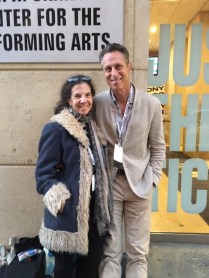
Mark Hyman and me 2019

While waiting to check out my books, I realized he is not the only Mark to have left his mark on me. The others are Dr. Mark Hyman and Marc David. I have not merely figuratively crossed paths with them. I have the pleasure of knowing them both.

I have literally sat in Mark Hyman’s bed–it was a long time ago. Back then, he was my college housemate and friend–a doe-eyed, gentle and sensitive spiritual seeker pursuing Asian Studies. Such interest and the influence of another housemate–a nutrition graduate student-led him to both medical school and the study of Chinese medicine. Today, he is one of the leading voices in the field of alternative medicine. Not only is he a deeply caring physician, but he is also a prolific writer and a leading proponent regarding the creation of a new health care paradigm.

Mark’s practice of medicine involves a whole systems approach described by a model called Functional Medicine, which includes nutrition and lifestyle support. Approaching health from this point of view and really understanding that food is medicine, changes the conversation I have with my clients every day. Presenting health care from this angle is challenging in the climate that defines our practice of medicine. We are programmed to be patients, essentially dependent on a pharmaceutical-based promise of healing. Though it is endemic on all levels, this thinking is especially entrenched in the low-income communities like the one where I serve, because options are not available and the stressors are exacerbated.

Every day I hear the pain and strain of being stuck in this prescribed role. People limp into my office with plastic bags filled with myriad medications. In spite of this, they still ache, they are often depressed, and they feel helpless and confused. But, I see the fire in their eyes and the longing in their souls as they suggest that they do not want to take an additional pill. Acknowledging that, I can remind them that they are capable of being an active participant in their own care and feeding. This is the consciousness shift that is happening through the work of people like Mark.

And then, there is Marc David,  a good friend of Mark Hyman. He is less well-known than the “k” Marks, but his message is phenomenally powerful and equally important. Marc is a nutritional psychologist, deeply learned in the areas of the physiology of eating, metabolism, and digestion. He is the founder of the Institute for the Psychology of Eating. His books, Nourishing Wisdom: A Mind-Body Approach to Nutrition and Well Being and The Slow Down Diet: Eating for Pleasure, Energy and Weight Loss are both revolutionary in their understanding of nutrition.

As most of the cultural chatter focuses on what we eat, Marc explores the more primal questions of who we are as eaters and why and how we eat. He writes that we can no longer separate the science of nutrition from the psychology of eating. I agree. His institute is training professionals to counsel from this perspective and his message is increasingly permeating the field. His ideas are very prescient and worthy to explore. He is a scientist, a Buddhist, a healer, and a wonderful writer–but as I once told him, I think he is mainly channeling his grandmother.

So, as I continue to walk among the eaters of the world, assisting where I can, I am glad to have these three good Mark (c) s beside me. These guys, along with some other wonderfully knowledgeable and visionary people are not only informing my work but are opening new doors to the understanding of human nourishment.

I’d be interested to know which piece of the nutritional puzzle you feel you most need to address, advance or heal your eating or health status. Is it informational, structural, shopping/cooking or emotional/behavioral support?

Thank you for listening, sharing, following and supporting my writing. Please subscribe in the sidebar to receive notice of new posts. Comments and greetings always welcome.

In health, Elyn

IMG_1939

Kripalu’s My Plate 

My Plate Haiku

Food made joyfully

As a gift of time and self

Feeds body and soul. by Anne Marie


wings of desire

I have been hiding under the covers since before the Super Bowl game. This was not the weekend for peace-loving nutritionists. Too much head bashing and too many food blitzes for my liking.

Dear Sweet Luna

A few days prior to the game I was at the supermarket. I saw a shopping cart filled with about twelve cartons of frozen pepperoni pizza. I thought it was being used to stock the freezer section, till I saw a guy proceed with it to the check-out line. It vaguely dawned on me that this might be due to the game. I then saw legions of 2-liter soda bottles marching out the door along with armored tanks of beer. Little bags of celery sticks were unwittingly running behind. Little did they know they would soon meet their fate, drenched in fat-laden dip, in mouths that mindlessly devour whatever comes near.

While often feeling like the nutritional equivalent of Florence Nightingale, ready to mend and tend with soothing bowls of oatmeal and blueberries, this is a battlefield I will not administer to. Spectators and players alike are not innocent victims. They participate in this bloody sport of gladiator gore and gluttony of their own volition. The players come to score while the spectators come to gape and gorge.

Being big is an asset in football. However, even that begs a hefty question. How big is big enough? In 1970, only one player in the NFL was over three hundred pounds. Now 532 players or 25% of the league claim that distinction. This excessive mass is detrimental to the players and to their opponents alike. It is well documented that these very large offensive and defensive linemen suffer serious health consequences related to their size and eating behaviors after the end of their careers, and increasingly, while they are still active players. Even in this well-padded professional sports league with all the resources in the world, it is only recently that nutrition is being carefully considered. How do you promote strength and power in these guys without jeopardizing their health, and prevent turning them out to pasture to fend for themselves–often sooner than later.

So, if the guys with the big contracts hardly get the support they need, the shlubs on the couch in the den eating with pure Pavlovian abandon are entirely on their own when it comes reckoning time. Is it just me, or has the ferocity of the Super Bowl Game Glutton Fest actually increased in the past few years? Genteel women– including some of my own friends– now converse about watching the game, what team they are for and what they are serving. We have now been seriously programmed with Big Brother intensity to associate this event with bingeing. The Bowl brimmeth over.

While under the blankets with a flashlight, I read that the day of the game is called “Restaurant Christmas”. An article in my newspaper about local food establishments anticipating the big day described a restaurant that “uses a computer spreadsheet to track orders and strategically positions 15 employees to produce and deliver the restaurant’s maximum capacity: 300 wings and seven pizzas every 15 minutes. They expect to churn out more than 5,000 wings and in excess of 100 pizzas.” I think that means 2,500 chickens and many tomatoes were sacrificed for the game plan just at this one place. Again I ask, can this possibly be?

I don’t mean to sound like a party pooper, though that’s not really a big problem ’cause I didn’t go to any party to poop on–though I did surprisingly actually have two invites. One was from someone who doesn’t really know me and should be glad I didn’t show. However, the whole scene just exaggerates our already extreme daily eating that severely compromises our health. If this was truly a one-day event that would be one thing, but sadly, it isn’t. Or, if our health care system just had to carry the weight of a few shoulder injuries and some bruised egos, but that is not the reality either.

So, like that other February icon, Puxatawney Phil, I must try to venture out from my hole. If I don’t see another major food holiday in sight, maybe, just maybe, I can just predict a salubrious spring. And, Happy Valentine’s Day. Enjoy the Dark Chocolate.

Thank you for listening, sharing, following and supporting my writing. Please subscribe in the sidebar to receive notice of new posts. Comments and greetings always welcome.

In health, Elyn

Related Posts: Peepin’ Out; Spring Cleaning and the NBA Finals; Skinny Boys

(Update 2020: Just in. The Frito-Lay U.S. Snack Index Report for Super Bowl LIV. This is quite a compendium of snacking statistics and financials. Retail sales data shows Super Bowl Sunday is the biggest day of the year for salty snacks, generating approximately $520 million in one day. Historically, Frito-Lay produces approximately 600 million pounds of snacks in the six weeks leading up to the game – nearly 20 percent of its annual snack production – and more than 67 million pounds of snacks the week of Super Bowl. If you’re looking for me, I’ll be back under the covers.)

Thank you for listening, sharing, following and supporting my writing. Please subscribe in the sidebar to receive notice of new posts. Comments and greetings always welcome.

In health, Elyn

Related Recipe: Vegan Keto Buffalo Jackfruit Dip

by george, i think he’s got it!

Thorazine, Seroquel, Paroxetine and Lipitor. It looked like a good case of schizophrenia with a touch of high cholesterol. Unless I am very busy, I usually get a glimpse of my client’s history on the electronic medical record before I call them in. This is usually a good idea.

There is a set of double doors and a short hallway separating my office from the waiting room area where patients wait. As I pushed through the doors, a tall gentleman was anxiously waiting right at the other side, surprising me. James? I ventured. Yes, indeed.  Well, that was touching. Not all my clients are quite so eager to see me.

baked bread on plate near mug with coffee

Photo by Sarah Boudreau on Unsplash

James began excitedly talking before we even made it back to my office. Persons with mental health problems are no strangers on my schedule. Often the powerful medications they are on have high side effect profiles–most of which include weight gain. In addition to this, many in this population cannot work and live on the very limited fixed incomes provided by their disability payments. The capacity to access and prepare good food is pretty low–and coping behaviors like cigarette smoking, coffee drinking, and pastry eating are high.

I admit that sometimes, as I am doing my ritualistic walk from office to waiting room, premature assumptions rotate my eyeballs upward and I internally utter something like, Dear Lord, really? Is my job as a nutritionist not already hard enough? Couldn’t you have made me a psychiatrist or neurosurgeon or something easy like that instead? This was one of those times.

James is 45-years-old. He lives in a studio apartment by himself. His meager kitchen consists of a refrigerator, microwave, and hot plate. He smokes close to a pack of cigarettes a day. And, he is a baker at a local cafe and bakery. So, every morning, James is at the bakery, not only surrounded by but preparing mouth-watering temptations–and an always fresh pot of brewed coffee. Together, that popular combination has been the foundation of his diet for many years. He confides that he loves his Folgers and has 2-3 big cups per day with sugar and powdered creamer.

About three weeks ago, James’ doctor informed him that his cholesterol levels were high and prescribed the usual statin Lipitor. Of course, that scenario is exceedingly common.  Most people are generally just told to take the medication; some are given lip service on eating a low-fat diet; and a few who may be fortunate to have a doctor who knows of a nutritionist a few doors down, are told, “Go see the nutritionist”.

James says he doesn’t want to have health problems like this and that he has already made some changes. He’s not really sure if what he is doing is right though, and he’d like some input. He proceeds to tell me that instead of just having coffee and a sweet in the morning, he is now eating a bowl of instant oatmeal at home; leaving the pastries alone and waits till late morning when the head cook prepares for him a bowl of her well-regarded freshly made soup. Also, he has stopped going to McDonald’s; has cut down his coffee intake and is drinking more water. And, when he wants to snack at night he is having some peanuts. Impressively, he is trying some new vegetables which he admits is hard for him. Almost apologetically, he explains he never ate any of that kind of stuff when he was growing up.

I am praising, affirming and singing hallelujah. Then, he says that with his next paycheck he is planning on buying a steamer and a countertop grill. He imagines that he has room for those and they wouldn’t be that expensive. He asks if I think that is a good idea.  Suddenly, he is the Eliza Doolittle to me, Professor Higgins, and though I haven’t done anything, I could not be more proud.

By these simple changes, James has already cut his consumption of dangerous refined sugars and carbohydrates,  increased soluble fibers, decreased trans fats and improved his hydration status. When I weigh him he is already down three pounds. This pleases him. But, most incredibly, he says that he already feels a little better– not just physically, but mentally as well. Yes. This is a very profound statement for someone who has been medicated for most of his adult life. James has gleaned what most have never considered–the relationship between nutrition and emotional and behavioral health.  As we finish, he acknowledges that he is not ready to address his smoking, but he is really thinking about it. Though there are changes I will still recommend–and some things that I will not be able to change–James is on his way.

This story is typical of instances I am privileged to encounter on most days and which really keep me going– people like James, who despite very difficult circumstances, find some way to respond to an inner impulse to find a better way. As often as I may wish for easier work, I do look upward and say thanks for some incredible inspiration and beautiful encounters in the name of health. Now that wasn’t so hard, was it?

Thank you for listening, sharing, following and supporting my writing. Please subscribe in the sidebar to receive notice of new posts. Comments and greetings always welcome.

In health, Elyn

meditation v. medication

Once upon a time, like this past Monday, I was walking down the hall of the Health Center where I work. Passing a closed exam room, I heard the doctor who was inside with a patient say, “Here’s a meditation for you.” Ah, meditation. Instantaneously, I felt my spine lengthen, my breath deepen, and my third eye got a nice little buzz.

But wait. Which of the Young Living Essential Oils that I frequently use had I just inhaled? Was it the oil blend Hope or Dreamcatcher? I must have been hoping or dreaming. By the time my foot that was in the back had overstepped the other one and placed itself in front on the cold, hard and very clean commercial tile, I realized she hadn’t said meditation. She said medication. Of course, silly of me. Where did I think I was?  cafegratitude

I must digress for a moment. The floors in the Health Center are incredibly shiny. Every day, they are cleaned in Zen-like fashion by a woman named Pam. After dancing with the waxing machine, she traces every seam with a long stick with a tennis ball attached to the end, and then with tiny little tools, she meticulously erases every scuff mark with the hands of a surgeon. The place glistens.

Perhaps my momentary delusion was fueled by the fact that the night before I saw this amazing film called, May I Be Frank. It is the true tale of transformation on the physical, emotional and spiritual planes of an overweight, lonely, ill, middle-aged ex-addict named Frank, living in San Francisco. His soul yearning unexpectedly leads him into a raw food restaurant named Cafe Gratitude and the story begins. Through the use of whole foods, affirmations, holistic health modalities, and the receiving of love, true and profound healing ensues. In the film, there is a scene where he goes to a massage therapist. The massage unleashes a deep emotional release in Frank that simultaneously relieves his chronic back pain. I noticed that on the table in the massage room was a collection of Young Living Oils that I am sure were used. I tell you, these oils are powerful.

How many times a day is the word medication used in the Health Center? I even say it about eleven times — and  I am mainly talking about green beans and sardines. Venturing a guess–seven hundred and nine times. No, I don’t think I am exaggerating. If anything, I am underestimating. There is a lot of medication going down.

Imagine if we could subliminally say meditation instead of medication this many times. What meditation are you taking? I am going to prescribe you some meditation. What’s that? You are calling for a refill on your meditation? Which one? You can pick it up at the sanctuary–along with your wheatgrass. That would simply and certainly alter the medical paradigm.

We would do well to consider our health facilities more so like holy temples with acolytes arriving for sustenance and to promote meditation as a veritable ally in the healing of ills. Though the practice of integrative medicine is growing in acceptance and availability–my yearning is to see it accessible and as a model of care in high-risk communities. I encourage everyone to take a look at the film, May I Be Frank. You will be inspired by being witness to possibility. Pam’s devotion to her task has prepared the sacred ground. When the time comes, may we be ready.

Thank you for listening, sharing, following and supporting my writing. Please subscribe in the sidebar to receive notice of new posts. Comments and greetings always welcome.

In health, Elyn