Your Pyramid

As a nutrition professional, I would like to share with you some tips on eating well.

For today, let’s start with a simple tool that is available to all Americans, brought to you by the US Department of Agriculture. You can probably find it right in your own kitchen–check your cereal boxes–the MyPyramid. Yes, that is your pyramid folks. Your tax dollars have paid for it–it would be a shame to see it go to waste. To the untrained eye, it appears like a triangle decorated with multi-colored vertical sections of varying bandwidths– with an alien climbing up some stairs on the side. However, hidden in that simple representation, is the culmination of US Dietary Policy.

The MyPyramid has been personalized just for you. Very obtusely, it suggests moderation, proportionality, variety, activity–and if your version happens to say on the bottom, Steps to a Healthier You–gradual improvement. Boy, you are lucky I am here.

Our government has been trying to figure out how to inform the masses about good nutrition since about 1916. Granted, this is not easy. I imagine those who’ve been assigned the task have resorted to some serious stress eating. From 1956 through 1992, using a minimalist approach, the Four Food Groups, which I grew up on, became the model of nutritional dictate. (This was proceeded by the more comprehensive– and rather rational–Basic 7 model introduced during wartime in 1943–a period of food rationing.) The four defined food groups–chosen to prevent nutrient deficiencies–were fruits and vegetables; meat; dairy; and, grains and breads. Many people still adhere to this model–but having forgotten what those four groups actually were, instead, make up their own. My husband’s preferred groups are ethnic food, ice cream (dairy), popcorn (whole grain), and carbonated beverage.

In the late 1980s, having a few years of nutrition counseling experience under my belt, I took a sabbatical to do some focused research in two distinct areas–both of an anthropological nature. The first included infant and toddler feeding with my son as the subject; and the second involved serving lots of burritos and chimichangas to gringos in a very popular Mexican restaurant. The first was more adorable–though the latter was more lucrative.

When I returned to the field a few years later, I learned that we were soon to be blessed with a long-awaited update of the dietary guidelines–with the experts busily designing what was soon to be ubiquitously known as the Food Guide Pyramid. After years of deliberation and millions of dollars, it was officially released in 1992–smack with 6-11 servings of essentially refined carbohydrates literally forming the base of its recommendations.
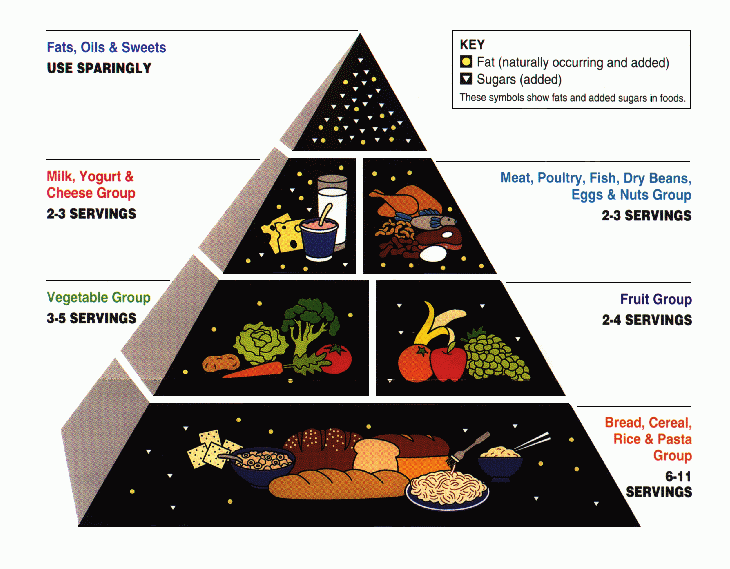
Having recognized that the American diet was somehow connected to a plethora of chronic diseases, and using evidence that cultures who ate traditional diets–which included some high fiber, carbohydrate foods like manioc root, taro, and sorghum–were not plagued by heart disease, colon cancer, and diabetes, the experts interpreted this to mean we should increase dietary attention to carbohydrates. (Needless to say, there were many other cultural differences as well.) Fats became increasingly vilified, and giant bagels and bowls full of pasta were elevated to celebrity status.

I was there. I witnessed it all–and I rubbed my forehead in disbelief. You see, I come from a long line of bagel eaters. Don’t get me wrong. Bagels are very good. They contribute to comedy and to cream cheese. However, it is obvious that this is not the foodstuff of those who epitomize physical prowess and longevity. If obesity and chronic disease prevention or lean and mean was what we were seeking, why were we not promoting the Hunza, Masai or Okinawa Diet?

But, so it was. By 1996, just four years after the introduction of the Food Guide Pyramid, the unprecedented increase in obesity, childhood obesity, diabetes, along with some other surprising health concerns was making the headlines. In 2005, after a mere thirteen years in existence, it was to be declared obsolete. President George W. Bush, as part of his Healthier US Initiative, introduced the dumbed-down version of the pyramid, that we are now fortunate to have at our disposal today.

Really, I do not wish to appear so cynical. But, when I look at that colorful triangle, I see what is hidden behind. Not a line drawing but real flesh and blood citizens seriously affected by the lack of a meaningful food policy in this country. I see a populace who was sufficiently seduced and ate what it was fed–regardless of what it may have read in the iterations of these dietary guidelines. Particularly in these most recent decades.

This may seem a moot discussion. It could be argued that few people even pay attention or that the situation will change shortly with the soon to be released 2010 Dietary Guidelines. Many are already aware of the competing interests that influence our health and nutritional policies. However, the reality is that it says a lot that that triangle says so little. And, it still represents the foundation of many dietary organizations’ precepts. I am shocked that the basic understanding of the feeding of human beings is still so conflicted and poorly understood. How could it be so difficult?

If you are holding a cereal box, take a deeper look. If it is a highly processed, artificially colored, multi-sugar sweetened, perversely marketed candy imposter–put down the box, back away and wonder what right the triangle has being on there anyway.

Thank you for listening, sharing, following and supporting my writing. Please subscribe in the sidebar to receive notice of new posts. Comments and greetings always welcome.

In health, Elyn

Update January 2026: The most recent revision of the Dietary Guidelines for Americans and its Food Pyramid have just been released. Take a look. If you are seeing it for the first time at sometime in the future, when things may have changed again, do know things are quite contentious in the here and now.

Also, I don’t know how I have not been aware until now of the brilliant work of food historian, Sarah Wassberg Johnson, and her writings and recorded series on The Food Historian: Food History Blog. She presents some fascinating information that informs how we partially arrived at where we are today, on her talk, When Sugar Was Good For You: The Development of Nutrition Science in America.

Magic Doughnuts–The Nutritionist’s Nemesis

A photo of 12 Original Glazed doughnuts from K...

Image via Wikipedia

It is time to raise my rates. The stakes are higher, the work is harder–Krispy Kreme is coming to town.

Looking back I can see that the signs were there, the portents. A few weeks ago, the lab technicians in the medical office where I work, hid a photo behind a cabinet door. The photo portrayed four very naked women standing in chorus line formation, clad only in sashes emblazoned with the words Krispy Kreme Donuts. The jolly foursome cumulatively weighed about twelve hundred pounds. The lab techs led me to their surreptitious closet and awaited my reaction. Oh, did we guffaw. But then I went back to my desk and stared out the window, contemplating the meaning of my life as a nutritionist.

It was only a matter of time then until my husband, aware of my prurient interest in all things fatty and sugary, sidled up next to me on the couch to announce the upcoming opening of the area’s first Krispy Kreme franchise.

I shouldn’t panic yet. The new store is to be located a good twenty miles from where I practice. Certainly, none of my client base would be able to procure any of these scrumptious confections. But, what was that? Local gas stations will also be carrying them? The story got worse. As my husband read to me from the article in the business section of the newspaper, the words and images were almost surreal.

According to the article, a “typical Krispy Kreme store opening will draw hundreds of customers who will wait several hours to buy hot doughnuts. In South Bend, Indiana, a customer camped outside of the store for seventeen days awaiting a store’s opening.” The statistics are baffling. Get this. Weekly sales for a Krispy Kreme franchise average about $58,000. This is up from $28,000 a mere four years ago. North American Krispy Kreme stores produce five million doughnuts daily. Daily! The little devils are even making their way into wedding receptions. Probably as invited guests-dear friends of the family.

Apparently, business experts credit this boom to “one of the most effective marketing strategies in the history of the restaurant industry.” However, “both franchisers and company officials say the enthusiasm is the result of the quality of their product-it has such a magical quality about it.” Was it the same combination of commerce and magic that had enticed four very large women to stand in their own doughy glory singing the praises of Krispy Kreme?

I could stand no more. I have been rather accustomed to waging a pathetic fight against the big guys and their Madison Avenue associates, but now they were playing with magic and using stainless steel cauldrons. I have not a chance. In the match-up between the company’s ‘Hot Original Glazed’ and me, I have as much pull as a stale biscuit. As if they knew I’d be reading this, they threw one more punch–right to the gut. In response to concerns about the low-carbohydrate trend, a company official is quoted in the article as saying; “even people trying to avoid sugary baked goods will make an exception for a Krispy Kreme.”

The following day I headed back to my office. I dreamed that there would be lines of devotees waiting to see me. That people would now realize that they were being seduced by an evil pudgy ball of dough, a wolf in sheep’s clothing, and would come in droves seeking my aid to protect them. I would be Super Nutritionist. But no one was there. Disheartened, I settled into my desk. I might just as well tell my clients to take two doughnuts and call me in the morning.

I guess I should just be patient. Eventually, the hoopla will have to die down and the magic will have to fade. The masses, those mere mortals, will be sorry then. Even the company officials and franchisers will have had one Krispy Kreme too many, and they will regret it. That is when they will come knocking on my door (or pulling up to my drive-thru window.) But, I don’t have any magic spells to undo the ravages of that enchanted edible. They will just have to work harder to lose that big doughnut they are now carrying around their middles and I will charge them more to do so, for I will have already raised my rates. I may even become the national spokesperson for Hole H.O.G. (Hot Original Glaze) – a doughnut victim compensation program. Well, we’ll see. They haven’t opened yet.

*Source-Sweet Smell of Success, Jeremy Boyer, Albany Times Union, Nov. 30, 2003

Thank you for listening, sharing, following and supporting my writing. Please subscribe in the sidebar to receive notice of new posts. Comments and greetings always welcome.

Related Post: Kicking Butt with Krispy Kreme

In health, Elyn


kicking butt with krispy kreme

I must strike on this one while the iron is still hot. Or, I should say, while the frying oil is still 375 degrees. That is the temperature for frying doughnuts–and extreme frying is exactly what Krispy Kreme doughnuts is up to. A few years back I gave old Krispy Kreme a piece of my mind when they expanded their territory into my neighborhood. I thought they backed off when I wrote a scathing little article, Magic Doughnuts–The Nutritionist’s Nemesis, showed it to some friends and put it in my drawer. Actually, right after that, the company did suffer some setbacks and had to close some of their stores. But, it appears that they have just reconnoitered. They are back with a vengeance.Image result for krispy kreme cheeseburger

According to my trusty Parade Magazine, they are now cooking up a Krispy Kreme bacon cheeseburger–a cheeseburger with chocolate-covered bacon on a glazed donut– that weighs in at 1000 calories. I am not exactly sure– they or some regional fast-food chain seem to be pushing these in the midwest. They have got to be kidding me. How do these people go to sleep at night? How do they look at themselves in the mirror? The only explanation as far as I can tell is that they may be up to no good.

Our military has had to turn down interested recruits because they are too heavy or can’t pass entry fitness exams. Meeting recruitment quotas is getting more difficult because of this. I’m probably just being paranoid but something seems fishy shall we say. The company’s vision statement actually states “to be the worldwide leader in sharing delicious tastes and creating joyful memories”. Hah! See? Operation Krispy Kreme bacon cheeseburger could quite stealthily advance any plan of domination.

If this explains supply, then what about demand? They could not be using such deceptive weaponry without a corps of unwitting subjects ready to gobble these things up. Who is buying these things? Are they my species-mates? Or, are they lemmings, disguised and accessorized? If they are lemmings, they may think this is a much more fun way to go than just marching off a cliff–but oh boy, do I have news for them. Doughnuts of this ilk are not something little mammals should be messing with. Note to lemmings–Undergoing kidney dialysis as a result of diabetes is not joyful.

Well, last time I wrote a little whiny story. This time, what they don’t realize is that I have been doing the Mark Bittman How to Cook Everything Vegetarian Diet and Weightlifting Program. At a $35 cover price, it beats most other products on the market and you get two tools in one. I am now fit and buff while they are downright doughy. Licensed to save the masses from their own mouths I must be more aggressive now. So, I am going to post that article I wrote a while back and hope that it scares Krispy Kreme– and all the other food companies that are creating caloric catastrophes and nutritional nightmares–into a full-scale retreat. If not, there will be no other option but to call Homeland Security–just to be safe.

Thank you for listening, sharing, following and supporting my writing. Please subscribe in the sidebar to receive notice of new posts. Comments and greetings always welcome.

Related Posts:  Magical Doughnuts-The Nutritionist’s Nemesis and So, What’s the Dilemma?

In health, Elyn

the importance of teaching kids about nutrition

She comes flying into the room and perches herself on the chair facing me. Three minutes ago she had been minding her business sitting in class, unaware that she was one of the anointed ones. Due to her high body mass index (BMI) she was selected to come to chat with me, the visiting nutritionist.  eat-547511_640

Fearless, she presents herself ready for the challenge–with no idea what it may be. I introduce myself and tell her that I am a nutritionist. I ask her if she knows what a nutritionist is. Tentatively she says, “Someone who talks about being healthy?” I praise her response, refine it by adding the food part and tell her that most nine-year-old children don’t know what a nutritionist is. She clarifies that she is almost ten.

Now that we understand the context of our being together, I offer her a carrot. She scrunches up her nose like a rabbit. “No way”, she says. I ask when was the last time she had tried one. Apparently, it was not since she was a little kid and that was a long, long time ago. When I beg a favor and ask if she would try one for me, the terms include placing the garbage can in close proximity. Fair enough. I knew that the carrots I had brought were not the sweetest. However, the girl I had sat with just prior had enjoyed them well enough, so I ventured a try with my new guest.

One bite, one chew and into the garbage it went. “Ewww! It tastes like it came out of the ground!” In educator-fashion, I ask, “Do you know where carrots come from?” “From out of the ground,” she says, in educator-fashion, having proudly proved her point.

OK, moving onward. We discuss what she has eaten today. She is now well into our game and ready to play. For school breakfast–only an institutional plastic cup of juice. There were bagels too, but she hadn’t been hungry. For lunch–a piece of pizza–the every Friday and frequent random day of the month menu item. She only had a few bites though and mainly ate the little cup of cubed pears along with chocolate milk.

Then, as if she had been born and raised in this cramped little space we are sharing, she reaches down to the computer printer that is positioned behind her, deftly removes a piece of paper, takes a colored marker from the case I have on the desk and proceeds to draw me the piece of pizza. She indicates where she took half-mooned bites from around the edges and includes the carton of milk and pears in the picture as well.

I ask her about hunger and how and where she knows she is hungry. With a touch of condescension, she tells me she just has an instinct about when she is hungry. OK, I concede. Whatever the game, I seem to be losing.

She continues her diatribe that though she likes fruits, she does not like vegetables except for corn and lettuce. But, she eats ketchup, and as if daring me, says ketchup is made from tomatoes, so it is a vegetable. It is subtle, but I mutter some consent. She is obviously right as was Ronald Reagan on this issue. I am not about to argue– she is in full control by now. “Peas?”, I meekly ask. “Gross, like little eyeballs.” I had set myself up for that one.

And so it goes. What does she like? The usual culprits she admits–hot dogs, pizza, chicken nuggets, french fries, Hi-C and Kool-Aid. She drinks low-fat milk because her mom gets it on the WIC program for her younger sister. Her mom has diabetes–so she knows that food matters. I begin to ask her, that given our talk would she be interested in trying something new for herself and, before I can even finish the sentence, she says, no she will not try a new vegetable. At this point, I inform her she is killing me. “How did you know this is exactly what I was going to ask?” “I just knew.” I have now officially been schooled.

Finishing up, she says, “Can we meet next week?” Obviously, she thinks I need some serious remedial work. I tell her I won’t be back until next month, to which she sweetly replies that we can meet then. In closing, she adds that she will try to eat less of her unhealthy choices.

Though I am already completely won over, she is not done. She signs the pizza picture for me and offers it over as a truce. She wants me to see how well she writes her name and informs me that she reads above grade level. I thank her deeply, tell her she is a very amazing kid, and we agree that we both had fun.

On a growth chart, this young girl will plot out in the 98th percentile of BMI for her age. Her school will forward her measurements to the state health department and she will be counted as an obese kid. In body, she is, as my mother would have said, a little pudgy. In being, she is lively and lovely and in full possession of her priceless childhood innocence and instincts.

What my conversation with her and others teaches me, is that this area of nutrition education requires a large degree of humility. The story is not only about the weights and measures which is the current focus. And, while I don’t mean to dismiss nutrition education, what our children really need is nutrition provision. We don’t expect children to childproof their own homes–why should we be asking them to childproof their own bodies?  

Our children deserve the birthright of both health and being valued for all that they are. Attention to good quality food in the world inhabited by our kids is what is required. I wish I could submit to the state an algorithmic index similar to that which assigns one’s BMI, but that would instead measure a child’s confidence, grace, and sense of self-worth–a self-esteem index (SEI). This girl’s SEI would be very high–but it might not be for long. I hope I did not cause any damage that day and that instead, it was more of an educational experience. Maybe it is true that teaching kids about nutrition is really important. I do seem to learn something every time.

Thank you for listening, sharing, following and supporting my writing. Please subscribe in the sidebar to receive notice of new posts. Comments and greetings always welcome.

In health, Elyn


meditation v. medication

Once upon a time, like this past Monday, I was walking down the hall of the Health Center where I work. Passing a closed exam room, I heard the doctor who was inside with a patient say, “Here’s a meditation for you.” Ah, meditation. Instantaneously, I felt my spine lengthen, my breath deepen, and my third eye got a nice little buzz.

But wait. Which of the Young Living Essential Oils that I frequently use had I just inhaled? Was it the oil blend Hope or Dreamcatcher? I must have been hoping or dreaming. By the time my foot that was in the back had overstepped the other one and placed itself in front on the cold, hard and very clean commercial tile, I realized she hadn’t said meditation. She said medication. Of course, silly of me. Where did I think I was?  cafegratitude

I must digress for a moment. The floors in the Health Center are incredibly shiny. Every day, they are cleaned in Zen-like fashion by a woman named Pam. After dancing with the waxing machine, she traces every seam with a long stick with a tennis ball attached to the end, and then with tiny little tools, she meticulously erases every scuff mark with the hands of a surgeon. The place glistens.

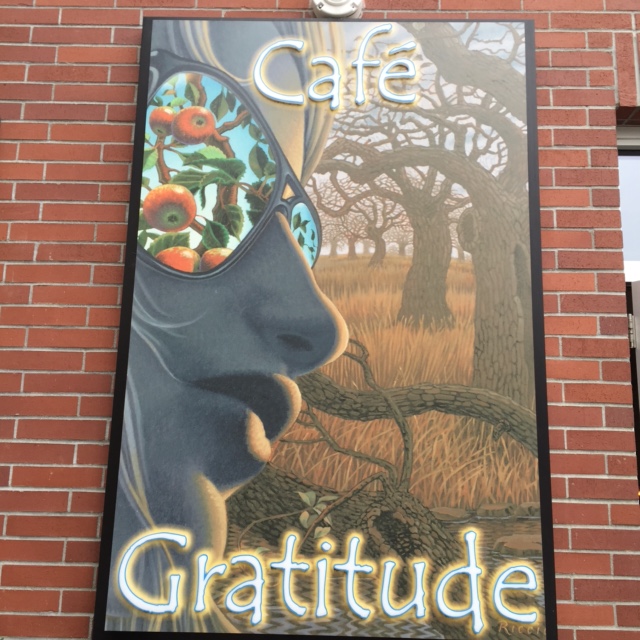
Perhaps my momentary delusion was fueled by the fact that the night before I saw this amazing film called, May I Be Frank. It is the true tale of transformation on the physical, emotional and spiritual planes of an overweight, lonely, ill, middle-aged ex-addict named Frank, living in San Francisco. His soul yearning unexpectedly leads him into a raw food restaurant named Cafe Gratitude and the story begins. Through the use of whole foods, affirmations, holistic health modalities, and the receiving of love, true and profound healing ensues. In the film, there is a scene where he goes to a massage therapist. The massage unleashes a deep emotional release in Frank that simultaneously relieves his chronic back pain. I noticed that on the table in the massage room was a collection of Young Living Oils that I am sure were used. I tell you, these oils are powerful.

How many times a day is the word medication used in the Health Center? I even say it about eleven times — and  I am mainly talking about green beans and sardines. Venturing a guess–seven hundred and nine times. No, I don’t think I am exaggerating. If anything, I am underestimating. There is a lot of medication going down.

Imagine if we could subliminally say meditation instead of medication this many times. What meditation are you taking? I am going to prescribe you some meditation. What’s that? You are calling for a refill on your meditation? Which one? You can pick it up at the sanctuary–along with your wheatgrass. That would simply and certainly alter the medical paradigm.

We would do well to consider our health facilities more so like holy temples with acolytes arriving for sustenance and to promote meditation as a veritable ally in the healing of ills. Though the practice of integrative medicine is growing in acceptance and availability–my yearning is to see it accessible and as a model of care in high-risk communities. I encourage everyone to take a look at the film, May I Be Frank. You will be inspired by being witness to possibility. Pam’s devotion to her task has prepared the sacred ground. When the time comes, may we be ready.

Thank you for listening, sharing, following and supporting my writing. Please subscribe in the sidebar to receive notice of new posts. Comments and greetings always welcome.

In health, Elyn

she weighs how much?

I present this as a Zen Koan. A Koan is a paradoxical question, the meaning of which cannot be understood by rational thinking. It derives from the Japanese words “ko” for public and “an” for ‘matter for thought’. This is clearly a public matter for thought in the current dialogue on childhood obesity. How do we best serve a seven-year-old girl whose high weight highly challenges notions of normal growth patterns?

pond-3046592_1280

Image by Debi Brady

This girl is not a nameless, theoretical child. Tanazia is an amazing girl who I know. She has keen inquisitive abilities, deep empathy for others, and sophisticated insight for someone so young. She is deeply connected to her family, respects her elders, and helps care for her three-year-old brother and emotionally reactive two-year-old foster-sister who she shares a room with. She excitedly tells me that when she grows up she would like to do something to help others. When her grandmother mentions the Peace Corps, she responds that there are people right here in her own community who are in need.

Tanazia—who is just one of many children who are accumulating weight in an inconceivable short amount of time–is in a relatively good situation. She now lives with a set of very caring grandparents who love her dearly. She has a stable roof overhead, and there is a modicum of food security. While some family members are overweight, her grandmother, who had gastric bypass surgery a few years ago, is generally food-savvy and keeps a relatively healthy home. Plus, she has a back yard–one large enough and safe enough to play in—a rare commodity in this part of the city.

Despite this, she has already had to armor her body with layers of body fat against many emotional wounds. She was born to a 15-year-old mother who has since had two more babies and is now pregnant again. Her father has died, and she was at an early age exposed to and a victim of domestic violence. Her grandmother has chronic health problems. And, she herself, has asthma–another player in the childhood obesity conundrum. Her mom has supervised custody and gets to see her daughter every other Saturday for just a few hours. Equipped with few ways to show her love, during their time together she usually takes Tanazia out to eat somewhere. It’s usually Chinese food or pizza with soda and candy.

This sweet child has already endured the taunts of kids. Going to school-squeezed into her charter school uniform skirt—is something she is already leery of by second grade. Though her grandma does give her breakfast at home and provides her with lunches to bring to school, controlling the intake at school is hard to do. Unfortunately, the meals provided by the school lunch programs do not meet nutritional recommendations and are a sad source of the low-quality foods and excessive fats, sugars and calories that are contributing to the problem. Turning down a free meal or two in a day would be hard for anyone to do, especially for those to whom the secure availability of food is not a given.

Declining the morsels of joy to be found in the cheap junk foods that easily find their way into all the cracks and crevices of our lives–cupcakes, bags of chips, Rice Krispie treats, fruit punch– is nearly impossible for those with easy and happy lives let alone for those who excessively use food as an easy and legal pursuit to push down painful life experiences.

And, although Tanazia has a backyard, the physical activity levels of young girls who live in vulnerable neighborhoods are amongst the most limited. Add in the cold winters in this part of the country and the possibility of expending calories diminishes even more.

Despite these challenges, this beautiful child tries hard to do what I—her nutritionist—have recommended. She drinks mainly water, she listens to her belly to see if it is really hungry—a task most adults find hard to do– and has only a small piece of cake at birthday parties and church functions.

My heart breaks at having to impose such harsh restrictions on such a young life. I know restriction breeds hunger. I know parental strategies require fortitude, patience, non-judgment, and structure. I don’t have many options nor enough solutions to fight all the forces that prey upon this innocent child and countless others like her. Current anti-obesity initiatives come far too late and offer little. Cute and catchy names of new programs belie the gravity of the situation and chew at my cynical side—the part of me who knows too many stories of real children’s lives. Societal weight stigmatization adds to the burden. I pray for this young girl to grow up healthy and whole, equipped with all she needs to be a powerful adult. Hopefully, size alone will not get in her way.

Thank you for listening, sharing, following and supporting my writing. Please subscribe in the sidebar to receive notice of new posts. Comments and greetings always welcome.

In health, Elyn


so, what’s the dilemma?

While musing about my blog and trying to decide how to best begin to describe what my dilemma is, a copy of chef Mark Bittman’s, How to Cook Everything Vegetarian blocked my path. I say blocked, because at 995 pages and weighing in at about 5 pounds, it is a boulder of a book and boulders don’t simply cross paths. How to Cook Everything Vegetarian : Simple Meatless Recipes for Great Food: Mark Bittman

Last week, despite a 30-plus year vegetarian lifestyle, I was seeking some inspiration– as I was to be soon hosting my neighborhood vegan week dinner. One day, just prior to closing, I ran into my local library looking for a good cookbook, and Bittman’s book insisted that I choose it. I could not argue and lugged the tome home and curled up with the most comprehensive compendium of my culinary clan that I had ever laid eyes on. One does not flip through the pages. Instead, one takes about a one-inch chunk of paper and hurls it over to see what else lies within.

An idea came flashing. Perhaps instead of my ponderous and not very amusing idea to outline the conundrums and frustrations I face in my profession, I could instead, a la Julie Powell who made her way through every recipe in Julia Child’s, Mastering the Art of French Cooking, start cooking and blogging my way through Bittman’s vegetarian bible. Page 38, the first page of actual recipes–simple green salad. Sounds easy enough, but there are then three sub-recipes for greek, lyonnaise, and endive salad. Would I have to prepare all of those too? That could really slow things down if I had to get to page 907. Should I call it Elyn and Mark? Would it take me three years or four? These seem like rightful dilemmas, do they not?

By the next morning’s dawn, reality came slapping me in the face. 6:30 am. Bleary-eyed and making my daughter’s avocado, cheese and spinach sandwich for lunch, an NPR reporter in lighthearted radio voice informs me that 84% of parents fed their kid (ages 2-11) fast food in the past week according to a new report published by the Yale University’s Rudd Center for Food Policy and Obesity. I grabbed for the closest writing implements–pen and paper napkin. Here’s what I hastily got down: advertising geared to children by fast food companies has increased 34% since 2003; despite the increased availability of healthier options, 80% of diners are given french fries automatically; marketing promises have not been kept; something about apple dippers; and, many kids meals still tally up to 1400 calories.

Oh boy, another day at the office. But, I wasn’t even at the office yet. By the time I did arrive, a co-worker had forwarded me additional gory details of the report in a Wall Street Journal article. The reality is though, I don’t need to read such reports. The data presents itself to me on an almost daily basis. By 10:45, a 13-year-old girl weighing 284 lbs. and with frighteningly high insulin levels portending diabetes was sitting before me. There I was outlining the grim details to this middle schooler and her mom. They got it. They weren’t idiots. But, they were up against some heavy outside forces–including billions of advertising dollars. So am I. And that is a big part of my dilemma.

So, for now, I will assign the Bittman project to the back burner. I have other work to do, other people’s stories to tell and other battles to fight. Perhaps best for the moment, I can just gently heave over a copy of Mr. Bittman’s book to this family. It could serve as both a nutritional guide and exercise weight in one. Now there’s a marketing idea. Diet and exercise. That’s all it takes, right?

Thank you for listening, sharing, following and supporting my writing. Please subscribe in the sidebar to receive notice of new posts. Comments and greetings always welcome.

In health, Elyn

(Update 2020: Mark Bittman has released the revised 20th Anniversary edition of How to Cook Everything. At only 960 pages, it features beautiful color photos and recipe updates mindful of sustainability concerns.)

Hello world!

Hi. Wow. I am about to start my blog. Something I would have just kept wondering about how to do for about the next decade or so. Personally, I am still marveling at the invention of the toaster oven, so modern technologies obviously are a little hard for me to adopt. Thankfully, one of my nutrition clients gave me the info I needed to even know where to begin.

IMG_3096

Hello Avocado!

Which brings me to the point of one of the issues I think I want to blog about. That above-mentioned client is gifted and funny and talented in so many ways and I would have remained stranded in a blogless universe without her. However, she and many others like her feel worthless because they are trapped in a body that betrays them. Their sense of themselves is molded as much by how they view themselves as to how they believe others perceive them. Whether medically, societally, or personally defined as fat–eating brings a vicious cycle of fear and loathing and momentary comfort and escape.

When I decided to study and become a nutritionist many years ago, I thought I was going to set out to solve problems of world hunger in remote parts of the globe. At that time, aside from that, the other main venue of applied nutrition was in hospital dietetics or in animal husbandry. Essentially, the MO was that we were all mainly basically nourished–or we were severely not. When I headed out on this path, yes, of course, there were overweight people, but their struggles were private and personal, and eating disorders were barely defined let alone described.

My nutrition work has briefly taken me to severely malnourished communities in Peru and Guatemala, but really, I am embarrassed to say, I have not strayed far from home. Society, politics, technology, media and an increasing focus on our individual selves changed the domestic landscape regarding nutrition. The issues intensified and the communal conversation amplified. My jobs kept me on the home front. I had no idea nutrition would become such a huge topic.

We all know how much nutrition information there is out there. New initiatives are good as we struggle to fix the ills that have befallen us in the past few decades. We are now attended to with myriad messages to eat right. I have sat in witness to this frenzy. While it has played out, I have been privileged to have worked with so many individuals and have heard their stories of frustration, pain, confusion, and guilt. What is obvious to me, is that we suffer mainly from being merely human.

The stories I want to relate will hopefully give voice to this humbling human experience regarding eating. I want to give my client who helped me get this started, along with others, tools and understandings that do not necessitate flagellation and deprivation. My wish is to assuage some of the loathing and to soften the edges of this intense dialogue. We will see.

Thank you for listening, sharing, following and supporting my writing. Please subscribe in the sidebar to receive notice of new posts. Comments and greetings always welcome.

In health, Elyn