Archives

reporting from the rim of the sinkhole

A few months ago, at about 4 PM, Pete sent me an email saying something about soul food. I was rushing to end my day so I overlooked the attachment that would have filled me in on the details and why he thought this might be of interest to me. I dismissed the message quickly.

That evening though, as fate would have it, I got another message on my email informing me that I had a new follower on Twitter. This was big news given that it is a rare occurrence. As Pete assures me that I am right behind Lady Gaga in terms of followers, I must assume that she might have like twenty-eight. So, I decided to check out my ignored little bird account and see who my new follower might be.

Once there, I stumbled upon a flurry of activity on the feed from someone I follow–chef and food activist Bryant Terry, author of Vegan Soul Kitchen and Urban Grub. The excited conversation was about a PBS documentary Soul Food Junkies which was apparently being aired right then. The praise was pouring in for this film by Byron Hurt, about his exploration of the historical and cultural roots of soul food cuisine and its relationship to the current health crisis with its impact on the African-American community.

Image result for soul food junkies

A documentary by Byron Hurt

Ah, now I got it. I ran upstairs to the TV room and grappled with the remote. Attempting to master its controls, I pushed that channel button frantically. I must mention that I have about as limited a relationship with the television as I do with my Twitter account–and relying on an old antenna like apparatus, have access to about seven channels. Still, I knew I did get PBS. Round and round I cycled through those seven channels, three PBS stations and still could not find the show I was looking for.

Instead, what I found was a program about a guinea worm eradication program sponsored by Jimmy Carter’s Carter Center in Africa. It was rather fascinating though quite gruesome to watch. Apparently, water-borne guinea worm disease which has plagued a wide swath of Africa and Asia for thousands of years is poised to be eradicated. In 1986 when the Carter Center began its campaign with the partner countries, there were an estimated 3.5 million cases in 21 countries. By 2012 there were 542 cases left in just four African countries.

Guinea worm disease is contracted from drinking unclean water contaminated with larvae that once inside the human abdomen grow into worms up to three feet long. These worms eventually emerge from the body through excruciatingly painful blisters on the skin. I guardedly watched as health workers painstakingly exorcised these worms from the legs of screaming children and stoic adults, wrapping the worms around little sticks that were slowly turned. One worm, one person at a time. The success of this amazing eradication program has been due to water treatment and filtration programs and community education at a very grass-roots level.

A few days later I was able to watch Soul Food Junkies on pbs.org. It is an excellent film and I have been talking it up with a lot of my clients–and others as well. Many of my clients are African-American and my daily consults revolve around discussing this interface between food as cultural identity and health. Soul food is not the only problem area. Many cultural cuisines that have sustained people for millennia are causing problems in the context of our modern existence. This is due to various reasons including agricultural alterations in the actual foodstuffs that form the basis of these cuisines, more processed versions of these dietary staples being substituted for the real foods, traditional diets being padded with the excess of sugars, concentrated carbohydrates and other addictive substances that infiltrate our beings and a massive increase in sedentary lifestyles and stress. The vulnerable communities that are more exposed to poverty and its attendant health disparities are experiencing greater discord between their food and their health.

This is multi-layered stuff that claws at the core of who we are as eaters and which reveals how deeply connected we are to our heritage. Food is clearly not just an extrinsic matter. It communicates intimately with our cellular makeup. And, it is a heavenly sacrament. I remember as a child listening to my mother and my aunties trying to sever the relationship between my hypertensive grandfather and the heavily salt-cured foods of his Russian roots. Little did I know I would one day be standing between an African-American man and his beloved fried chicken or an Asian woman and her dear little grains of rice.

But yes, there I am. Standing tall at five feet one, holding firm with my big professional tweezers before every diabetic who sits in my office. With exact precision, I try to extract each granule of sugar that has gone rogue in the bloodstream, wreaking havoc on the body–sort of like a guinea worm. Just as guinea worm disease takes hold in unsuspecting individuals so does diabetes. Persons consuming available foods for the purpose of sustaining survival and attaining some pleasure, awaken one day to learn that they are infested with massive globs of excess glucose.

I have been doing this work for a long time and I can tell you that the diabetic epidemic is getting worse. My daily roster is full of newly diagnosed cases of diabetes. This morning I woke up to some crazy NPR story about the woes of candy makers due to the relatively high price of sugar–the price regulated by the Farm Bill. Apparently, the makers of Dum Dum lollipops require 100,000 pounds of sugar for the daily manufacture of ten million Dum Dums–and they are having a hard time affording it. Can those numbers be for real? Well, please don’t tell Dum Dum that I have some sugar stockpiled in my office–mounds of the stuff that I have removed from my clients. I know they will just try to recycle it right back into the very folk I took it from.

Diabetes might not seem to be as bad as guinea worm–but one can actually make many metaphorical if not actual comparisons. Diabetes leaves many physical and emotional scars. My clients look at me through eyes that plead to spare them from this scary disease–that comes complete with implements that stab and jab and symptoms that pain and worry–depleting the soul. I scurry furiously to help pull them out of the sinkhole of this very complicated condition. If a disease caused by a swarm of microscopic larvae can be eradicated from the planet, it is hard to believe we can’t do better to minimize the incidence or increase the reversal of diabetes. The methods employed essentially would seem to be the same–access to ‘clean’ food, governmental responsibility, respect for human dignity, caring, education, and cultural adaptation.

And so, that is why the work of Bryant Terry and the film of Byron Hurt are so important–and why folk should watch Soul Food Junkies and align it with their own food foundation. Time is of the essence and Jimmy Carter deserves a rest.

Thank you for reading, really. As always, thoughts, tweezers, and twitter followers welcomed.

In health, Elyn

Related Recipe: Bryant Terry’s Citrus Collard Greens with Raisins Redux

(Update February 2020: Bryant Terry has just published a gorgeous cookbook, Vegetable Kingdom: The Abundant World of Vegan Recipes. From the Introduction: Vegetable Kingdom is inspired by my daughters, Mila and Zenzi. They have blessed this book like my ancestors blessed meals, by humbling me to that which is greater than myself.)

(Update June 2020: Bryant Terry prefers that his book(s) be purchased from independently-owned bookstores (check indiebound.org & bookshop.org) and ideally, from Black-owned bookstores like: @marcus.books@esowonbooks@peoplegetreadybooks, and @unclebobbies.)

(Update February 2021: Check out Byron Hurt’s continuing efforts @byronhurt and support completion of his new film, Hazing.)

shutterstock_275107754

Bryant’s My Plate

My Plate Haiku

This isn’t steroids

It’s Collard Greens.

from Ballin’ at the Graveyard (Documentary on an Albany, NY neighborhood basketball game)

“It includes the authentic voices of men working to do what’s right—for themselves, their families, and for the larger community. If you want to better understand our City’s character and come away feeling good about it, this film is a must-see.” Albany Mayor Kathy Sheehan

six calories of separation

I am related to Fay Wray. Yes, the actress well-known for her theatrical screams, who portrayed Ann Darrow in the original King Kong film. More dramatically, though inadvertently, she was “the beauty who killed the beast”. I guess lots of ordinary people have some connection to famous ones–but mine is pretty crazy, right? When Fay Wray died in 2004 at the age of 96, the lights of the Empire State Building were extinguished for fifteen minutes in her honor.download

The story is even a little more interesting. Cousin Fay was born in Canada to a Mormon family who eventually moved to Hollywood. She attended high school there and entered the film industry at a young age. Though most famous for her role in King Kong, she had many film and TV roles in her long career. It was in Hollywood that she met and married my grandfather’s cousin, Robert Riskin. Well, I know you are probably wondering if my connection by marriage counts–but Robert Riskin has a celebrated history as well. He was a prolific playwright and screenwriter–an Academy Award winner best known for his work with the director Frank Capra on films such as It Happened One Night, You Can’t Take it With You and Mr. Deeds Goes to Town.

So, while they led very glamorous Hollywood lives, the bulk of my relatives lingered in New York. Though many of them possessed various artistic talents, my celebrity relations remained thus limited. Nonetheless, though I live in a tiny circumscribed world, I am tickled by the notion of brushes with fame. My shortlist includes that of being picked up while hitchhiking in Big Sur by Carl Reiner and his wife Estelle, and of providing nutritional services to Tommy Lee Jones, Tom Brokaw, Peter Martins, and Bill Bradley during my various stints as a waitress. I actually had a little tiff with Mr. Bradley about a diet soda–he shouldn’t have been drinking the stuff anyway.

And, then there are my amazing nutrition connections. I have mentioned before in various posts that not only do I know Mark Hyman–I lived with him during college; I had breakfast with Marc David; I am pretty positive that I grew up in the same town as Michael Pollan–so that is association by geography; and I did clearly imagine seeing Mark Bittman in Brooklyn one day.

So, already sitting on a pretty full nest of impressive–though perhaps exaggerated–VIPs for a small village girl, imagine my surprise when this happened. A few weeks back, my inbox began to flood with feed from my professional and personal networks about a new book called Salt Sugar Fat: How the Food Giants Hooked Us. Everywhere I turned, I was seeing or hearing about this new exposé of the food industry. My first reaction was to file this for later. But, then something caught my eye– in the tiny print of the text that appeared on my screen. The author was Pulitzer Prize-winning investigative journalist Michael Moss. It took one quick message to my college and journalist friend Ellen to confirm my suspicion. This was not just any old Mike, Mark or Tom–but another very real connection.

Ellen dated Michael many years ago and I knew him through her. Back then, Michael was assigned to cover the New York State Legislature in Albany where he knew no one–except me, Pete–and baby Morgan. So Michael hung out–and ate–with us. At that time he was finishing his first book, Palace Coup: The Inside Story of Harry and Leona Helmsley of which I have an autographed copy–made out to the three of us.

Though we have been long out of touch, I was aware that he was a well-regarded journalist. He had won the Pulitzer in 2009 for his investigation of an E-coli outbreak. So, I was not at all shocked to see that he had written another book. Instead, I found it remarkable that someone I knew was bringing big attention to a matter so near and dear to my own work. The news about the book now seemed more close than far. Eager to get my hands on an excerpt the day it ran in the New York Times, I grabbed the magazine section from my brother-in-law before he even finished his beloved puzzle page.

In the weeks that have ensued since the book was published, Michael Moss has been very busy on the circuit with very public appearances including the Daily Show. Its been nice to see him again. His book unveils how many processed food items are insidiously designed to ensnare its consumers. It adds to the stomach-turning information revealed by the likes of Eric Schlosser in Fast Food Nation, David Kessler in The End of Overeating, and Greg Critser in Fat Land and discussed by people like–me.

However, what Michael has achieved is to put faces and names to the industry. He got inside and he obtained admissions from those who were controlling the direction and deception of the products–that what they were doing was bad. The depth of the collusion is always chilling to encounter, no matter how many times one learns of it–and for many, this will be new. He writes, “It’s telling that many of the wealthy food executives I spoke to about their products wouldn’t dream of eating the stuff themselves.” How he managed to obtain hidden documents and how deeply he infiltrated, speaks to his highly tuned investigative acumen.

So, here I am again, giddy that I actually know someone else who is poised to affect the societal metabolism. I am not sure how heavy his final indictment was–but he has certainly added to the conversation. Stuff like this makes me want to scream one really huge Fay Wray scream. Believe me–I have it in me–even if it is just by marriage.

Please continue to join me in the collective noise-making about food justice and reclaiming a path toward real food and societal health. Take a peek at the Turn the Tide Foundation. Watch the film, Hungry for Change. Drop me a line, say hi, and share your thoughts. When you are famous I will be so glad to say I know you too–though I am thrilled to know you anyway, right now.

Thank you for listening, sharing, following and supporting my writing. Please subscribe in the sidebar to receive notice of new posts. Comments and greetings always welcome.

In health, Elyn

Related Posts: Reporting from the Rim of the Sinkhole; The Dance of Diabetes; Have It Your Way at Red Chinese Sorghum Mutton Noodle; Three Good Mark(s)

(Update 2020: Did you know that General Mill’s and Hershey are sleeping together and begat Jolly Rancher Cereal which hit the shelves just in late December 2019? AAAAAAGH!)

(Update 2021: New book releases: Fast Carbs, Slow Carbs: The Simple Truth About Food, Weight and Disease by Dr. David Kessler; Hooked: Free Will and How the Food Giants Exploit Our Addictions by Michael Moss; and, Animal, Vegetable, Junk: A History of Food from Sustainable to Suicidal by Mark Bittman.)

My Plate Haiku

Smooth peanut butter

Spread on a peeled banana

Snack time perfection.

by Gretchen

so-duh

I have a confession to make. I recently had a soda. Yes, I did. That means, of my own volition, I purchased the vibrantly colored 12-oz. can, pulled up on that little flip top, and brought that fizzy, bubbly nectar–rife with all its high fructose corn syrup–up to my own lips…and swallowed. Then I swallowed again. And, I did all of this under the bright lights of the public eye. I tell ya. That little burst of Sunkist Orange Soda was quite satisfying.

It was a cold winter’s night. Pete and I had gone to our little local community-run movie theater where nice volunteers staff a humble concession stand. I don’t really know how it happened. I was thirsty. Ordinarily, I would have just purchased water–which was what I was assuming I was about to do again as I approached the counter. However, uncharacteristically, my thirst informed me right then and there that it would not be humored this time by just plain water and it insisted that I consider the offerings stocked in the small glass-front refrigerator.

shutterstock_110861171

Alice and the Cheshire Cat

I was stunned. I did not know what to do. Healthy-oriented me does really enjoy a few lines of lightly sweetened specialized iced teas but there were none of those to be found in that bastion of freon-cooled fare. Instead, there were just waters, sodas and those pouches of Capri Suns that you stick little straws into. I panicked. The cloyingly sweet fruit juice concoctions aroused a mild nausea, the sodas provoked my usual disgust and disdain and the concession people were beginning to look at me funny.

Suddenly, the sun logo on the little orange can seemed to wink at me and I found myself saying, “Yes, I’ll have an orange soda.” When I went back to sit in my chair, Pete turned to tell me that the seat was saved…for me. He really did not recognize me with that can in my hand. The last time he saw me with a can of soda was about 1981 when we were parched and poor living in Dallas, Texas.

Now, you might not think this was such a big deal without appreciating that I have about the lowest per capita soda consumption and am kind of like the Carrie Nation of the soda-drinking world. I tote around soda bottles emptied of their original content and refilled with their hidden sugar equivalency. Like I described in Private Health, I paste pictures of skulls and cross-bones on these bottles. I make my victims hold those bottles while I read them the insidious list of ingredients that their beloved brands contain. I make them weep as they promise to not ever imbibe again. When forced on rare occasions to empty the bottles of their original contents so I can use them for my own devices, I don plastic gloves and a face mask. That is how corrosive I consider these substances to be. And, if anyone had ever dared offer my own kids a soda in my presence, who knows what their fate may have been.

So, imagine my inner confusion as I leaned over and whispered to Pete during the movie, “This is pretty good.” Now, don’t get me wrong. It is not like I never had the stuff. I was raised on soda. The only thing that had stopped me from having a relationship with it long ago was an early adoption of a whole foods, crunchy granola lifestyle, an understanding of the depleting aspects of white sugar and resistance to large multi-national corporations. If I had not had such a strong philosophical position on such matters way back, I might have just gone along enjoying these nice little fizzies with the rest of the masses. Especially the innocent flavors like orange, black cherry, and ginger ale. Sometimes they do just hit the spot like nothing else can. If not bolstered by my iron-clad conviction that soda should be a banned substance, I could easily imagine getting another one of these little cans of sunshine the next time I go to the movies. And then, maybe when I go to a restaurant or if I am on a trip. I could then just keep a few in my own fridge.

Maybe I should have relaxed a little last week with my lovely 300 plus-pound 35-year-old client who was diagnosed with diabetes a year ago. His blood sugars are better but still not in good control. He is drinking way less Pepsi than he used to. Now, he only has one or two cans a day, sometimes none, while on the job during the day as a building maintenance supervisor. Should the fact that he is the father of five– the youngest of which was with him during our consult and who was the cutest thing ever–matter? Is it just a coincidence that he sees a connection between his blood sugar levels and his soda consumption?

Maybe I shouldn’t have tried so hard last week to figure out what was up with my 34-year-old pregnant client. Prior to this pregnancy, her chart indicated that there was evidence of high blood sugar–hyperglycemia–without a full diagnosis of diabetes. She came in bemoaning her foul moods, agitation and lack of both patience and energy. Came to find out she has been consuming 2 to 3 liters of Cherry Coke daily for a long while. Imagine her surprise when I pulled out a sugar-filled bottle of her favorite blend from under my desk.

Once again, there is a new hoopla in the divisive soda world as Coca-Cola is releasing these commercial spots touting their supposed corporate responsibility in the fight against obesity while at the same time ignoring the true effects of their confectionery concoctions. You can watch one of them here. My peeps, Mark Bittman, Marion Nestle, CSPI, and others are thankfully responding to this deceptive campaign accordingly. This is good because I am busy in the trenches.

These little stories I cite above are just examples of situations I really encounter over and over, even in the course of a day. Corroded teeth, eroded stomachs, poor mood regulation, extreme belly fat and of course, diabetes lie in the wake of soda consumption and its adherent addiction. It is this that fuels my manic reaction to the stuff–and will continue to do so.

Being diagnosed with diabetes is like falling down Alice’s rabbit hole. Every day I meet the people who have unfortunately fallen into the hole chasing some elusive White Rabbit. Reality changes mighty quickly and quite extremely. Simply awakening from a strange dream will not make it go away. Eating cake will certainly not help and the Red Queen is apt to yell, “Off with her toes!” And, Coca Cola and Pepsico will have nothing to offer except a Cheshire Cat smug grin.

So, though I enjoyed that little refreshment, it will be a long time until my next one.

Thank you for listening, sharing, following and supporting my writing. Please subscribe in the sidebar to receive notice of new posts. Comments and greetings always welcome.

In health, Elyn

IMG_0595

A Bank of Beverage Machine’s My Plate

My Plate Haiku

Did you really think

That you could hide fish in rice?

Oh, the green paste burns!

by A Cat

(from I Could Pee on This and other poems by cats collected by Francesco Marciuliano)

a bushel and a peck of ways to address childhood obesity

It seems that we spend a lot of time fixing things that should not have ever become so broken. Not only time is wasted but a lot of resources– that seem to be rather scarce these days.

As this relates to the care and feeding on the physical, emotional and spiritual levels of human beings, we certainly have been drawn off course. Some significant digressions from what should have been a rather intuitive matter or a natural symbiotic relationship with the natural and nurturing environment have occurred.

Healthy Children

Healthy Children (Photo credit: Korean Resource Center 민족학교) drawing by 13 yo Suzy An, Irvine, California

Though early humans expended much of their energy trying to procure food for survival, they still seemed to have had time for other endeavors as well–like discovering fire, inventing the wheel and designing clothes. Nomadic cultures certainly had to find to go or take out food solutions. One would think that at this stage of the game, we too should be able to both nourish and progress.

Listening to the persistent conversation about the problem of obesity one might think evolution-wise we were still inventing the wheel. The top experts in the field are engaged in the mandate to ferret out the problem and find solutions, huge research projects are undertaken, big monies are allocated, programs are created, public health campaigns are rampant. The hunt is on and it has been going on for decades. This time its pursuit is not roaming bison or wild turkey but the reclaiming of our natural homo sapien form and functioning. So far, we seem to have only snagged the primordial beast of ‘eat less and exercise more’.

I wonder if this all has to be so difficult. Where and how did we stray so far off course? How did we allow the school food situation to get so bad? Other nations with way fewer resources have maintained a large degree of nutritional integrity, even if in the form of some hearty gruel. Jamie Oliver, a simple lad from England, has managed to bring nourishing food into kids’ cafeterias.

Today, sadly aware that September is Childhood Obesity Awareness Month, I venture into the childhood obesity debacle to suggest that maybe we can shift the focus, listen to our inherent wisdom, reclaim our cultural connectedness and tweak the approach, to save some of the expended resources that we are currently draining. I know these are complicated matters but perhaps there really are more holistic solutions.

Here are some possibilities:

ð  Legislate paid maternity leave of a valuable length. The United States is one of only three countries in the world that do not offer paid maternity leave. The other two are Swaziland and Papua New Guinea. Most countries provide paid leave of between 14-22 weeks. Norway allows 44 weeks, while Canada allows 50. Mothers here who do get to stay home for a meager six weeks after the birth of their babies generally are those whose jobs provide disability insurance. Wow. What a warped difference in consciousness. maternity leave comparison

ð Implement more generous, equitable and flexible time-off policies. Without time for parents to establish healthy routines, many important aspects related to family and child health are neglected. Additionally, one cannot even begin to discuss weight matters without acknowledging the role of stress on our eating and metabolism.

ð Promote and normalize breastfeeding. It is important to understand the nutritional, metabolic, digestive, and immune implications of replacing human breastmilk with artificially manufactured milk substitutes. Updated 2020: Infant Feeding History Revised

ð  Revisit infant feeding recommendations. Our early feeding practices rely on the introduction of cow milk and soy-based proteins, processed grain cereals and juices as babies’ first foods. Infant feeding recommendations promulgated by physicians professionally under-educated on nutritional matters and baby food manufacturers seem almost sacrosanct in our society. Decades-long infant feeding guidelines are based on often misguided attempts to compensate for and mitigate the negative effects of depriving infants of species-specific breastmilk. The digestive imprinting and physiological adaptations to our first foods provide important clues as to children’s feeding inclinations. Ignoring this stage is short-sighted.

Update 2020: Somehow I missed the memo. While I had known the American Academy of Pediatrics had through the years strengthened their stance on promoting breastmilk as babies’ first food, I did not realize that in 2017 they updated their 2008 guidelines on starting solid foods. Notable changes are recommendations for extended breastfeeding, no juice during the first year, and an increased variety of introductory solid foods instead of just iron-fortified cereals. First foods to give your baby.

ð  Appropriately nurture children’s developing food palates–like other food-conscious cultures do). This means we should not be catering to children’s unformed palates. Doing so dwarfs the development required to appreciate more sophisticated and healthier foods, tastes and textures. Overexposing children early to an onslaught of sweet and chemically-produced tastes inhibits acceptance of the wide variety of foods required for a balanced diet and predisposes them to serious health problems. How the french feed their children;

ð   Stop advertising and marketing food to children. Over thirty-five years ago, Michael Jacobson of the Center for Science in the Public Interest and Action for Children’s Television petitioned the Federal Trade Commission (FTC) to restrict advertising aimed at children–in large part due to its effects on children’s dietary preferences and intake. The FTC agreed that such practices were inappropriate. However, the food, toy, and advertising industries pushed back and unfortunately pressured Congress to halt taking action. Today, 17 to 20 billion dollars are spent annually on the marketing of non-nutrient foods to children.

ð Remove unsavory ingredients from the food system. While our FDA continues to hold to its stance that artificial food dyes and preservatives in our food are safe, other countries have begun to take progressive action to remove these substances from their products–even those made by American manufacturers–for the sake of their young citizens.

ð  Redesign supermarket and drug store layouts so that they do not cater to 4- year-olds’ sensibilities. Next time you shop, pay attention to how many cartoon character endorsed products are populating the food aisles, especially at the eye-catching “end caps” and checkout counters.

ð  Direct adequate funding to school meal programs. School lunch in Japan.

ð  Respect recess. Put it back in the schools if it has been taken away. Provide it daily and preferably before lunch. Children innately know how to move. We just have to ensure that they have the appropriate time and space to do so.

ð  Integrate relaxation/yoga/resilience training and cooking/gardening/movement curriculum at all grade levels.  

ð  Protect farmers and subsidize fruits and vegetables.

Well, using agricultural measurement, I think that is enough for now. If we truly and intelligently wish to address this matter–and to heal what should have never become so broken–we have to restore the capacity of those best equipped to nourish and protect our children–the parents, farmers, cooks, teachers and schools. And yes, it may require the funding, creation, and implementation of policies on a larger-scale which will facilitate that as a nation we are prepared to do so.

May we love our children a bushel and a peck.

Thank you for listening, sharing, following and supporting my writing. Please subscribe in the sidebar to receive notice of new posts. Comments and greetings always welcome.

In health, with a hug around the neck, Elyn

Related Posts: Childhood Awareness Month Obesity; The Humanist Imperative to Nourish and Care for Our Children


My Plate Haiku

Smooth peanut butter

Spread on a peeled banana

Snack time perfection. by Gretchen

oh mother

I was hoping not to have to work today. It is Sunday and I promised myself a little repose. So there I was actually lounging on the couch this morning when the news of New York City Mayor Michael Bloomberg’s announcement of the New York City Health Department’s Latch on NYC breastfeeding initiative filtered into my airspace from an NPR podcast.

breastfeeding

breastfeeding (Photo credit: sdminor81)

Clearly, the launch of this voluntary program for New York City’s hospitals was timed to coincide with World Breastfeeding Week. The story started off nicely enough with a rational presentation of the benefits of breastfeeding and informed that 27 out of 40 New York City hospitals have already signed on to the recommended policy. But, it then whacked me with a tirade of the backlash (and responses) to the initiative–bemoaning that women do not want to have their parenting decisions enforced, especially by a man–and specifically not by health policy promoting Mayor Michael Bloomberg.

I rolled over and groaned into the cushions. My hopes for a relaxing day were shattered. I intended to glue my attention to the Olympics–one of the rare times I surrender to watching TV– but this report was going to interfere. Having discussed the topic of breastfeeding previously, I had no choice but to respond to this in a timely manner. Water polo and volleyball could wait, but this must be addressed before track and field and gymnastics takes to the screen.

In brief, Mayor Bloomberg did not make up these policies, and in fact, they are not mandated. These are recommendations consistent with the guidelines of the Baby-Friendly Hospital Initiative. Other larger jurisdictions have already implemented these policies. The intention is not to take choice away from women or to impound life-giving nourishment. It will not send women back into the kitchen chained to the stove with babes pulling on the teat as some editorials that I read implied.

Instead, it is a long-overdue remediation of a situation that separated the human species from their species-specific milk and compromised in both subtle and profound ways the health of many moms and babes. The superiority of human milk, as compared to artificial milk or formula, for human babies is not disputed and its immuno-protective properties are well established. There are many other benefits as well of mother’s milk as a substance and breastfeeding as a method.

What is not as well-known is that formula companies have participated in the disruption of this mother and child feeding relationship for many years and that this has promoted a cultural ignorance about the benefits of breast milk and a communal lack of wisdom regarding supporting women in this most natural of human behaviors. Big corporations have been the beneficiaries of immeasurable profits by influencing infant feeding using extreme measures by literally getting invited right into the hospital.

Pregnant women are wooed with coupons, samples, and free merchandise. New moms are given goodie bags with loyalty promoting formula brands. What formula a baby is started on has nothing to do with the baby or the doctor, but by whatever company got their hands on those tiny sucking lips first. Where else does this marketing intrusion occur so blatantly in matters related to health?

Women’s efforts to nurse have been sabotaged in hospitals for decades by babies being given sugar-water or formula without consent. Birth attendants including doctors and nurses not educated in lactation have also impeded the mother’s success at nursing. The result is a society that for decades has been led to believe that nursing is difficult, inconvenient and an impediment to maternal freedom. What has created barriers for mothers choosing to nurse is not nursing, but a lack of education, limited support, pathetic maternity leave policies, lack of comfortable places for nursing and pumping and a prudish culture that has turned to feed at the breast into a lascivious act aggravated by laws that even make nursing in public illegal in some places.

If you wish to discuss enslaving factors as regards women’s choices, this is what people should be concerned with–not the new policies. Of course, there will be some situations where babies will require formula, and there will be women who will choose formula feeding for a multitude of reasons. But, I am pretty sure the locked cabinet that the policy suggests will not be in the hospital basement by the janitors’ supplies and that women won’t be found dragging their IV poles down the hall in desperate search of a contraband formula to sate their starving babies. And, I strongly doubt that nursing staff will be utilizing methods of intimidation to enforce breastfeeding.

This is just an opportunity to fully educate and inform and to take the profits out of our babies’ bellies. It is one of a long series of efforts by many health care professionals to enhance the health of women and children in both the short and long-term. This is not rocket science nor is it evidence of a nanny state. If we as mothers have to choose our battles–this is not the one to wage.

Thank you for listening, sharing, following and supporting my writing. Please subscribe in the sidebar to receive notice of new posts. Comments and greetings always welcome.

In health, Elyn

Related Posts: Blessed Feeding; To She Who Loves Us; A Winning Goal; Breastfeeding Redux

photo (3)

Cathy’s My Plate

My Plate Haiku

Blueberry bushes

Three children with empty pails

Pluck, pluck, crunch, exhale.

by Michael

private health

My dilemma was really excited. We hadn’t been to a conference in a while. Usually, I try to keep my nutritional dilemma quiet and out of sight. But, last week as I was heading to a meeting of the New York State Public Health Association I figured nothing would be too controversial, so I relaxed my grip on it a bit as we headed out. It was an unusually warm morning and as I rolled down the car windows, my dilemma, riding shotgun, stuck its head out into the fresh air, giddily taking in all the sights and smells like a golden retriever.

golden retriever

We arrived at the hotel, easily found a parking space and the right room, and settled in. I applauded the availability of Tazo Tea and forgave the choice of bad white bagels. I knew there was some consciousness on the part of the Association to be mindful of the food so I appreciated that there was an alternative to the usual sugar-laden breakfast pastries.

The title of the conference was “Transforming Communities through Public Health Practice”.  The keynote speaker was  Michelle Davis, Deputy Regional Health Administrator for the  US Department of Health and Human Services.

As I sat through the morning, I checked the program to remind myself of the focus of the day and why I had chosen to apply my limited continuing education benefits here. Though I mainly do my nutrition and health thing privately within the confines of my small offices, working with one member of the public at a time, I also try to promote health messages to a larger audience as well. I practice what I term stealth health–introducing information or programs that enhance well-being in both supportive and unsuspecting ways. Here was an opportunity to listen and learn from others who are out there doing community transformation. This is what motivated my choice–to be with my peeps–like-minded people doing great things in this arena.

As an attendee I learned of the new goals of the Healthy People 2020 initiative; I heard about some worthy activities happening on the local scene; and, I sat in on an interesting session that reviewed a relatively well-funded menu labeling education campaign that encouraged consumers to choose fast food meals containing 600 calories or less. The initial results were apparently somewhat disappointing though the evaluation data was limited. The research ironically showed that those who did not receive the message curtailed calories more than those who did.

I thought I had my dilemma well-leashed, but in retrospect, I realize it was already starting to whimper and whine. However, it was not until I attended the first session of the afternoon, “Development and Implementation of  Formal Policies and/or Local Legislation to Increase the Availability of Non-Sugar Sweetened Beverages in Public Buildings: Reports from the Field” that its bark became disruptively loud. The session was facilitated by two women who had overseen a project of the NY State Association of County Health officials wherein monies and other resources were allocated to a handful of county health departments to assist their county governments in achieving this goal.

They effectively reviewed how the different counties applied their efforts–which really were intended to decrease the availability of sugar-sweetened beverages (SSBs). They described media campaigns, seltzer water promotion activities, revenue concerns, working with government officials from the top down and with procurement managers from the bottom up. They discussed vending contracts and how these are virtually impossible to change until the contract runs out. They explained the challenges, push back and resistance that each county encountered and the small changes that were made. This was an absolutely positive action, but it required that they had to play nice politics with these good public dollars.

I suppose I know this is how the process works but the cumulative view of the public health community working so hard for such small gains–even in the public sector–turned my dilemma rabid. It circled wildly, foamed at the mouth and even raised its hand and expressed its opinion. To calm it back down, I had to go get it a fruit kabob at the next break.

Who do we still have to convince at this stage of the game that vending machine revenues will not outpace health care spending? Who do I need to invite into my office to hear the daily stories of health compromised by tepid health care policies and timid action? How many cases of people addicted to Mountain Dew, Pepsi, and other such SSBs must I detail as evidence to show how they suffer from rotted teeth that cannot be repaired; ravaged digestive systems bandaged with a plethora of damaging antacid medications; excessive weight that has literally brought them to their knees; anxiety propelled by excessive caffeine; and, destroyed glucose control that relegates them to a life with diabetes? Is it not tragic how many are children and young adults are already affected?

I always say that if I was the ruler of the food planet, I would remove sodas immediately. There is a heavy toll on health from such irresponsibly marketed products available for consumption with the clink of just a few coins in most public places–not only here but around the globe. And, though soda addiction knows no boundaries, as usual, the economically poor, are disproportionately affected. Recently, a client of mine told me that the school bus company that he works for removed soda vending from the employee break room. Cannot our own government agencies venture such a commitment? Bearing such witness, I am perforce required to display the amount of sugar in various SSB bottles wherever I may be. Right now in the lobby of the health center, I have such a display with associated handouts. People truly gasp when they see the load of sugary stuff that otherwise stays dissolved in the highly acidic medium.

This week, just a few days after the episode at the hotel, a fifteen-year-old boy who has lived a large part of his life in a home for troubled youth was brought to see me–ostensibly for his high weight problems. He was accompanied by a case manager–and another boy who came along. We had a pretty good chat and among other things, we talked about his soda drinking. I told him I really felt sodas were toxic substances that deserved some type of poison label. He asked me if I had a Sharpie. I said, of course, dug it out for him–and he drew me a page full of well-executed skulls and crossbones. I thanked him profusely for his contribution to my crusade. Who knows, perhaps through this experience of participation, he will become a stealth health advocate. When we were done, I gave him and his little buddy two water bottles that I had actually picked up at the conference.

Afterward, I realized my dilemma had been watching the whole encounter from under my desk. It pawed at me and looked me squarely in the eye. It bemoaned that private health is truly a deeply public health matter and vice-versa, and with its tail between its legs, it quietly crawled away.

Let me know what you think about this issue. Thanks.

In health, Elyn

My Plate

My Plate Haiku

Lagoon watercress

Peppers my tongue

With spring joy.

by Roxanne

no passing

Today, I awoke to a landscape that looked like a poorly iced cake. A wet, mushy, disorganized snow fell overnight and pathetically covered the ground, leaving crumbs of grass unattractively exposed. Now, a cold, icy rain is falling and I am glad that I don’t have to go out for a while. So, I am curled up warm and cozy, just chillin’ with my dilemma. We are wondering where is the art in the science of nutrition.

photo by Jennifer O’Conner

Sometimes, the standard approaches used in this field seem as dreary to me as this grey day. Reducing food to its macronutrient content; shaping diets to conform to a square, triangular or circular configuration; indicating proper serving sizes by comparing them to a computer mouse, a golf ball or a dissected thumb tip; helping decipher rather indecipherable food labels, or interrogating the true source of our hungers–objectifying these practices can leave me as uninspired as a plate of overcooked green beans.

I seem to prefer something a little juicier with more feeling, color, passion, and heart in this pursuit of health promotion. A tad annoyed with me, my dilemma poses that I should have just become an art historian, museum curator–or an artist–if I wished to find Picasso, Rembrandt or Gauguin in my daily work. Or a chef or a farmer, it grunts. It is right of course.

My dilemma reminds me that I know darn well where this work comes alive–where it jumps off the page-turning from black and white into full technicolor; where it brightens from canned pea puce to fresh green pepper emerald; and from hamburger helper to the tastiest, soul-nourishing food that one can ever imagine. I know where palette meets palate.

One of the most inspiring aspects of my own work is the collaboration I am able to do with an organization called the Capital District Community Gardens (CDCG)–(update Capital Roots). This non-profit is committed to irrigating food deserts with a vengeance through a variety of projects. It is responsible for forty-seven food gardens in the local community, a farm-to-market program for youth, an initiative that enables local corner stores to appropriately stock and effectively sell a variety of fresh produce, and, a program that serves childcare programs. In addition, it is the mother of the Veggie Mobile–the healthy answer to the ice cream truck–a produce section on wheels.

This brightly painted, bio-diesel and solar-powered retrofitted truck winds its way–playing Beatles, Motown, and Hip Hop–through underserved neighborhoods in four nearby urban centers. It brings its well-stocked bounty of wholesale priced fruits and vegetables, locally grown when available, to public and senior housing units, schools, neighborhood centers and–I am thrilled to say–the health center where I work. When I called them about two years ago and asked them to help promote the message of food as medicine, they expanded their schedule to accommodate my request. It is amazing for me to watch every Tuesday as patients, doctors, nurses, staff, clients of the center’s substance abuse program and neighbors take their turn in line to shop. Most times I witness some beautiful gem of nourishment. Recently, I was touched by observing an elderly gentleman speaking to his wife on his cell phone telling her what was available and filling his bag per her requests.

photo by Jennifer O’Conner

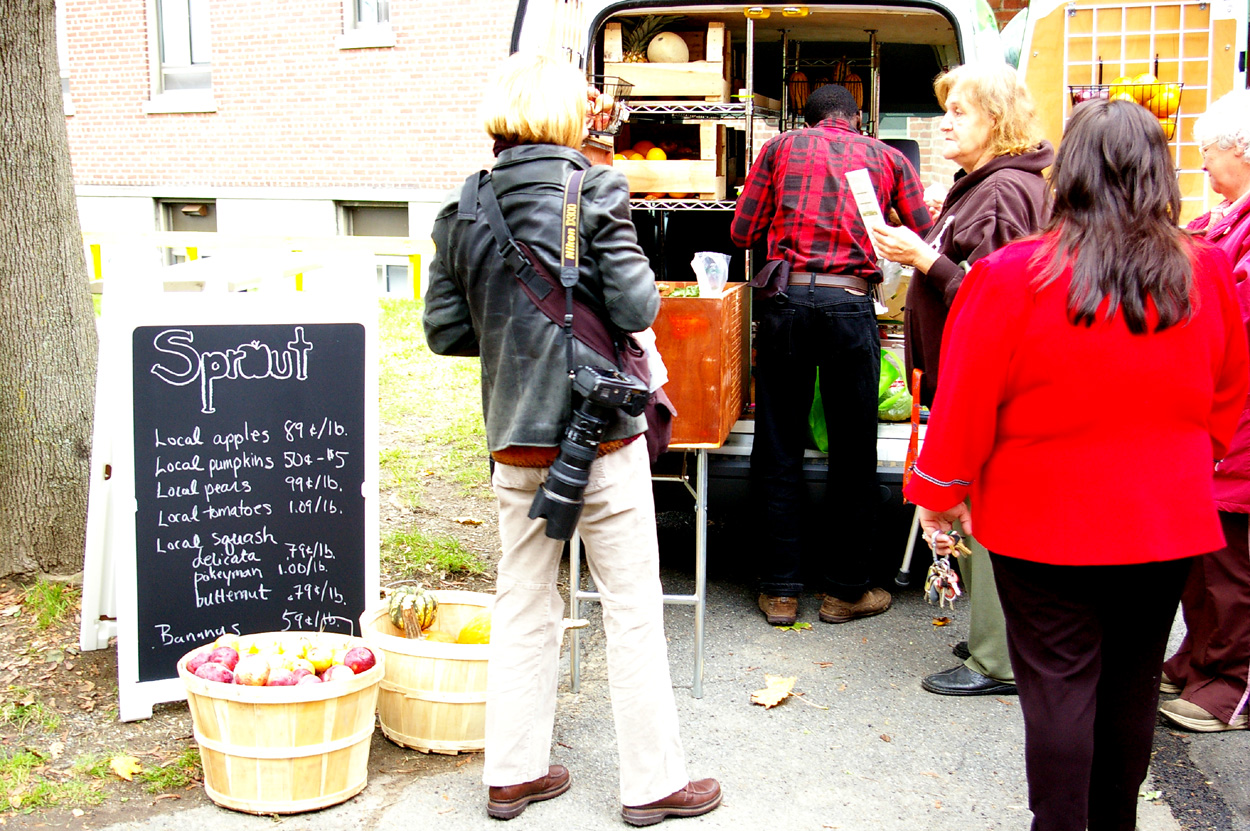
A few weeks ago I went to the rolling out party of the CDCG’s newest baby. A smaller version of the Veggie Mobile–called Sprout–was ready to take to the streets to expand their service area. As I was on the highway heading to the event, a big McDonald’s truck got ahead of me as it sped in from the on-ramp. As I wrote about in Morose Meals and Human Bites, McDonald’s tries to get my goat–so I knew this was no ironic coincidence. The back panel of the truck pictured a giant-sized box of french fries, with the words NO PASSING. Don’t they think they’re clever with their subliminal messaging? However, I know what those starchy sticks are made of. Potatoes, vegetable oil, canola oil, hydrogenated soybean oil, natural beef flavor made from wheat and milk derivatives, citric acid, dextrose, sodium acid, pyrophosphate, and salt will not seduce me. Neither will the canola oil, corn oil, soybean oil, hydrogenated soybean oil, with TBHQ, citric acid and dimethylpolysiloxane that they are cooked in. Immune to their tactics, I switched lanes, put the pedal to the metal and passed that truck right by.

As I arrived at little Sprout’s press conference, I got all choked up. There it was–the art and poetry. It was the most beautiful and colorful canvas. Bright greens, reds, oranges, and yellows were everywhere from the painting on the truck to the gorgeous apples, yams, bananas, squash and collards that filled it. County Supervisors and other local politicians were there to welcome this new addition to the fleet, stating that only 44% of people in this city had access to healthy food. Sprout’s efforts would help to increase that number. How wonderful is that? So, take that you big giant McDonald’s truck. You are no match to this little mighty David.

photo by Jennifer O’Conner

After the speeches were over, local residents who were present began to shop. I took an apple that was being offered and grabbed a big juicy bite. Here, a few blocks from the very Hudson River that had informed the palette of a whole school of artists, was a veritable Garden of Eden–in a backstreet parking lot. This is where nutrition leaves science behind and becomes a thing of true beauty.

Two other projects have recently come to my attention which also remind me of the color of nourishment. One is the work of Gina Keatley, a chef and nutritionist, who witnessing malnutrition in East Harlem, founded a non-profit called Nourishing NYC.

The other is a fascinating documentary called Urban Roots, by filmmaker Mark McInnis about Detroit’s urban agricultural movement. It captures a grass-roots revolution in its truest sense that is impacting the access to food and hence the nutritional status of a largely disenfranchised population in a post-industrial era.

Please check out all of these groups and their work. I am sure donations would be welcomed.

So, in celebration of our harvest feast, rich with the hues of autumn, I give thanks to all who grow and help bring food to the table–for there lie the most important nutritional lessons of all. And, deep gratitude to my readers, Haiku poets, friends and family. Inspired by you, I strive to bring creativity and love to my own purpose.

Happy Thanksgiving.

In health, Elyn

my plate

My Plate Haiku

Food is medicine

Farmers are doctors, Cooks priests

Eat, pray, eat, pray, love.

by Gordon

the nightmare before halloween

It has been one year almost to the date that I first began my blog. Just as I was ready to celebrate having come full circle, I realized that there was one more event in the liturgical feeding cycle to attend to in order to truly do so. Halloween.

Halloween is this nutritionist’s nightmare. It makes all my dilemmas go screaming wildly around in the scary darkness like a gathering of roaming ghosts. Starting in mid-October, I began to see discussion of these hair-raising topics appear in various articles. Some people were writing about Halloween as a sanctified binge-eating holiday. Commentary ensued on memories of guilt-encompassed candy hoarding and gorging. Then guilt- minimizing strategies were presented–instructions were offered on how to partake but not overdo; and, suggestions were given on organic, high cacao content, lower sugar, chocolate alternatives.

Then, there was the issue of the politics of chocolate–the problems of impoverished cocoa farmers, environmental degradation and the use of forced child labor on cocoa farms. With one-quarter of all candy sold annually in the US being purchased for Halloween–this is no small matter. EqualExchange, the producers of organic, fairly-traded chocolate products, sponsors a Reverse Trick or Treating Program. Trick-or-Treaters give a piece of Fair Trade chocolate attached to an informational card as a mass action to educate the public about this.

Finally, the childhood obesity issue surfaced as well. I learned of a dad from Georgia, David Soleil, whose activism was inspired by being fed up witnessing too many Halloweens–overweight parents driving cars around his neighborhood unloading their children at intervals to gather the loot; pillowcases loaded 3/4 full with candy and the endorsement of multiple pre-Halloween events. He launched a response with a movement called Healthy Halloween House where people pledge to provide a healthy trick or treat alternative. I love his slogan–“Eat the pumpkin and let the candy rot on the porch.”

So, with my own inner pillowcase filled to the brim, I informed my daughter Zena–as I do every year–that for the holiday we would be distributing some Skarrots (baby carrots packaged in fun inducing wrappers) and pencils–and that she would be doing reverse trick or treating. In her kind, gentle way she asked me to sit down. She assured me lovingly, that every other day of the year I do my part to encourage healthy eating and I have spared many children many pounds of sugar–but, she does not want to be one of those “weird” houses on the T&T trail. And then, she asked me if I have forgotten where we live.

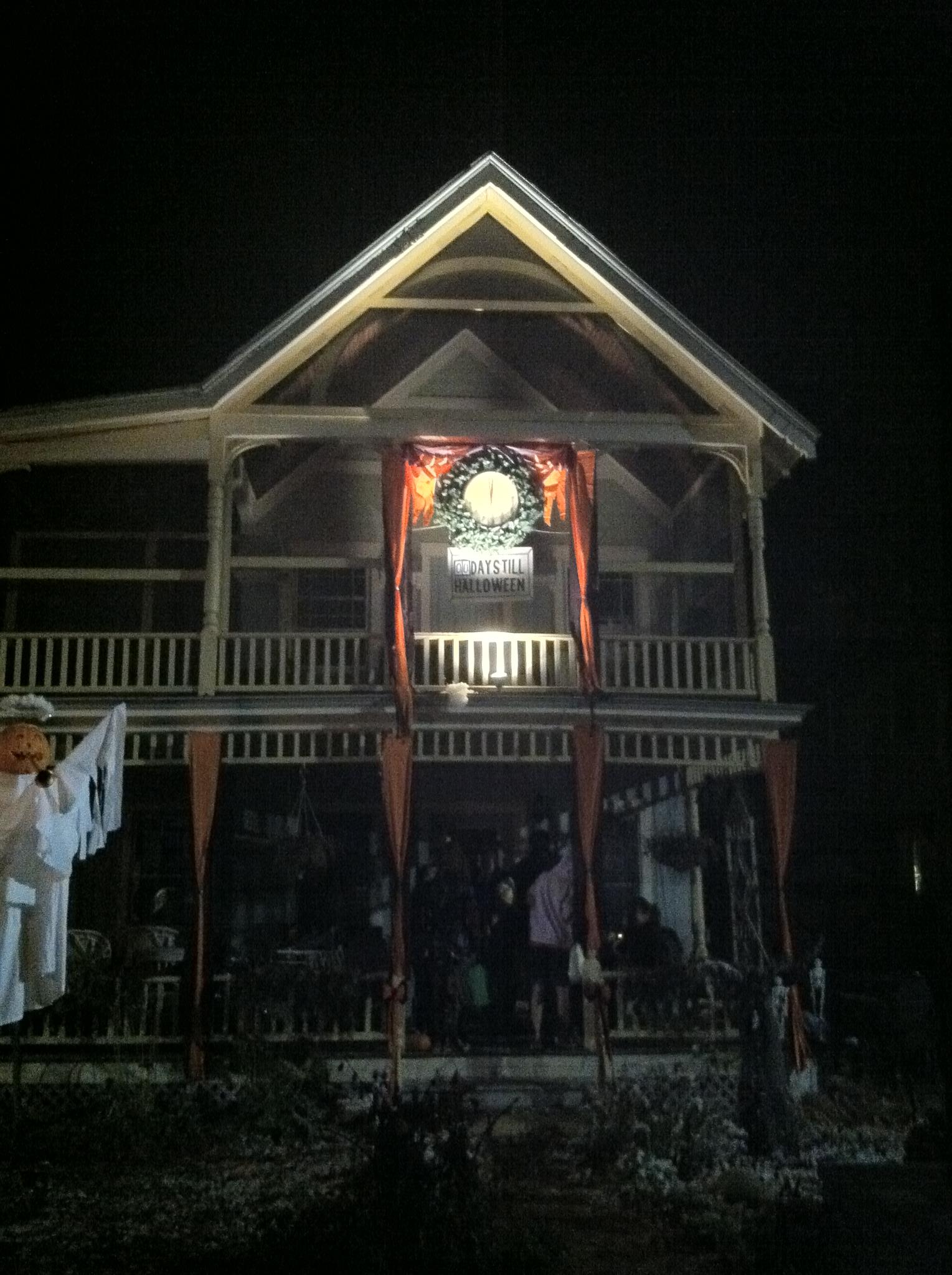
We live in an old Victorian village of the type that inspires the imaginations of people like Tim Burton. It is truly the epicenter of Halloween. Houses are old enough to provide residence to a few generations of real ghosts, tiny streets with closely packed houses draw hundreds of trick or treaters from miles around–and our next-door neighbors are deranged, wonderful folk who do things like this and this (video).

Their preparations are usually quite furtive, though they say things to me like, “Did we tell you we got a snowmaking machine?”, or ask, “Do you have a fire extinguisher? Good.”

So, heeding Zena’s words, and not even knowing where to buy hundreds of bags of Scarrots; and not convinced kids would really use the cutesy pencils that trees gave their lives for, I backed down. Still, I knew I personally would not be able to buy the drugs–I mean candy–nor distribute it. In cowardly fashion, I assign the purchasing to my husband, Pete or to the friends I invite for the festivity of the evening; and the distribution to whatever available child or visiting foreign exchange student I can find.

Figuring out the amount we need requires a complicated quadratic equation and often we have miscalculated. This means that we have to indenture our own children and recycle the booty they have worked hard for, or we have to run upstairs and hide in the dark, pretending we are not home.

Halloween evening was perfect this year. The weather was gentle with only a touch of autumn’s crisp bite in the air. At the witching hour, all the creatively-costumed children emerged from their homes and took immediately to their task. As we were simultaneously welcoming friends, warming the cider, finishing the pumpkins, adjusting costumes and oohing and aahing at the little munchkins crowding the porch–we realized we were going to be in trouble early.

As I was frantically emptying the bags into the cauldron, trying to appease the munchkins turned monsters now knocking down the door, one of my guests said that the contents of candy bags had gotten smaller. He was right and this was seriously offsetting the math. Later, with the cauldron barren, we found ourselves sitting with the lights out–considering giving away some of our tchotchkes, artwork, cats and used pencils.

Early in the evening, a Jedi knight informed Pete that he required two offerings. His headless horseman friend explained that he was making up for last year. Amused, Pete was about to challenge this request, but the Little Red Ridinghood mother bared her big teeth, said he was in the hospital then and snatched a candy for herself. Next year we may ask for discharge papers or a gnawed off wrist band.

So, once again, we gaped at our neighbors’ amazing creation– which draws hordes of happy revelers–spun through the few hours of insane madness, walked the streets with our friends–and it all eventually quieted down. We were reverse trick or treated, and there was actually some healthy and adorable popcorn to be found.

At the end of the night, I removed my Bob Cratchet ba-humbug costume, enjoyed a Reese’s Peanut Butter Cup or few and imagined that everyone will be needing a nutritionist come morning’s tolling of the bells.

What does Halloween bring up for you?

Thank you for listening, sharing, following and supporting my writing. Please subscribe in the sidebar to receive notice of new posts. Comments and greetings always welcome.

In health, Elyn

Related Posts: Post Halloween Post; The Eye of the Newt; So, How Did It Go?

Related Recipe: Pumpkin Muffins by Cookie+Kate


Halloween My Plate


My Plate Haiku

Eat the Pumpkin

Let the candy rot on the porch.

by the guy in Georgia


attacking the causes of obesity, really?

I have been having what I suppose you could call a blog clog lately, or maybe a blogade. Lots of stuff and stories going around in the brain but they are experiencing a log jam while trying to get out in some type of orderly fashion.

Howard Johnson's Restaurant

Howard Johnson’s Restaurant

This seems to have started when Pete showed me a Jane Brody article from the New York Times a few weeks back called, “Attacking the Obesity Epidemic by First Figuring Out Its Cause”. I should probably just have considered it a moot subject and ignored it, but it wrapped its little serifs around me and wouldn’t let go. You mean we haven’t already figured this out? Apparently not. And, this is the missing piece that has still been feeding the epidemic so to speak?

According to Ms. Brody, an impressive team of experts spent the last two years investigating the big O and published their conclusions in a series of reports in The Lancet. I will assume that what she goes on to describe is a reflection of their findings and not a cover-up for some obscure but shocking discoveries that will remain hidden in a boring medical journal.

Apparently, the impressive experts determined that the demise of the following is responsible for the puddle of fat we now find ourselves in. From the 1940’s through the 1970’s more or less– the years that preceded the epidemic–we played, walked and biked more; watched less TV, ate meals prepared at home by moms who mainly did not work, ate out only for special events, downed mainly hot or cold cereal for breakfast, had fewer mass-produced convenience foods, and consumed fewer refined carbohydrates as well as fewer calories.

I will try to keep my cynicism to a minimum but remember I did warn you about this side of me in Diet for a Small Caterpillar. Maybe this is breaking news or perhaps fascinating ancient history to those born after those more svelte decades, but two years of research, really? Those impressive experts could have just come and asked me, or better yet could have paid me. I’d love to be a paid impressive expert. I was actually one of those referenced skinny, cereal eating, hop-scotching kids on a bike, who occasionally ate out at Howard Johnson’s with my family when my non-working mother was too tired to cook. Wait, how old are those exalted researchers, anyway?

With all due respect to Drs. Gortmaker and Swinburn, et al who were cited in the article– unless I am remiss for not reading the source material, this is superficial and obvious stuff. A lot has changed since that time and the changes have had many effects on the human experience besides causing obesity. I think it is myopic to put the attack and hence the shame and blame only on those walking around with the visible consequences of our societal shifts or imbalances. Many things have increased since the 1970s besides weight like rates of divorce, cancer, childhood poverty, autism, learning disabilities, alcoholism, underage drinking, the perverse pursuit of thinness and high school dropout rates–and all carry a high cost as well–but these conditions are invisible in the rising tide of humanity. Still, even if we are to keep our attention just on the problem of obesity, one could identify other significant and more profound influences.

One of my impressive experts, Marc David, who I introduced previously in Three Good Mark(c)s, meaningfully and sensitively addresses this topic in his article, ‘A New Way to Lose Weight–Listen to It’. Moving beyond the easily observed poor food choices that plague us, he explores causes of the emotional hunger we face these days that propel people to overuse or abuse food. These are very important, and when personified, they are what present in my office every day–repressed feelings, unmet needs, self-doubt, chronic stress, disconnection from one’s body and loneliness.

These are associated as well with the larger cultural issues that he dares expose. These are not new, but the ramifications are coming to a head, perhaps similar to global warming. He speaks of a nation that has valued excess and overconsumption; a culture that values speed and ease; a world filled with fear, anxiety, and mistrust; and, a people separated from their spiritual source.

Though I don’t fit their demographic, I have come to enjoy reading the magazine, Outside. It is for those who live the active life–in a rather bold way–and is a tad less dry than The Lancet. In a recent issue, there was an article, Jamie Oliver Will Work 4 Food about renegade British chef, Jamie Oliver, who is sincerely trying to clean up our country’s food mess. I admire Oliver’s means and message. I share his penchant for crying. The author, Jeff Gordinier, describes the obstacles Oliver is facing here in America. He writes, “As one wag put it, Oliver “just doesn’t get the fact that excessive consumption is woven into our national DNA.” This concurs with some of what Marc David is saying.

If a lack of identifying causes is impeding solving the problem, then acknowledging our national and personal constitutional makeups is as important as looking at what we are eating for breakfast now, well, compared to in my day. Doing so would help to explain why we lay down reason in the feeding of ourselves and our children.

My own causative list would go even further. It implicates the usurping of the practice of medicine by the pharmaceutical industry, unethical corporate practices and the disempowerment of women in pregnancy and birth for starters. I’ll leave it there for now. As I’ve hopefully unclogged the blog, I will be able to pick up on those topics soon.

Stay posted. I promise that will be fun. And tell me what would be on your list.

Thank you for listening, sharing, following and supporting my writing. Please subscribe in the sidebar to receive notice of new posts. Comments and greetings always welcome.

In health, Elyn

my plate

My Plate Haiku

Hunger tiptoes in

From bellies, hearts or minds

Feed me now she calls.

By, Eva

wait wait michael pollan

American science journalist and author Michael... Michael Pollan Image via Wikipedia

Oh, dear Michael Pollan. You got schooled–and on National Public Radio no less. I am so sorry. You must realize that nutritionists and comedians are not a good mix–even if you are really just a journalist. You should have known better. I hope you will be more careful the next time.

Here’s where I was when this public humiliation happened. In my kitchen concentrating fiercely on grout. Yes, grout. For the past few months, I have been held hostage by a kitchen renovation project. My release was imminent, but not until I finished grouting the backsplash tile. My contractor guy left me home alone equipped with a grout float, a grout sponge, a bucket and a milk carton-like container of powder with indecipherable directions.

Normally, my husband, Pete, provides me a task and temperament appropriate playlist of music before I undertake such projects–but not then. I just turned the radio on to find the weekly broadcast of the NPR game show Wait Wait Don’t Tell Me. I hear it occasionally, but I am not a regular listener. Just as I was trying to decide if I could really grout and listen to an inane game show at the same time, they announced the guest of the day–food and food economics guru, proponent of the sustainable food movement, and my blog name inspirationeven though he won’t admit that we are from the same once big potato farm–Michael Pollan. I now had no choice but to turn up the radio and begin mixing the grout powder with water.

The host touted Pollan’s accomplishments, listed The Omnivore’s Dilemma as one of his landmark works and asked him to describe some of the basic tenets of his nutritional philosophy. That is where the pounding began by none other than Paula Poundstone. Ouch. It pains me to recall the situation.

All serious-like, Pollan started out by saying we need to distinguish between food and edible food-like substances. Right off, Ms. Poundstone managed to get her mouth in. She announced to Mr. Pollan, that Ring Dings are one of her reasons for living. Were they not considered food? She informed him that they only have three ingredients–devil’s food cake, a creamy filling, and a rich chocolate outer coating. Pollan pathetically informed her that the creamy filling is not real cream. She retorted that it is C-R-E-M-E-Y and asked him, “What the hell’s the matter with you?”

Pollan stammered and began to comfort her that it is ok to have such a treat once in a while. She interrupted to remind him that she said they constituted a role in her reason for living and asked if he was suggesting that she save it for one day a year. Meekly, he said that he would not want to deprive her of that. This “Battle in Berkeley” as the show was called, taped in Pollan’s adopted hometown, was now calling for my attention at the risk of hardening my grout mixture. Poundstone, now ready to fully devour her prey, attacked with, “You may know a lot about food, but you don’t know the first thing about living, buddy.”

The host intercepted, trying to save his guest, and asked Pollan another question. This led Pollan to tell a little story about shopping at ‘The Berkeley Bowl’. The local crowd went crazy at the mention of this Berkeley food oasis. For the wider radio audience, he had to describe the large grocery store as full of all sorts of wonderful produce, grass raised beef, etc. He jabbed at Poundstone, that the store would be like her idea of hell, but the comment fell flat and got no response. The indignity finally ended only after Pollan was made to answer three questions about electronic Japanese Supertoilets. Forget the backsplash. At this, I felt the sclerosis of my own inner being.

This may have all been in the name of fun and games, but to us real nutritional professionals, this is the substance of what we do. The Paula Poundstones of the world are who fill the cracks and crevices of the story behind the dogma–though most are not nearly as funny. Right now, I am considering using a photo of Ring Dings as the graphic for my post. But, I know that mere visual suggestions of such foods can cue unhealthy feeding behaviors. I’d prefer not to feed into that so to speak. But, I will be torn. I am sure they will be more colorful and enticing than any stock photo I may find of Mr. Pollan.

If Ms. Poundstone was my client, we might explore such issues as food addiction, what role food is playing in her life, comfort eating, insulin resistance, effects of sugar, menopausal weight gain, food sensitivities, the seduction of chocolate and motivation for dietary change. Inside, I’d be grappling with the question of what do I know about living and the sacrifice of putting down the beloved Ring Ding and stepping away.

These are the things I muse about daily. The crossroads of food, health, the environment, and pleasure. I am an adherent to the pathways that Mr. Pollan promotes as essential for increased sustainability and to rescue our birthright of health. I am grateful for how his writings have advanced this work. However, I hope he has gleaned that it is one thing to write about this stuff, another to work it in the wild. Throughout my career, I have often joked that after a long day at the office, I am grateful to go out to the parking lot and find that there is still air in my tires. That I have not pissed off the Ms. Poundstones in my role as the messenger and that I have still maintained my sense of humor in this work.

Well, by now, the renovation is done. Fortunately, I have now added grouting and caulking to my resume. By my professional assessment, I think there will always be work to do in the proverbial kitchen.

Thank you for listening, sharing, following and supporting my writing. Please subscribe in the sidebar to receive notice of new posts. Comments and greetings always welcome.

In health, Elyn

The closest I come to comedians is that I keep an article about Drew Carey’s transformational weight loss on the bulletin board in my office. With that, I can trust that he can be solely a source of inspiration rather than nervous perspiration.

Related Post: Holistic, Intuitive Eating, Community-Based Nutritionist Seeking Michael Pollan

My Plate Haiku

Drink tea and nourish life.  With the first sip joy.

With the second, satisfaction.

With the third, danish.

by Jewish Grandpa