Archives

where it all began

Last week, I dug out the dark green heavy plastic bin that resides at the bottom of one of my storage closets. It’s not easily accessible, but not too hard to get to either. Years can go by without my opening it, but I like to know where it is among all of my stored stuff. It contains the artifacts of my formative years and preserves that nascent stage of my existence.

Stuffed in the bin is mainly personal correspondence of my life from pre-junior high through post-college. They are written on bright flowery stationery, thin and wide-lined loose-leaf paper, odd scraps and postcards from near and far. Some are hammered out on yellowing typing paper. They document boring summer days, summer camp activities, courses taken, teenage-angst, young love and declarations of forever friendship. There are also some official documents like my school report cards, SAT scores and college tuition bills which seem quite cachectic compared to the full robust ones of today.

On the rare occasions when I open the bin, it is easy to get lost in there, randomly opening envelopes to see what long-forgotten piece of soul revealing information lies within. On my recent excavation, I tried not to linger too long. I was looking for some particular letters to give to an old friend who had authored them many years ago–and found them pretty quickly.

However, to my surprise, I happened to dredge up a scribbled draft of my college application essay describing my intention to embark on the study of nutrition. In my once prized small script, amid the many cross-outs, the blue ink asserted that “For many years I have been concerned about my own diet and now, I have become increasingly aware of problems and inadequacies in the public’s diet due to social conditions and the lack of proper nutritional information.” It goes on to say that having worked for a summer in a local health food store, I came to understand that I wanted to pursue the field of nutrition. Every day was a learning experience as I gained knowledge from both my employer and the customers. I add that I have an interest in the social sciences and have a desire to help people. And, that I think the program I am applying for is one of the best.

It was rather embarrassing to read this declaration of purpose from my unformed self and to see my simplistic writing. It also made me wonder if I have evolved much since then, as I seem to still be living an old vision. I know it is time for me to manifest something new. Still, I was struck by my awareness at that point of the inadequacies of the American diet and its effects on our health. This was 1977. Dietetics at that time was still essentially practiced in the caverns of hospitals, nursing homes, and school cafeterias. It was also a few years before high fructose corn syrup and other chemically-transformed concoctions tsunamied their way into our entire food supply, altering the contours of the human physique which pulled the alarm bells–and margarine and saccharin were still considered rather benign.

As I mentioned in Holistic, Intuitive Eating, Community Nutritionist Seeking Michael Pollan, I thought my early intentions were focused on global hunger issues. I did not remember that health and personal feeding concerns inspired my path.

Looking back, I now know that Hy, the owner of that health food store–ironically located next to a pizza shop in a tiny row of stores in a largely industrial area–was way ahead of his time. He was a round, bespectacled man already in his late sixties who had retired from a career with the famed Harry Winston Jewelers.

Hy was self-taught, having studied the work of other nutritional gurus. From him, I learned about health issues that are only recently becoming widely accepted. He talked about the dangers of sugar, how bad it was to eat when stressed, and the importance of exposure to natural light. He knew about the healing properties of herbs. He quietly assisted customers with unorthodox treatments and kept some special products in the backroom. A few years later when I was struggling with some serious irritable bowel symptoms, I desperately sought him out. He readily guided me to a simple herbal supplement right on the shelf, and my condition was almost immediately improved. Maybe that is when my perspective changed from the global to the personal. It clearly began my departure from conventional medicine.

Little could I have imagined then where this interest would lead me. Though I have done community nutrition work, and have had some short-term experiences doing public health work in both Guatemala and Peru, my work has been very local and essentially contained within the vast personal geography of the individual.

Interestingly, the friend whose letters I was looking for was overweight as a teenager. Her frank comments about herself and her struggles with weight were a constant part of our adolescent conversations. I remember once during high school her parents went away for the weekend. Left to our own devices, she and I made a beeline to the store and giddily filled a shopping cart with boxes of junk food.

In one of the letters, she writes about being in love with some guy who she met when she started college. She describes her realization that her years of constant hunger and adoration of food had for the first time, amazingly diminished. She acquires, at that moment, an important knowing that is still barely recognized in the big chat room of culinary chastisement and dietary deprivation–that pleasure is a vital nutrient. Trying to beat down the desire to overeat without nurturing other areas of pleasure in one’s life will only foster continual frustration and unsuccessful weight loss or healthier eating attempts.

This is a very important concept that I never learned in my academic studies but which is now being beautifully presented to the world by some lovely wise women–Jena La Flamme, Tonya Leigh, and Angela Minelli. Please check out their offerings.

Right now, I am sitting on the couch taking one more glance at this old college essay before I go upstairs to pack it back in the bin. So much has changed since then. I wonder what would have happened, what would have been different if I had not been accepted to that college nutrition program. Who knows.

I’d love to hear about what sparked your interest or passion in this area.

In health, Elyn

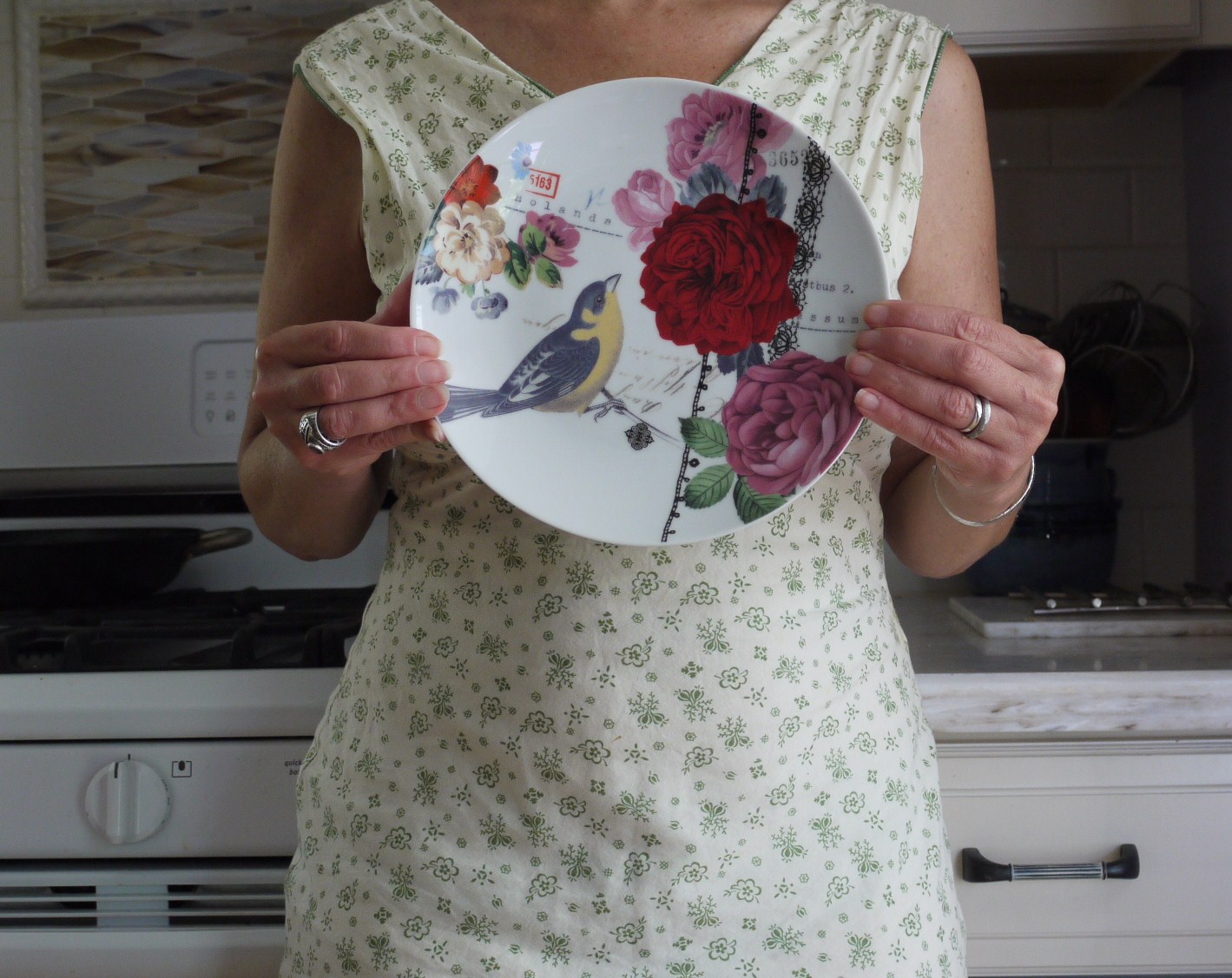
my plate

My Plate Haiku

Food made joyfully

As a gift of time and self

Feeds body and soul.    By Anne-Marie

no passing

Today, I awoke to a landscape that looked like a poorly iced cake. A wet, mushy, disorganized snow fell overnight and pathetically covered the ground, leaving crumbs of grass unattractively exposed. Now, a cold, icy rain is falling and I am glad that I don’t have to go out for a while. So, I am curled up warm and cozy, just chillin’ with my dilemma. We are wondering where is the art in the science of nutrition.

photo by Jennifer O’Conner

Sometimes, the standard approaches used in this field seem as dreary to me as this grey day. Reducing food to its macronutrient content; shaping diets to conform to a square, triangular or circular configuration; indicating proper serving sizes by comparing them to a computer mouse, a golf ball or a dissected thumb tip; helping decipher rather indecipherable food labels, or interrogating the true source of our hungers–objectifying these practices can leave me as uninspired as a plate of overcooked green beans.

I seem to prefer something a little juicier with more feeling, color, passion, and heart in this pursuit of health promotion. A tad annoyed with me, my dilemma poses that I should have just become an art historian, museum curator–or an artist–if I wished to find Picasso, Rembrandt or Gauguin in my daily work. Or a chef or a farmer, it grunts. It is right of course.

My dilemma reminds me that I know darn well where this work comes alive–where it jumps off the page-turning from black and white into full technicolor; where it brightens from canned pea puce to fresh green pepper emerald; and from hamburger helper to the tastiest, soul-nourishing food that one can ever imagine. I know where palette meets palate.

One of the most inspiring aspects of my own work is the collaboration I am able to do with an organization called the Capital District Community Gardens (CDCG)–(update Capital Roots). This non-profit is committed to irrigating food deserts with a vengeance through a variety of projects. It is responsible for forty-seven food gardens in the local community, a farm-to-market program for youth, an initiative that enables local corner stores to appropriately stock and effectively sell a variety of fresh produce, and, a program that serves childcare programs. In addition, it is the mother of the Veggie Mobile–the healthy answer to the ice cream truck–a produce section on wheels.

This brightly painted, bio-diesel and solar-powered retrofitted truck winds its way–playing Beatles, Motown, and Hip Hop–through underserved neighborhoods in four nearby urban centers. It brings its well-stocked bounty of wholesale priced fruits and vegetables, locally grown when available, to public and senior housing units, schools, neighborhood centers and–I am thrilled to say–the health center where I work. When I called them about two years ago and asked them to help promote the message of food as medicine, they expanded their schedule to accommodate my request. It is amazing for me to watch every Tuesday as patients, doctors, nurses, staff, clients of the center’s substance abuse program and neighbors take their turn in line to shop. Most times I witness some beautiful gem of nourishment. Recently, I was touched by observing an elderly gentleman speaking to his wife on his cell phone telling her what was available and filling his bag per her requests.

photo by Jennifer O’Conner

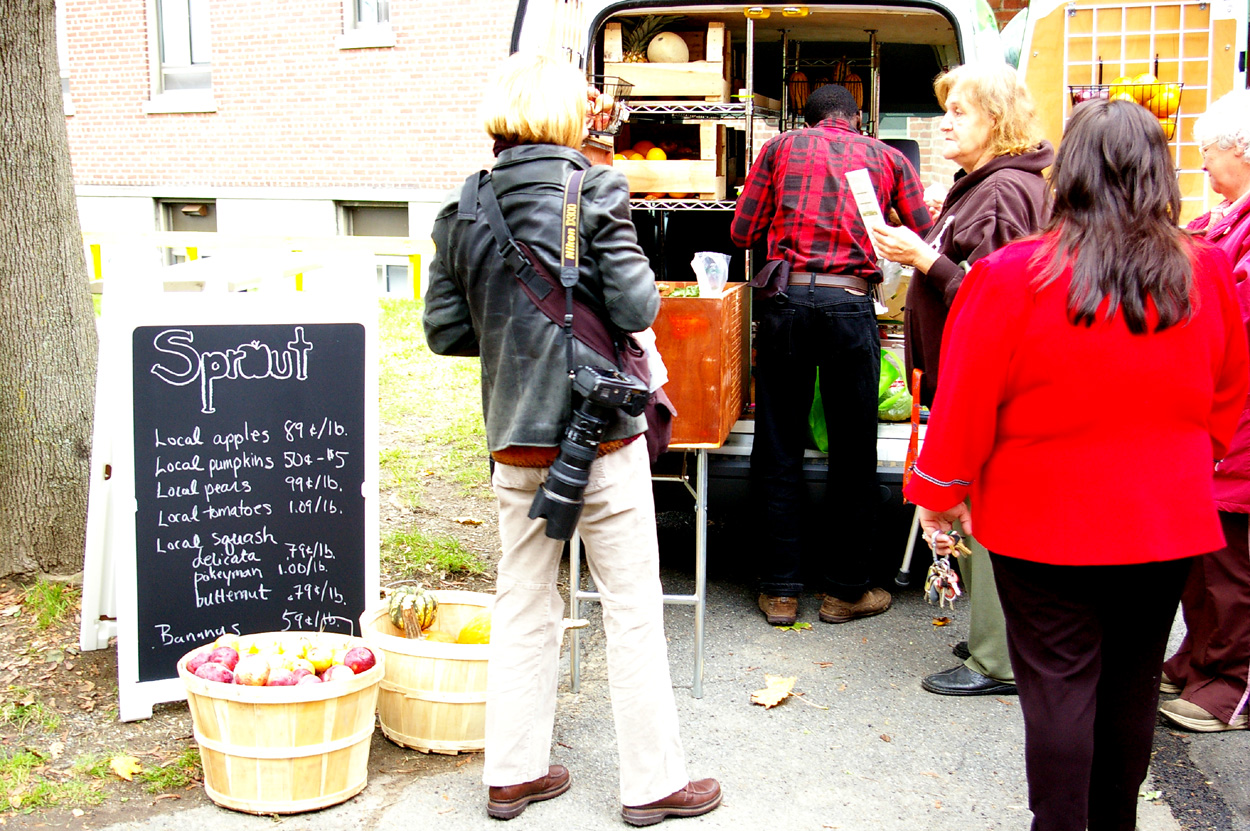
A few weeks ago I went to the rolling out party of the CDCG’s newest baby. A smaller version of the Veggie Mobile–called Sprout–was ready to take to the streets to expand their service area. As I was on the highway heading to the event, a big McDonald’s truck got ahead of me as it sped in from the on-ramp. As I wrote about in Morose Meals and Human Bites, McDonald’s tries to get my goat–so I knew this was no ironic coincidence. The back panel of the truck pictured a giant-sized box of french fries, with the words NO PASSING. Don’t they think they’re clever with their subliminal messaging? However, I know what those starchy sticks are made of. Potatoes, vegetable oil, canola oil, hydrogenated soybean oil, natural beef flavor made from wheat and milk derivatives, citric acid, dextrose, sodium acid, pyrophosphate, and salt will not seduce me. Neither will the canola oil, corn oil, soybean oil, hydrogenated soybean oil, with TBHQ, citric acid and dimethylpolysiloxane that they are cooked in. Immune to their tactics, I switched lanes, put the pedal to the metal and passed that truck right by.

As I arrived at little Sprout’s press conference, I got all choked up. There it was–the art and poetry. It was the most beautiful and colorful canvas. Bright greens, reds, oranges, and yellows were everywhere from the painting on the truck to the gorgeous apples, yams, bananas, squash and collards that filled it. County Supervisors and other local politicians were there to welcome this new addition to the fleet, stating that only 44% of people in this city had access to healthy food. Sprout’s efforts would help to increase that number. How wonderful is that? So, take that you big giant McDonald’s truck. You are no match to this little mighty David.

photo by Jennifer O’Conner

After the speeches were over, local residents who were present began to shop. I took an apple that was being offered and grabbed a big juicy bite. Here, a few blocks from the very Hudson River that had informed the palette of a whole school of artists, was a veritable Garden of Eden–in a backstreet parking lot. This is where nutrition leaves science behind and becomes a thing of true beauty.

Two other projects have recently come to my attention which also remind me of the color of nourishment. One is the work of Gina Keatley, a chef and nutritionist, who witnessing malnutrition in East Harlem, founded a non-profit called Nourishing NYC.

The other is a fascinating documentary called Urban Roots, by filmmaker Mark McInnis about Detroit’s urban agricultural movement. It captures a grass-roots revolution in its truest sense that is impacting the access to food and hence the nutritional status of a largely disenfranchised population in a post-industrial era.

Please check out all of these groups and their work. I am sure donations would be welcomed.

So, in celebration of our harvest feast, rich with the hues of autumn, I give thanks to all who grow and help bring food to the table–for there lie the most important nutritional lessons of all. And, deep gratitude to my readers, Haiku poets, friends and family. Inspired by you, I strive to bring creativity and love to my own purpose.

Happy Thanksgiving.

In health, Elyn

my plate

My Plate Haiku

Food is medicine

Farmers are doctors, Cooks priests

Eat, pray, eat, pray, love.

by Gordon

dear you, the readers

It has been one year since I first birthed my blog.  One intention, many fears, countless hours and fifty posts.

Having mothered my blog through its infancy, I now must ponder its future as a toddler-staged blog which I call a blogger. My little bloggler is learning to stand on its own and is getting fed some nice comments and words of support. But, mothering a bloggler raises new developmental issues and it is important to have a philosophy of care. Sometimes, one must look for support and feedback from others in order to persevere.

Honest Tea Cap

Honest Tea cap

So, my dear subscribers and readers, as the days grow shorter and as those of us up here in the northern climes prepare to go inward and grow pensive, I ask you for a moment of your time in the form of a click on the “like” box, a few words in the “comment” box, a share of a post, a decision to subscribe or to follow me on Twitter, a submission of a haiku, or a message in an email to let me know what you think.

Are my writings of interest, is there a resonance in the stories, is my exploration of the experiences of real eaters meaningful for you? Are my musings too long or convoluted in their message; do they not offer the hands-on suggestions and answers that we so often seek in this vast landscape, or, are they, as my brother recently told me, intriguing but rather depressing? And if they are, might they also be, as I hope, a bit funny.

Are there topics you would like me to address more, was I remiss in not discussing National Food Daylike Michael Pollan did, should I post more photos of my cat Chico? Have I not discussed menopause enough– which really, I still plan to do?  Am I too cutesy or not cutesy enough? Would you care to know that today I ate a nice nori roll for lunch and that I tried a new flavor of Honest Tea that I really liked called Heavenly Lemon Tulsi–tulsi being another name for Holy Basil which you should really check out? And, while sitting outside on this unusually warm November day, I ventured some deep gulps of the mineral spring waters that flow freely from the fountains that immortalize my nearby town? Would it be good if I included some recipes like many other food bloggers do? Should I change my template or alter the background color? Am I too pink or does my cynicism tinge the blog a light shade of tan?

Should it matter to you that this week I worked with a 41-year-old woman who weighed 78 pounds? And, then, immediately following, a 39-year-old woman who weighed 310 pounds? That a woman at my daughter’s crew event told me that getting her house ready for the real estate agent to show was so stressful, that she needed three scoops of ice cream at Friendly’s? That yesterday, a nine-year-old told me that she feels different from everyone else, and trying on clothes that say Plus Size in the store is very embarrassing? That next week I will see a two-year-old who weighs 65 pounds? Or, that a mere few hours ago, a beautiful 18-year-old college student shared with me that being thinner than 100 pounds would make her less ugly than she already is and that she has never loved her body?

It has been a number of years now since I ended my subscription to Mothering Magazine and I am certainly feeling a little lost without it. So, any input, advice or inspiration would be greatly appreciated. Gotta run. Time to put the little bloggler to bed.

Thank you for listening, sharing, following and supporting my writing. Please subscribe in the sidebar to receive notice of new posts. Comments and greetings always welcome.

In health, Elyn

my plate

My Plate Haiku

Grasses, grain, fruit, wine

Garden flowers produce joy

Kitchen flours bread.

By Gordon

attacking the causes of obesity, really?

I have been having what I suppose you could call a blog clog lately, or maybe a blogade. Lots of stuff and stories going around in the brain but they are experiencing a log jam while trying to get out in some type of orderly fashion.

Howard Johnson's Restaurant

Howard Johnson’s Restaurant

This seems to have started when Pete showed me a Jane Brody article from the New York Times a few weeks back called, “Attacking the Obesity Epidemic by First Figuring Out Its Cause”. I should probably just have considered it a moot subject and ignored it, but it wrapped its little serifs around me and wouldn’t let go. You mean we haven’t already figured this out? Apparently not. And, this is the missing piece that has still been feeding the epidemic so to speak?

According to Ms. Brody, an impressive team of experts spent the last two years investigating the big O and published their conclusions in a series of reports in The Lancet. I will assume that what she goes on to describe is a reflection of their findings and not a cover-up for some obscure but shocking discoveries that will remain hidden in a boring medical journal.

Apparently, the impressive experts determined that the demise of the following is responsible for the puddle of fat we now find ourselves in. From the 1940’s through the 1970’s more or less– the years that preceded the epidemic–we played, walked and biked more; watched less TV, ate meals prepared at home by moms who mainly did not work, ate out only for special events, downed mainly hot or cold cereal for breakfast, had fewer mass-produced convenience foods, and consumed fewer refined carbohydrates as well as fewer calories.

I will try to keep my cynicism to a minimum but remember I did warn you about this side of me in Diet for a Small Caterpillar. Maybe this is breaking news or perhaps fascinating ancient history to those born after those more svelte decades, but two years of research, really? Those impressive experts could have just come and asked me, or better yet could have paid me. I’d love to be a paid impressive expert. I was actually one of those referenced skinny, cereal eating, hop-scotching kids on a bike, who occasionally ate out at Howard Johnson’s with my family when my non-working mother was too tired to cook. Wait, how old are those exalted researchers, anyway?

With all due respect to Drs. Gortmaker and Swinburn, et al who were cited in the article– unless I am remiss for not reading the source material, this is superficial and obvious stuff. A lot has changed since that time and the changes have had many effects on the human experience besides causing obesity. I think it is myopic to put the attack and hence the shame and blame only on those walking around with the visible consequences of our societal shifts or imbalances. Many things have increased since the 1970s besides weight like rates of divorce, cancer, childhood poverty, autism, learning disabilities, alcoholism, underage drinking, the perverse pursuit of thinness and high school dropout rates–and all carry a high cost as well–but these conditions are invisible in the rising tide of humanity. Still, even if we are to keep our attention just on the problem of obesity, one could identify other significant and more profound influences.

One of my impressive experts, Marc David, who I introduced previously in Three Good Mark(c)s, meaningfully and sensitively addresses this topic in his article, ‘A New Way to Lose Weight–Listen to It’. Moving beyond the easily observed poor food choices that plague us, he explores causes of the emotional hunger we face these days that propel people to overuse or abuse food. These are very important, and when personified, they are what present in my office every day–repressed feelings, unmet needs, self-doubt, chronic stress, disconnection from one’s body and loneliness.

These are associated as well with the larger cultural issues that he dares expose. These are not new, but the ramifications are coming to a head, perhaps similar to global warming. He speaks of a nation that has valued excess and overconsumption; a culture that values speed and ease; a world filled with fear, anxiety, and mistrust; and, a people separated from their spiritual source.

Though I don’t fit their demographic, I have come to enjoy reading the magazine, Outside. It is for those who live the active life–in a rather bold way–and is a tad less dry than The Lancet. In a recent issue, there was an article, Jamie Oliver Will Work 4 Food about renegade British chef, Jamie Oliver, who is sincerely trying to clean up our country’s food mess. I admire Oliver’s means and message. I share his penchant for crying. The author, Jeff Gordinier, describes the obstacles Oliver is facing here in America. He writes, “As one wag put it, Oliver “just doesn’t get the fact that excessive consumption is woven into our national DNA.” This concurs with some of what Marc David is saying.

If a lack of identifying causes is impeding solving the problem, then acknowledging our national and personal constitutional makeups is as important as looking at what we are eating for breakfast now, well, compared to in my day. Doing so would help to explain why we lay down reason in the feeding of ourselves and our children.

My own causative list would go even further. It implicates the usurping of the practice of medicine by the pharmaceutical industry, unethical corporate practices and the disempowerment of women in pregnancy and birth for starters. I’ll leave it there for now. As I’ve hopefully unclogged the blog, I will be able to pick up on those topics soon.

Stay posted. I promise that will be fun. And tell me what would be on your list.

Thank you for listening, sharing, following and supporting my writing. Please subscribe in the sidebar to receive notice of new posts. Comments and greetings always welcome.

In health, Elyn

my plate

My Plate Haiku

Hunger tiptoes in

From bellies, hearts or minds

Feed me now she calls.

By, Eva

yesterday

BEATLES MANZANA

Image via Wikipedia

Yesterday, the big nutritional and societal issues that trouble me did not seem so far away. It was an unusual day as my afternoon was devoted to working with children as part of a new project I am involved in.

In the morning I saw a client who at age 42 weighs 371 pounds and requires a cane. She had recently come to me with uncontrolled diabetes and pending renal failure. Surprisingly, she had made some pretty profound changes in the time since I had last seen her and had greatly improved her blood sugar levels. When I asked her what explained the change, she said being spoken to about her kidney damage; and her love for her nine-year-old daughter made her face that big mighty river that flows through all of us.

I encounter many common themes in my work, and often the same ones coincidentally present themselves repeatedly in the course of a month, a week or even a day. One of my current recurrent themes, represented by that client, has been women in their early forties with way too much pain and far, far too many pounds and medications to bear. I always wonder, where did this story start, how did it get so extreme, how was it not prevented?

These questions often leave deep indentations as I press my fingertips into my forehead while bowing over my desk. On some days, the pressure is so deep I can almost feel my prefrontal cortex. But, yesterday, I knew I needed to ready myself for the children, so I yanked my hand down away from my head and put on my happy face. Little did I know the answers to my rhetorical questions lay in these young kids who awaited me.

First, was a pretty, very precociously developed, thirteen-year-old girl who hates her body and by association herself. As I was speaking with her she picked up her cell phone, pushed a button and brought it to her ear almost as unconsciously as brushing a hair behind one’s ear. As I asked her to put the phone away, I fumbled looking to offer her a better connection with me. I asked her and her mom a few of the perfunctory questions but my words sounded hollow. Even at her age, I could tell there were already too many chapters to her story and too few cutesy nutritional clichés that could assuage her experience of being fat.

Next, was a six-year-old boy. He is a big boy at 100 lbs. He was accompanied by both of his very big parents who were eager to help their son as well as themselves. With the boy quickly picking his way through the things in my crowded office I needed a distraction fast. I passed the dad these fun picture cards I have where different scenes are creatively constructed out of fruits and vegetables–while asking the mom for some history.

Dad did successfully engage the boy while Mom described to me that he started on whole milk as a one-month-old infant because her WIC checks for formula were stolen. Since then he has always drunk a lot of milk at will without limit–until very recently. How much milk did she say he drank a day? Why had she not gotten new WIC checks? Already, six years of details had passed me by due to my split attentions. What else was already missed in this young boy’s story and by how many people? Done looking at the cards, the child slid off his dad’s lap and came and stood right in front of me. He asked me the hardest question to answer simply–Is milk good for you?

And then, a lovely, smart and very insightful thirteen-year-old came and placed her presence before me. Within the passing of our first few shared sentences, she told me that she doesn’t eat breakfast or lunch at school because she does not want the other kids to make fun of her. At 271 pounds she has lost the right to eat in peace. A right so assumed we don’t even define it–has already been denied this child–and who knows what else has accompanied this loss. And dinner, she eats in her bedroom in front of the television.

Her mom, full of appropriate concern then joined us. She assumed responsibility for a household with much dysfunction in regard to structure and care associated with food and eating but she was more guilty of love than neglect. Still, her daughter now has abnormal glucose and insulin levels, has had to undergo an ultrasound for an ovarian cyst related to hormonal imbalance, suffers from depression and has already been on a number of medications for various issues.

Though the session was over, I apologized for having to go. I felt a shadow hanging over me–the connection between these children’s stories and those of the women who I described above. Is it already too late for these kids? Is their situation already too extreme? Was too much already missed and not prevented? And, is twenty the new forty?

But, I had to rush out to go pick up my own daughter. It was her birthday–my, seventeen came suddenly.

Thank you for listening, sharing, following and supporting my writing. Please subscribe in the sidebar to receive notice of new posts. Comments and greetings always welcome.

In health, Elyn

Related Posts: She Weighs How Much; Of Poverty and Light; Some Big Feet to Fit

IMG_1775

Broken My Plate

My Plate Haiku

Hunger tiptoes in

From bellies, hearts or minds

Feed me now she calls.

By Eva

some big feet to fit

My first pair Image by deshanta via Flickr

Yesterday, my first patient, Harry, was late and my second patient, Dan, was early. As I went out to the waiting room to call Dan, I saw Harry checking in with the receptionist. I had worked with him a few years back and remembered him well. He greeted me warmly and said he understood that he would have to wait. He assured me that this was not a problem.

This is a story about these two men. It probably should be two different stories. But, since the lines of their lives intersected on that morning, and since they share many commonalities–though Harry is black and Dan is white–merged, for now, they will be.

Harry and Dan are both 52-years-old. They are both over six feet tall and over three hundred pounds, though Dan dwarfs Harry in height and weight. They both are caring fathers. Harry has some older boys while Dan has an adorable non-biological three-year-old son he is raising. They are unemployed and poor, have had difficult lives and confront stress on a daily basis. They have diabetes and the usual laundry list of related issues. Impressively, and not commonly seen, they have both successfully and proudly quit 35 year-long cigarette addictions–Harry in the past two years, Dan about three months ago. You can see they were both once very handsome. Harry’s good looks are better preserved. Dan’s are more difficult to perceive due to his lack of teeth, long dirty stringy hair and enormous belly, but his pretty blue eyes and sculpted face tell me he once broke a few hearts. Oh, and they both like ginger ale.

I started working with Dan a few months ago. The loud-talking, heavy-walking, gentle giant stomped into my office in June feeling lousy. He had just been diagnosed with diabetes. He described to me a life marked by serious fatigue and inertia. He spent most of his day splayed on the couch watching television while keeping an eye on his preschool son. He started his day with coffee containing a mountain of sugar, drank iced tea throughout the afternoon and despite his lack of teeth, mainly ate an enormous dinner of starchy, fatty food which he said could probably feed five. At 380 pounds and smoking at least a pack a day, he could barely climb a flight of stairs. His ability to do the odd jobs he got paid for like mowing lawns and shoveling snow was becoming too difficult.

He presented with the common combination of desperation and despair but with a twinkle in his eye. I am always looking for some sign of the life force because making change necessitates pulling something out from the inside. Being illiterate and impoverished as Dan is, can profoundly dampen if not obliterate that inner will, but an eye twinkle is a good indicator that there is still fire within. Illiteracy and diabetes education are not a great combination but he has persevered and has made some amazing changes for someone who has only known mainly one path for half a century. He has literally and figuratively awakened recently and expresses his gratitude for the wake-up call. Though some of his work has been championed from my wonderful little office support team, he actually greatly surprised me by undertaking to quit smoking essentially from his own initiative.

At this week’s visit, he told me that his son just started a daycare program at a local YMCA. He and I had discussed his getting a Y membership which would now be great since he has to take his son there every day. He told me that he had tried to apply for a scholarship as I suggested, but that required bringing in some documentation and filling out some forms. Even as I handed him some free trial membership coupons I have for my clients, I knew that even this simple step requires filling out some paperwork at the other end.

At the end of our meeting, I brought him to the scale. I asked him to remove his old, worn-out heavy steel-toed boots that barely had a lace left between them. I weighed him and I weighed his boots at 4.2 pounds. Cumulatively, that is a lot of weight to drag around. Knowing the answer, I asked if he had sneakers.

With my steps already weary, I then walked back out to the waiting room to call Harry who I knew was waiting. I was still thinking about Dan–wondering how much a pair of good, supportive sneakers for his very large feet would cost. Being able to read and write and having some good sneakers sure would help this man to get moving.

I was abruptly brought back to the moment upon encountering Harry. There he was sitting at an empty table usually reserved for insurance representatives–about to dive into a take-out container of eggs, bacon, home fries, and toast. Though just last week I had to confiscate the bag of Swedish Fish a patient had brought into my office, in all my years I had never experienced catching anyone with a full-blown meal. “Where did you get that?” I asked in shock. “From the diner,” he replied. “How did you get it since I last saw you just a few minutes ago?” “I called them and they delivered it,” he explained somewhat surprised by my reaction and naiveté. “Am I busted?” he asked. No wonder he hadn’t minded earlier if I took my time. I dragged him and the breakfast into my office.

Harry actually has a lot more personal and community resources than Dan, but right now his blood sugar and health markers are much worse–and his situation had deteriorated since I had last worked with him a few years ago. I expressed my concern. He said that he had a lot of personal and family problems recently–though he was not making excuses. He lives alone and barely cooks at home. He is a personable guy and when I asked if there are a lot of local restaurants that know him by name–he confirmed my suspicion. Though he still has his teeth, he could soon not have working kidneys.

We looked at pictures from an old Parade Magazine about the comic Drew Carey’s diet and weight transformation. I told him the story of the film “May I Be Frank” that I discussed in Meditation v Medication. He put down the bacon and he told me he wanted his health.

I suppose I tell these tales to give a face and a fake name to the real people behind the current health crisis. Sometimes, I am hoping to inspire with stories of how people do overcome serious health and dietary challenges. Today though, I am wondering how to really help  Harry and Dan a little more. I can assist Dan with the Y application and can call Literacy Volunteers of America; I will loan Harry my DVD copy of the film. But what would those who dream, think and act big do? Who should I call? Oprah, Shaquille O’Neal, Michelle Obama, Drew Carey, the Tom Shoes guy? What do NBA players do with their Nike’s and and1’s after they have worn them on the courts a few times? Is there a healthy food delivery service for patients left languishing while waiting in doctors’ and hospital waiting rooms?

If you have any ideas let me know. Besides, these guys deserve something. They have taken the biggest step to health by quitting smoking. I am thinking of lauding them by posting their photos in the Health Center. Maybe we could write them a Haiku? What do you think?

Thank you for listening, sharing, following and supporting my writing. Please subscribe in the sidebar to receive notice of new posts. Comments and greetings always welcome.

In health, Elyn

Related Posts: Meditation v. Medication; Inventive Incentive

Update 2020: The 2018 Farm Bill allotted $25 million dollars in funding to Produce Prescription Programs. These dollars have ferried in an increase in the number and types of programs designed to provide food as medicine. They are an extension of the pilot program I developed and managed beginning in 2012 at the Health Center where I worked and described in Inventive Incentive. These programs have evolved over time, becoming increasingly sophisticated, supported by additional dollars, research confirming savings in health care spending, and new technologies. Programs increasingly do include the provision of medically tailored meals for specific health conditions and home delivery. Harry certainly had the right idea, just the wrong food.

My Plate Haiku

We serve the fruit of the Spirit

At the deli. Why not ask?

The Yellow Deli

be kind to animals

It is Vegan Week in my anachronistic village. Almost a year ago, when I first began to dispense my little stories about food and eating, I was about to join with a few neighbors in adhering to a foodscape that did not include any animal products for one week. To celebrate this intention, we were to share dinners–with a different person hosting each evening.

This idea had sprung from the fruitful minds of two of my neighbors–extraordinary women though just ordinary carnivores. One beautiful, sunny summer day, Carrie and Sharon had taken a day trip to the Culinary Institute of America, where it just so happened that in the bookstore, or perhaps more aptly, cookstore, of all things mind you, it was a vegan cookbook that caught their eye and nipped them in the tongue. The drive home stirred up their giddy excitement of deciding to live in the colorful, ingredient-rich world of the herbivore–for a week. They laid out the table and one night invited me–the vegetarian next door–over for a beautiful and delicious repast.

We all live within the confines of some dietary codex whether we are conscious of it or not and we get quite cozy there. My own vegetarian diet has certainly lost some of its philosophical punch throughout the decades that I have been living it and my food choices can be mundane. So, even though I have many days where my eating may be vegan, when the opportunity arose to be part of the spontaneously conceived next seasonal Vegan Week, I chose to participate.

Our little neighborhood group now has a few Vegan Weeks under our belts. We stroll leisurely over to each other’s homes, sit and relax, eat amazing food, discover nuances and ingredients that a truly vegan dietary requires, hear how badly someone is dreaming of a big, juicy burger and home we go–with no dishes to do. We once shared a vegan picnic at our local performing arts venue.

I realize that for the meat-eaters in the group, going vegan is a big and abrupt change–and they have all been really good egg-replacement-products about it. They have to plan all their meals differently, buy some special ingredients and do without that big chunk of flesh on their plate. By week’s end, they begin to feel the effects of the dietary change usually in a positive way. They seem to appreciate the change though admit that it is not easy.

However, even for me, for whom the omission and inclusion of these foods are not as extreme, the very act of dietary consciousness applied to each bite is profound. Ordinarily, one does not experience this, unless related to a religious ritual like Lent, Ramadan, keeping Kosher or fasting. Or, when going on a diet.  Personally, this week brings up a lot for me to think about.

To begin with, it heightens my vegetarian consciousness. It makes me think about my relationship with the animal world as it relates to the procurement or processing of eggs, dairy, and even honey. How many big resources of the animal kingdom does it take to bring me the little gifts my vegetarian choices allow?

It then makes me wonder about choosing to eat for health, kindness, philosophy or sustainability; and the difference between feeding my mind, my taste buds or my body.  Is there compatibility or dissonance between these concepts? Though I am a very happy plant-eater, I must see if my body feels it needs some of the energy provided by animal food; and, I have to decide if I am comfortable with some of the substitution processed foods sometimes used in a vegan diet.

Lastly, it makes me very mindful of the fact, that every day as a nutritionist, I am asking each and every client who sits before me, to make a commitment to some form of conscious dietary change–and usually, not just for a week, but possibly for the rest of their lives. As Vegan Week was approaching I was doing a lot of doubting. I’d had a lot going on lately and was not sure that I had it in me to pull up the resources I would need to get it together for hosting, extra cooking, special shopping–let alone the sacrifice and consciousness required. This made me appreciate that this is the same resistance that even just the thought of scheduling an appointment with a nutritionist raises.

Interestingly, last November, just after my first Vegan Week, Carrie and I went to see the film, May I Be Frank, about a guy from Brooklyn, whose life is changed when he accidentally steps into a raw food, vegan cafe called Cafe Gratitude in San Francisco. I wrote about this in Meditation v. Medication. A few months later, Carrie was in San Francisco. She ate at the restaurant, texted me a photo of her gorgeous meal and came home with a copy of the cafe’s beautiful cookbook, I Am Grateful.

As my resolve to do the week was weak, I curled up with my now own copy of the cookbook for some culinary inspiration–much like I had done with Mark Bittman’s How to Cook Everything Vegetarian and shared in So, What’s the Dilemma? The story of this film, the restaurant, the cookbook and the people behind it, Terces and Matthew Englehart is quite remarkable and I invite you to get a glimpse or a taste of what they present as a possibility for both eating and living. As the restaurant’s name suggests, gratitude is the foundation of their purpose. Each recipe is named with some affirming attribute like I am Ravishing, I am Whole, and I am Courageous.

Thus informed, I planned my menu which included the cafe’s I Am Giving Marinated Kale Salad and was on my way. I am glad to have the question of what am I grateful for placed before me right now. At this moment, I am grateful for all who share their stories with me and who are open to some dietary consciousness change; of incredible food and the creative people who know what to make with it; and, for my charming neighbors for choosing a culinary theme that includes and nourishes me on many levels.

Is there any particular diet or food change you would like to consider being conscious of making now? Would you like to know what we ate this week? What are you grateful for?

Thank you for listening, sharing, following and supporting my writing. Please subscribe in the sidebar to receive notice of new posts. Comments and greetings always welcome.

In health, Elyn

Related Resource: LIVEKINDLY

Related Post: Vegan Envy

IMG_1672

My Plate Plate

My Plate Haiku

Food made joyfully

As a gift of time and self

Feeds body and soul

– Anne Marie

how can you say no to a brownie?

Yesterday, I attended a conference on Bariatrics and Nutrition, put on by the Bariatric Department of my local university medical center. Bariatrics is the science of obesity. Spell check is questioning my use of this word, so let me go appease it. My quick search into its derivation informs me that its root bar is the same as in the word barometer–the measure of the weight of air. The word was created in 1965 and first used in 1977. It rhymes with allopatric, geriatric, pediatric, podiatric and psychiatric, in case you wish to use it in a song or poem.

A brownie on a napkin

The seductive brownie (Photo credit: Wikipedia)

We mainly use the word regarding bariatric surgery or the surgical approach to weight reduction. I have worked with a few people who have had this surgery. There are increasingly newer and easier procedures and more centers doing them–and thereby more people having them–so I chose to attend the conference to better inform myself.

I walked into the dimly lit hotel conference room, with bad feng shui, grabbed the last seat at a table with a few other women, put my stuff down and made my way over to the breakfast spread in the adjoining room. From left to right there was coffee, tea, small glasses of orange and cranberry juice, a big tray of danish, another of white bagels with little individual cream cheese servings, a platter of fruit and an icy bin filled with Sierra Mist, Pepsi, Diet Pepsi, and Brisk iced tea.

The morning session was well presented by highly credentialed physicians, a pharmacist, and a psychologist. I did learn some things that were of professional interest to me, but I was finding myself with another one of my nutritional dilemmas. An endocrinologist spoke about how these procedures and their concomitant weight loss results are greatly reducing blood pressure, cholesterol, sleep apnea, and even the high blood sugar levels of diabetes–and are thereby also reducing the cost burden to our health care system of these conditions. However, I was still unsettled by such invasive methods with major implications for nourishment and still uncertain as to how these experts felt about their own program.

After a few hours, I was drained from the bad room energy and hungry. I stuffed my dilemma and headed out to the more naturally lit lunch area. I was pleased to find myself satisfied by a meal that met my own personal nutritional needs and headed back feeling much better and fortified for the afternoon session. It was a good thing too. Three surgeons, whose mothers or kindergarten teachers must have taught them very good craft skills, were soon to reveal to me the gorier aspects of the art of bariatrics.

Currently, there are three major types of either restrictive or malabsorptive bariatric surgeries that are performed in this country–gastric bypass, gastric banding, and sleeve gastrectomy.  Sleeve gastrectomy is the newest of the three. While I imagined something more benign, a young boy wonder doctor described the procedure by way of both schematic and actual slides of our insides. He explained that the procedure entails using a stapling device that creates a thin vertical sleeve of stomach while the other two-thirds of the stomach on the other side of the staples–is lopped off. Oh.

The next surgeon, who at least looked like he was born before the first use of the word bariatric, also described various procedures. He was very careful to explain that all of these come with some significant complications. Despite his obvious experience and calm demeanor, transparent in his message was that the safest surgery is no surgery.

As I was digesting this, the woman I had been sitting next to all day raised her hand and asked that if one had already had gastric banding, which has the highest weight loss failure, could they be a candidate for sleeve gastrectomy.

At the next break, at risk of being intrusive, I asked the woman if she’d had the band procedure. She replied that she had, and was frustrated that she only lost 50 pounds. She had the band re-tightened which is done by filling it with more saline solution. Quietly, she admitted that she was responsible for having made some bad choices. I left it at that.

A few minutes later she returned from the break room which had been freshly stocked with a new array of sodas and sweets, with a Pepsi and a brownie. The other women at the table, who I had come to realize were not medical professionals, muttered something to her and she replied, “How can you say no to a brownie?”

The final speaker of the afternoon was a plastic surgeon. This guy was a Michelangelo in GQ clothing. Through a series of slides, I witnessed the graphic photos of about twenty post-bariatric surgery patients clad only in their underpants, before and after the liposuction and body contouring procedures he had sculpted on them. I saw the flaccid flesh of breasts, bellies, arms, thighs, and butts hanging in folds from alien-looking bodies. One woman’s belly flesh reached almost to the floor. Matter-of-factly, he showed how he lifted skin, sucked out fat from one area, stuffed it back into another, and sewed people back up often around their entire circumference. He told of removing up to twenty-five pounds of skin and fat during a single procedure.

As shocked as I was by what he was showing, it was what he explained in closing that was more distressing and deeply telling. He shared that some patients have said to him, that in retrospect, even though they may even feel better, they actually liked their bodies more before the procedure. They may have been fat but they felt they at least had a healthier glow or more natural body. Some, express dissatisfaction with other minute parts of their bodies that they had never thought about before, and many still perceive themselves as fat as they ever were. There is no guarantee that the person will experience a greater sense of well-being and less depression–though many do.

At the end of the day, the Bariatric Program Director and conference facilitator asked the panel of presenters, where did they think we are heading in the next five to ten years. Are we going to be doing way more procedures as the obesity rates continue to increase?  Do we fully know what percentage of people who have undergone these procedures truly keep the weight off and the diseases at bay? Do we know the correct prevention measures? The presenters looked a bit deflated in response.

Regarding the prevention question, I left one respectful suggestion on my evaluation form–that the medical community should be particularly mindful of the food it offers at conferences. We talk about healthy eating and yet are unable to establish a new food paradigm in this culture.

Digging for my car keys, I found my dilemma at the bottom of my pocketbook where I had stuffed it. It looked me in the eye and asked, “How can you say no to a brownie?” “It’s tough”, I responded. I headed out into the late afternoon traffic.

How do you say no to a brownie?

Thank you for listening, sharing, following and supporting my writing. Please subscribe in the sidebar to receive notice of new posts. Comments and greetings always welcome.

In health, Elyn

my plate

My Plate Haiku

Adirondack lake

Soothes us from the heat–weightless

We float like feathers. by Elyn

touched by the tempted temperament

Last week, I wrote about The Tempted Temperament. Just days later, I had a related experience I just want to share.

A sweet, 8-year-old girl came to see me along with her mom. She was a beautiful child with long, dark black hair and piercing eyes that carried the wisdom of her ancients. She was rather quiet. And, yes. She was overweight and has already endured bullying by other children.

IMG_3309

Healthy Eating Art

The mom, a tall, slender woman told me part of her child’s story. They have just returned back in the area after living for a year near San Antonio, Texas. I did not get a lot of the family’s history during this consult, partly due to the fact that not all can be disclosed in front of a child, but it was not difficult to glean that there were problems.

I learned that this child is the youngest of four children. Her oldest sister who is nineteen has a more full-bodied figure. The mom, is a loving parent and provides generally well-prepared foods and has nicely established boundaries on fast food and the watching of television. The child has no health problems. I did not, as I would write in my progress note, assess any significant dietary indiscretions.

The mom’s concern is that her daughter is not inclined to want to go out and play much and resists her mom’s offers to go exercise with her. They live in a cramped house in a difficult neighborhood.

This is not an environment for the outdoor spontaneous combustion of calories that should be the birthright of all our children. I learned that the girl enjoys eating and adores musicals, swimming and doing artwork. I knew I was in the company of a pleasant phlegmatic.

Together we discussed community resources, walking to school, school lunches and simple options for play. We addressed the preservation of her self-esteem which her mom already had a good handle on. I then looked into the deep eyes of this dear girl, deciding what to offer her that would be respectful of who she is. As always, and as I hope I am conveying in my stories, there is a deep responsibility in this task of balancing the societal scales, to honor the individual and the circumstances of their lives. And, I usually only have a few minutes to do so.

I glanced around the meager library, medicine cabinet and market basket that metaphorically describes my office. Though I wished I had something richer, I handed her a calendar book that comes with two types of stickers. One sticker is of a fun pair of sneakers, the other of a fork, knife, and spoon in a happy face kind of configuration. It’s designed to encourage a child to keep note of their healthy choices, hopefully in a fun way. Kids generally like it because they tend to love stickers.

The child’s face lit up. After having been rather reserved throughout the meeting, she perked up and said, “I know what I can do with this.” I asked her what that was. She replied, that instead of using the stickers if she ate healthy food or played something, she would draw a picture of that instead. I breathed a sigh of relief. The world will be a more beautiful place graced by the gifts of this young artist.

Thank you for listening, sharing, following and supporting my writing. Please subscribe in the sidebar to receive notice of new posts. Comments and greetings always welcome.

Also, big news this week. I am now on Twitter at http://www.twitter.com/lifeseedsnutrit. You can follow my little bird there and share my stories.

In health, Elyn

My Plate Haiku

Peach baskets brimming

Raspberries ripe on the bush

Apples soon to come.
by Crystal

the tempted temperament

Original Winnie the Pooh stuffed toys. Clockwi...

The Adorable Four Temperaments Image via Wikipedia

Chances are you know a child like Sam. Sam, was a classmate of my daughter since kindergarten and I have watched him grow up. He is a sweet-natured kid. When he was young he was a really big boy with hands like mitts.  His eyes used to almost pop out of his head with excitement when food was presented.  Once, when my husband brought brownies to my daughter’s class in celebration of her birthday, Sam sized him up quickly and befriended him immediately. While waiting, he sidled up to my husband and whispered, “We better eat those brownies soon before they go raw.” The well-being of those brownies was of his utmost concern.

We know that there are two types of people–those who live to eat and those who eat to live. This attribute in individuals is one of those things we seem to just be born with. It is not necessarily defined by genetics or the environment. It is not inherently good or bad.

Amidst the fray about childhood obesity, there is an urgent need to uncover the causes and to implement solutions. External factors such as fast food, school lunches, excessive TV and computer use are the usual culprits, and of course, they are a part of the problem. However, missing from the dialogue is any mention of children’s natural dispositions. Though the external forces must be addressed, in overlooking or disregarding the nature of the individual child and the powerful relationship with the act and art of eating, we lose an opportunity to be sensitive to children with particular natures. Considering this piece may reveal some approaches to care and serve to remove the element of blame or human weakness from the child, as well as the parent.

Hippocrates and the ancient Greeks spoke of the four temperaments. The temperaments described different formative forces that human beings possess that give rise to different soul types. The model of the temperaments as a tool for understanding human nature was popular until the end of the Elizabethan Age. It has been the inspiration for many artistic endeavors and in the 1920s, philosopher Rudolf Steiner integrated it into his work on childhood development where today it remains an active piece of the Waldorf School Movement, which he developed.

The four defined temperaments are choleric, sanguine, melancholic and phlegmatic. In brief, they can be defined as such: the choleric is strong-willed; the sanguine is light, wispy and perhaps flighty with many curiosities; the melancholic is sensitive, suffering, and self-conscious; and the phlegmatic is dreamy and slow in movement. The characters that inhabit A.A. Milne’s Hundred Acre Wood can serve as archetypes of the different temperaments. Tigger is choleric; Piglet is sanguine; Eeyore is melancholic; while Pooh is quintessentially phlegmatic.

In young children, one can easily see distinct aspects of the temperaments and a predominant constitution–though most healthy kids do exhibit some sanguine tendencies. The temperaments can manifest in all aspects of our beings. When it comes to a deeply passionate relationship with food, it is here that Sam and the phlegmatics reign. They live to eat, and accordingly, tend to have soft, round bodies and are most prone to becoming overweight. Remember Pooh’s sheer love of honey and how that devotion caused him to become stuck in the doorway of Rabbit’s house. Dear Pooh.

As most parents can attest, children’s natures become evident almost from birth. In the early years, one can often tell the phlegmatic children by body type along with behaviors. Phlegmatic infants are most likely roly-poly and slow and steady feeders. They are happy to lie in the crib cooing, playing with their hands and feet. With the introduction of solid food, they euphorically greet the oncoming spoon and are not easily distracted from eating. Phlegmatic children may take to walking and talking later than their peers and are generally easy-going.

With the attainment of verbal skills, these children frequently say “I’m hungry.” Though most healthy young children are often hungry due to high growth demands, the phlegmatic’s request for food seems to come less from actual physical hunger and more from a desire to be eating and digesting. This seemingly constant refrain of “I’m hungry” becomes one of the greatest challenges to the parents of a phlegmatic child, especially if the parents do not share that temperamental tendency themselves.

How does one respond to this repetitive declaration of hunger and cry for food? How does a parent distinguish between true physical hunger and emotional or digestive hunger? Does non-physical hunger lack validity and deserve to be ignored or denied?  How many times can a mother just look her cherubic child in the face and say no?  Phlegmatic children are quite endearing and can easily work their way into our hearts in Pooh-like fashion. Over restriction or overindulgence in feeding are both understandable reactions.

In being sensitive to the innate natures of our children at an early stage, we can adopt some feeding practices to better assist them in a healthy unfolding to adulthood. Phlegmatic children can be best served by being mindful of their enjoyment of eating but by providing them satisfaction with foods that are as healthy and naturally sweetened as possible. If no serious emotional issues seem present, then the parent sees to the careful provision of a varied diet at scheduled times and the child sees to their appetite. As the child gets older, helping them to find interests and activities, including physical pursuits that fit their temperament is important. If extreme weight issues can be avoided, the growing child will not be distracted by these matters and can then focus on the development of his or her natural abilities.

It is tempting to believe that we will one day whip all the children into proper shape by successful programming. It is also a commonly held belief that the overweight child is destined to a life of obesity. However, there may be more to be gained and less damage to be done from working with our children’s tendencies than fighting against them. I have observed many round kids morph into lean adolescents through a combination of factors including their genetic blueprint, hormonal changes and their own conscious ability to choose how to feed themselves. Sam is now sixteen. He is a high-level competitive rower. I think he might now be described as highly buff.  He recently told me, that once he discovered what he was interested in he found a way of eating that served his purpose.

The gifts of the phlegmatics are many. They are compassionate, serene, steady individuals capable of faithful and abiding love. They often possess natural musical and artistic abilities, and in the final analysis are the true geniuses–the slow, steady and thoughtful thinkers of our times. By viewing such children through this more compassionate lens we can tend to their care more appropriately and be inspired to feed them well with good intentions.

Were you a Tigger or a Pooh?

Thank you for listening, sharing, following and supporting my writing. Please subscribe in the sidebar to receive notice of new posts. Comments and greetings always welcome.

In health, Elyn

IMG_3096

Avocado’s My Plate Plate

My Plate Haiku

Pick your own today

Happy kids in wide-brimmed hats

Sweet summertime fruit.

by Anna