Archives

Your Pyramid

As a nutritional professional, I would like to share with you some tips on eating well.

For today, let’s start with a simple tool that is available to all Americans, brought to you by the US Department of Agriculture. You can probably find it right in your own kitchen–check your cereal boxes–the MyPyramid. Yes, that is your pyramid folks. Your tax dollars have paid for it–it would be a shame to see it go to waste. To the untrained eye, it appears like a triangle decorated with multi-colored vertical sections of varying bandwidths– with an alien climbing up some stairs on the side. However, hidden in that simple representation, is the culmination of US Dietary Policy.MyPyramid

The MyPyramid has been personalized just for you. Very obtusely, it suggests moderation, proportionality, variety, activity–and if your version happens to say on the bottom, steps to a healthier you–gradual improvement. Boy, you are lucky I am here.

Our government has been trying to figure out how to inform the masses about good nutrition since about 1916. Granted, this is not easy and I imagine those who’ve been assigned the task have resorted to some serious stress eating. By 1956, using a minimalist approach, the four food groups, which I grew up on, became the model of nutritional dictate. Many people still adhere to this model–but having forgotten what those four groups actually were, actually make up their own. My husband’s preferred groups are ethnic food, ice cream, popcorn (whole grain) and carbonated beverage.

In the late 1980s, having a few years of nutrition counseling experience under my belt, I took a sabbatical to do some focused research in two distinct areas–both of an anthropological nature. The first included infant and toddler feeding with my son as the subject; and the second involved serving lots of burritos and chimichangas to gringos in a very popular Mexican restaurant. The first was more adorable–though the latter was more lucrative.

When I returned to the field a few years later, I learned that we were soon to be blessed with a long-awaited update of the dietary guidelines–with the experts busily designing what was soon to be ubiquitously known as the Food Pyramid. After years of deliberation and millions of dollars, it was officially released in 1992–smack with 6-11 servings of essentially refined carbohydrates literally forming the base of its recommendations. Having recognized that the American diet was somehow connected to a plethora of chronic diseases, and using evidence that cultures who ate traditional diets–which included some high carbohydrate foods like manioc root, taro, and sorghum–were not plagued by heart disease, colon cancer, and diabetes, the experts interpreted this to mean we should increase dietary attention to carbohydrates. Fats became increasingly vilified, and giant bagels and bowls full of pasta were elevated to celebrity status.
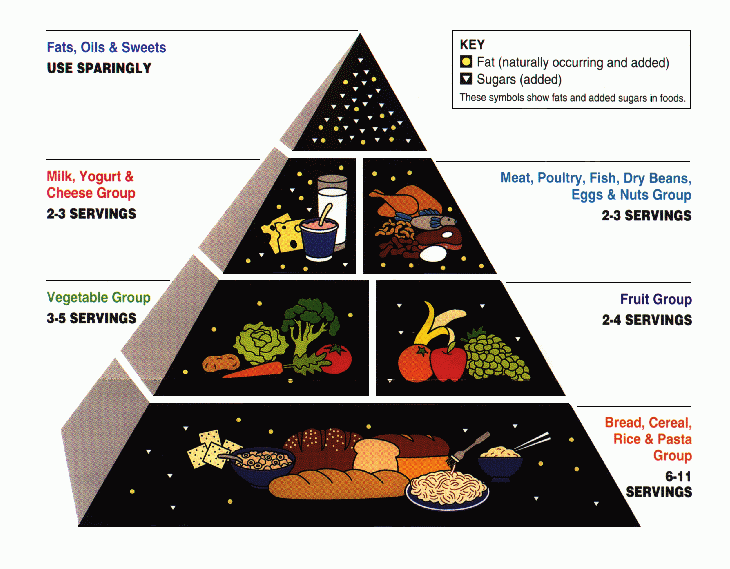
I was there. I witnessed it all–and I rubbed my forehead in disbelief. You see, I come from a long line of bagel eaters. Don’t get me wrong. Bagels are very good. They contribute to comedy and to cream cheese. However, it is obvious that this is not the foodstuff of those who epitomize extreme physical perfection and longevity. If obesity and chronic disease prevention or lean and mean was what we were seeking, why were we not promoting the Hunza, Masai or Okinawa Diet? Modern, western scientific orientation would continue to dismiss cultures who have powerful food beliefs or view food as medicine.

But, so it was. By 1996, just four years after the introduction of the Food Pyramid, the unprecedented increase in obesity, childhood obesity, diabetes, along with some other surprising health concerns was making the headlines. In 2005, after a mere thirteen years in existence, the Food Guide Pyramid was to be declared obsolete. President Bush, as part of his Healthier US Initiative, introduced the dumbed-down version of the pyramid, that we are now fortunate to have at our disposal today.

Really, I do not wish to appear so cynical. But, when I look at that colorful triangle, I see what is hidden behind. Not a line drawing but real flesh and blood citizens seriously affected by the lack of a meaningful food policy in this country. I see a populace who was sufficiently seduced and ate what it was fed.

This may seem a moot discussion. It could be argued that few people even pay attention or that the situation will change shortly with the soon to be released 2010 Dietary Guidelines. Many are already aware of the competing interests that influence our health and nutritional policies. However, the reality is that it says a lot that that triangle says so little. And, it still represents the foundation of many dietary organizations.

If you are holding a cereal box, take a deeper look. If it is a highly processed, artificially colored, multi-sugar sweetened, perversely marketed candy imposter–put down the box, back away and wonder what right the triangle has being on there anyway.

Thank you for listening, sharing, following and supporting my writing. Please subscribe in the sidebar to receive notice of new posts. Comments and greetings always welcome.

In health, Elyn

kicking butt with krispy kreme

I must strike on this one while the iron is still hot. Or, I should say, while the frying oil is still 375 degrees. That is the temperature for frying doughnuts–and extreme frying is exactly what Krispy Kreme doughnuts is up to. A few years back I gave old Krispy Kreme a piece of my mind when they expanded their territory into my neighborhood. I thought they backed off when I wrote a scathing little article, Magic Doughnuts–The Nutritionist’s Nemesis, showed it to some friends and put it in my drawer. Actually, right after that, the company did suffer some setbacks and had to close some of their stores. But, it appears that they have just reconnoitered. They are back with a vengeance.Image result for krispy kreme cheeseburger

According to my trusty Parade Magazine, they are now cooking up a Krispy Kreme bacon cheeseburger–a cheeseburger with chocolate-covered bacon on a glazed donut– that weighs in at 1000 calories. I am not exactly sure– they or some regional fast-food chain seem to be pushing these in the midwest. They have got to be kidding me. How do these people go to sleep at night? How do they look at themselves in the mirror? The only explanation as far as I can tell is that they may be up to no good.

Our military has had to turn down interested recruits because they are too heavy or can’t pass entry fitness exams. Meeting recruitment quotas is getting more difficult because of this. I’m probably just being paranoid but something seems fishy shall we say. The company’s vision statement actually states “to be the worldwide leader in sharing delicious tastes and creating joyful memories”. Hah! See? Operation Krispy Kreme bacon cheeseburger could quite stealthily advance any plan of domination.

If this explains supply, then what about demand? They could not be using such deceptive weaponry without a corps of unwitting subjects ready to gobble these things up. Who is buying these things? Are they my species-mates? Or, are they lemmings, disguised and accessorized? If they are lemmings, they may think this is a much more fun way to go than just marching off a cliff–but oh boy, do I have news for them. Doughnuts of this ilk are not something little mammals should be messing with. Note to lemmings–Undergoing kidney dialysis as a result of diabetes is not joyful.

Well, last time I wrote a little whiny story. This time, what they don’t realize is that I have been doing the Mark Bittman How to Cook Everything Vegetarian Diet and Weightlifting Program. At a $35 cover price, it beats most other products on the market and you get two tools in one. I am now fit and buff while they are downright doughy. Licensed to save the masses from their own mouths I must be more aggressive now. So, I am going to post that article I wrote a while back and hope that it scares Krispy Kreme– and all the other food companies that are creating caloric catastrophes and nutritional nightmares–into a full-scale retreat. If not, there will be no other option but to call Homeland Security–just to be safe.

Thank you for listening, sharing, following and supporting my writing. Please subscribe in the sidebar to receive notice of new posts. Comments and greetings always welcome.

Related Posts:  Magical Doughnuts-The Nutritionist’s Nemesis and So, What’s the Dilemma?

In health, Elyn

the importance of teaching kids about nutrition

She comes flying into the room and perches herself on the chair facing me. Three minutes ago she had been minding her business sitting in class, unaware that she was one of the anointed ones. Due to her high body mass index (BMI) she was selected to come to chat with me, the visiting nutritionist.  eat-547511_640

Fearless, she presents herself ready for the challenge–with no idea what it may be. I introduce myself and tell her that I am a nutritionist. I ask her if she knows what a nutritionist is. Tentatively she says, “Someone who talks about being healthy?” I praise her response, refine it by adding the food part and tell her that most nine-year-old children don’t know what a nutritionist is. She clarifies that she is almost ten.

Now that we understand the context of our being together, I offer her a carrot. She scrunches up her nose like a rabbit. “No way”, she says. I ask when was the last time she had tried one. Apparently, it was not since she was a little kid and that was a long, long time ago. When I beg a favor and ask if she would try one for me, the terms include placing the garbage can in close proximity. Fair enough. I knew that the carrots I had brought were not the sweetest. However, the girl I had sat with just prior had enjoyed them well enough, so I ventured a try with my new guest.

One bite, one chew and into the garbage it went. “Ewww! It tastes like it came out of the ground!” In educator-fashion, I ask, “Do you know where carrots come from?” “From out of the ground,” she says, in educator-fashion, having proudly proved her point.

OK, moving onward. We discuss what she has eaten today. She is now well into our game and ready to play. For school breakfast–only an institutional plastic cup of juice. There were bagels too, but she hadn’t been hungry. For lunch–a piece of pizza–the every Friday and frequent random day of the month menu item. She only had a few bites though and mainly ate the little cup of cubed pears along with chocolate milk.

Then, as if she had been born and raised in this cramped little space we are sharing, she reaches down to the computer printer that is positioned behind her, deftly removes a piece of paper, takes a colored marker from the case I have on the desk and proceeds to draw me the piece of pizza. She indicates where she took half-mooned bites from around the edges and includes the carton of milk and pears in the picture as well.

I ask her about hunger and how and where she knows she is hungry. With a touch of condescension, she tells me she just has an instinct about when she is hungry. OK, I concede. Whatever the game, I seem to be losing.

She continues her diatribe that though she likes fruits, she does not like vegetables except for corn and lettuce. But, she eats ketchup, and as if daring me, says ketchup is made from tomatoes, so it is a vegetable. It is subtle, but I mutter some consent. She is obviously right as was Ronald Reagan on this issue. I am not about to argue– she is in full control by now. “Peas?”, I meekly ask. “Gross, like little eyeballs.” I had set myself up for that one.

And so it goes. What does she like? The usual culprits she admits–hot dogs, pizza, chicken nuggets, french fries, Hi-C and Kool-Aid. She drinks low-fat milk because her mom gets it on the WIC program for her younger sister. Her mom has diabetes–so she knows that food matters. I begin to ask her, that given our talk would she be interested in trying something new for herself and, before I can even finish the sentence, she says, no she will not try a new vegetable. At this point, I inform her she is killing me. “How did you know this is exactly what I was going to ask?” “I just knew.” I have now officially been schooled.

Finishing up, she says, “Can we meet next week?” Obviously, she thinks I need some serious remedial work. I tell her I won’t be back until next month, to which she sweetly replies that we can meet then. In closing, she adds that she will try to eat less of her unhealthy choices.

Though I am already completely won over, she is not done. She signs the pizza picture for me and offers it over as a truce. She wants me to see how well she writes her name and informs me that she reads above grade level. I thank her deeply, tell her she is a very amazing kid, and we agree that we both had fun.

On a growth chart, this young girl will plot out in the 98th percentile of BMI for her age. Her school will forward her measurements to the state health department and she will be counted as an obese kid. In body, she is, as my mother would have said, a little pudgy. In being, she is lively and lovely and in full possession of her priceless childhood innocence and instincts.

What my conversation with her and others teaches me, is that this area of nutrition education requires a large degree of humility. The story is not only about the weights and measures which is the current focus. And, while I don’t mean to dismiss nutrition education, what our children really need is nutrition provision. We don’t expect children to childproof their own homes–why should we be asking them to childproof their own bodies?  

Our children deserve the birthright of both health and being valued for all that they are. Attention to good quality food in the world inhabited by our kids is what is required. I wish I could submit to the state an algorithmic index similar to that which assigns one’s BMI, but that would instead measure a child’s confidence, grace, and sense of self-worth–a self-esteem index (SEI). This girl’s SEI would be very high–but it might not be for long. I hope I did not cause any damage that day and that instead, it was more of an educational experience. Maybe it is true that teaching kids about nutrition is really important. I do seem to learn something every time.

Thank you for listening, sharing, following and supporting my writing. Please subscribe in the sidebar to receive notice of new posts. Comments and greetings always welcome.

In health, Elyn


Hello world!

Hi. Wow. I am about to start my blog. Something I would have just kept wondering about how to do for about the next decade or so. Personally, I am still marveling at the invention of the toaster oven, so modern technologies obviously are a little hard for me to adopt. Thankfully, one of my nutrition clients gave me the info I needed to even know where to begin.

IMG_3096

Hello Avocado!

Which brings me to the point of one of the issues I think I want to blog about. That above-mentioned client is gifted and funny and talented in so many ways and I would have remained stranded in a blogless universe without her. However, she and many others like her feel worthless because they are trapped in a body that betrays them. Their sense of themselves is molded as much by how they view themselves as to how they believe others perceive them. Whether medically, societally, or personally defined as fat–eating brings a vicious cycle of fear and loathing and momentary comfort and escape.

When I decided to study and become a nutritionist many years ago, I thought I was going to set out to solve problems of world hunger in remote parts of the globe. At that time, aside from that, the other main venue of applied nutrition was in hospital dietetics or in animal husbandry. Essentially, the MO was that we were all mainly basically nourished–or we were severely not. When I headed out on this path, yes, of course, there were overweight people, but their struggles were private and personal, and eating disorders were barely defined let alone described.

My nutrition work has briefly taken me to severely malnourished communities in Peru and Guatemala, but really, I am embarrassed to say, I have not strayed far from home. Society, politics, technology, media and an increasing focus on our individual selves changed the domestic landscape regarding nutrition. The issues intensified and the communal conversation amplified. My jobs kept me on the home front. I had no idea nutrition would become such a huge topic.

We all know how much nutrition information there is out there. New initiatives are good as we struggle to fix the ills that have befallen us in the past few decades. We are now attended to with myriad messages to eat right. I have sat in witness to this frenzy. While it has played out, I have been privileged to have worked with so many individuals and have heard their stories of frustration, pain, confusion, and guilt. What is obvious to me, is that we suffer mainly from being merely human.

The stories I want to relate will hopefully give voice to this humbling human experience regarding eating. I want to give my client who helped me get this started, along with others, tools and understandings that do not necessitate flagellation and deprivation. My wish is to assuage some of the loathing and to soften the edges of this intense dialogue. We will see.

Thank you for listening, sharing, following and supporting my writing. Please subscribe in the sidebar to receive notice of new posts. Comments and greetings always welcome.

In health, Elyn