Archives

breast feeding redux

Poster advertisement for Nestle's Milk by Théo...

Image via Wikipedia

So, here is what happened. Last week I wrote about breastfeeding. On one level I was addressing the possible connection between most babies’ first food and the increased incidence of weight issues in children. On another, I was speaking to the very low rates of breastfeeding in this country and the implications of that as well.

Right after I posted, my friend who is a wonderful adoptive new father responded that breastfeeding was not a viable option for his baby. I felt bad. I know a lot of adoptive parents. And, having worked in maternal and child health for many years,  I know there are some real situations that make breastfeeding not possible for some. There are many women who have really tried but for different reasons have not been able to nurse. I hope I did not appear insensitive. As a health counselor, I am very sympathetic to one’s personal experience– but I also know that our low breastfeeding rates are not caused by these exceptional types of cases.

In my discussion, I had decided to not make apologies or to outline the contraindications to nursing in the limited words I afford my writings. Most materials related to breastfeeding already do so. I had wanted to challenge the oft-repeated message that breastfeeding is challenging, but mainly I wanted to bring the topic of breastfeeding to the table. As a nutritionist, I consider breast milk a quintessential component of the human diet. Once I did, I  thought  I was ready to move on–but as I lingered in the post post aftermath and received some thoughtful responses, I considered that how we feed our babies is a way too overlooked issue in this huge conversation about food, culture, and weight. Breastfeeding is discussed in breastfeeding circles among women who are nursing. Beyond that, not many people ever think about this very important topic–even some parents to be. Most people in our culture have never really seen a baby nursing at the breast. I am highly attuned to watching for nursing babies–and I rarely get a sighting (except for my multi-cultural workplace that offers pre and postnatal care.)

I worry about what a world would look like that really no longer knew how to instinctually nurse its young. So, during the past week, I thought a lot about recent natural disasters where water and food supplies are not available–what happened to the formula-fed babies in the wake of Hurricane Katrina;  I considered the tragedy of the melamine-tainted formula in China that affected 300,000 babies; I wondered about the plastics that every formula feed involves through either bottle or artificial nipple; and, I lingered on antibiotic resistance and even genetic modification of formula. As I was doing all this a few things happened.

Firstly, quite coincidentally, I came upon an article called Cows Genetically Modified to Produce Human Milk. Writer Erika Nicole Kendall in her blog, the Black Girl’s Guide to Weight Loss does not seem to miss much regarding our confusing cultural cuisine–and one need be neither black, young, female or overweight to appreciate the topics she very thoughtfully explores and exposes. Here, she tells about a recent exhibition in China where technical achievements are touted as part of the country’s five-year plan.  Fascinatingly, in ancient China, emperors and empresses drank human milk throughout their lives. Apparently, presented at the exhibition were a herd of cows that have been genetically modified to produce human milk–which apparently contains the anti-microbial, anti-inflammatory agents and the hormones and digestive enzymes particular to the real stuff.  The milk purportedly will preserve and improve the immune systems and central nervous systems of children and will address decreasing breastfeeding rates in that country. Must I explain the irony here?  http://blackgirlsguidetoweightloss.com/news-feed/cows-genetically-modified-to-produce-human-milk/

Then, mon cher French ami who is always on topic in spite of mothering three young children–who she nursed in succession–sent me an article on breastfeeding in France. I learned that France has the lowest breastfeeding rate in the Western world. Mon Dieu. I was shocked and rather nauseated by the story. The nationwide gist is that breasts are for your husband–not your baby. French doctors apparently are in collusion with this imperative of preserving the sexual function of its countrywomen rather than supporting their maternal inclinations. Accompanying comments mocked those who promote breastfeeding as the breast police. Really? Does fighting tobacco advertising and helping people to quit smoking make one the lung police?  http://www.guardian.co.uk/commentisfree/2011/apr/01/france-breast-breastfed-baby-death

And, lastly, just Tuesday night, I watched the first episode of Jamie Oliver‘s second season of the Food Revolution. As he was stymied by the Los Angeles City School District to get into their schools for filming, he invited the public to bring him samples of the foods that the kids are being served there. In the opening scene, he is shown surrounded by a group of people who are presenting to him all types of horrific-looking junk that is splayed out on a table. A woman in the group is carrying a few month old beautiful baby girl. He reaches for the baby who gently accepts his arms. He reminds us how totally pure and perfect our babies come into this life. Seeing this gorgeous little being surrounded by this landscape of low-quality food was a powerful juxtaposition–it is the way I also see the situation.

Before school food, infant formula is the ingredient template that constitutes most of a child’s diet for most of its first year. Aside from added vitamins and minerals, the following are what milk and soy formulas are made of in some variation:  non-fat milk, lactose, vegetable oil, whey protein, high oleic safflower oil, soy oil, corn syrup solids, soy protein isolate, sugar, and coconut oil.  Interestingly, as most formulas now try to mimic the beneficial lipid profile naturally found in breastmilk–mortierella alpina oil and crythecodimium coluni oil are what are used to make them closer than ever to breast milk.

So, I decided, it was a worthwhile effort to pursue this conversation a little more–in the name of restoring, reviving, encouraging a resurgence–a redux of what I consider to be our natural birthright. The right of babies under most circumstances to be sustained on the foodstuff designed for their biology, presented in a form supportive of their neurological wiring and physiologically and hormonally consistent with that of the other member of the feeding dyad–their mother. The rest of the population may benefit as well–even the men.

And, in case some shared wisdom on this motherly art is sought, please check out this very thorough Breastfeeding Tips and Guide lovingly prepared by Sara Spencer. It contains some nice videos including a great one on feeding twins.

I am just wondering, were you breastfed?

Thank you for listening, sharing, following and supporting my writing. Please subscribe in the sidebar to receive notice of new posts. Comments and greetings always welcome.

In health, Elyn

Related Posts: Blessed Feeding; To She Who Loves Us Before She Meets Us; Oh MotherA Winning Goal; First Food

blessed feeding

Breastfeeding an infant

Image via Wikipedia

It was one of those mornings. One minute I am simply getting dressed for work, the next I am hopping around with only one leg in my tights, trying to find pen and paper to grab what I can from another nutrition-related radio story.  On that particular day, it was an NPR story entitled, Some Baby Formulas May Cause Faster Weight Gain.

The story which ran on January 24, 2011, starts out by saying that breastfeeding can be challenging, so most babies are on formula. It was about a small study comparing cow’s milk formula and predigested protein formulas– which are very expensive and used mainly for babies with significant digestive issues including cow’s milk allergies. The research suggested that at 7 months of age, the cow’s milk formula babies weighed two pounds more than breastfed and predigested formula babies. The study only observed that the babies drinking the cow’s milk formula took a longer time to be satiated and therefore drank more. There was no explanation given for this.

Interviewed for the story was Dr. Nicholas Stettler, a pediatrician at Children’s Hospital in Philadelphia. He starts out by saying that formulas have been proven safe and effective, and if infants like them and eat them, they’ll maintain their health and weight.  He then goes on to say that babies who gain too much weight in the first weeks and months of life are 5 times more prone to obesity and its inherent health risks by age 20–and that formula babies often gain too much. He concludes by advising that, “Parents should work closely with their pediatricians to make sure their babies don’t gain too much or too little. In this case, average is best.”

All in all, it wasn’t worth the hopping. None of this was exactly news to me and if anything I was surprised at the limited analysis of the results. However,  it touched on an issue that I feel quite strongly about–the dismal state of affairs regarding breastfeeding in this country and its many implications.

Ironically, on January 20th, just four days before, Surgeon General Regina Benjamin announced the “Surgeon General’s Call to Action to Support Breastfeeding“.  Outlined clearly in the announcement and its accompanying report are the many benefits of breastfeeding and the attendant health risks of not doing so. Clearly known in the medical and nursing community is that there are many physical and emotional benefits for both nursing moms and their babies and that babies who are not breastfed are at increased risk for diarrhea, ear infections, more serious lower respiratory infections, SIDS, childhood leukemias, asthma, diabetes, and obesity. Lactation experts and women who do breastfeed understand that human milk is species-specific for human babies, and its composition perfectly designed for proper and progressive growth. Mother’s milk changes composition during each feeding as well due to differences in the foremilk and hindmilk and naturally provides nutritional, immunological and satiety factors.

In the introduction to the report, Department of Health and Human Services Secretary Kathleen Sebelius writes, “For much of the last century, America’s mothers were given poor advice and were discouraged from breastfeeding to the point that breastfeeding became an unusual choice in this country.” I appreciated the admission. Tucked in the report amongst the many reasons for our pathetically low breastfeeding rates  was this paragraph:  “A recent survey of pediatricians showed that many believe the benefits of breastfeeding don’t outweigh the challenges that may be associated with it and report various reasons to recommend against it.”

This seems pretty shocking given the following. Comparing formula-fed babies to those who were breastfed exclusively for four months, the rates of hospitalization for lower respiratory tract infections are 250% greater; for GI infections including diarrhea are 178% greater; and, for necrotizing enterocolitis in premature babies 138% greater for the formula-fed babies. The economic impact of just these three illnesses that breastfeeding can prevent, costs this country 3.6 billion dollars per year. In cultures where babies have unlimited access to the breast and constant maternal contact, the prevalence of psycho and sociopathic behaviors are very low. What is the economic cost of those disorders?

Though the American Academy of Pediatrics recommends exclusive breastfeeding for the first six months of life, this recommendation does not translate into proper education, promotion, and support. Hindering the promotion of breastfeeding in this country is the perpetuation of the idea that the decision to breastfeed is a personal one and we should not make women feel guilty for not breastfeeding. Also, as a non-breastfeeding society for a few generations now, the cultural belief system is that most babies are raised on formula and they are fine. Additionally, like nutrition, obstetricians, and pediatricians– who are best poised to promote this clearly biologically superior milk–may not receive much training on breastfeeding and there is an awkwardness about women and breasts–even in the medical community.

The moment that baby opens its little mouth and receives artificial milk, it is unwittingly committed to a different path than its breastfed nursery mate. Immediately, that baby becomes a consumer of a highly and often deceitfully marketed corporate product; is more vulnerable to various illnesses and diseases with short or long term health implications; compromises its innate ability to self regulate feedings, and now in this weighted world, must work with its pediatrician to strive for average.

The Health Center where I work serves a large and diverse international clientele. I feel very fortunate to encounter daily a multi-cultural perspective. Last week, as I was walking past the main waiting area, two young women were nursing their babies. One woman was Mexican and the other was Burmese. This was not shy, covered up nursing. Both, were one breast exposed unabashedly doing what women have been doing for thousands and thousands of years. Confidently nourishing their young. How challenging can it be?

Thank you for listening, sharing, following and supporting my writing. Please subscribe in the sidebar to receive notice of new posts. Comments and greetings always welcome.

In health, Elyn

Related Posts: To She Who Loves Us Before She Meets Us; Breastfeeding Redux; Oh MotherA Winning Goal; First Food


you ain’t necessarily misbehavin’– part 2

A while back, in my post You Ain’t Necessarily Misbehavin’, I began to explore the topic of how we arrive at being the eaters we are today, and how we berate ourselves for so many things that we had little control over.

The last week of February marks the observation of National Eating Disorder Awareness Week–which also has been expanded to reach out to the many who live in daily distress from hating their bodies. I have not been sure what to add to the conversation which is so ably cradled by many wise people. However, as this struggle is so relevant to the story, and such a part of the fabric that we are all woven into, I offer a continuation of the examination of how our relationship with food and eating gets shaped. Last time, I left off, just as we were being born.

After we slide out or are plucked from our mothers’ tummies, the messages regarding food and security are profound. Influencing this stage are many factors: how our cries of hunger were responded to; if food was used to placate other needs; whether our cues of satiety were observed; or if we were encouraged to keep feeding according to some external measurement.Image result for crying babies images free download

The emotional state of our caregivers also colors our early feedings. A premature or reluctant feeding infant whose parent anxiously counts every milliliter consumed is having a different sentient experience than the content babe who nuzzles and guzzles while mother hums dreamily.

Whether we are breastfed or formula-fed also may affect us. A breastfed baby exposed to a wider palette of flavors based on mom’s diet may develop greater food acceptability than the formula-fed baby who gets the same recipe with each feeding. Also, fullness (and growth) may be appreciated differently, due to the difference in the composition of human and artificial milk.

Other subtleties influence this early feeding stage. Our innate temperaments reveal if we eat to live or live to eat. Some babies internalize the joy of clutching the breast or bottle as core to their being; others see the business of feeding as a mere requisite to the more important work of exploring the larger world. Certainly, much is anchored when we are merely minutes, days and months old.

Then, soon enough, we are small children. By the age of four, by my calculations, we have already had at least eight thousand, seven hundred and sixty eating encounters–and we are already pretty savvy little humans. We have begun to glean that food serves a greater purpose than fueling our bodies for play. It is somehow powerfully linked with love and affection and has powers way beyond its nutrient content. Candy can mend a hurt, ice cream can cool our heated outbursts of emotion and creamy, warm, familiar foods will bring comfort in a heartbeat. We know if food is abundant or if it is scarce.

Another message we receive at this time is that our own bodily sensations are secondary to behaving according to the rules. This ensues when we are told we must wait until mealtime to eat and that we must clean our plates; or, that we are eating too much or too little. These common parenting practices can serve to teach us that our own feelings are not valid and can begin to detach us from natural signals of hunger and fullness. Age-appropriate feeding should match and support the normal physiological and growth needs of young children. (An understanding of the principles of feeding dynamics are best gleaned by reading the work of Ellyn Satter, social worker and dietitian who pioneered research in this area. Her Division of Responsibility in Feeding should be the crux of all childhood nutrition education.)

When we are a little older we may begin to experience disconnects regarding food and our bodies. As little children, we do not differentiate ourselves from our environment. This sense of separation–and its attendant self-awareness–does not occur until a child reaches the age of eight or nine. But, with the early introduction of media and abstract reasoning in both schooling and socialization, this change is happening at an earlier age. I believe this is why eating disorders now manifest in younger kids.

Exposure to a barrage of images with distorted messages about feeding, body image, and personal values affects everyone, but it is particularly detrimental to at-risk individuals. Unfortunately, we cannot identify who is at risk. Interestingly, non-industrialized cultures only begin to show eating disordered behaviors after television becomes available.

With self-awakening, we are catapulted into self-reflection. Girls navigating through this time yearn to be let into the “club”. We enter the kitchen; we sidle up to our mothers, their friends, the aunties, and the older sisters. We listen to their rich stories and are sensitive to their attitudes and judgments. Often we hear women dissect and belittle their bodies, and the chant of the societal and personal mantra “I’m so fat” begins to penetrate our beings. We take all of this and figuratively stuff it into our new training bras and bikini underpants as our bodies begin to take on form and shape.

This is a very vulnerable period in the evolution of feeding behaviors. As a girl’s body begins to change rapidly, and she experiences the emotional and physical hunger that accompanies that growth, any chaos, fear, abuse or significant uncertainty in the outer environment can cause the body to become the battlefield for unexpressed emotions. We can stuff emotions down by overeating or we can deaden them by starvation. For some, negative comments from important male figures can solidify maladaptive behaviors that might have otherwise remained transient. Though girls may be more susceptible to this change, boys are by no means immune when they begin their maturation.

By adolescence, the stage is essentially set as the cascade of sex hormones takes up residence, settles in and rounds out the edges of our physical and emotional beings. After this huge developmental landmark, barring a few other components like what we eat, we just ride the waves, responding to food based on the summation of our earlier nature and nurture experiences.

Does this resonate with you? In honor of this week, please take a moment to think about your own story. No judgment, no blame, just acknowledge it. There may be much to actually appreciate. Practice replacing bitter feelings about your body with kind thoughts. Refrain from all trash talk about other people’s size as well as your own. If you suffer, or if you know someone who does, or if you just care about this subject, please find appropriate and supportive resources including the National Eating Disorder Association. Any sharings here will be deeply honored.

Thank you for listening, sharing, following and supporting my writing. Please subscribe in the sidebar to receive notice of new posts. Comments and greetings always welcome.

Related Posts: You Ain’t Necessarily Misbehaving, Part 1; The Tempted Temperament

In health, Elyn


have it your way at Red Chinese Sorghum Mutton Noodle

Happy Chinese New Year. It is the Year of the Rabbit, but things may not be so cute in bunny land no matter what astrological system you ascribe to. Last month there were reports of a shift in the astrological alignments apparently due to an Earth wobble or precession. This wobble or twist of the Earth’s axis is caused by the gravitational attraction of the moon on Earth’s equatorial bulge. I may not know a lot about astrology, but I do know about anatomy, and with the sudden burgeoning of obesity amongst 325 million people in China, I suspect that equatorial bulges may, in fact, explain the wobble.

About twelve years ago I caught a segment on television, perhaps on 60 MinutesLay’s Potato Chips were being imported to China for the first time and a massive marketing campaign was underway to introduce these thinly sliced, deep-fried and salted tubers served in a colorful and crinkly bag. One early morning as millions of people in some enormous city were bustling to work on foot and bike, a very large display of cardboard boxes was stacked at the entrance of a market.  The boxes were marked with lots of Chinese letters–and Lay’s. People were being stopped in their busy tracks and asked to sample this wonderful new product. Many of them were holding small paper bags of peanuts–their centuries-old “on the go” breakfast. The chips got a mixed review.

This segment was followed by a piece on the rapid increase in childhood obesity in China. Apparently, within ten years of the introduction of American fast food into China, ten percent of urban youth were overweight. Featured was a military boot camp-like program where about one hundred rank and file uniformed kids were being led sternly through a highly supervised exercise program.  This did not look particularly fun, but to the Chinese government, this was no laughing matter.

Five years ago, I attended a conference sponsored by the American Heart Association on obesity. A Chinese physician who now practices in the US was one of the speakers. He said, that twenty years prior–about 1985–when he attended medical school in China, it was extremely rare to encounter diabetes. For his training, he had to travel to a far off province to find a study case. He explained that now, diabetes is so rampant in China, that it is a significant drain on the Chinese health care system, and subsequently on its total economy.

As I sat to write this, my original thesis was that the US had purposefully set out to fatten up, sicken and slow down the industrious Chinese with fast food as an economic dominance tactic– but my research now makes me wonder if it was payback for what the Chinese had done to us–in retaliation for what we had done to them. Chinese cooks and restauranteurs had long ago figured out how to alter their cuisine to meet and oversatiate the American palate– happily to their own economic advantage. Consider that the first privately owned restaurant only opened in Beijing in 1980; while the first Chinese restaurant opened in this country in San Francisco in 1849. According to http://factsanddetails.com/china, there are more Chinese restaurants in the US than the top three large fast-food chains combined. Can that be?

I am often apt to echo Eric Schlosser’s Fast Food Nation rant against food additives and flavorings and how their application to our food supply has fostered an epidemic of food addiction that afflicts even very young children. But, was not the MSG that peppered our Chinese take-out and addled our brains perhaps the grandfather of all such flavor enhancers? Had the Chinese immigrants who were so mistreated here, literally found a way to have us eating out of their hands? Nowadays, Thanksgiving is the only day of the year that Chinese restaurants here are not busy–apparently, it’s a big day for Chinese weddings.

One of the more difficult parts of my work is weaning folk off of General Tso’s Chicken, Beef and Broccoli, and pork fried rice. Big grown men look at me with sad puppy dog eyes and whimper like puppies too. They whine, well how come Chinese people aren’t fat–(or didn’t use to be)? I respond harshly, make them do a hundred jumping jacks and tell them to walk home.

The second that China loosened its restrictions on the West, American fast food conglomerates were ready to flood its shores with a deluge of the additive-enhanced foods we specialized in–and the modern, more prosperous populace was ready and eager to be seduced. The first American fast-food chain to set up shop was Kentucky Fried Chicken in 1987. Apparently, what has been attractive to the Chinese diner is the cleanliness, efficiency, and courtesy of the western establishments where customers get escorted to their tables. This gesture (perhaps along with the under 5-yuan menu) has put western establishments way above their Chinese competitors who actually serve food more accommodating to the Asian palate. However, once exposed to our mischievously enhanced food products, there is no looking back. Even the big Chinese national chain, Red Chinese Sorghum Mutton Noodle could not withstand the heat. Perhaps Confucius say: Kill enemy softly.

Though I know this is not breaking news, it is still hard for many people to fully comprehend the effects of these “manipulated” foods on our bodies. They have contributed to the alteration of the global waistline and median blood sugar level. It is really difficult for me to explain this to the many kind and gentle adults and children who sit before me as clients. How could we imagine that we are sold food that fosters a profoundly unnatural, addictive relationship? But, we are.

Well, I have a few more people in this country to tend to and then I may have to head over to China. Until I arrive, they may need to use some of those ghastly Chinese manufactured plastic food models that they ship here to teach us about food and proper portion sizes. Once there, I’ll have to convince them to reclaim their own cultural snack food of peanuts–or hua sheng. I am told that they do still magically appear if you say pi-jin–the word for beer. One thing I won’t have to contend with there is fortune cookies-the alluring end to an Americanized Chinese meal. Apparently, they originated in Japan and are not at all part of China’s culinary traditions. Still, I must remember, the stakes are high. The wobble may just make this the Year of the Hippopotamus if they do not act quickly.

I leave you with an old Chinese proverb: Wherever smiles happen and happiness is celebrated you’ll find Lay’s Potato Chips. So tell me, how are you going to celebrate?

Thank you for listening, sharing, following and supporting my writing. Please subscribe in the sidebar to receive notice of new posts. Comments and greetings always welcome.

In health, Elyn

I Speak for the Fat People: middle part

Let’s put the issue of overweight into perspective. If we look at weight historically, I’m pretty certain that from the beginning of time, there have been fat people. We have all seen the pictures of early Cro-Magnon and Neanderthal men. Even those quintessential hunters and gatherers seemed capable of packing on a few pounds. After them came Confucius, King Henry the Eighth, Mamie in Gone with the Wind, Jackie Gleason, Pavarotti, Aunt Bea, and my grandmother. Chances are your grandmother was fat, too.

English: Luciano Pavarotti in Vélodrome Stadiu...

Pavarotti Image via Wikipedia

Since our early beginnings, human beings have come in varying shapes and sizes and large-size was not necessarily an aberration of medium-size. It is good that there are large-sized people. A world without them would mean a world with fewer great opera singers, chefs, women of ample bosom, football players, construction workers, and cuddly grandmothers.

It is not very difficult to become fat. You do not have to go out of your way to try.  If Chinese youth can become fat, then anyone can. Only about 4% of the population has naturally model-thin bodies. That means that many models are starving themselves in order to be models. It also means that the rest of the size 2 wannabes are expending a lot of physical and mental energy in the pursuit of thinness. Carolyn Knapp, in her book Appetites, tells the story of a woman who describes the angst she feels putting on her stockings every morning. She wonders what she could have accomplished in her life with the time she has spent worrying about her weight.

There are the naturally skinny–and then there are the neurotically and pathologically skinny; and the metabolically hyper-activated skinny–those who sustain themselves on a steady diet of excessive caffeine and nicotine—or maybe extensive exercise. For the rest of us, the possibility of becoming overweight is just around the corner. We are physiologically and neurologically wired to pack it on. The ability to store fat came in pretty handy a time or two during our multi-millenial evolution. We have about 107 compensatory mechanisms that prevent us from starving to death.  A bunch of those certainly kicked in to save our forefathers when they were unable to kill a bison. In people who attempt to starve themselves toward thinness, the body fights back–it regains the lost weight plus more, and then absolutely refuses to budge.

In addition, we are wired for comfort. Research shows that the food habits that sustain us are those that we developed while still wrapped in the loving veil of early childhood.  Whether that happened to be gazelle, chicken soup, mashed potatoes or cheeseburgers, you will probably turn to those foods as an adult. Believe me, the corporate world certainly knows this.  The Happy Meal ensures that today’s toddlers will become tomorrow’s adult fast-food consumers.  The concept of comfort foods is one I hear a lot about during my spy missions. Women have confessed to me that they would choose a good loaf of bread over sex. The quality of the sex is not indicated in this context.

Then, of course, there are our natural temperaments as well as good old genetics.  I listened once to the tender story of a woman who was adopted as a child.  She never met her birth mother, but she possessed a very old, poor quality home movie that she believes is of her mother. Though she struggles to see the face better in search of subtle resemblances, it is the woman’s thighs that confirm her finding.  She states, “Look at the thighs. Those are my thighs.”

On top of all this, let’s sprinkle on a life change, or just daily, chronic stress. Take your pick. Break-ups, abuse, graduate school, poverty, working long hours, caregiving, depression or menopause are possible choices. And, God forbid you should simply possess a deep sensuous life-affirming passion for cooking and eating.**  Throw any of these on your plate and if your primal wiring wasn’t enough to enlist you, then current circumstances will. Even the once-thins can become the now-fat–especially in this current milieu where food is literally out to get ya. Not even the high school cheerleader is immune. Any emotional state that is heightened, increases for many, the desire to seek food for a reward. When one is working their way up the weight chart, it is because they are possessed by physical or emotional hunger or physiological changes that they can neither understand nor control.

I can hear you begin to protest that it has to be more than just this. Aren’t we soooo bad?  We ate the piece of chocolate cake (and we loved it). How could we? How dare we?  That translates into four hours of floor mopping according to the calorie expenditure charts.  That must be fair penance for the crime. As a spy, my days are peppered with the monologues and dialogues of self-hate and recrimination that people utter like a mantra before and/or after each foray into eating. The guilt is palpable. We must have all been ____________ in a previous lifetime. (insert your own response.)

(one more segment to follow)

Thank you for listening, sharing, following, and supporting my writing. Please subscribe in the sidebar to receive notice of new posts. Comments and greetings always welcome.

Related Posts:  I Speak for the Fat People: First Part and I Speak for the Fat People: Last Part

In health, Elyn

Related Resources 2010: The end of overeating. Taking Control of the Insatiable American Appetite (David A. Kessler, MD); Born Round:  A Story of Family, Food and a Ferocious Appetite (Frank Bruni)


a cinderella story

Yesterday, at 2:00, I had my last client guest of the year. I was visited by the young Haitian princess Atabei. I have had the pleasure of working with her over the course of the past year. I was granted permission to be in her highness’s presence because her royally endowed figure put her by age sixteen very close to 300 lbs. Now, she is almost eighteen. She is not the heaviest of my young clients but I do particularly worry about her because she has Type 2 diabetes.

HISTORY | Her Serene Highness Princess Olive, Daughter of Emperor Soulouque. Haiti C. 1858

Haitian Princess

As we know from many fairy tales, life is not always easy for the crown-wearing crowd. Atabei has had a not so rosy past and has been fending for herself for a very long time. She has a queen mother and an older prince brother who love her–but who are caught up in their own problems to have much time for her. She navigates most of her medical care essentially on her own. Unfortunately, Medicaid doesn’t pay physicians for castle calls.

Like many royals and commoners alike, Atabei was used to eating in a bacchanalian fashion and was not subscribing to my pedestrian nutritional guidebook. She mainly craved and consumed foods that in her own giggly adolescent words were magically delicious. For those of you who may not know what that means, Lucky Charms, Toaster Strudels, and Dunkin’ Donut Munchkins are magically delicious, while whole wheat bread and oatmeal are not.

Progress was very slow, but she got a lot of credit for what we call just showing up–despite multiple challenges and limited ability to change her food environment; and she was succeeding at what I like to refer to as weight gain stabilization–she wasn’t losing weight but she wasn’t gaining either. Being evicted from the castle and landing in a motel does not usually lend itself to being able to focus on one’s eating habits and feeling good about oneself. Still, despite a few missed appointments here and there, she kept coming and she kept journaling. She was never too shy to hide her utter disgust at some of my suggestions and held tight to the foods that comforted her.

Eventually, I began to encourage her to get over to the local YMCA, where I have a partner in crime–Ben. Ben’s a little wiry guy, but as the wellness director responsible for youth programming and as a trainer, he is deeply committed to catching any kid–no matter how big- I can throw his way. Patiently, he serves to help re-knit the self-esteem that has been unraveled from so many through the art of attention and physical activity.

After a few failed attempts, Atabei gathered her horses, got in her coach, and proceeded over to the Y. Yesterday was the first time I had seen her in a while. She arrived in her radiant beauty, sans tiara, more alert and positive than I have ever seen her. She has only been going to the Y for a month, but she is already enjoying that her endurance and strength have increased. She is drinking a lot more water, is less obsessed and possessed by her old magically delicious foods, and is shocked to realize she can now choose to leave food behind. Gradually, she has made some significant diet changes which will help heal her insulin resistance. I had to almost stand on my desk and shout for her to acknowledge this. But, when the scale confirmed what I already had, her beautiful princess smile widened even more.

At the end of the session, I helped her set some of her goals for the new year. She had never before been able to even imagine that there was a possibility for change that she could empower herself. Now she finally could. What did I ask of her? That she keeps really listening to her body and seeing what it actually needs; and that she does not give up on herself. She will try–she does like to humor me.

When the clock struck three and she stepped off the curb in front of the building, she may have looked like just another poor, black, fat kid– but things are not always as they appear in the kingdom. Blessed be. Tres Bonne Annee, Atabei!

Please acknowledge the health and dietary impacts resultant from our huge cultural and environmental challenges and inequities–and honor your own small victories. Cheers.

Thank you for listening, sharing, following, and supporting my writing. Please subscribe in the sidebar to receive notice of new posts. Comments and greetings always welcome.

In health, Elyn

Your Pyramid

As a nutritional professional, I would like to share with you some tips on eating well.

For today, let’s start with a simple tool that is available to all Americans, brought to you by the US Department of Agriculture. You can probably find it right in your own kitchen–check your cereal boxes–the MyPyramid. Yes, that is your pyramid folks. Your tax dollars have paid for it–it would be a shame to see it go to waste. To the untrained eye, it appears like a triangle decorated with multi-colored vertical sections of varying bandwidths– with an alien climbing up some stairs on the side. However, hidden in that simple representation, is the culmination of US Dietary Policy.MyPyramid

The MyPyramid has been personalized just for you. Very obtusely, it suggests moderation, proportionality, variety, activity–and if your version happens to say on the bottom, steps to a healthier you–gradual improvement. Boy, you are lucky I am here.

Our government has been trying to figure out how to inform the masses about good nutrition since about 1916. Granted, this is not easy and I imagine those who’ve been assigned the task have resorted to some serious stress eating. By 1956, using a minimalist approach, the four food groups, which I grew up on, became the model of nutritional dictate. Many people still adhere to this model–but having forgotten what those four groups actually were, actually make up their own. My husband’s preferred groups are ethnic food, ice cream, popcorn (whole grain) and carbonated beverage.

In the late 1980s, having a few years of nutrition counseling experience under my belt, I took a sabbatical to do some focused research in two distinct areas–both of an anthropological nature. The first included infant and toddler feeding with my son as the subject; and the second involved serving lots of burritos and chimichangas to gringos in a very popular Mexican restaurant. The first was more adorable–though the latter was more lucrative.

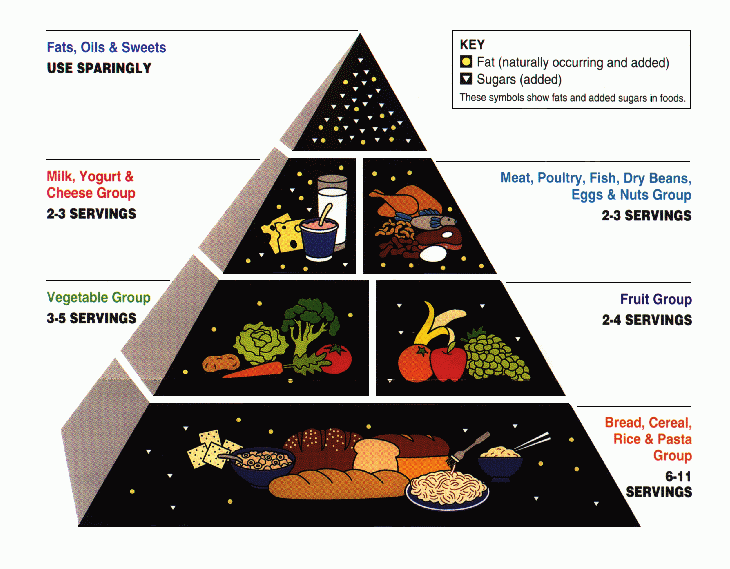
When I returned to the field a few years later, I learned that we were soon to be blessed with a long-awaited update of the dietary guidelines–with the experts busily designing what was soon to be ubiquitously known as the Food Pyramid. After years of deliberation and millions of dollars, it was officially released in 1992–smack with 6-11 servings of essentially refined carbohydrates literally forming the base of its recommendations. Having recognized that the American diet was somehow connected to a plethora of chronic diseases, and using evidence that cultures who ate traditional diets–which included some high carbohydrate foods like manioc root, taro, and sorghum–were not plagued by heart disease, colon cancer, and diabetes, the experts interpreted this to mean we should increase dietary attention to carbohydrates. Fats became increasingly vilified, and giant bagels and bowls full of pasta were elevated to celebrity status.

I was there. I witnessed it all–and I rubbed my forehead in disbelief. You see, I come from a long line of bagel eaters. Don’t get me wrong. Bagels are very good. They contribute to comedy and to cream cheese. However, it is obvious that this is not the foodstuff of those who epitomize extreme physical perfection and longevity. If obesity and chronic disease prevention or lean and mean was what we were seeking, why were we not promoting the Hunza, Masai or Okinawa Diet? Modern, western scientific orientation would continue to dismiss cultures who have powerful food beliefs or view food as medicine.

But, so it was. By 1996, just four years after the introduction of the Food Pyramid, the unprecedented increase in obesity, childhood obesity, diabetes, along with some other surprising health concerns was making the headlines. In 2005, after a mere thirteen years in existence, the Food Guide Pyramid was to be declared obsolete. President Bush, as part of his Healthier US Initiative, introduced the dumbed-down version of the pyramid, that we are now fortunate to have at our disposal today.

Really, I do not wish to appear so cynical. But, when I look at that colorful triangle, I see what is hidden behind. Not a line drawing but real flesh and blood citizens seriously affected by the lack of a meaningful food policy in this country. I see a populace who was sufficiently seduced and ate what it was fed.

This may seem a moot discussion. It could be argued that few people even pay attention or that the situation will change shortly with the soon to be released 2010 Dietary Guidelines. Many are already aware of the competing interests that influence our health and nutritional policies. However, the reality is that it says a lot that that triangle says so little. And, it still represents the foundation of many dietary organizations.

If you are holding a cereal box, take a deeper look. If it is a highly processed, artificially colored, multi-sugar sweetened, perversely marketed candy imposter–put down the box, back away and wonder what right the triangle has being on there anyway.

Thank you for listening, sharing, following and supporting my writing. Please subscribe in the sidebar to receive notice of new posts. Comments and greetings always welcome.

In health, Elyn

Magic Doughnuts–The Nutritionist’s Nemesis

A photo of 12 Original Glazed doughnuts from K...

Image via Wikipedia

It is time to raise my rates. The stakes are higher, the work is harder–Krispy Kreme is coming to town.

Looking back I can see that the signs were there, the portents. A few weeks ago, the lab technicians in the medical office where I work, hid a photo behind a cabinet door. The photo portrayed four very naked women standing in chorus line formation, clad only in sashes emblazoned with the words Krispy Kreme Donuts. The jolly foursome cumulatively weighed about twelve hundred pounds. The lab techs led me to their surreptitious closet and awaited my reaction. Oh, did we guffaw. But then I went back to my desk and stared out the window, contemplating the meaning of my life as a nutritionist.

It was only a matter of time then until my husband, aware of my prurient interest in all things fatty and sugary, sidled up next to me on the couch to announce the upcoming opening of the area’s first Krispy Kreme franchise.

I shouldn’t panic yet. The new store is to be located a good twenty miles from where I practice. Certainly, none of my client base would be able to procure any of these scrumptious confections. But, what was that? Local gas stations will also be carrying them? The story got worse. As my husband read to me from the article in the business section of the newspaper, the words and images were almost surreal.

According to the article, a “typical Krispy Kreme store opening will draw hundreds of customers who will wait several hours to buy hot doughnuts. In South Bend, Indiana, a customer camped outside of the store for seventeen days awaiting a store’s opening.” The statistics are baffling. Get this. Weekly sales for a Krispy Kreme franchise average about $58,000. This is up from $28,000 a mere four years ago. North American Krispy Kreme stores produce five million doughnuts daily. Daily! The little devils are even making their way into wedding receptions. Probably as invited guests-dear friends of the family.

Apparently, business experts credit this boom to “one of the most effective marketing strategies in the history of the restaurant industry.” However, “both franchisers and company officials say the enthusiasm is the result of the quality of their product-it has such a magical quality about it.” Was it the same combination of commerce and magic that had enticed four very large women to stand in their own doughy glory singing the praises of Krispy Kreme?

I could stand no more. I have been rather accustomed to waging a pathetic fight against the big guys and their Madison Avenue associates, but now they were playing with magic and using stainless steel cauldrons. I have not a chance. In the match-up between the company’s ‘Hot Original Glazed’ and me, I have as much pull as a stale biscuit. As if they knew I’d be reading this, they threw one more punch–right to the gut. In response to concerns about the low-carbohydrate trend, a company official is quoted in the article as saying; “even people trying to avoid sugary baked goods will make an exception for a Krispy Kreme.”

The following day I headed back to my office. I dreamed that there would be lines of devotees waiting to see me. That people would now realize that they were being seduced by an evil pudgy ball of dough, a wolf in sheep’s clothing, and would come in droves seeking my aid to protect them. I would be Super Nutritionist. But no one was there. Disheartened, I settled into my desk. I might just as well tell my clients to take two doughnuts and call me in the morning.

I guess I should just be patient. Eventually, the hoopla will have to die down and the magic will have to fade. The masses, those mere mortals, will be sorry then. Even the company officials and franchisers will have had one Krispy Kreme too many, and they will regret it. That is when they will come knocking on my door (or pulling up to my drive-thru window.) But, I don’t have any magic spells to undo the ravages of that enchanted edible. They will just have to work harder to lose that big doughnut they are now carrying around their middles and I will charge them more to do so, for I will have already raised my rates. I may even become the national spokesperson for Hole H.O.G. (Hot Original Glaze) – a doughnut victim compensation program. Well, we’ll see. They haven’t opened yet.

*Source-Sweet Smell of Success, Jeremy Boyer, Albany Times Union, Nov. 30, 2003

Thank you for listening, sharing, following and supporting my writing. Please subscribe in the sidebar to receive notice of new posts. Comments and greetings always welcome.

Related Post: Kicking Butt with Krispy Kreme

In health, Elyn


the importance of teaching kids about nutrition

She comes flying into the room and perches herself on the chair facing me. Three minutes ago she had been minding her business sitting in class, unaware that she was one of the anointed ones. Due to her high body mass index (BMI) she was selected to come to chat with me, the visiting nutritionist.  eat-547511_640

Fearless, she presents herself ready for the challenge–with no idea what it may be. I introduce myself and tell her that I am a nutritionist. I ask her if she knows what a nutritionist is. Tentatively she says, “Someone who talks about being healthy?” I praise her response, refine it by adding the food part and tell her that most nine-year-old children don’t know what a nutritionist is. She clarifies that she is almost ten.

Now that we understand the context of our being together, I offer her a carrot. She scrunches up her nose like a rabbit. “No way”, she says. I ask when was the last time she had tried one. Apparently, it was not since she was a little kid and that was a long, long time ago. When I beg a favor and ask if she would try one for me, the terms include placing the garbage can in close proximity. Fair enough. I knew that the carrots I had brought were not the sweetest. However, the girl I had sat with just prior had enjoyed them well enough, so I ventured a try with my new guest.

One bite, one chew and into the garbage it went. “Ewww! It tastes like it came out of the ground!” In educator-fashion, I ask, “Do you know where carrots come from?” “From out of the ground,” she says, in educator-fashion, having proudly proved her point.

OK, moving onward. We discuss what she has eaten today. She is now well into our game and ready to play. For school breakfast–only an institutional plastic cup of juice. There were bagels too, but she hadn’t been hungry. For lunch–a piece of pizza–the every Friday and frequent random day of the month menu item. She only had a few bites though and mainly ate the little cup of cubed pears along with chocolate milk.

Then, as if she had been born and raised in this cramped little space we are sharing, she reaches down to the computer printer that is positioned behind her, deftly removes a piece of paper, takes a colored marker from the case I have on the desk and proceeds to draw me the piece of pizza. She indicates where she took half-mooned bites from around the edges and includes the carton of milk and pears in the picture as well.

I ask her about hunger and how and where she knows she is hungry. With a touch of condescension, she tells me she just has an instinct about when she is hungry. OK, I concede. Whatever the game, I seem to be losing.

She continues her diatribe that though she likes fruits, she does not like vegetables except for corn and lettuce. But, she eats ketchup, and as if daring me, says ketchup is made from tomatoes, so it is a vegetable. It is subtle, but I mutter some consent. She is obviously right as was Ronald Reagan on this issue. I am not about to argue– she is in full control by now. “Peas?”, I meekly ask. “Gross, like little eyeballs.” I had set myself up for that one.

And so it goes. What does she like? The usual culprits she admits–hot dogs, pizza, chicken nuggets, french fries, Hi-C and Kool-Aid. She drinks low-fat milk because her mom gets it on the WIC program for her younger sister. Her mom has diabetes–so she knows that food matters. I begin to ask her, that given our talk would she be interested in trying something new for herself and, before I can even finish the sentence, she says, no she will not try a new vegetable. At this point, I inform her she is killing me. “How did you know this is exactly what I was going to ask?” “I just knew.” I have now officially been schooled.

Finishing up, she says, “Can we meet next week?” Obviously, she thinks I need some serious remedial work. I tell her I won’t be back until next month, to which she sweetly replies that we can meet then. In closing, she adds that she will try to eat less of her unhealthy choices.

Though I am already completely won over, she is not done. She signs the pizza picture for me and offers it over as a truce. She wants me to see how well she writes her name and informs me that she reads above grade level. I thank her deeply, tell her she is a very amazing kid, and we agree that we both had fun.

On a growth chart, this young girl will plot out in the 98th percentile of BMI for her age. Her school will forward her measurements to the state health department and she will be counted as an obese kid. In body, she is, as my mother would have said, a little pudgy. In being, she is lively and lovely and in full possession of her priceless childhood innocence and instincts.

What my conversation with her and others teaches me, is that this area of nutrition education requires a large degree of humility. The story is not only about the weights and measures which is the current focus. And, while I don’t mean to dismiss nutrition education, what our children really need is nutrition provision. We don’t expect children to childproof their own homes–why should we be asking them to childproof their own bodies?  

Our children deserve the birthright of both health and being valued for all that they are. Attention to good quality food in the world inhabited by our kids is what is required. I wish I could submit to the state an algorithmic index similar to that which assigns one’s BMI, but that would instead measure a child’s confidence, grace, and sense of self-worth–a self-esteem index (SEI). This girl’s SEI would be very high–but it might not be for long. I hope I did not cause any damage that day and that instead, it was more of an educational experience. Maybe it is true that teaching kids about nutrition is really important. I do seem to learn something every time.

Thank you for listening, sharing, following and supporting my writing. Please subscribe in the sidebar to receive notice of new posts. Comments and greetings always welcome.

In health, Elyn


she weighs how much?

I present this as a Zen Koan. A Koan is a paradoxical question, the meaning of which cannot be understood by rational thinking. It derives from the Japanese words “ko” for public and “an” for ‘matter for thought’. This is clearly a public matter for thought in the current dialogue on childhood obesity. How do we best serve a seven-year-old girl whose high weight highly challenges notions of normal growth patterns?

pond-3046592_1280

Image by Debi Brady

This girl is not a nameless, theoretical child. Tanazia is an amazing girl who I know. She has keen inquisitive abilities, deep empathy for others, and sophisticated insight for someone so young. She is deeply connected to her family, respects her elders, and helps care for her three-year-old brother and emotionally reactive two-year-old foster-sister who she shares a room with. She excitedly tells me that when she grows up she would like to do something to help others. When her grandmother mentions the Peace Corps, she responds that there are people right here in her own community who are in need.

Tanazia—who is just one of many children who are accumulating weight in an inconceivable short amount of time–is in a relatively good situation. She now lives with a set of very caring grandparents who love her dearly. She has a stable roof overhead, and there is a modicum of food security. While some family members are overweight, her grandmother, who had gastric bypass surgery a few years ago, is generally food-savvy and keeps a relatively healthy home. Plus, she has a back yard–one large enough and safe enough to play in—a rare commodity in this part of the city.

Despite this, she has already had to armor her body with layers of body fat against many emotional wounds. She was born to a 15-year-old mother who has since had two more babies and is now pregnant again. Her father has died, and she was at an early age exposed to and a victim of domestic violence. Her grandmother has chronic health problems. And, she herself, has asthma–another player in the childhood obesity conundrum. Her mom has supervised custody and gets to see her daughter every other Saturday for just a few hours. Equipped with few ways to show her love, during their time together she usually takes Tanazia out to eat somewhere. It’s usually Chinese food or pizza with soda and candy.

This sweet child has already endured the taunts of kids. Going to school-squeezed into her charter school uniform skirt—is something she is already leery of by second grade. Though her grandma does give her breakfast at home and provides her with lunches to bring to school, controlling the intake at school is hard to do. Unfortunately, the meals provided by the school lunch programs do not meet nutritional recommendations and are a sad source of the low-quality foods and excessive fats, sugars and calories that are contributing to the problem. Turning down a free meal or two in a day would be hard for anyone to do, especially for those to whom the secure availability of food is not a given.

Declining the morsels of joy to be found in the cheap junk foods that easily find their way into all the cracks and crevices of our lives–cupcakes, bags of chips, Rice Krispie treats, fruit punch– is nearly impossible for those with easy and happy lives let alone for those who excessively use food as an easy and legal pursuit to push down painful life experiences.

And, although Tanazia has a backyard, the physical activity levels of young girls who live in vulnerable neighborhoods are amongst the most limited. Add in the cold winters in this part of the country and the possibility of expending calories diminishes even more.

Despite these challenges, this beautiful child tries hard to do what I—her nutritionist—have recommended. She drinks mainly water, she listens to her belly to see if it is really hungry—a task most adults find hard to do– and has only a small piece of cake at birthday parties and church functions.

My heart breaks at having to impose such harsh restrictions on such a young life. I know restriction breeds hunger. I know parental strategies require fortitude, patience, non-judgment, and structure. I don’t have many options nor enough solutions to fight all the forces that prey upon this innocent child and countless others like her. Current anti-obesity initiatives come far too late and offer little. Cute and catchy names of new programs belie the gravity of the situation and chew at my cynical side—the part of me who knows too many stories of real children’s lives. Societal weight stigmatization adds to the burden. I pray for this young girl to grow up healthy and whole, equipped with all she needs to be a powerful adult. Hopefully, size alone will not get in her way.

Thank you for listening, sharing, following and supporting my writing. Please subscribe in the sidebar to receive notice of new posts. Comments and greetings always welcome.

In health, Elyn