As a nutrition professional, I would like to share with you some tips on eating well.
For today, let’s start with a simple tool that is available to all Americans, brought to you by the US Department of Agriculture. You can probably find it right in your own kitchen–check your cereal boxes–the MyPyramid. Yes, that is your pyramid folks. Your tax dollars have paid for it–it would be a shame to see it go to waste. To the untrained eye, it appears like a triangle decorated with multi-colored vertical sections of varying bandwidths– with an alien climbing up some stairs on the side. However, hidden in that simple representation, is the culmination of US Dietary Policy.
The MyPyramid has been personalized just for you. Very obtusely, it suggests moderation, proportionality, variety, activity–and if your version happens to say on the bottom, Steps to a Healthier You–gradual improvement. Boy, you are lucky I am here.

Our government has been trying to figure out how to inform the masses about good nutrition since about 1916. Granted, this is not easy. I imagine those who’ve been assigned the task have resorted to some serious stress eating. From 1956 through 1992, using a minimalist approach, the Four Food Groups, which I grew up on, became the model of nutritional dictate. (This was proceeded by the more comprehensive– and rather rational–Basic 7 model introduced during wartime in 1943–a period of food rationing.) The four defined food groups–chosen to prevent nutrient deficiencies–were fruits and vegetables; meat; dairy; and, grains and breads. Many people still adhere to this model–but having forgotten what those four groups actually were, instead, make up their own. My husband’s preferred groups are ethnic food, ice cream (dairy), popcorn (whole grain), and carbonated beverage.
In the late 1980s, having a few years of nutrition counseling experience under my belt, I took a sabbatical to do some focused research in two distinct areas–both of an anthropological nature. The first included infant and toddler feeding with my son as the subject; and the second involved serving lots of burritos and chimichangas to gringos in a very popular Mexican restaurant. The first was more adorable–though the latter was more lucrative.
When I returned to the field a few years later, I learned that we were soon to be blessed with a long-awaited update of the dietary guidelines–with the experts busily designing what was soon to be ubiquitously known as the Food Guide Pyramid. After years of deliberation and millions of dollars, it was officially released in 1992–smack with 6-11 servings of essentially refined carbohydrates literally forming the base of its recommendations.
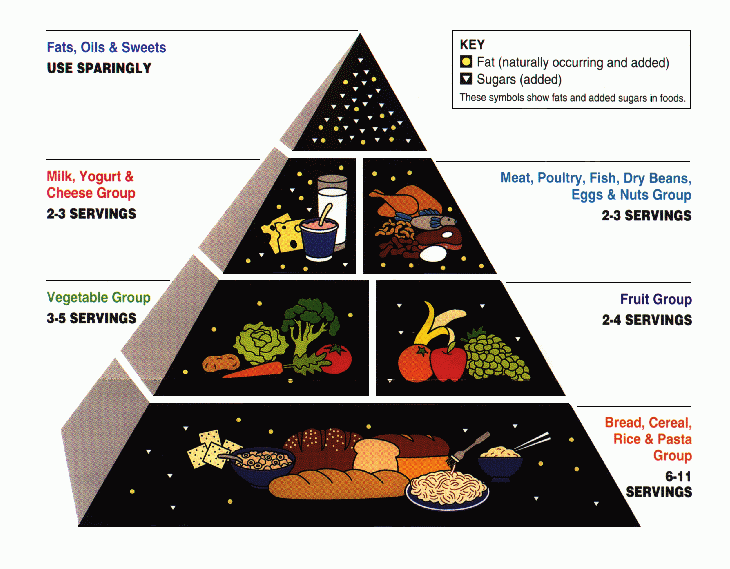
Having recognized that the American diet was somehow connected to a plethora of chronic diseases, and using evidence that cultures who ate traditional diets–which included some high fiber, carbohydrate foods like manioc root, taro, and sorghum–were not plagued by heart disease, colon cancer, and diabetes, the experts interpreted this to mean we should increase dietary attention to carbohydrates. (Needless to say, there were many other cultural differences as well.) Fats became increasingly vilified, and giant bagels and bowls full of pasta were elevated to celebrity status.
I was there. I witnessed it all–and I rubbed my forehead in disbelief. You see, I come from a long line of bagel eaters. Don’t get me wrong. Bagels are very good. They contribute to comedy and to cream cheese. However, it is obvious that this is not the foodstuff of those who epitomize physical prowess and longevity. If obesity and chronic disease prevention or lean and mean was what we were seeking, why were we not promoting the Hunza, Masai or Okinawa Diet?
But, so it was. By 1996, just four years after the introduction of the Food Guide Pyramid, the unprecedented increase in obesity, childhood obesity, diabetes, along with some other surprising health concerns was making the headlines. In 2005, after a mere thirteen years in existence, it was to be declared obsolete. President George W. Bush, as part of his Healthier US Initiative, introduced the dumbed-down version of the pyramid, that we are now fortunate to have at our disposal today.
Really, I do not wish to appear so cynical. But, when I look at that colorful triangle, I see what is hidden behind. Not a line drawing but real flesh and blood citizens seriously affected by the lack of a meaningful food policy in this country. I see a populace who was sufficiently seduced and ate what it was fed–regardless of what it may have read in the iterations of these dietary guidelines. Particularly in these most recent decades.
This may seem a moot discussion. It could be argued that few people even pay attention or that the situation will change shortly with the soon to be released 2010 Dietary Guidelines. Many are already aware of the competing interests that influence our health and nutritional policies. However, the reality is that it says a lot that that triangle says so little. And, it still represents the foundation of many dietary organizations’ precepts. I am shocked that the basic understanding of the feeding of human beings is still so conflicted and poorly understood. How could it be so difficult?
If you are holding a cereal box, take a deeper look. If it is a highly processed, artificially colored, multi-sugar sweetened, perversely marketed candy imposter–put down the box, back away and wonder what right the triangle has being on there anyway.
Thank you for listening, sharing, following and supporting my writing. Please subscribe in the sidebar to receive notice of new posts. Comments and greetings always welcome.
In health, Elyn
Update January 2026: The most recent revision of the Dietary Guidelines for Americans and its Food Pyramid have just been released. Take a look. If you are seeing it for the first time at sometime in the future, when things may have changed again, do know things are quite contentious in the here and now.
Also, I don’t know how I have not been aware until now of the brilliant work of food historian, Sarah Wassberg Johnson, and her writings and recorded series on The Food Historian: Food History Blog. She presents some fascinating information that informs how we partially arrived at where we are today, on her talk, When Sugar Was Good For You: The Development of Nutrition Science in America.
 the nutritionist's dilemma
Lovely insight into national health priorities — massive investment in “health care” while being unable to focus on basic nutritional guidelines for “good health”.
LikeLike
thank you michael. i appreciate this comment. just food for thought.
LikeLike